Arborist Resume Examples: free score, then the gap list
Build an Arborist Resume That Proves Climbing and Risk Skill
By Mustafa Tarabya, founder of CVBooster · Published · Updated
Arborist resume example with climbing, rigging and tree risk bullets, ISA credential placement and a complete writing guide.
Sample resumes for a arborist
The same arborist content laid out in three CVBooster templates, so you can see what the finished document looks like before you write a word.
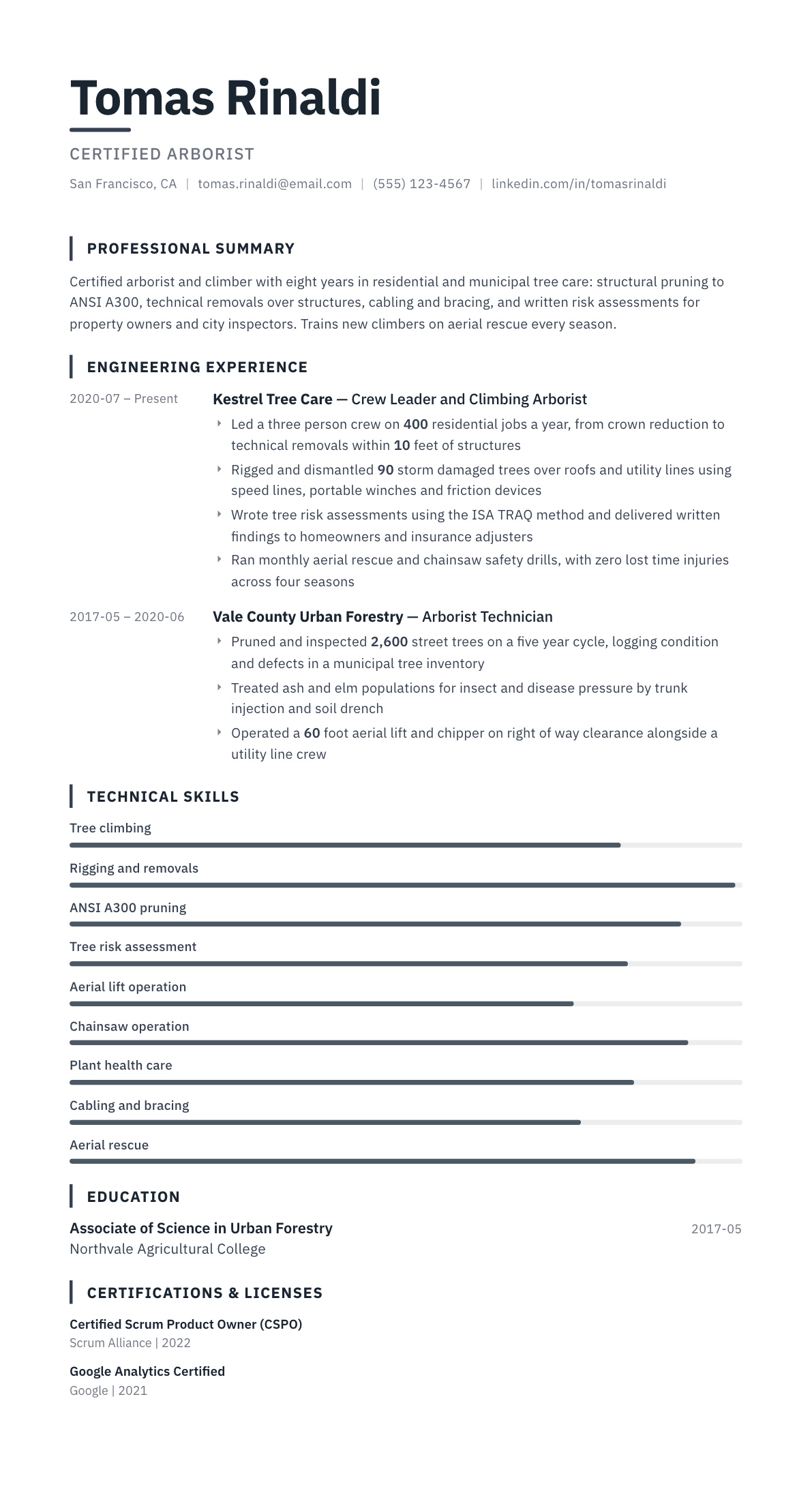
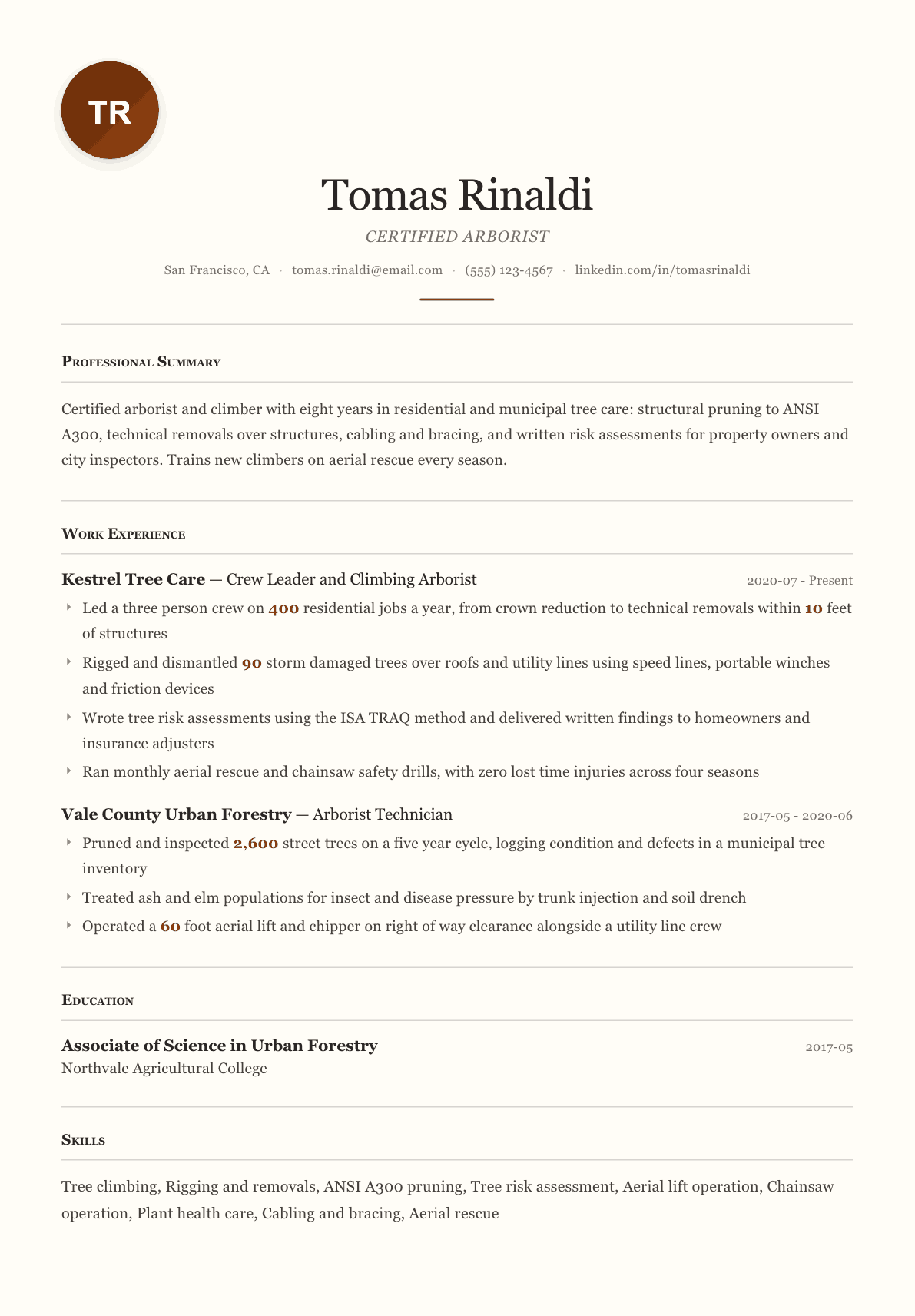
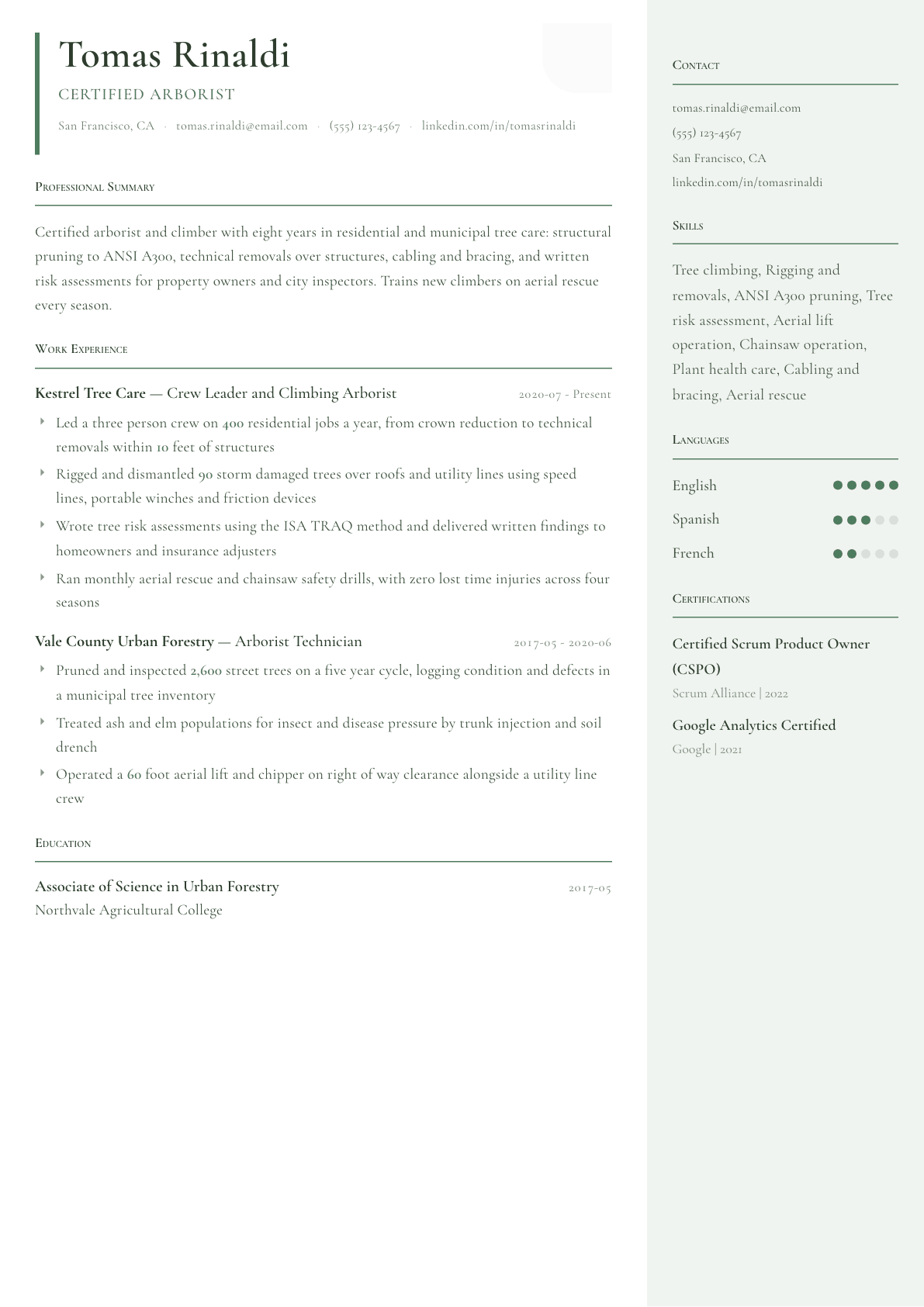
Example Arborist summary
ISA Certified Arborist with eight years climbing and leading crews on residential and municipal tree work. Skilled in structural pruning to ANSI A300, technical removals over structures and utility lines, cabling and bracing, and written tree risk assessment. Runs aerial rescue and saw safety drills and has trained six climbers to solo work. Seeking a lead arborist role with a plant health care program.
Skills to list on a Arborist resume
- Tree climbing
- Aerial rescue
- Rigging
- Crown reduction
- Structural pruning
- Hazard tree removal
- Tree risk assessment
- Cabling and bracing
- Plant health care
- Pest and disease diagnosis
- Chainsaw maintenance
- Stump grinding
- Aerial lift operation
- Traffic control
- Crew leadership
What actually gets this resume read
- Put your ISA Certified Arborist number and TRAQ qualification in the header where a hiring manager sees them first.
- Separate climbing work from bucket work, because a company hiring a climber wants proof you can work a rope and saddle.
- Describe removals by their difficulty: proximity to structures, utility lines, rigging method and the size of the wood.
- Show plant health care work by naming pests, diagnosis method and treatment, not just the phrase tree care.
- Include your safety record and the drills you run, since insurance costs make injury history a real hiring factor.
- List equipment you are checked out on: chippers, stump grinders, aerial lifts, cranes, mini loaders and grapple trucks.
How to write a arborist resume
There are three kinds of arborist job and one resume will not win all of them. Production tree care companies want a climber who can put in a full day of removals and pruning. Utility contractors want line clearance discipline and traffic control. Municipalities and consulting practices want inventories, risk assessments and written reports. Decide which one you are applying for before you write a word.
Whoever reads the resume checks credentials first. Certification through the International Society of Arboriculture, a tree risk assessment qualification, and a clean safety history are what let a company put you on a customer property and keep its insurance rate. Those belong in the header and in a block of their own.
After credentials, the read is about difficulty. Anyone can say they removed trees. The resume that gets interviewed says what was under the tree, how the wood came down, and what equipment made it possible. This guide walks through each section and shows before and after bullets that make that difference visible.
Format: one page, credentials on top, safety visible
One page, single column, plain headings. Tree companies are small and the owner reads applications himself between jobs, so make the scan fast. Put your certification number next to your name and a credentials block immediately under the summary.
Add a safety line early. Years without a lost time injury, the drills you run, and the training you have completed all reduce the risk a new hire represents. In a trade where insurance is a major cost, that line is a hiring argument.
- Header: name, certification and number, city and state, phone, email, driver license class.
- Section order: summary, certifications and qualifications, experience, equipment and skills, training and safety record.
- A groundworker moving up leads with rigging support, chipper work and any climbing or aerial lift time logged.
Summary: climber or bucket, and what kind of work
State whether you climb, run a bucket, or both, because that is the first question on the phone screen. Then name the work: residential pruning and removals, storm response, utility line clearance, municipal street trees, or plant health care.
Close with a specialty. Technical removals over structures, cabling and bracing, large tree preservation during construction, or diagnosis and treatment programs each mark you as more than a saw operator.
Experience: describe the tree, the hazard and the method
A removal bullet is only useful when the reader can picture the site. Give the constraint: distance to the house, energized conductors nearby, a pool below, no crane access, a neighbor fence line. Then give the method: speed line, portable winch, friction device, crane assisted pick, or piecing down to a rope.
Pruning bullets should reference the standard rather than a vague adjective. Structural pruning, crown reduction, crown cleaning and clearance pruning to the ANSI A300 standard tells a reader you were trained properly and will not top a tree because a customer asked.
Plant health care is its own thread. Name the pests and diseases you diagnose, the treatment methods you use such as trunk injection, soil drench or foliar application, and any soil work you do including air spading and root collar excavation.
If you have municipal or consulting experience, write the reporting side: inventory data collection, condition rating, risk assessment level, and the format the findings were delivered in.
- Volume: jobs per year, trees pruned on cycle, acres of right of way cleared.
- Difficulty: proximity to structures and conductors, rigging method, wood size.
- Outcome: no property damage, storm restoration times, treatment survival.
Equipment, credentials and safety training
List the equipment you are checked out on: climbing systems including moving and stationary rope technique, aerial lifts, chippers, stump grinders, mini loaders, grapple trucks and cranes. Say if you have crane signaling experience, since crane assisted removals need a qualified signal person on the ground.
Credentials get their own block. Certification, tree risk assessment qualification, first aid and cardiopulmonary resuscitation, aerial rescue training, electrical hazard awareness, and any commercial driver license with air brake endorsement. Utility contractors will also look for line clearance qualification.
Keywords that show up in tree care postings
Expect the same phrases across postings: climbing arborist, rigging, crown reduction, hazard tree removal, tree risk assessment, plant health care, stump grinding, aerial rescue and traffic control. Mirror the ones you can prove and skip the ones you cannot.
Consulting and municipal roles add another vocabulary: tree inventory, preservation plan, construction impact assessment, appraisal and ordinance compliance. If you are aiming there, those words matter more than production numbers.
Arborist resume summary examples
Groundworker moving up
Tree care groundworker with two seasons on rigging, chipper and stump grinder work, now climbing on removals under supervision. Trained in aerial rescue and chainsaw safety, comfortable running traffic control on residential streets, and studying for the arborist certification exam.
Certified climber
Certified arborist and production climber with five years on residential pruning and removals. Prunes to the ANSI A300 standard, rigs technical removals over roofs and fences with speed lines and friction devices, and holds a tree risk assessment qualification for written customer reports.
Crew leader
Crew leader and certified arborist with eleven years across residential, storm and municipal tree work. Runs a three person crew on 400 jobs a year, plans crane assisted removals, writes risk assessments for city inspectors, and has trained six climbers to solo work with no lost time injuries.
Work experience bullets: before and after
Before: Removed trees for residential customers.
After: Dismantled 90 storm damaged trees over roofs and utility lines using speed lines, a portable winch and friction devices, with no property damage claims across four seasons.
The hazard, the rigging method and the damage record are what a company owner is actually buying.
Before: Pruned trees to make them look better.
After: Performed structural pruning and crown reduction to the ANSI A300 standard on mature oaks and maples, refusing topping requests and explaining the alternative to homeowners.
The standard and the refusal show training and the customer conversation that comes with it.
Before: Checked trees for problems.
After: Completed written tree risk assessments using a recognized qualification method, documenting targets, likelihood of failure and mitigation options for homeowners and adjusters.
A risk assessment framework turns an opinion into a defensible report a client can act on.
Before: Treated trees for bugs and disease.
After: Diagnosed borer, scale and fungal leaf disease across a residential route and treated by trunk injection and soil drench, tracking response through the following season.
Naming pests, treatment routes and follow up shows plant health care skill rather than blanket spraying.
Before: Kept the crew safe on the job.
After: Ran monthly aerial rescue and saw safety drills, held a briefing at every job start, and set drop zones and traffic control before the first cut.
Specific safety rituals are verifiable, while a claim of being safety conscious is not.
Hard skills
- Climbing systems and work positioning
- Rigging and technical removals
- ANSI A300 pruning
- Aerial rescue
- Chainsaw operation and maintenance
- Aerial lift operation
- Stump grinding
- Cabling and bracing
- Tree risk assessment
- Pest and disease diagnosis
- Trunk injection and soil treatment
- Traffic control setup
- Crane signaling
Soft skills
- Customer explanation of tree work
- Crew briefing and supervision
- Judgment under storm conditions
- Training newer climbers
- Working calmly at height
Certifications worth listing
- ISA Certified Arborist (International Society of Arboriculture)
- ISA Tree Risk Assessment Qualification (International Society of Arboriculture)
- ISA Board Certified Master Arborist (International Society of Arboriculture)
- ISA Certified Tree Worker Climber Specialist (International Society of Arboriculture)
- Certified Treecare Safety Professional (Tree Care Industry Association)
Mistakes that cost arborist candidates the interview
- Leaving the certification number off, which forces an employer to verify you manually before scheduling a call.
- Writing removals with no context, so the reader cannot tell an open field drop from a rigged pick over a garage.
- Claiming climbing experience when the hours were all in a bucket, which surfaces on the first work test.
- Omitting the safety record in a trade where insurance history decides whether an owner can afford to hire you.
- Ignoring plant health care and diagnosis, which are the higher margin services companies want to grow.
- Applying to a utility contractor without mentioning line clearance qualification or electrical hazard training.
Arborist resume questions
Do I need certification to work as an arborist?
Many production jobs will hire an uncertified climber with real skill, but certification widens the field, supports higher pay, and is often required for municipal contracts and consulting work. Note your exam date if you are studying.
How do I show climbing ability on paper?
Give the systems you use, the removals you have rigged, the heights and species you work in, and any competition or training you have completed. Then expect a work test, because every company confirms climbing in the field.
Should storm work go on a tree care resume?
Yes, and describe it properly. Storm response shows judgment under pressure, work with utility crews and long deployments away from home, all of which companies value when they staff an emergency call list.
What if I want to move from production work into consulting?
Lead with your assessment and reporting experience: inventories, condition ratings, risk qualification work and any written deliverables. Then show the field background as the reason your reports are grounded in what actually happens in a tree.
How should I present a safety incident history?
State the positive record where you have one and never invent it. If something happened, do not put it on the resume, prepare an honest answer for the interview, and lead with the training and drills you run now.
Related resume examples
- Groundskeeper Resume example
- Landscaper Resume example
- Crane Operator Resume example
- Landscape Architect Resume example
- Wind Turbine Technician Resume example
- Demolition Worker Resume example