Groundskeeper Resume Examples: free ATS score and gap list
Write a Groundskeeper Resume That Shows Real Turf Skill
By Mustafa Tarabya, founder of CVBooster · Published · Updated
Groundskeeper resume example with turf, irrigation and equipment bullets, licensing keywords and a section by section writing guide.
Sample resumes for a groundskeeper
The same groundskeeper content laid out in three CVBooster templates, so you can see what the finished document looks like before you write a word.
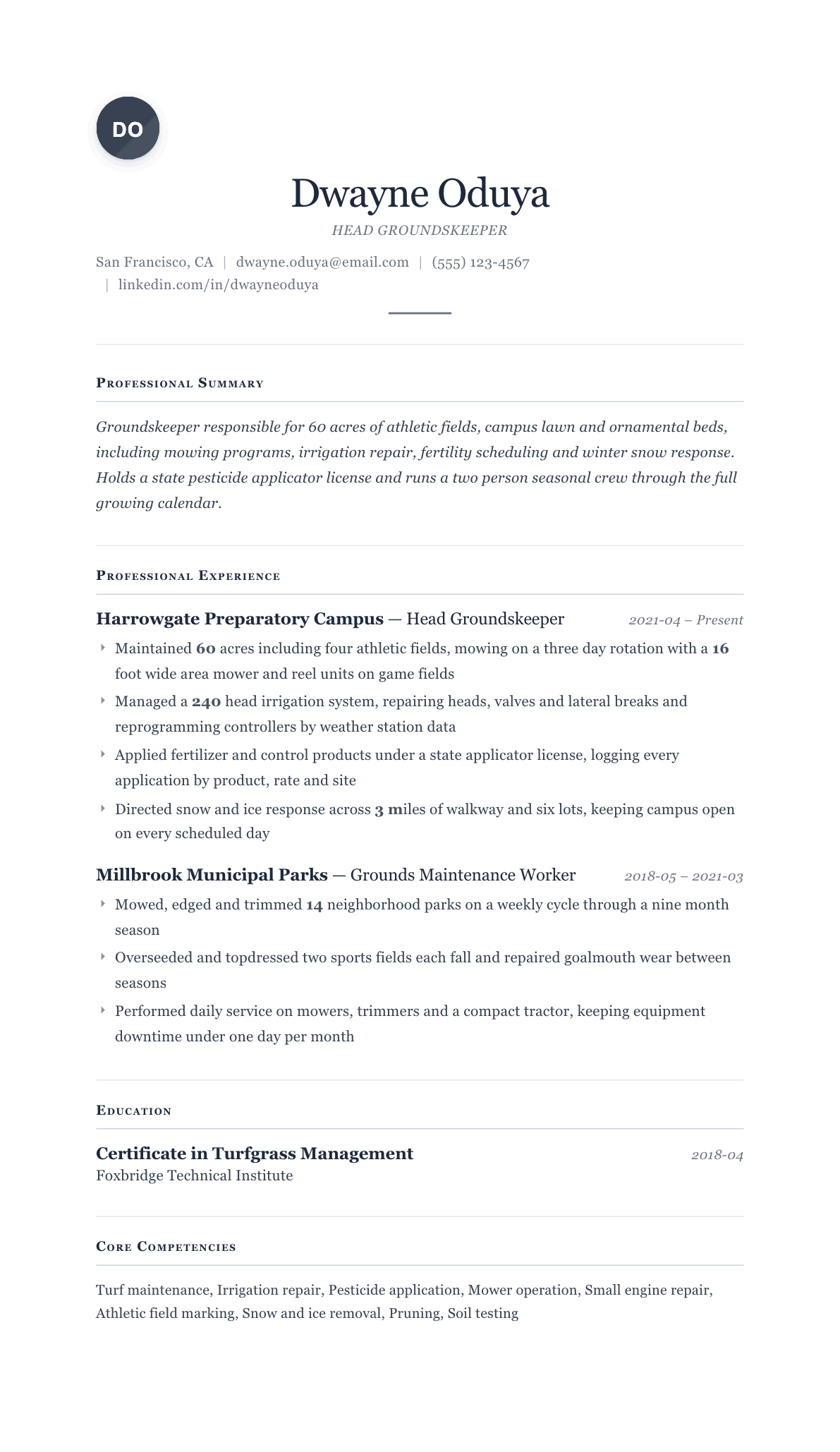

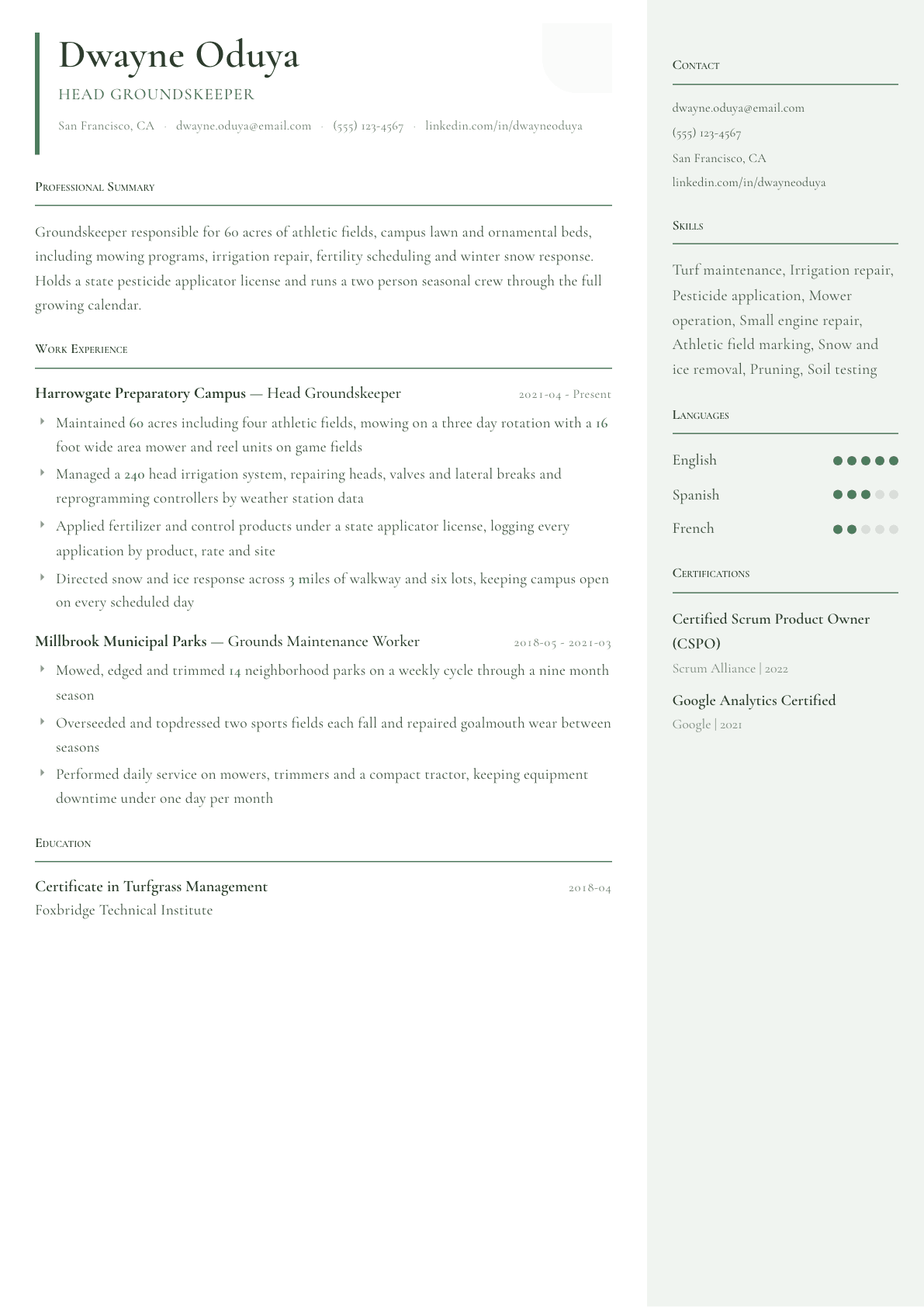
Example Groundskeeper summary
Head groundskeeper with six years maintaining athletic fields, campus turf and ornamental beds across sixty acres. Runs mowing rotations, irrigation repair, fertility and control programs under a state applicator license, and a winter route covering three miles of walkway. Trains and schedules seasonal crew, and keeps game fields playable through a full competitive season. Seeking a grounds supervisor position at a larger property.
Skills to list on a Groundskeeper resume
- Turf management
- Mowing and edging
- Irrigation troubleshooting
- Fertilizer application
- Pesticide application
- Athletic field preparation
- Aeration and overseeding
- Pruning and trimming
- Snow removal
- Equipment maintenance
- Tractor operation
- Soil amendment
- Crew supervision
- Grounds safety
What actually gets this resume read
- Open with the acreage you maintain and the property type, because a campus, a cemetery and a ballpark are different jobs.
- Name your state pesticide applicator license and its categories, since many postings will not consider a resume without it.
- List the equipment you run by class: zero turn, wide area, reel, compact tractor, skid steer, aerator, topdresser.
- Show irrigation work in detail, from head and valve repair to controller programming, because it is the costliest failure.
- Include snow and ice response if the site has it, with route size and how many events you covered in a season.
- Give any crew leadership plainly: how many seasonal staff you scheduled and trained during peak growing months.
How to write a groundskeeper resume
Groundskeeper postings look interchangeable and are not. A school district wants safe athletic fields and a person who can be trusted around students. A cemetery wants precision and quiet. A golf course wants agronomy. A property management company wants curb appeal and a snow plan. The resume that wins names the property type it is built for.
The person hiring is usually a facilities director or a grounds superintendent who has been short staffed all season. He is scanning for three things: the acreage you have actually maintained, whether you hold a pesticide applicator license, and how much equipment he can put you on without training you first.
This guide covers the layout, how to write a summary that survives that scan, how to turn seasonal work into evidence, which licenses to feature, and the questions groundskeepers ask when they sit down to update a resume that has not changed in years.
Format: one page, trades style, no decoration
One page is right for almost everyone in this field. Use a plain single column layout with clear section headings. Facilities departments often run applications through public sector hiring software that mangles columns and icons, and a shredded resume never reaches the superintendent.
Put licenses and certifications in a block right under the summary. That block is the fastest read on the page and it decides whether the application moves forward at a property that sprays its own turf.
- Header: name, city and state, phone, email, and driver license class if you hold a commercial one.
- Section order: summary, licenses and certifications, experience, equipment operated, education and training.
- A first time applicant leads with equipment and any farm, landscape or facilities work, paid or not.
Summary: acreage, property type, season length
Open with what you maintain and how much of it. Sixty acres of campus with four athletic fields tells a reader more in one line than a paragraph about dedication. Add the season pattern where it applies: a nine month growing season plus a winter snow route is a different job from year round mowing.
If you supervise, say how many people and whether they are seasonal. Grounds crews swell in spring and shrink in fall, and a candidate who can run temporary staff through that swing is worth more than one who cannot.
Experience: turf, water, iron, and weather
Structure each job around the four things that actually take the hours. Turf: mowing heights, rotation frequency, deck widths, and the practices you run such as aeration, overseeding, topdressing and fertility timing. Water: irrigation head counts, valve and lateral repair, controller programming and how you adjust for weather.
Iron: the machines you run and service. Zero turn and wide area mowers, reel units for game fields, compact tractors, skid steers, aerators, topdressers, sprayers, blowers and trimmers. Add the maintenance you do yourself, because a groundskeeper who changes blades, sharpens reels and handles small engine repair saves a shop budget.
Weather: storm cleanup, snow and ice response, drought restrictions and the recovery work after each. Give route size and event counts so the reader can price your winter value.
Athletic field work deserves its own bullets when you have it: mowing patterns, field marking and paint, goalmouth and infield repair, mound and plate work, and the game day turnaround between events.
Licenses, training and safety
The pesticide applicator license is the single most valuable line on many groundskeeper resumes. Give the issuing state and the categories you hold, such as ornamental and turf or right of way, and note your recertification status.
Add anything else that removes a training cost: playground safety inspection, irrigation technician credentials, aerial lift or forklift cards, chainsaw training, and any commercial driver license class with endorsements. Schools and municipalities will also note background check clearance, so mention it if the sector expects it.
Keywords a facilities screener looks for
Common posting language includes grounds maintenance, turf management, irrigation repair, pesticide application, athletic field preparation, snow removal, equipment operation and preventive maintenance. Use each once in the summary, the skills block or a bullet where it is true.
Public sector job descriptions often list physical requirements and shift expectations. If you can lift the stated weight, work early starts, or take call for storm events, say so plainly in the summary rather than making the reader wonder.
Groundskeeper resume summary examples
First grounds job
Reliable outdoor worker with two seasons mowing, trimming and mulching for a residential maintenance crew. Comfortable on zero turn mowers, string trimmers and a compact tractor, and trained on safe fuel handling and daily equipment checks. Available for early starts and winter storm call outs.
Five seasons in
Groundskeeper maintaining twenty two acres of municipal parks and two sports fields on a weekly cycle. Repairs irrigation heads, valves and controllers, applies fertility and control products under a state applicator license, and services mowers and small engines in house. Runs a three mile winter walkway route.
Head groundskeeper
Head groundskeeper responsible for sixty acres of campus turf, ornamental beds and four competition fields. Plans the annual fertility, aeration and overseeding calendar, manages a two hundred head irrigation system, schedules and trains seasonal staff, and directs the campus snow and ice response.
Work experience bullets: before and after
Before: Mowed grass and maintained the grounds.
After: Mowed sixty acres on a three day rotation using a 16 foot wide area machine and reel units on game fields, adjusting height of cut through the season.
Acreage, rotation and machine type let a superintendent picture the workload immediately.
Before: Fixed sprinklers when they broke.
After: Maintained a 240 head irrigation system, repairing heads, valves and lateral breaks and reprogramming controllers weekly against weather station data.
System size and controller work show real irrigation competence instead of occasional patching.
Before: Applied chemicals to the turf.
After: Applied fertilizer, pre emergent and broadleaf control under a state applicator license, logging every application by product, rate, site and weather conditions.
Licensing and record keeping are the compliance side that a public employer is legally exposed on.
Before: Helped with snow in the winter.
After: Directed snow and ice response across three miles of walkway and six parking lots, covering fourteen events in a season with no campus closure.
Route size, event count and the outcome turn winter work into a measurable service record.
Before: Took care of the equipment.
After: Serviced mowers, trimmers and a compact tractor on a scheduled interval, sharpening reels and rebuilding carburetors, and held unplanned downtime under a day a month.
Naming the actual repairs proves you reduce shop costs rather than just filling fuel tanks.
Hard skills
- Turf mowing and height of cut management
- Aeration, overseeding and topdressing
- Irrigation troubleshooting and repair
- Fertilizer and control product application
- Athletic field marking and repair
- Pruning and bed maintenance
- Compact tractor and skid steer operation
- Small engine and mower maintenance
- Snow and ice removal
- Soil testing and amendment
- Tree and shrub planting
- Hand and power tool use
Soft skills
- Working unsupervised
- Seasonal crew training
- Public and student awareness
- Dependability in bad weather
- Radio and work order communication
Certifications worth listing
- Commercial Pesticide Applicator License (State department of agriculture)
- Certified Sports Field Manager (Sports Field Management Association)
- Landscape Industry Certified Technician (National Association of Landscape Professionals)
- Certified Irrigation Technician (Irrigation Association)
- Certified Playground Safety Inspector (National Recreation and Park Association)
Mistakes that cost groundskeeper candidates the interview
- Writing maintained the grounds with no acreage, property type or field count attached to it.
- Leaving the applicator license off the page when it is the requirement that filters most of the pile.
- Listing equipment as machinery instead of naming the classes a superintendent staffs a crew around.
- Hiding seasonal gaps rather than labeling the position as seasonal, which reads as unexplained absence.
- Skipping winter work entirely at a property where snow response is half the reason the job exists.
- Using a graphic template with icons that public sector application software strips into unreadable text.
Groundskeeper resume questions
Do I need a pesticide license to be hired as a groundskeeper?
Not for every job, but it moves you up the pile everywhere. Properties that spray their own turf need licensed applicators on staff, and an employer who has to send you for training will prefer the candidate who arrives with the card.
How do I handle seasonal jobs on the resume?
Label them seasonal with the months worked, then group repeat seasons at the same employer into one entry with the years. That reads as returning staff, which is a compliment, rather than as someone who leaves every autumn.
Should I list every piece of equipment I have run?
List the classes rather than every model. Mowers by type, tractors and their attachments, skid steers, aerators, sprayers, blowers and any lift or truck you are checked out on. That list is a hiring shortcut for a short staffed crew.
What if my experience is landscaping rather than institutional grounds?
Translate it. Mowing and bed work carry across, so lead with those, then name the pieces a campus needs that you have less of, such as athletic fields or snow routes, and say you are ready to be trained on them.
How long should a groundskeeper resume be?
One page unless you have supervised large properties for more than a decade. Facilities directors read quickly, and a second page usually just repeats the same mowing and trimming duties under a different employer name.
Related resume examples
- Landscaper Resume example
- Building Maintenance Worker Resume example
- Arborist Resume example
- Maintenance Technician Resume example
- Handyman Resume example
- General Laborer Resume example