Occupational Health and Safety Specialist Resume Examples
Build an Occupational Health and Safety Specialist Resume That Passes Screening
By Mustafa Tarabya, founder of CVBooster · Published · Updated
An occupational health and safety specialist resume example with incident rates, audits and training records, ATS keywords and a full guide.
Sample resumes for a occupational health and safety specialist
The same occupational health and safety specialist content laid out in three CVBooster templates, so you can see what the finished document looks like before you write a word.
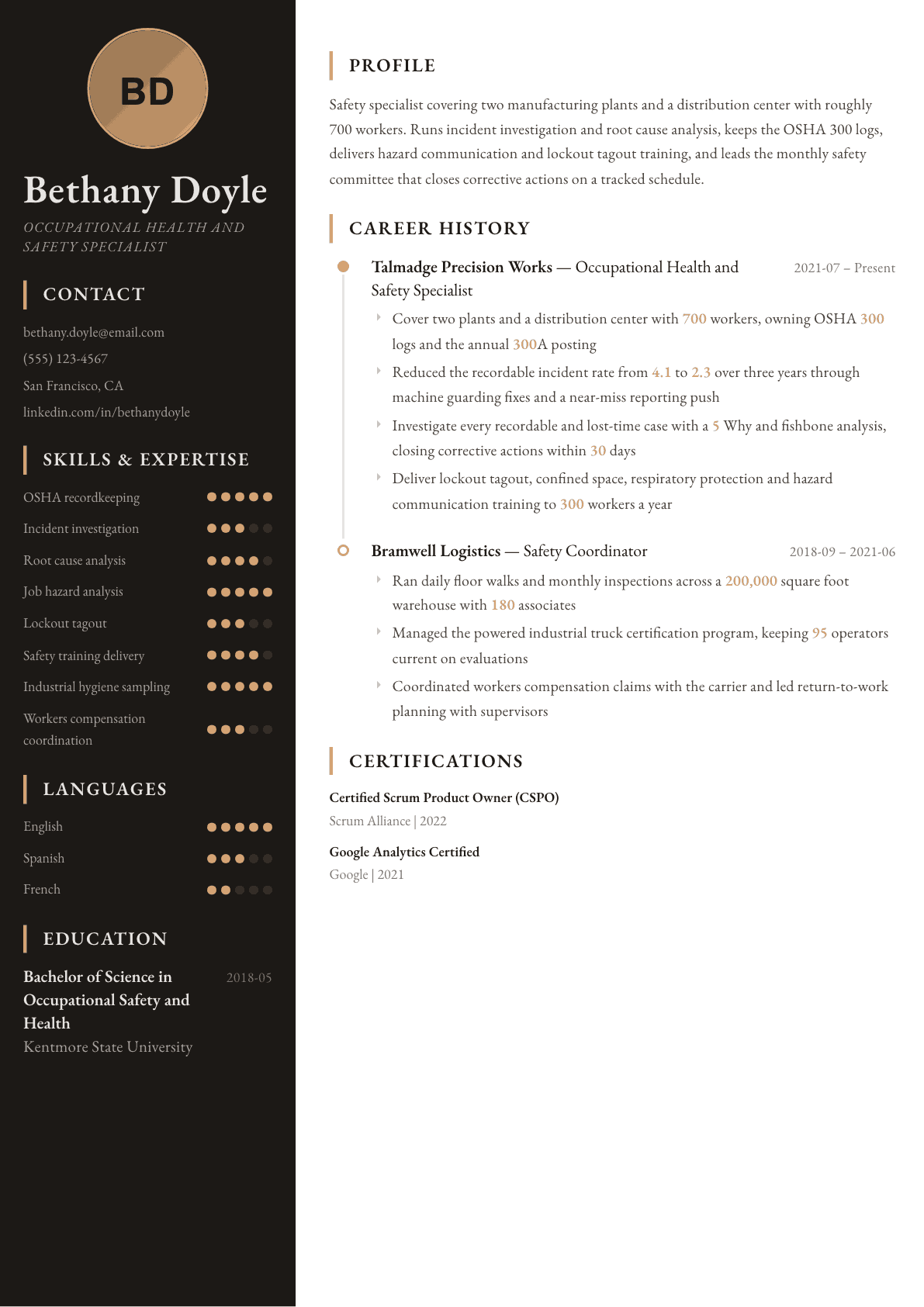
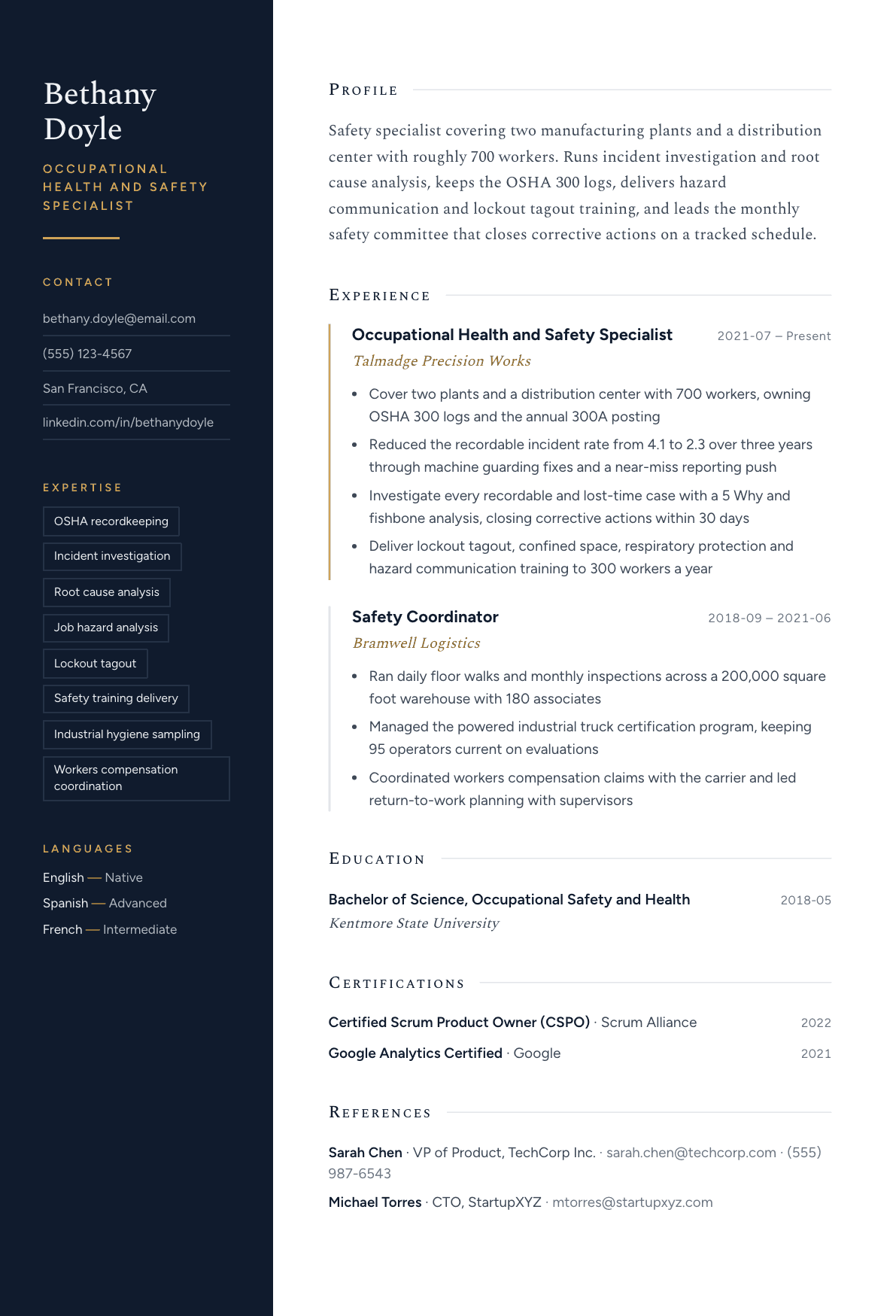
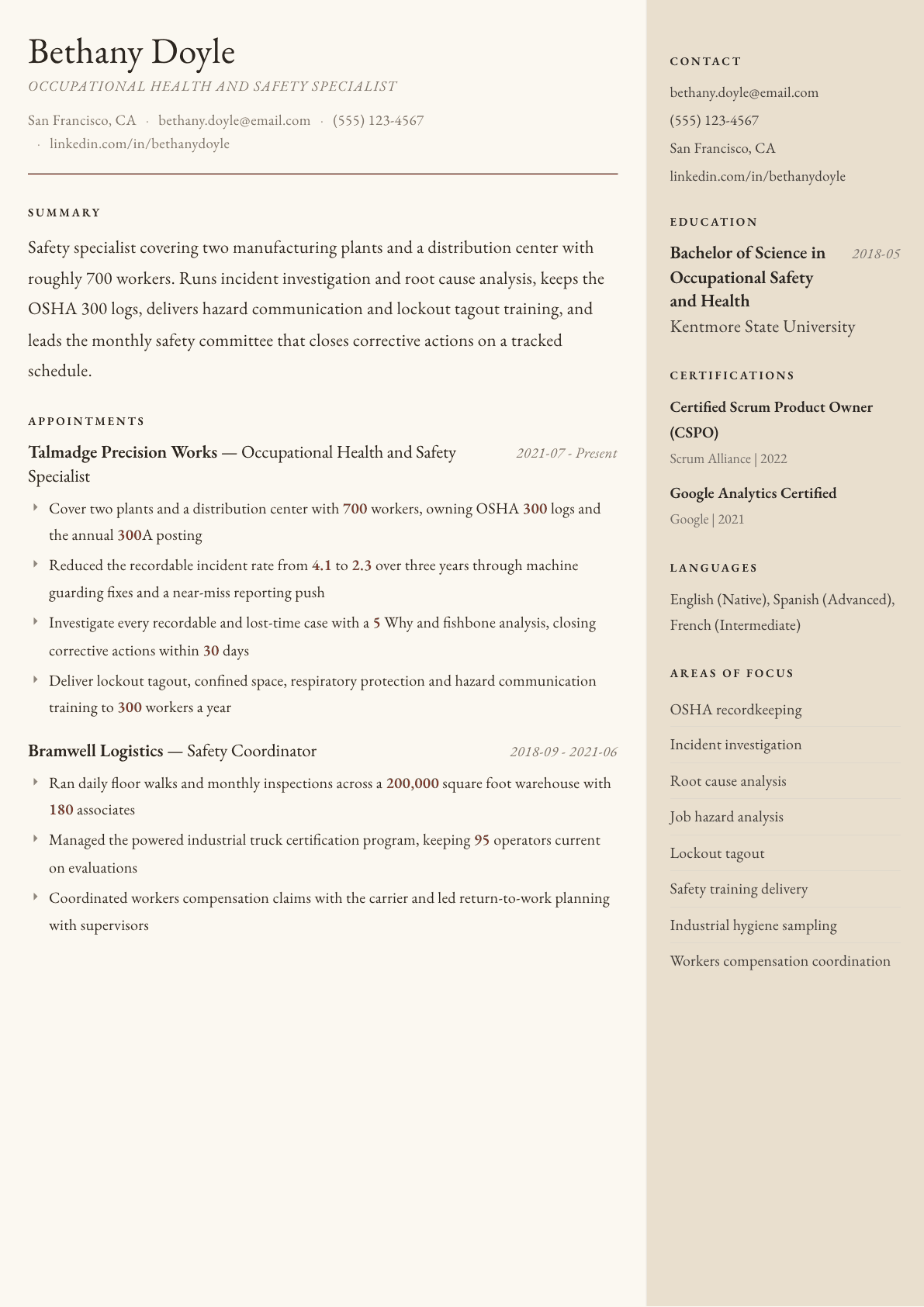
Example Occupational Health and Safety Specialist summary
Occupational health and safety specialist with six years covering manufacturing and distribution sites of about 700 workers. Owns OSHA recordkeeping, incident investigation and root cause analysis, and brought the recordable rate from 4.1 to 2.3 through guarding upgrades and a near-miss reporting push. Delivers lockout tagout, confined space and hazard communication training, and chairs the site safety committee.
Skills to list on a Occupational Health and Safety Specialist resume
- OSHA 300 recordkeeping
- Incident investigation
- Root cause analysis
- Job hazard analysis
- Lockout tagout
- Confined space entry
- Respiratory protection
- Hazard communication
- Machine guarding
- Industrial hygiene sampling
- Ergonomic assessment
- Emergency response planning
- Safety training delivery
- Workers compensation coordination
- Contractor safety management
- ISO 45001 awareness
What actually gets this resume read
- Open with the settings you have covered: manufacturing, construction, warehouse, laboratory or healthcare, and the headcount at each.
- Put your safety credentials in the header or a section near the top, with the issuing body spelled out.
- Give the incident rate you inherited and the one you left behind, because that trend is the strongest evidence you have.
- Name the standards you work under by number so the applicant tracking system matches them exactly.
- Show training volume: which courses you deliver, how many workers, and how you track completion and refreshers.
- Include audit and inspection outcomes, including any regulatory visit you supported and how findings were closed.
How to write a occupational health and safety specialist resume
A safety resume is screened by someone who is accountable when an inspector arrives. That person reads for three things in order: the industry settings you have worked in, the credentials you hold, and whether your incident numbers moved in the right direction while you were there. Everything else on the page is secondary.
Industry match matters more in occupational health and safety than in most HR-adjacent fields. Construction, general manufacturing, warehousing, chemical processing, healthcare and utilities each carry different standards, different hazards and different regulatory attention. A specialist who has only worked in offices will not be shortlisted for a plant, so name the environments and the hazards plainly.
This guide covers how to present site scope and headcount, how to write incident and audit bullets that a safety director trusts, which credentials carry weight and who issues them, and the training and recordkeeping detail that separates a specialist from a coordinator.
Format: credentials in the header, settings in the scope line
Reverse-chronological, one page for under eight years and two after that. Put credential abbreviations after your name in the header the way the field writes them, and repeat the full credential name with its issuing body in a certifications section.
Each employer needs a scope line before the bullets: the type of site, the number of sites, the worker headcount, whether contractors are included, and the shift pattern. A specialist covering two plants and a distribution center with seven hundred workers has a job a reader can picture immediately.
- Header: name, credentials, city and state, phone, email.
- Section order: summary, certifications and licenses, experience, training delivered, education.
- Candidates crossing industries should name the hazards they have managed, since hazards transfer better than sector names.
Summary: settings, headcount, program ownership, one trend
Four lines. Name the industries and site types, the population covered, the programs you own, and the incident trend during your tenure. Give the rate you inherited and the rate you left, because that pair is the most persuasive evidence available to a safety professional.
Avoid opening with a commitment to a safe workplace. Every applicant writes that sentence, and it displaces the industry and hazard detail the reader is scanning for.
Experience: incidents, programs, training, audits
Structure each job around four families. Incidents: how many recordables and lost-time cases you investigated, the method you use, how corrective actions are tracked and closed, and the trend over your tenure. Programs: name the written programs you own such as lockout tagout, confined space entry, respiratory protection, hazard communication, fall protection, machine guarding, hot work and contractor safety.
Training: which courses you deliver, how many workers per year, how you track completions and refreshers, and whether you built the material or delivered someone else's. Audits and inspections: your internal audit cycle, findings closed, and any regulatory visit you supported with the outcome described factually.
Cut bullets that describe safety as a general responsibility. Promoting a safety culture and ensuring compliance appear on nearly every applicant resume and prove nothing. Replace each with the program, the population and the measurable result.
- Name standards by their number so keyword filters catch them exactly as the posting writes them.
- Say whether you own the recordkeeping logs yourself or support someone who does.
- Include industrial hygiene sampling if you have performed it, with the exposure types you sampled for.
Certifications: the real ones, with the real issuer
The credentials that move a safety resume are issued by a small number of bodies. Write the full name and the issuer, and include the outreach training cards you hold along with any authorized trainer status, because employers filter on those separately.
If you are in progress toward a credential, say so plainly with the stage reached rather than listing it as held. Safety hiring managers verify credentials, and an overstatement here ends a process faster than in almost any other field.
Keywords a safety posting is built from
Postings repeat recordable incident rate, lost time, root cause analysis, job hazard analysis, safety committee, corrective action, personal protective equipment, hazard communication, lockout tagout, confined space, fall protection, industrial hygiene, ergonomics, emergency response, contractor management and workers compensation.
Mirror the exact terms the posting uses, including the standard numbers. Then make sure each keyword appears somewhere it is doing real work in a bullet, not only in the skills block.
Occupational Health and Safety Specialist resume summary examples
New to the field
Occupational safety graduate with an internship and one year as a safety coordinator in a distribution center of 180 associates. Ran daily floor walks and monthly inspections, managed powered industrial truck evaluations for 95 operators, and holds the general industry outreach training card.
Six years in
Safety specialist covering two manufacturing plants and a distribution center with 700 workers. Owns recordkeeping, incident investigation and root cause analysis, and brought the recordable rate from 4.1 to 2.3 over three years through machine guarding upgrades and a near-miss reporting push. Delivers lockout tagout and confined space training.
Regional safety lead
Regional environmental health and safety lead for nine sites and 3,200 workers across manufacturing and logistics, managing four site specialists. Built the corrective action tracking system now used company-wide, led two regulatory inspections to closure, and holds certified safety professional status.
Work experience bullets: before and after
Before: Investigated workplace accidents and wrote reports.
After: Investigated every recordable and lost-time case across three sites using 5 Why and fishbone analysis, closing corrective actions within 30 days and reviewing open items at the monthly safety committee.
The method, the closure window and the review forum show a disciplined process rather than paperwork after the fact.
Before: Reduced injuries at the facility.
After: Cut the recordable incident rate from 4.1 to 2.3 over three years by funding machine guarding upgrades on twelve presses and rebuilding near-miss reporting so supervisors logged hazards the same shift.
The rate pair plus two specific interventions is the evidence a safety director actually weighs.
Before: Delivered safety training to employees.
After: Delivered lockout tagout, confined space, respiratory protection and hazard communication training to about 300 workers a year, tracking completions and refresher dates in the learning system.
Naming the courses, the volume and the tracking distinguishes a program owner from an occasional presenter.
Before: Maintained OSHA logs and paperwork.
After: Maintained the OSHA 300 logs for three sites, prepared the annual 300A summary and posting, and reconciled case classifications with occupational health before each year-end close.
Classification review is the part that goes wrong; showing it proves the recordkeeping was done properly.
Before: Handled workers compensation claims.
After: Coordinated workers compensation claims with the carrier for 40 cases a year and built return-to-work plans with supervisors that matched restrictions to available light duty tasks.
Case volume and the restriction matching show operational involvement rather than passing paperwork along.
Hard skills
- OSHA 300 recordkeeping
- Incident investigation and root cause analysis
- Job hazard analysis
- Lockout tagout program
- Confined space entry
- Respiratory protection program
- Hazard communication
- Machine guarding assessment
- Fall protection
- Industrial hygiene sampling
- Ergonomic assessment
- Emergency response planning
- Contractor safety management
- Safety training delivery
- Workers compensation coordination
Soft skills
- Stopping work without losing the crew
- Coaching supervisors on hazard reporting
- Investigative interviewing after an incident
- Plain instruction for a multilingual workforce
- Holding a corrective action to its due date
Certifications worth listing
- Certified Safety Professional (CSP) (Board of Certified Safety Professionals)
- Associate Safety Professional (ASP) (Board of Certified Safety Professionals)
- Occupational Health and Safety Technologist (OHST) (Board of Certified Safety Professionals)
- Certified Industrial Hygienist (CIH) (Board for Global EHS Credentialing)
- OSHA 30-Hour General Industry Outreach Training (OSHA Training Institute Education Centers)
Mistakes that cost occupational health and safety specialist candidates the interview
- Leaving out the industry and site type, which is the first filter a safety director applies.
- Describing a safety culture without a single incident, audit or training number on the page.
- Listing standards you have read rather than programs you have written and run.
- Claiming a credential that is in progress as though it were already awarded.
- Omitting worker headcount, so the reader cannot judge the scale of the program.
- Hiding regulatory inspection experience because the outcome was imperfect, when handling one is valuable.
- Using vague phrases such as ensured compliance in place of the specific program you owned.
Occupational Health and Safety Specialist resume questions
Which safety certification should I get first?
Most people start with an associate level credential from the Board of Certified Safety Professionals while building the experience hours the full professional credential requires. Add the general industry or construction outreach training card that matches the sector you are targeting.
Should I put incident rates on my resume?
Yes, when you can defend the calculation and the period. Give the rate when you arrived and the rate when you left, plus the interventions behind the change. Never estimate the figure, because an experienced interviewer will ask how it was computed.
How do I move from warehouse safety to manufacturing?
Lead with hazards rather than sectors. Powered industrial trucks, lockout tagout, ergonomics, contractor control and emergency response all transfer. Then name the manufacturing-specific programs you have studied or supported so the gap is visible and addressed.
Does environmental experience belong on a safety resume?
Include it if the posting is for a combined environmental health and safety role, which many are. Name the specific programs such as waste manifesting, stormwater or air permit reporting, and keep them separate from the safety bullets so both are easy to scan.
How do I describe a regulatory inspection I was part of?
State it factually: the type of visit, your role in preparing and hosting it, the categories of finding, and how the corrective actions were closed. Employers care that you have been through one and know how the process runs from start to finish.
Related resume examples
- Human Resources Resume example
- Warehouse Worker Resume example
- HR Compliance Manager Resume example
- Wellness Coordinator Resume example
- Learning and Development Specialist Resume example
- Total Rewards Manager Resume example