Legal Receptionist Resume Examples: the lines they read
Create a Legal Receptionist Resume Law Firms Call Back
By Mustafa Tarabya, founder of CVBooster · Published · Updated
Legal receptionist resume example with front desk bullets, intake and conflict check keywords, and tips for busy law firm reception work.
Sample resumes for a legal receptionist
The same legal receptionist content laid out in three CVBooster templates, so you can see what the finished document looks like before you write a word.
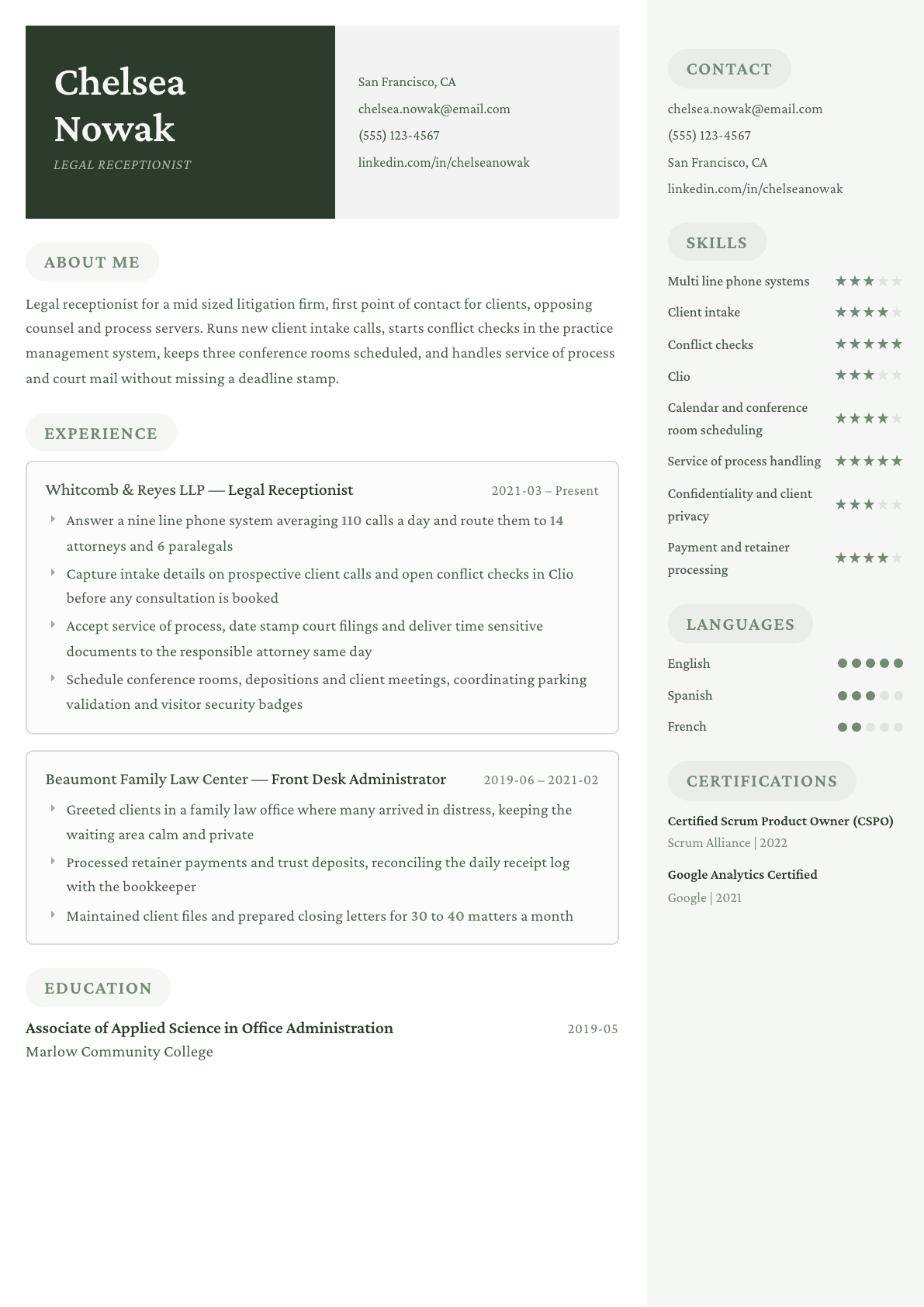
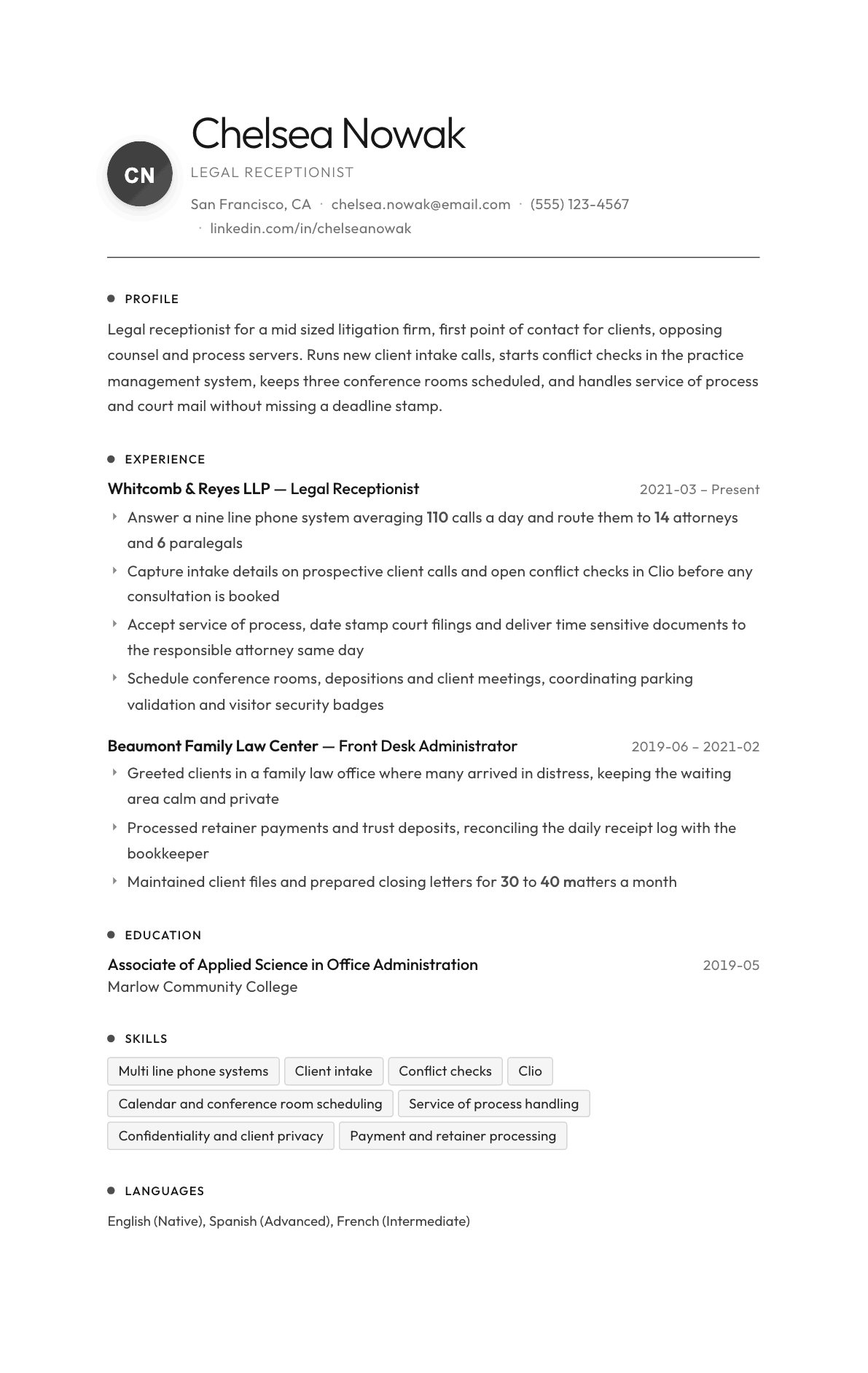
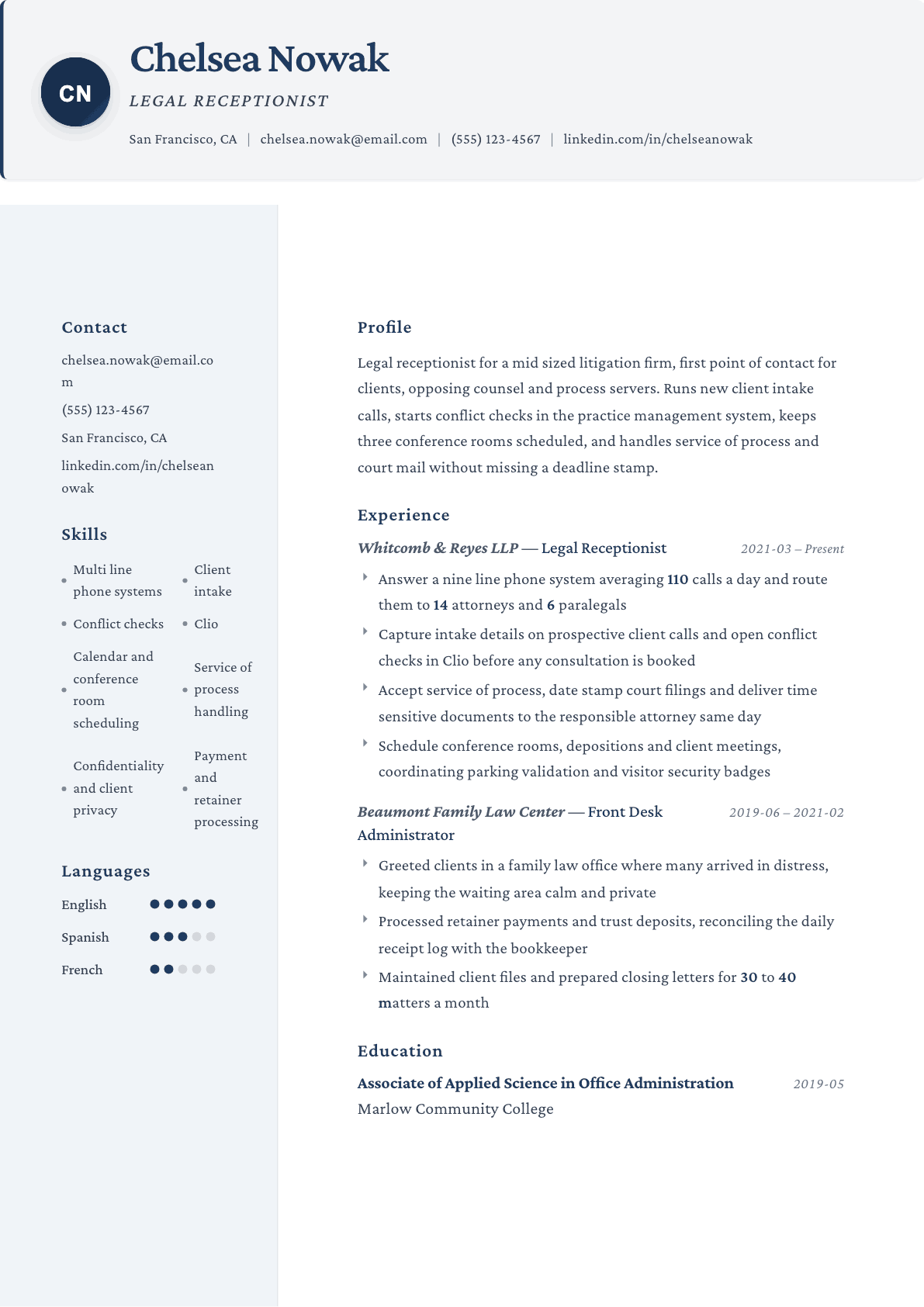
Example Legal Receptionist summary
Legal receptionist with five years at the front desk of litigation and family law firms, handling a high call volume for a floor of attorneys and paralegals. Runs prospective client intake, opens conflict checks in the practice management system, accepts service of process, and keeps the deposition calendar clean. Seeking a front desk role at a growing firm.
Skills to list on a Legal Receptionist resume
- Front desk reception
- Multi line phone routing
- New client intake
- Conflict of interest checks
- Attorney calendar support
- Conference room scheduling
- Service of process intake
- Court mail and date stamping
- Practice management software
- Client confidentiality
- Retainer and payment intake
- File opening and closing
- Visitor and security check in
What actually gets this resume read
- Say how many lines, attorneys and daily calls you handle, because firm size is what a hiring office manager weighs.
- Name the practice management system you use, since firms on Clio, Smokeball or MyCase filter resumes on it.
- Show intake work with the details you capture and how you start a conflict check before a consultation is booked.
- Mention service of process, date stamping and court mail, since mishandling any of them creates a deadline problem.
- Name the practice areas you have supported, because a family law front desk is a different job from corporate reception.
- Point to confidentiality practice in concrete terms: private waiting space, screen positioning, and no client names aloud.
How to write a legal receptionist resume
A legal receptionist is the firm to everyone outside it. The office manager doing the hiring knows that a mishandled intake call loses a case the firm would have taken, and that a process server turned away at the desk creates a problem nobody wants to explain to a partner. She is reading your resume for evidence that you understand both.
That is why a generic front desk resume rarely lands at a law firm. The duties look similar to any reception job, but the consequences are not. Conflict checks, service of process, date stamped filings and client confidentiality are the parts that make this a legal position, and they need to appear by name.
This guide shows how to structure the page for a firm reader, how to describe intake and phone volume in numbers that mean something, and how to present transferable reception experience when your background is outside the law.
Format: one page, firm details up front
One page, reverse chronological, no exceptions early in a reception career. Under the header, add a line that sizes the firms you have worked in: number of attorneys, practice areas, and the number of phone lines or the daily call volume you carried. Firm size predicts pace better than any adjective.
Use a plain single column. Firms often forward resumes as attachments through a practice management inbox, and a layout that survives that trip is worth more than one that looks impressive on screen.
- Header: name, city and state, phone, email, and a notary commission if you hold one.
- Order: summary, firm experience, other reception or administrative work, education, skills and systems.
- Applicants new to law should add a short line naming the legal terminology or paralegal coursework completed.
Summary: the firm, the practice area, the front desk load
Two or three lines naming the practice areas you have supported, the size of the attorney group, and the volume you handled. A criminal defense front desk fields calls from people in custody and their families. A corporate reception desk fields couriers and closing parties. Neither prepares you fully for the other, and saying which you know is more useful than claiming both.
If you are moving in from medical or hotel reception, use the summary to name the parallel: high call volume, confidentiality obligations, distressed visitors and a calendar shared across many professionals.
Experience: calls, intake, calendar, documents
Give each job four kinds of bullets. Phones: lines, daily call volume, how many attorneys and staff you route to, and whether you screen. Intake: what you capture from a prospective client, how you start a conflict check, and how you book consultations without promising anything the firm cannot deliver.
Calendar: conference rooms, depositions, client meetings, court appearances you help track, and any coordination with a docket clerk. Documents: mail sorting, date stamping filings, accepting service of process and getting time sensitive papers into the right hands the same day.
Add money handling if you did it. Taking retainer payments, logging trust deposits and reconciling a daily receipt log is real responsibility in a law office, and firms are careful about who they let near it.
Confidentiality, intake and the judgment calls
Firms want to see that you know what not to say. Describe the practices you follow: not confirming whether someone is a client, positioning screens away from the lobby, keeping the waiting area private when two opposing parties might arrive on the same afternoon.
Intake judgment matters just as much. Show that you take a complete message from a distressed caller, log the potential conflict details, and route an urgent matter to a supervising attorney rather than leaving a voicemail and hoping.
Systems, software and the words a firm searches
Name the practice management system, the document management system, the phone platform and the calendar tools you use. Firms screen on these because a receptionist who already knows their software is productive in days rather than weeks.
Then mirror posting vocabulary: front desk reception, client intake, conflict check, attorney calendar, service of process, court mail, e-filing confirmations, retainer, trust account deposit, conference room scheduling, visitor check in.
Legal Receptionist resume summary examples
New to law firms
Front desk administrator with 3 years in a medical office handling a 6 line phone system, patient intake and confidential records, plus a legal terminology course completed. Comfortable with high call volume, distressed visitors and shared calendars, and seeking a reception role in a litigation firm.
Four years at the firm desk
Legal receptionist for a 14 attorney litigation firm, answering a 9 line system averaging 110 calls a day. Captures prospective client intake, opens conflict checks in the practice management system, accepts service of process and schedules depositions across 3 conference rooms.
Front office lead
Front office lead at a 40 attorney firm, supervising 2 receptionists and owning the intake queue, conflict check log and visitor security process. Trains new front desk staff on confidentiality practice and coordinates conference room and deposition scheduling for 4 practice groups.
Work experience bullets: before and after
Before: Answered phones and greeted clients.
After: Answered a 9 line phone system averaging 110 calls a day, routing to 14 attorneys and 6 paralegals and screening prospective client calls before booking consultations.
Lines, call volume and headcount let a hiring manager compare her front desk to the one you already run.
Before: Took information from new clients.
After: Captured intake details on prospective client calls, including opposing party names, and opened a conflict check in the practice management system before any consultation was scheduled.
Naming the conflict check step shows you understand why intake at a law firm is not just a message pad.
Before: Handled mail and deliveries.
After: Accepted service of process, date stamped incoming filings and hand delivered time sensitive documents to the responsible attorney the same day they arrived.
Service and date stamping carry deadline consequences, and saying so proves you know what the mail actually is.
Before: Scheduled meetings and rooms.
After: Scheduled depositions, client meetings and closings across 3 conference rooms, coordinating court reporters, parking validation and visitor security badges.
The named participants show a calendar with external parties rather than an internal meeting booking.
Before: Kept client information confidential.
After: Kept the lobby private when opposing parties were scheduled the same afternoon, declined to confirm whether callers were clients, and positioned the intake screen away from public view.
Confidentiality becomes believable when it is three concrete practices instead of a promise.
Hard skills
- Multi line phone systems
- Prospective client intake
- Conflict of interest checks
- Practice management software
- Attorney and court calendar support
- Conference room and deposition scheduling
- Service of process intake
- Court mail and date stamping
- Retainer and trust deposit logging
- File opening and closing procedures
- Document management systems
- Visitor security check in
Soft skills
- Discretion
- Calm with distressed callers
- Message accuracy
- Warm professional tone
- Triage under interruption
Certifications worth listing
- Accredited Legal Professional (ALP) (NALS, the association for legal professionals)
- Notary Public Commission (State commissioning authority)
Mistakes that cost legal receptionist candidates the interview
- Submitting a general reception resume with no mention of intake, conflicts, service of process or client confidentiality.
- Leaving out firm size and practice area, which are the two facts an office manager uses to judge fit.
- Describing call handling without a volume, so a busy firm cannot tell whether you can hold its phone.
- Ignoring the practice management system by name when firms filter resumes on their own software.
- Overstating legal knowledge, which raises the worry that you might answer a caller question you should route.
- Burying trust deposit or retainer handling that shows a firm already trusted you with client money.
Legal Receptionist resume questions
Do I need legal experience to be hired as a legal receptionist?
Not always. Firms hire strong reception candidates from medical, hospitality and corporate desks, then train the legal specifics. Improve your odds by naming a legal terminology course and by showing confidentiality practice in your current role.
How do I show call volume if my old firm never tracked it?
Estimate honestly from the phone system reports or your own count over a normal week, and describe the number of lines and the staff you routed to. A stated range with context reads better than silence on the busiest part of the job.
Should a legal receptionist resume mention typing speed?
Only if the posting asks or the role includes transcription and correspondence. Space on a one page resume is better spent on intake, conflict checks and calendar coordination, which are harder to teach than typing.
What if the firm wants reception plus administrative support?
Split the experience bullets so front desk duties come first and support duties follow: file maintenance, document preparation, expense logs, supply ordering. That order matches how the office manager reads the posting she wrote.
Is a notary commission worth adding?
Yes. A receptionist who can witness an affidavit or certify a copy saves the firm a trip and a fee, and many small offices treat it as a tiebreaker between two otherwise equal candidates.