Law School Graduate Resume Examples: what gets the call
Write a Law School Graduate Resume While Awaiting Bar Results
By Mustafa Tarabya, founder of CVBooster · Published · Updated
Law school graduate resume example with bar status, clinic and research keywords, plus a guide to job hunting between graduation and admission.
Sample resumes for a law school graduate
The same law school graduate content laid out in three CVBooster templates, so you can see what the finished document looks like before you write a word.
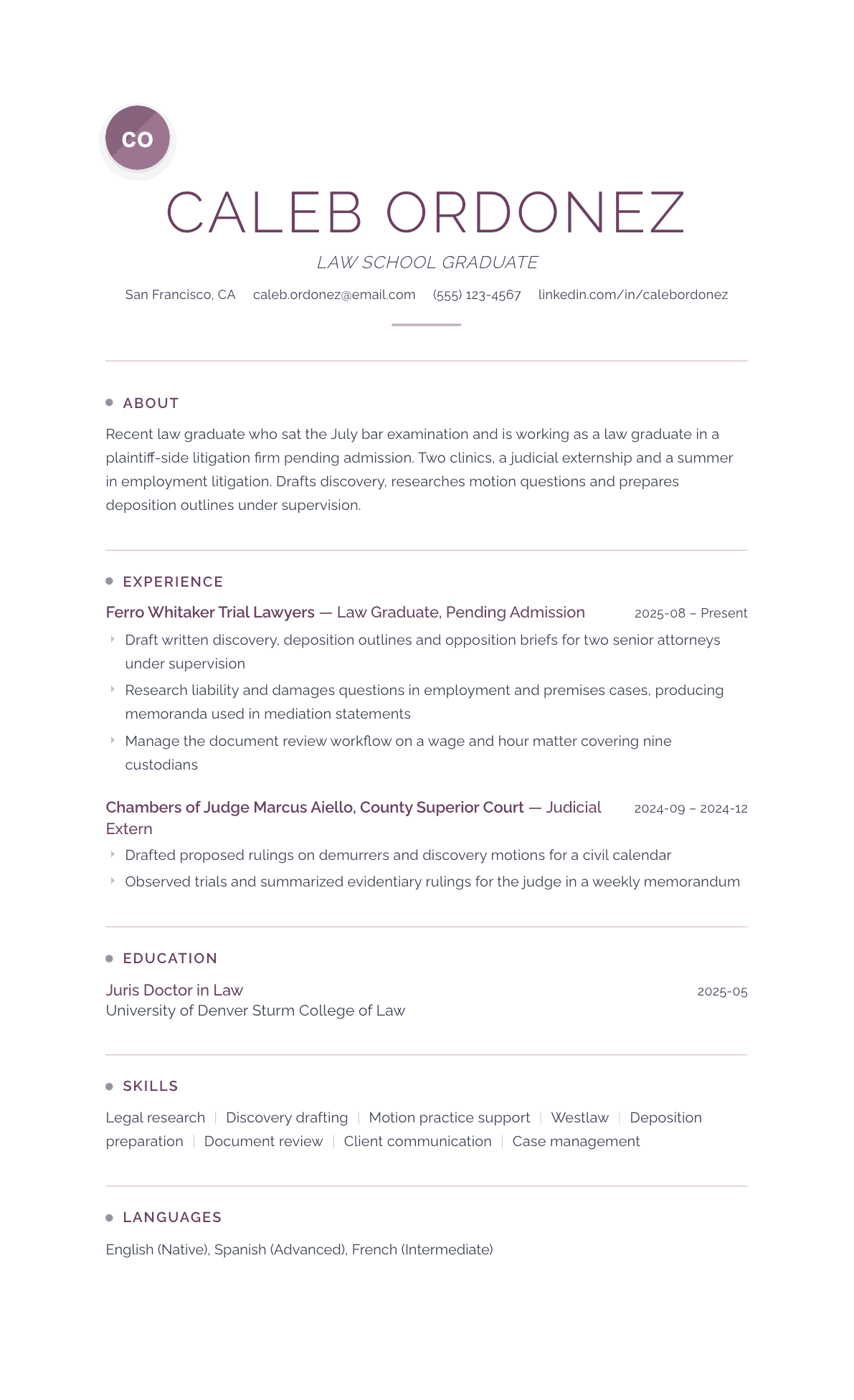
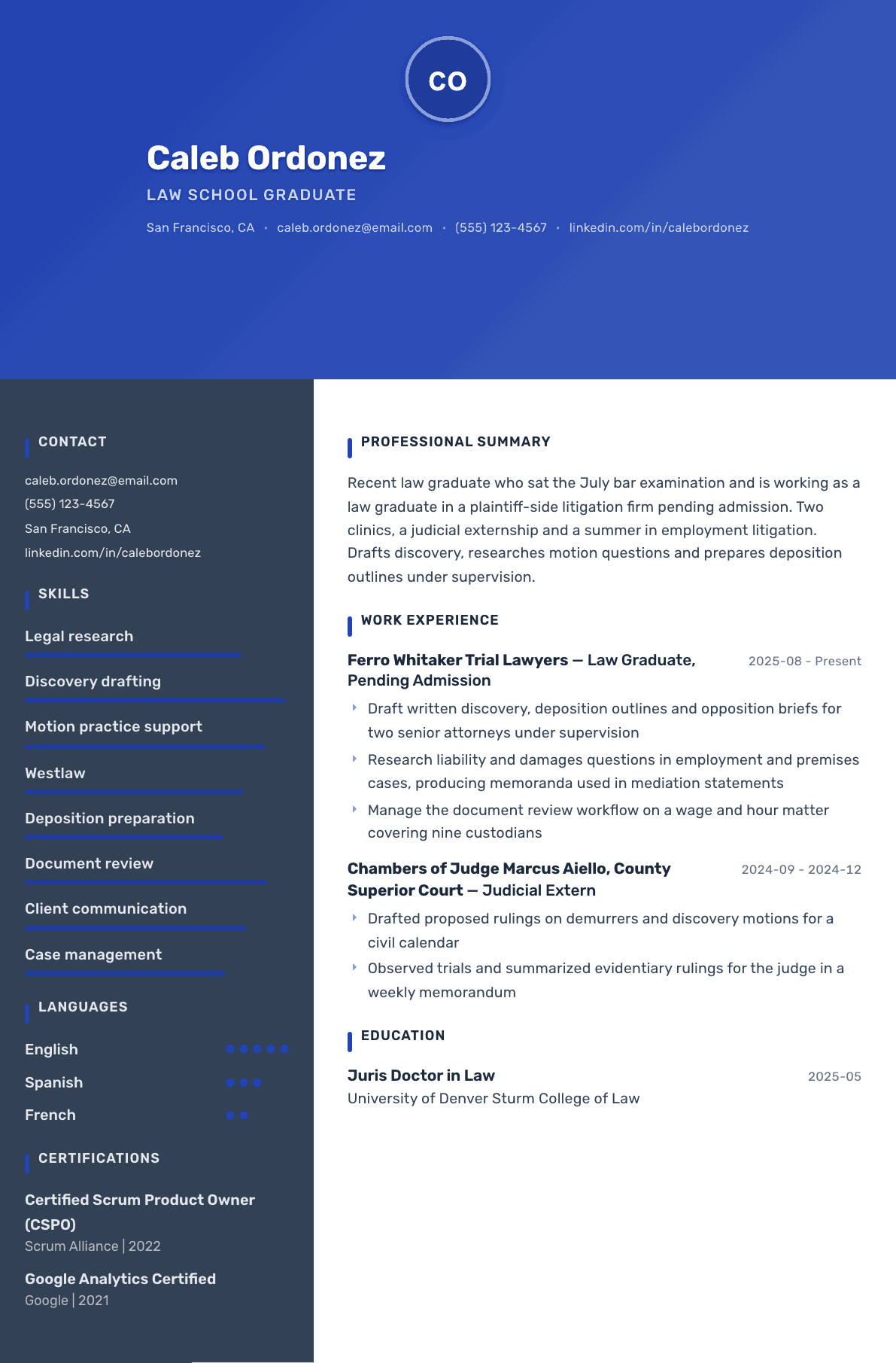
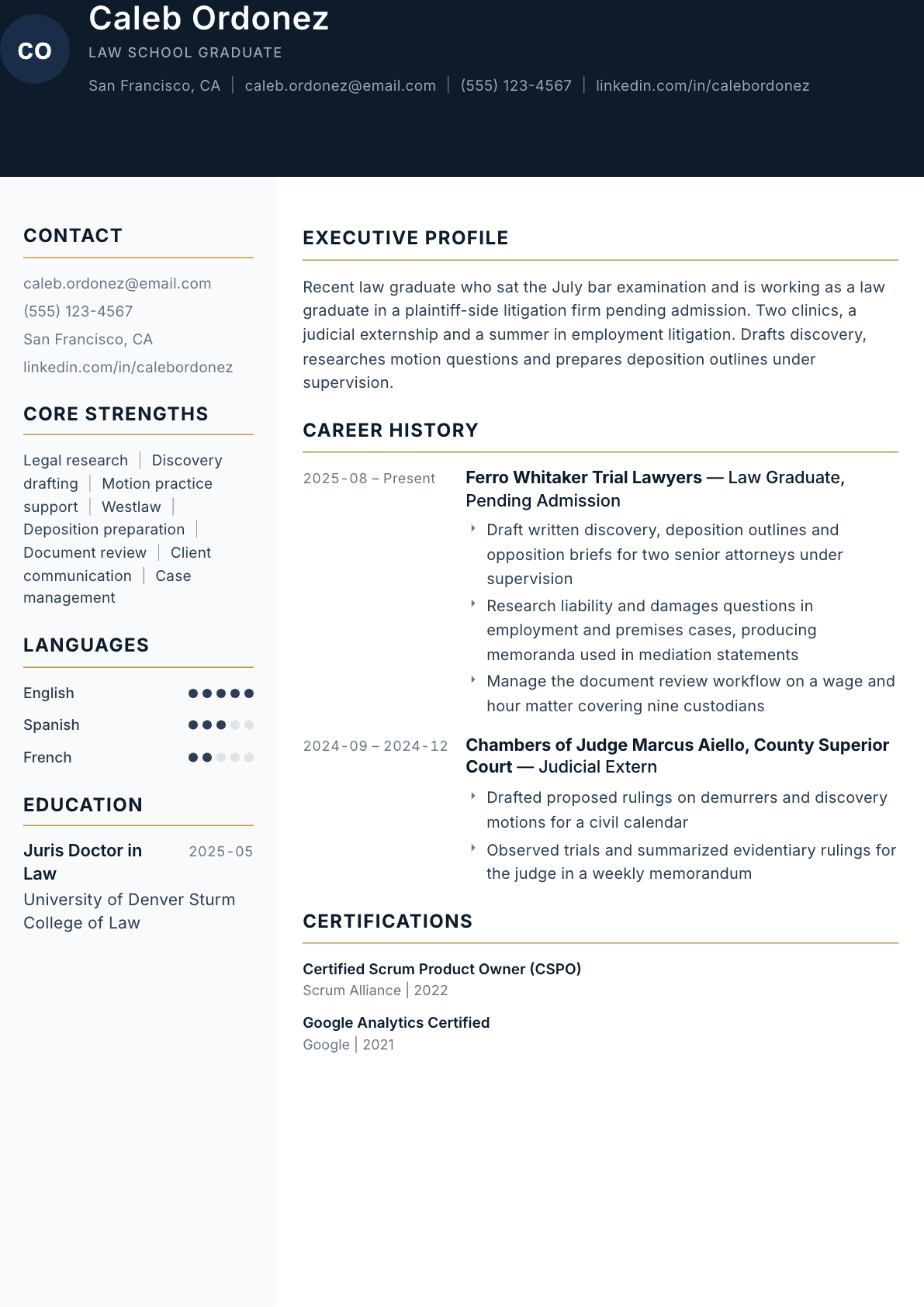
Example Law School Graduate summary
Law school graduate working as a law graduate in a plaintiff-side litigation firm pending bar admission, drafting discovery, opposition briefs and deposition outlines under supervision. Two clinics and a judicial externship drafting proposed rulings on demurrers and discovery motions. Seeking an associate position in employment or general civil litigation once admitted.
Skills to list on a Law School Graduate resume
- Legal research
- Legal writing and memoranda
- Written discovery drafting
- Motion practice support
- Deposition outline preparation
- Document review
- Westlaw and Lexis
- Client intake and interviewing
- Case file management
- Court filing procedures
- Bluebook citation
- Mediation and settlement support
What actually gets this resume read
- State your bar status plainly near the top: which examination you sat, the state, and when results are expected.
- Keep education first until you are admitted, then let experience take the top of the page.
- Translate clinic and externship work into practice language, because employers hire for what you can do on Monday.
- Describe supervised work honestly, saying under supervision where it applies, since misstating your status ends an application.
- Name every court you appeared in as a certified student attorney and what you argued or presented there.
- Add the practice areas you want in the summary, because a graduate resume with no direction reads as an application to everything.
How to write a law school graduate resume
The months between graduation and admission are the strangest stretch of a legal career. You have a Juris Doctor, you are not yet a lawyer, and every employer reading your resume needs to know precisely what you are allowed to do for them right now. A law school graduate resume that leaves bar status ambiguous creates hesitation at exactly the moment you need a decision.
The second problem is credibility. Your resume is full of clinics, externships and a summer position, all of them real work, none of it labeled the way a practicing employer labels work. The fix is to describe what you did in the vocabulary of practice: discovery drafted, hearings attended, motions researched, clients interviewed, files managed.
This guide covers where bar status goes and how to phrase it, how to convert academic experience into practice terms without overstating your authority, summaries for a graduate awaiting results, one working under supervision and one newly admitted, and the questions graduates ask about gaps, retakes and unposted jobs.
Bar status: state it plainly and put it high
Put your bar status in the header or in the first line under your name. Say which examination you sat, in which state, and when results are expected. If you have already passed and are awaiting swearing in, say that. If you are registered for an upcoming administration, say that instead. Every one of those is a normal position to be in, and none of them is improved by vagueness.
Never use a title that implies admission you do not hold. Law graduate, law clerk and legal fellow are the usual accurate options, and employers who hire at this stage recognize all of them. The one error that ends an application is describing yourself as an attorney before the state says you are.
- Header: name, city and state, phone, email, and a bar status line stating the state and expected result date.
- Order until admitted: education, bar status, experience, skills. After admission, experience moves up.
- Add any second state you have applied to, since multi-state candidates are worth more to regional employers.
Turning school experience into practice experience
Employers hire for what you can do next week. Go through your clinics, externships and summer positions and rewrite each one around deliverables: written discovery, motions researched or drafted, declarations prepared, intake interviews conducted, hearings attended, files managed, deadlines tracked.
Keep the supervision language where it belongs. Drafted under attorney supervision is accurate and expected, and it protects you if an interviewer probes. Where you held a student practice certification, name the certification and the court, because that is a documented authority rather than a claim.
Externships in chambers translate especially well. Drafting proposed rulings on demurrers or discovery motions is directly comparable to the research a first-year associate does, so describe the motion types rather than the fact that you were in a courthouse.
The bridge job and how to describe it
Many graduates work as a law graduate, law clerk or document review attorney while waiting. That work belongs on the resume as a real position with real bullets. Say who you supported, what you drafted, what systems you worked in and what volume you handled, exactly as you would a first associate job.
Contract review and staffing agency projects count too, provided you describe the substance: the review protocol, the tools, the issue coding, the privilege calls escalated. Employers know the market and do not penalize the work. They penalize a page that hides three months behind a blank space.
Direction: name the practice you want
A graduate resume with no stated direction reads as an application sent to everyone. Use the summary to name one or two practice areas and connect them to something on the page: the clinic, the externship docket, the industry you worked in before law school, the note you wrote.
When you are open to several areas, tailor the summary for each application rather than listing four practices at once. The rest of the page stays the same, so this is a two line edit and it changes how the whole resume reads.
Gaps, retakes and the honest page
A gap after graduation is common and unremarkable if the page accounts for it. Study period, caretaking, a contract project, volunteer legal work at a clinic or a bar association pro bono program: any of these is a line, and a line beats a hole.
If you are retaking an examination, you do not need to announce the earlier attempt on the resume. State your current status accurately, keep working in a legal-adjacent role if you can, and let the interview handle the history if it comes up.
Law School Graduate resume summary examples
Awaiting results
Law school graduate who sat the July bar examination with results expected in the fall, with two clinic semesters and a judicial externship drafting proposed rulings on demurrers and discovery motions. Seeking a law graduate or research position in civil litigation while awaiting admission.
Working under supervision
Law graduate at a plaintiff-side litigation firm pending admission, drafting written discovery, deposition outlines and opposition briefs for two senior attorneys. Manages document review on a wage and hour matter across nine custodians and researches liability and damages questions for mediation statements.
Newly admitted
Newly admitted attorney with a year of supervised litigation work before admission, now handling written discovery, motion drafting and client communication on employment and premises files. Appeared at two case management conferences in the first month after swearing in. Seeking an associate position in general civil litigation.
Work experience bullets: before and after
Before: Assisted attorneys with litigation tasks.
After: Drafted written discovery, deposition outlines and opposition briefs for two senior attorneys under supervision, on employment and premises liability files.
Naming the documents, the supervision and the case types tells an employer exactly what can be assigned on day one.
Before: Externed for a judge during law school.
After: Judicial extern on a civil calendar: drafted proposed rulings on demurrers and discovery motions and summarized evidentiary rulings for the judge in a weekly memorandum.
Motion types and a recurring written deliverable convert a school credit into recognizable litigation experience.
Before: Did document review on a large case.
After: Ran the document review workflow on a wage and hour matter across nine custodians, applying the issue coding protocol and escalating privilege questions to the supervising attorney.
Scope, protocol and escalation show a graduate who understands review as a supervised legal process rather than a chore.
Before: Researched legal issues for the firm.
After: Researched liability and damages questions in employment and premises cases, producing memoranda that were used in two mediation statements.
A destination for the research proves the work was relied on rather than filed away unread.
Before: Worked at a legal clinic with clients.
After: Interviewed clients at intake as a certified student attorney, prepared declarations and exhibit packets, and appeared at a status hearing with the supervising attorney present.
The certification and the specific client deliverables set out your authority accurately while still showing real practice.
Hard skills
- Legal research
- Legal memoranda and brief drafting
- Written discovery drafting
- Deposition outline preparation
- Document review and issue coding
- Westlaw and Lexis
- Client intake interviewing
- Court filing and local rules
- Case file and deadline management
- Bluebook citation
- Mediation and settlement support
- Motion practice support
Soft skills
- Accuracy about scope of authority
- Working under close supervision
- Turning drafts around quickly
- Client-appropriate communication
- Organization across many files
- Asking for feedback
Mistakes that cost law school graduate candidates the interview
- Leaving bar status off the page, which forces an employer to guess what work you can legally be given.
- Using the title attorney before admission, which is the single fastest way to lose an offer at this stage.
- Keeping course names and school vocabulary instead of translating experience into practice deliverables.
- Hiding a post-graduation gap rather than accounting for it with a study period or a contract project.
- Applying with no stated practice direction, which makes the resume look mass mailed even when it is not.
- Dropping contract or review work off the page out of embarrassment when it shows current legal activity.
Law School Graduate resume questions
How do I list bar exam status on my resume?
Give it its own line near your name: the examination you sat, the state, and the month results are expected. If you passed and await swearing in, say awaiting admission. Update the line the day your status changes, since employers check it before scheduling interviews.
What job titles can I use before I am admitted?
Law graduate, law clerk, legal fellow and legal analyst are all accurate and understood. Use whatever title your employer assigned in writing. Do not use attorney, associate or counsel until the state admits you, even if your daily work resembles an associate's.
Should education stay at the top after graduation?
Keep education first until you are admitted and have several months of substantive legal work, because your degree and bar status are the two facts driving the decision. Once you are practicing, move experience above education and shorten the school block.
How do I explain a gap between graduation and my first legal job?
Account for it with a short entry: bar preparation, a contract review project, volunteer work with a legal aid office or a bar pro bono program, or caretaking. Employers expect this period to be uneven. What they dislike is an unexplained blank stretch on the page.
Is it worth applying to firms before bar results arrive?
Yes. Many firms and government offices hire graduates specifically for supervised work before admission, and some make offers conditional on passing. State your status clearly, apply for law graduate positions rather than associate roles, and treat the pre-admission period as your first legal job.