Legal Secretary Resume Examples: the lines they read
Create a Legal Secretary Resume That Opens Doors at Top Firms
By Mustafa Tarabya, founder of CVBooster · Published · Updated
Build a professional legal secretary resume showcasing your document preparation, calendar management, and litigation support skills with polished templates.
Sample resumes for a legal secretary
The same legal secretary content laid out in three CVBooster templates, so you can see what the finished document looks like before you write a word.
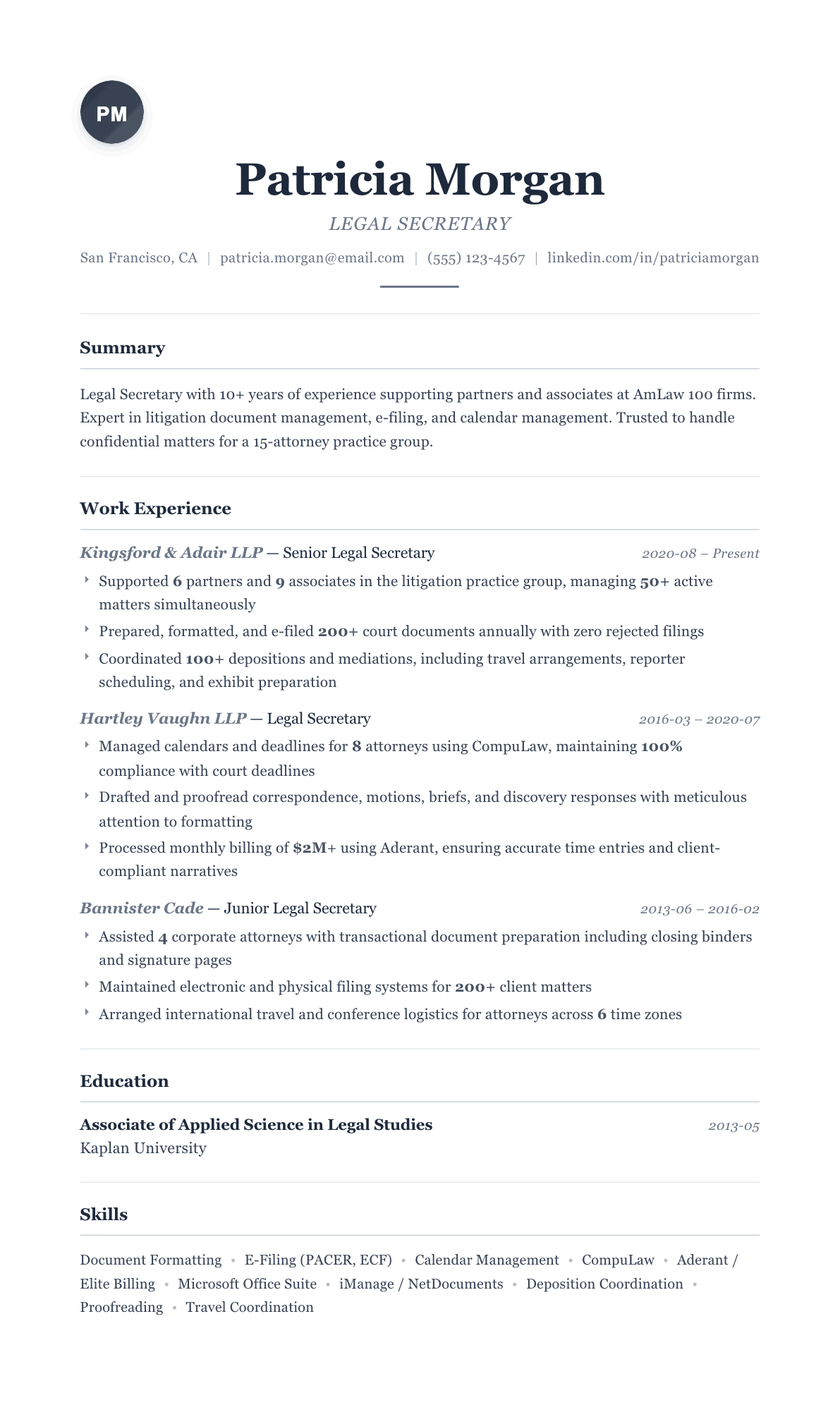
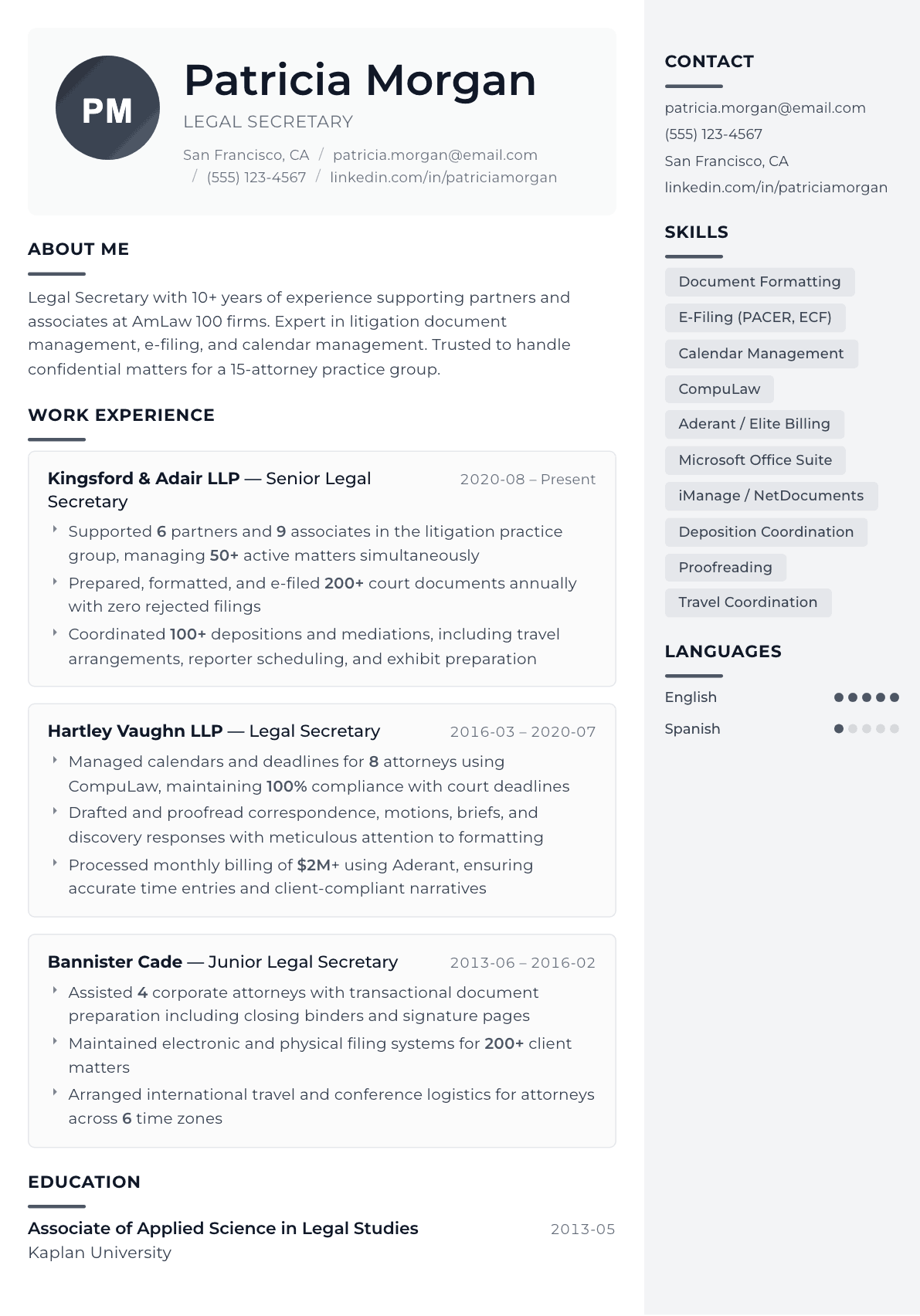
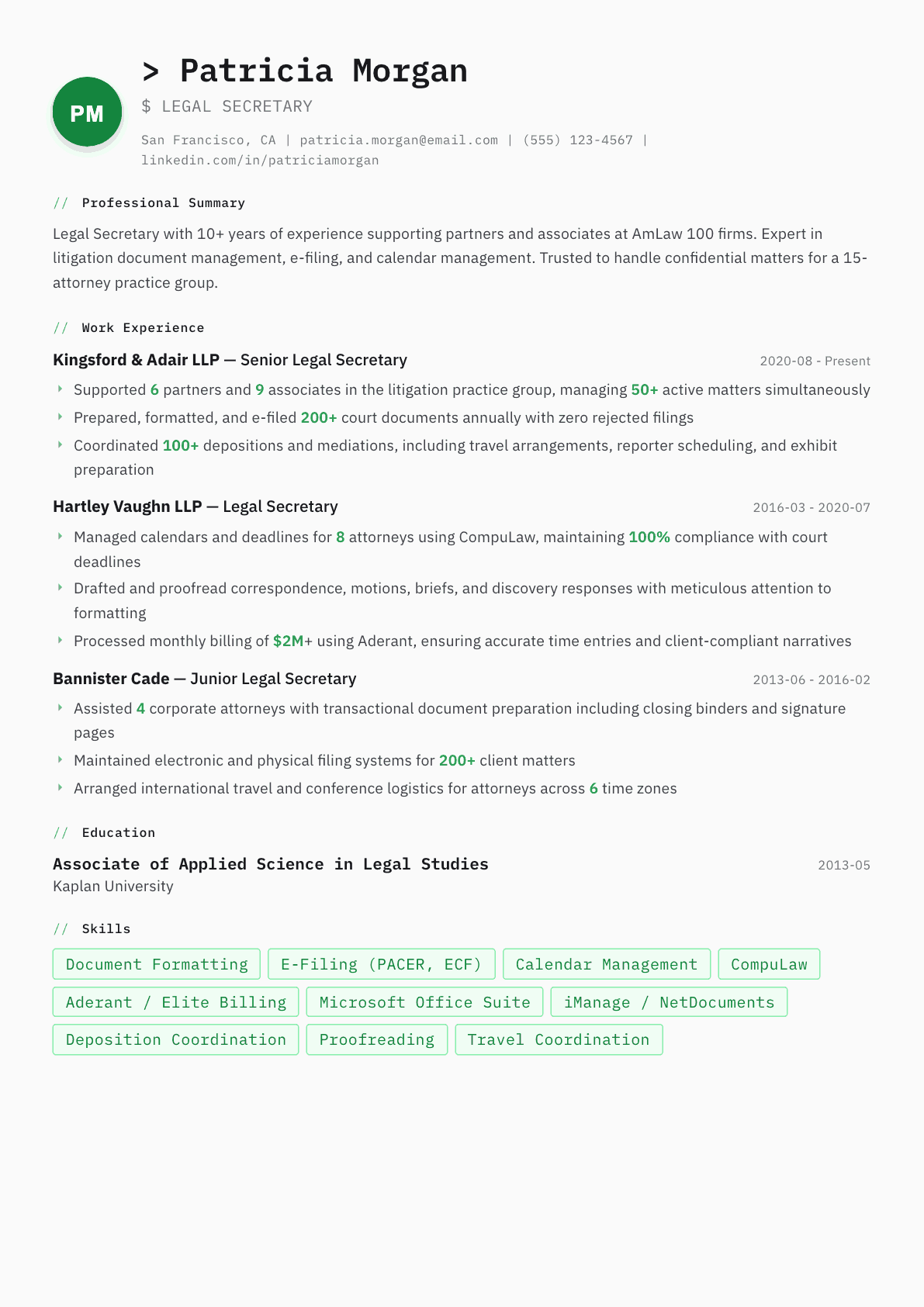
Example Legal Secretary summary
Legal Secretary with 10 years supporting litigation partners and associates at large corporate firms. Holds a 100% court deadline compliance record and zero rejected filings across 200+ submissions a year. Works daily in CompuLaw, iManage, and Aderant, and coordinates depositions, travel, and exhibits.
Skills to list on a Legal Secretary resume
- Document Formatting
- E-Filing (PACER, ECF)
- Calendar Management
- CompuLaw
- Aderant / Elite Billing
- Microsoft Office Suite
- iManage / NetDocuments
- Deposition Coordination
- Proofreading
- Travel Coordination
- Dictation / Transcription
- Client Communication
- Confidentiality
- Multi-Attorney Support
What actually gets this resume read
- Highlight the firm names, practice areas, and attorney counts you have supported -- context matters in legal.
- Mention e-filing systems you know: PACER, ECF, state-specific systems.
- Include billing and document management software: Aderant, Elite, iManage, NetDocuments, Worldox.
- Quantify: filings per year, active matters managed, billing amounts processed, deadline compliance rate.
- Show your attention to detail: zero-error filings, formatting precision, proofreading accuracy.
How to write a legal secretary resume
The legal secretary role survives at law firms because attorneys cannot bill while formatting a table of authorities, chasing a conformed copy or fixing a signature block at eleven at night. The person hiring you is a legal support manager who knows exactly how much time a good secretary returns to a timekeeper, and she reads your resume looking for whether you can already produce firm-standard documents in the systems the firm runs.
That makes this one of the few roles where naming software versions, document styles and filing systems is more persuasive than any adjective. A resume that says proficient in Microsoft Office loses to one that says it builds tables of authorities, cleans metadata before a document leaves the firm and applies the firm numbering scheme without being asked.
This guide covers the layout legal support managers expect, how to describe the attorneys and practice areas you have supported, three career-stage summaries, and the rewrites that turn generic office duties into recognizable law firm production work.
Format: the resume is a writing sample for document production
Your resume is the first document you will produce for this firm, and it will be judged as one. Consistent spacing, aligned dates, one font family, no orphaned lines, no stray tab stops. A legal support manager notices formatting drift because it is exactly what she is hiring you to prevent.
One page for under ten years, two only if you have long tenure across several practice groups. Reverse-chronological, single column. Put a systems line near the top, because the software match is the fastest reason to call you in.
- Header: name, city and state, phone, email, and typing speed only if it is genuinely high and tested.
- Section order: summary, systems and software, experience, education and certifications, additional skills.
- If you have supported a specific practice area for years, name it in the header line under your name.
Summary: who you supported, in what practice, at what scale
Say the practice area, the number of timekeepers you supported and the firm environment. Supporting two partners and three associates in a litigation group is different from a floating pool assignment covering a whole floor, and both are legitimate, but a manager staffing a specific desk needs to know which you have done.
Then name the production work you own: pleadings and discovery in litigation, closing documents and entity records in corporate, leases and title documents in real estate, or wills, trusts and probate filings in estates. Close with the systems, not with an adjective about professionalism.
Experience: document production, filing and calendar ownership
Lead each position with the frame, then bullets on production. Preparing pleadings and discovery in firm format, converting and cleaning documents between formats, building tables of contents and tables of authorities, redlining and comparing drafts, cleaning metadata before external delivery, and assembling signature packages.
Electronic filing deserves its own bullets. Say which court systems you have filed in, whether you handle federal filings and state or county portals, and what happens after: confirming acceptance, saving the conformed copy to the document management system, and calendaring the deadlines the filing triggers.
Then the calendar and travel side, which is where a secretary saves an attorney the most hours: managing court dates and internal deadlines, arranging depositions with court reporters and conference rooms, booking travel, processing expense reports, and handling client and opposing counsel calls with the right level of discretion.
Billing: the part most candidates undersell
Time and billing work is revenue work, and secretaries who do it well are hard to replace. Say that you enter and proof time for named timekeepers, prepare monthly prebills, apply outside counsel guidelines on task and activity codes, chase narrative corrections before invoices go out, and follow up on aged receivables when the firm asks.
If you have worked with electronic invoicing systems that clients require, name them. A candidate who has already handled rejected invoices and guideline disputes removes a recurring headache from a billing partner.
Systems and the keywords the screener matches
Name every relevant platform: the word processing and document comparison tools, the document management system, the docketing and calendaring software, the time and billing platform, the case management system and the electronic filing portals. Add the firm-specific habits that only legal secretaries have, such as running a document comparison before circulating a draft and maintaining the pleading index.
Mirror the posting language once in the summary and once in the bullets: document preparation, e-filing, calendaring, transcription, correspondence, travel coordination, expense reporting, timekeeping and client service. Screening tools match strings, and firms write their postings from a standard template.
Legal Secretary resume summary examples
New to law firms
Administrative professional moving into legal support after three years in a corporate office, with a legal terminology and document preparation course completed and a notary commission. Fast and accurate document formatting, comfortable with document management systems, and seeking a litigation secretary role.
Six years in
Litigation secretary supporting two partners and three associates, preparing pleadings and discovery in firm format, e-filing in federal and state courts, and calendaring deadlines for roughly 70 active matters. Builds tables of authorities, runs document comparisons and prepares monthly prebills for review.
Senior legal secretary
Senior legal secretary with fourteen years across litigation and corporate practice, supporting a five-timekeeper group and mentoring new support staff. Owns closing document assembly, outside counsel billing guideline compliance and the practice group filing calendar, and trains the group on the document management system.
Work experience bullets: before and after
Before: Typed and formatted legal documents for attorneys.
After: Produced pleadings, discovery responses and briefs in firm format, building tables of contents and authorities, applying the firm numbering scheme and running comparisons before each draft circulated.
Naming the document types and the formatting mechanics proves law firm production skill rather than typing speed.
Before: Filed court documents electronically.
After: E-filed in federal courts and three county portals, confirming acceptance, saving conformed copies to the document management system and calendaring every deadline the filing triggered.
Showing the whole loop after the upload is what separates a filer from someone who once clicked submit.
Before: Managed attorney calendars and appointments.
After: Maintained litigation calendars for 70 matters, scheduled depositions with court reporters and conference rooms, and reconciled deadlines with the docketing department each week.
Volume, the vendor coordination and the reconciliation habit turn a scheduling claim into a verifiable process.
Before: Handled billing and expenses.
After: Entered and proofed time for five timekeepers, prepared monthly prebills, applied client billing guidelines on task codes and resolved rejected electronic invoices with the billing department.
Guideline and rejected-invoice work is revenue recovery, and few candidates think to put it on the page.
Before: Answered phones and greeted clients.
After: Served as first point of contact for clients, opposing counsel and court staff, screening calls, taking accurate messages on active matters and protecting confidential information in a shared reception area.
The named callers and the confidentiality detail show professional judgment instead of front desk coverage.
Hard skills
- Pleading and discovery document preparation
- Table of authorities and table of contents generation
- Document comparison and redlining
- Metadata cleaning before external delivery
- Federal and state court e-filing
- Docketing and deadline calendaring
- Document management systems
- Time entry and prebill preparation
- Outside counsel billing guideline compliance
- Travel and deposition scheduling
- Transcription and correspondence
- Closing binder and signature package assembly
Soft skills
- Discretion
- Anticipating attorney needs
- Composure at deadline
- Precise proofreading
- Professional phone manner
- Working across several timekeepers
Certifications worth listing
- Accredited Legal Professional (ALP) (NALS, the Association for Legal Professionals)
- Professional Legal Secretary (PLS) / Certified Legal Professional (NALS, the Association for Legal Professionals)
- Certified Paralegal (CP) (NALA, the Paralegal Association)
- Notary Public commission (State commissioning authorities)
Mistakes that cost legal secretary candidates the interview
- Sending a resume with inconsistent spacing or misaligned dates, when document production is the entire job you are applying for.
- Writing proficient in office software instead of naming the document management, docketing and billing platforms the firm actually runs.
- Omitting the practice area, so a litigation manager cannot tell whether you have ever formatted a pleading caption.
- Leaving out billing work, which is the most valuable and least advertised part of the role.
- Describing calls and calendars without the number of timekeepers or matters, so nobody can judge your capacity.
- Listing a typing speed and nothing else technical, which dates the resume and leaves the systems question unanswered.
Legal Secretary resume questions
Is the legal secretary role different from a legal assistant?
At most firms yes. A legal secretary owns document production, filing, calendars and billing for named timekeepers, while a legal assistant may do more substantive case work. Read the posting duties and mirror its language rather than assuming the titles match.
Should I put my typing speed on a legal secretary resume?
Only if it is genuinely high and you have been tested. It is a minor signal now. Document comparison, tables of authorities, metadata cleaning and e-filing experience carry far more weight with a legal support manager.
How do I show experience with a practice area I have not worked in?
Do not claim it. Instead show that your production skills transfer: formatting to a house standard, deadline calendaring, filing portals and billing guidelines work the same way across practices, and say plainly that you learn a new document set quickly.
Do law firms still use applicant tracking software for support roles?
Larger firms do, and they configure it around exact software names and terms like e-filing, docketing and prebill. Use the same words the posting uses, keep the layout single column, and avoid tables that scramble when parsed.
How many attorneys should I say I can support?
Say what you have actually supported and describe how you triaged competing requests. A manager staffing a desk cares more about how you handled two partners with the same deadline than about the highest number you can claim.