Logistics Intern Resume Examples: the lines they read
Build a Logistics Intern Resume With No Full-Time Experience Yet
By Mustafa Tarabya, founder of CVBooster · Published · Updated
Logistics intern resume example with coursework, Excel and warehouse project keywords, plus a writing guide for students applying to supply chain internships.
Sample resumes for a logistics intern
The same logistics intern content laid out in three CVBooster templates, so you can see what the finished document looks like before you write a word.
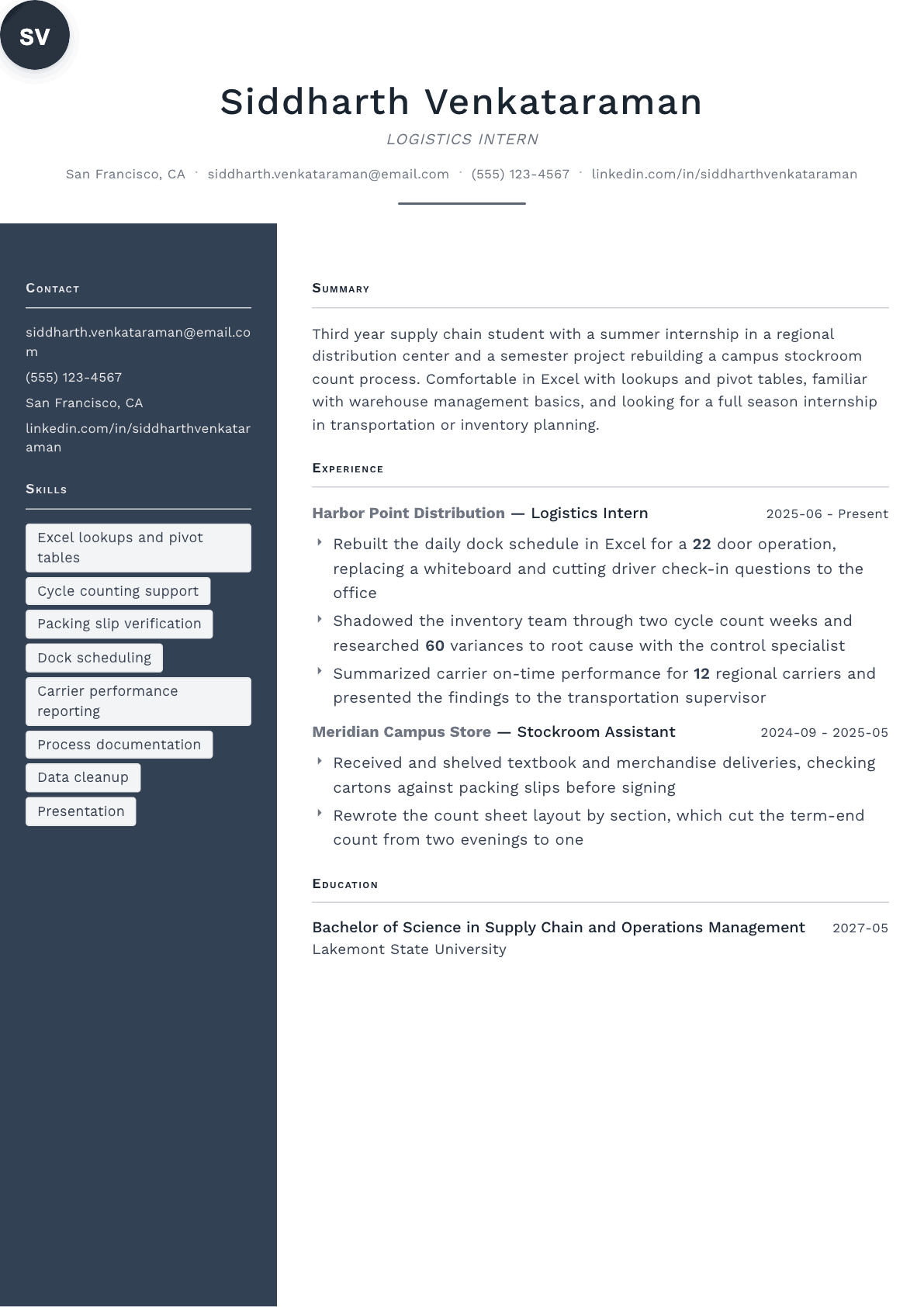
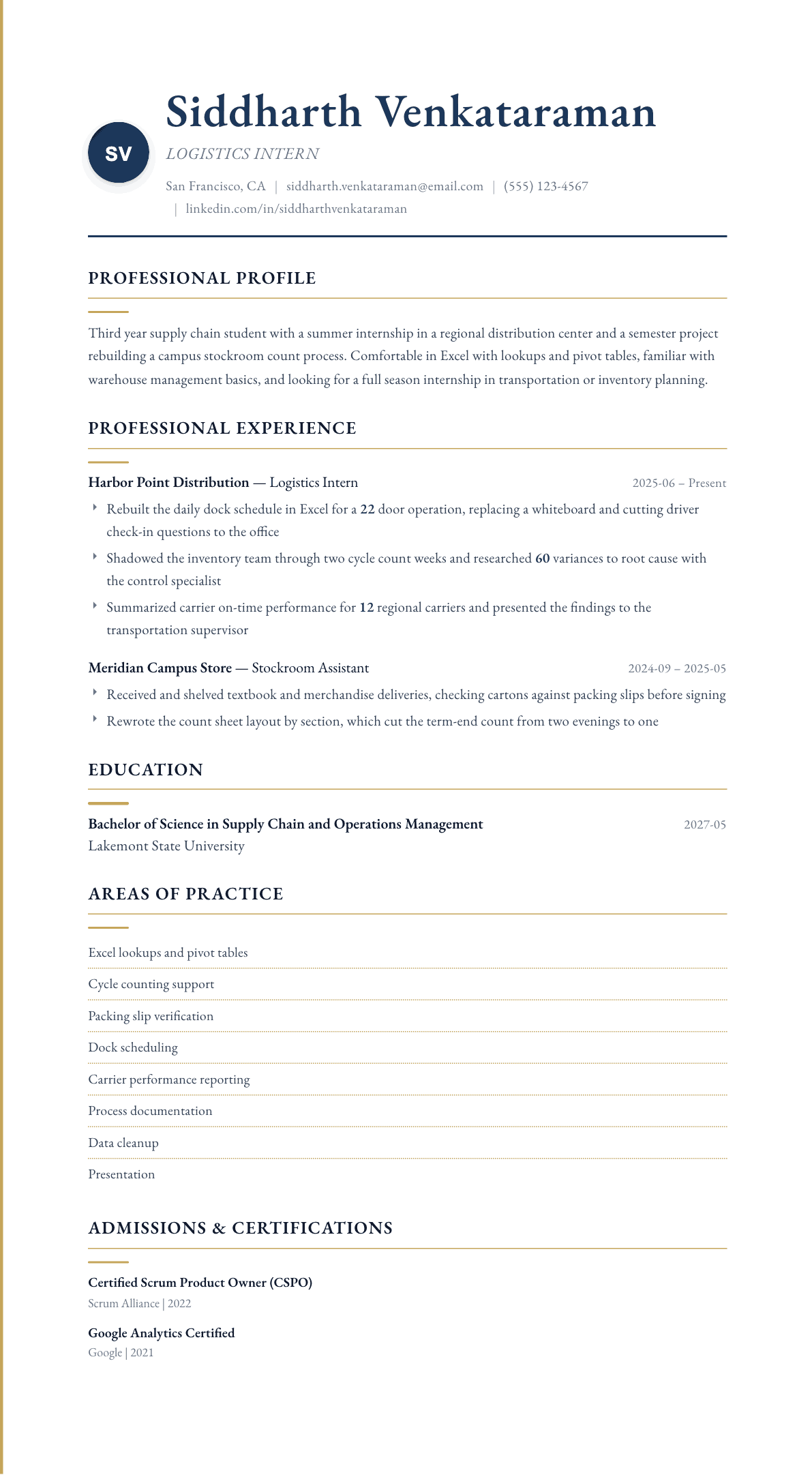
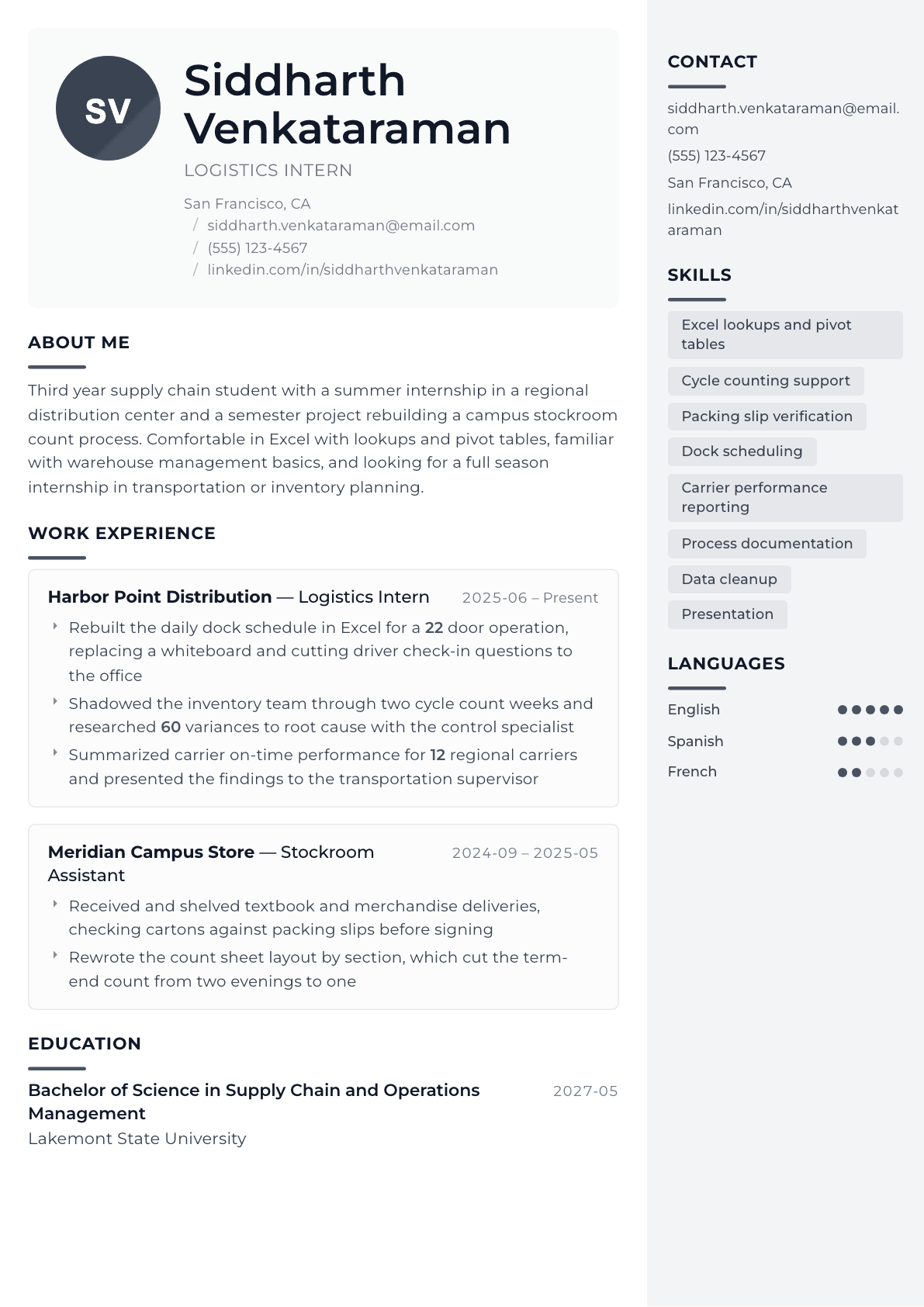
Example Logistics Intern summary
Supply chain student in a third year program with a distribution center internship and stockroom experience. Rebuilt a dock schedule in Excel for a twenty two door operation, researched cycle count variances with the inventory team, and reported carrier on-time performance to a transportation supervisor. Strong with lookups and pivot tables. Seeking a summer logistics internship in transportation or inventory planning.
Skills to list on a Logistics Intern resume
- Excel lookups and pivot tables
- Data cleanup
- Cycle counting support
- Receiving verification
- Inventory reporting
- Dock scheduling
- Carrier performance reporting
- Process documentation
- Warehouse safety basics
- ERP navigation
- PowerPoint reporting
- Time management
What actually gets this resume read
- Put education first and include coursework that maps to the internship, such as transportation, procurement or operations analysis.
- Treat class projects as real experience when you name the data, the tool and the recommendation you made.
- Show Excel depth with the functions you actually use, because a supply chain team screens for spreadsheet ability first.
- Convert retail or campus jobs into logistics language: receiving, counting, stock rotation, and shrink control.
- Say what you want to learn in the summary, since an internship posting is looking for direction rather than deep expertise.
- Keep it to one page, list clubs such as a student supply chain association, and include any warehouse or safety training.
How to write a logistics intern resume
A logistics intern resume is read by a supply chain manager who knows you have not done the job yet. He is not comparing you against professionals. He is comparing you against thirty other students with similar coursework, and he is looking for three signals: that you can work a spreadsheet without hand holding, that you are comfortable in a building where forklifts are moving, and that you finish what you start.
The mistake almost every student makes is apologizing for a thin history. The retail job, the campus stockroom, the class project and the club role are real evidence if they are written in operations language. Counting stock, checking deliveries against a packing slip, and rebuilding a schedule are the same activities the internship will ask for, only smaller.
This guide covers what to put first when you have no professional title yet, how to write a class project so it survives an interview question, three summaries for different points in a degree, before and after bullets drawn from real student resumes, and the questions students ask before a supply chain internship application.
Format: one page, education first, no objective statement
One page, single column, reverse chronological within each section. Education goes above experience until you graduate, because your program, expected graduation date and relevant coursework are the first things a supply chain manager checks against the internship requirements.
Replace the old style objective with a short summary that says where you are in your degree, what you have already done, and what kind of work you want. An objective describes what you want from the employer. A summary describes what he gets, which is the only version that helps you.
- Header: name, city and state, phone, school email, and a link to a professional profile.
- Education: school, degree, field, expected graduation month and year, relevant coursework.
- Then: experience, projects, skills, activities and any training or certifications.
Summary: year in program, what you have touched, what you want
Three lines. Where you are in the degree, the most operationally relevant thing you have done, and the area you are aiming at. A student who writes motivated student seeking to gain experience in a challenging environment has written the least distinguishing sentence available. A student who writes third year supply chain student who rebuilt a dock schedule during a summer internship and researched cycle count variances has given the reader something to ask about.
Naming a target area helps rather than narrows. Transportation, inventory planning and warehouse operations are different teams, and a manager filling an inventory seat is glad to see a student who already knows the difference.
Experience: translate the job you had into the job you want
Most students already have operations experience under a different name. Retail stock work is receiving, count accuracy and stock rotation. Restaurant work is inventory rotation, waste control and prep scheduling. A campus job in a mailroom is sorting, tracking and chain of custody. Write those in the vocabulary of the internship, without inflating what you did.
Give every bullet a number, even a small one. Cartons received per delivery, hours cut from a count, items tracked, or people trained. Small numbers are honest and they show you pay attention to measurement, which is exactly the habit a supply chain team wants in an intern.
If you have already had a logistics internship, treat it as your strongest section and expand it. Say what you rebuilt, what you shadowed, what data you touched and who you presented to. Interns who present anything to a supervisor should always say so, because it separates you from interns who only observed.
- Retail or stockroom: deliveries checked, counts run, shrink or rotation practices.
- Any job: schedules built, processes documented, training given, hours saved.
- Internship: systems touched, analyses run, and who received the output.
Projects and coursework: only the ones you can defend
A projects section is worth more than a longer coursework list. Pick two projects and write each with the question, the data, the tool and the recommendation. A transportation cost comparison, a warehouse layout redesign, a forecast accuracy exercise or a supplier evaluation all work, provided you can explain your own numbers when asked.
List coursework selectively and only when it maps to the posting. Transportation management, operations analysis, procurement, business statistics and database courses are worth naming. A full transcript on the page reads as filler and pushes the projects down where nobody reaches them.
Skills and activities: spreadsheet depth first
Excel is the tool an intern uses most, so be specific about it. Lookups, pivot tables, conditional formatting, basic charting, and any exposure to a query language or a reporting tool. Writing proficient in Microsoft Office tells a manager nothing, because every applicant writes it and half of them cannot build a pivot table.
Activities matter more here than on a professional resume. A student supply chain association, a case competition, a warehouse safety training, or a forklift certification from a summer job all show commitment to the field. Include work authorization or shift availability if the posting asks, since internship scheduling is usually tight.
Logistics Intern resume summary examples
First or second year student
Second year supply chain student with campus stockroom experience checking deliveries against packing slips and running term end counts. Rewrote the count sheet layout and cut the count from two evenings to one. Building Excel skills and seeking a first logistics internship in warehouse or inventory operations.
Third year with one internship
Third year supply chain student with a distribution center internship where I rebuilt a dock schedule for a 22 door operation and researched cycle count variances with the inventory team. Comfortable with lookups and pivot tables, and looking for a summer logistics internship in transportation.
Final year, targeting a full-time offer
Final year supply chain student with two internships covering inbound receiving and carrier performance reporting, plus a capstone modeling a two site distribution network. Presented on-time findings for twelve regional carriers to a transportation supervisor. Seeking a logistics internship that converts to a graduate analyst role.
Work experience bullets: before and after
Before: Helped out in the warehouse during my internship.
After: Shadowed the inventory team through two cycle count weeks and researched 60 variances to root cause alongside the control specialist.
Naming the activity, the duration and the count of variances converts vague help into visible work.
Before: Made a spreadsheet for the dock.
After: Rebuilt the daily dock schedule in Excel for a 22 door operation, replacing a whiteboard and cutting driver check-in questions to the office.
The scale of the dock and what the spreadsheet replaced show a real problem you removed.
Before: Did a group project about transportation.
After: Compared truckload and less than truckload cost for a class network exercise across eight lanes and recommended a consolidation point supported by the cost model.
Lane count and a defensible recommendation make a class project survive an interview question.
Before: Worked in retail and stocked shelves.
After: Received and shelved textbook and merchandise deliveries, checking every carton against the packing slip before signing the delivery receipt.
Written in receiving language, the retail job becomes directly relevant instead of unrelated.
Before: Presented my findings to my manager.
After: Summarized on-time performance for 12 regional carriers and presented the findings and two recommendations to the transportation supervisor.
The audience, the data scope and the recommendations show output rather than attendance.
Hard skills
- Excel lookups and pivot tables
- Data cleanup and reconciliation
- Cycle count support
- Receiving and packing slip verification
- Dock and appointment scheduling
- Carrier performance reporting
- Process documentation
- ERP navigation
- Inventory reporting
- Presentation building
Soft skills
- Asking questions on the floor
- Punctuality across early shifts
- Note taking and follow up
- Working with hourly teams
- Accepting correction
- Finishing an assignment unsupervised
Certifications worth listing
- Certified Supply Chain Analyst (CSCA) (International Supply Chain Education Alliance)
- Certified Logistics Associate (CLA) (Manufacturing Skill Standards Council)
- OSHA 10-Hour General Industry (OSHA Outreach Training Program)
Mistakes that cost logistics intern candidates the interview
- Opening with an objective that describes what the student wants instead of what the team gets.
- Leaving retail and campus jobs off the page because they feel unrelated, when they are the only operations evidence available.
- Writing proficient in Microsoft Office, a line that every applicant submits and no manager believes.
- Listing every course taken rather than the few that map to the internship duties.
- Describing a class project without naming the data or the recommendation, which makes it unusable in an interview.
- Stretching to two pages with activities and coursework when the reader gives a student resume one quick pass.
Logistics Intern resume questions
How do I write a logistics intern resume with no work experience at all?
Put education first, then a projects section with two class exercises written as real analyses, then any paid work translated into operations language. Volunteer roles, campus jobs and club leadership all count when you describe the task, the number and the result.
Should I include my grade point average?
Include it if it is strong or if the posting asks, and leave it off otherwise without explanation. A missing grade rarely blocks an interview at internship level, while a weak one printed on the page invites the question before you can answer it in person.
Do supply chain internships expect me to know a specific system already?
Rarely. Excel is the real expectation, and any exposure to an enterprise system is a bonus rather than a requirement. Name what you have touched honestly, and say you are learning the rest, because interns are hired for trajectory instead of tooling.
Is a warehouse job worth putting on a logistics internship resume?
Very much so. Time on a floor tells a supply chain manager you understand what the data describes and that you will not be surprised by the pace or the noise. Include equipment training and any safety certification you earned there.
How do I turn an internship into a full time offer through my resume?
Write the internship as owned work rather than observation: what you rebuilt, what you measured, who received it. Then keep the file updated the week you finish, while the numbers are still fresh and your supervisor can still confirm them.
Related resume examples
- Warehouse Worker Resume example
- Logistics Coordinator Resume example
- Supply Chain Coordinator Resume example
- Inventory Analyst Resume example
- Logistics Specialist Resume example
- Distribution Manager Resume example