Distribution Manager Resume Examples: what gets the call
Write a Distribution Manager Resume That Shows Network Control
By Mustafa Tarabya, founder of CVBooster · Published · Updated
Distribution manager resume examples covering throughput, cost per unit and carrier performance, with ATS keywords and a section-by-section guide.
Sample resumes for a distribution manager
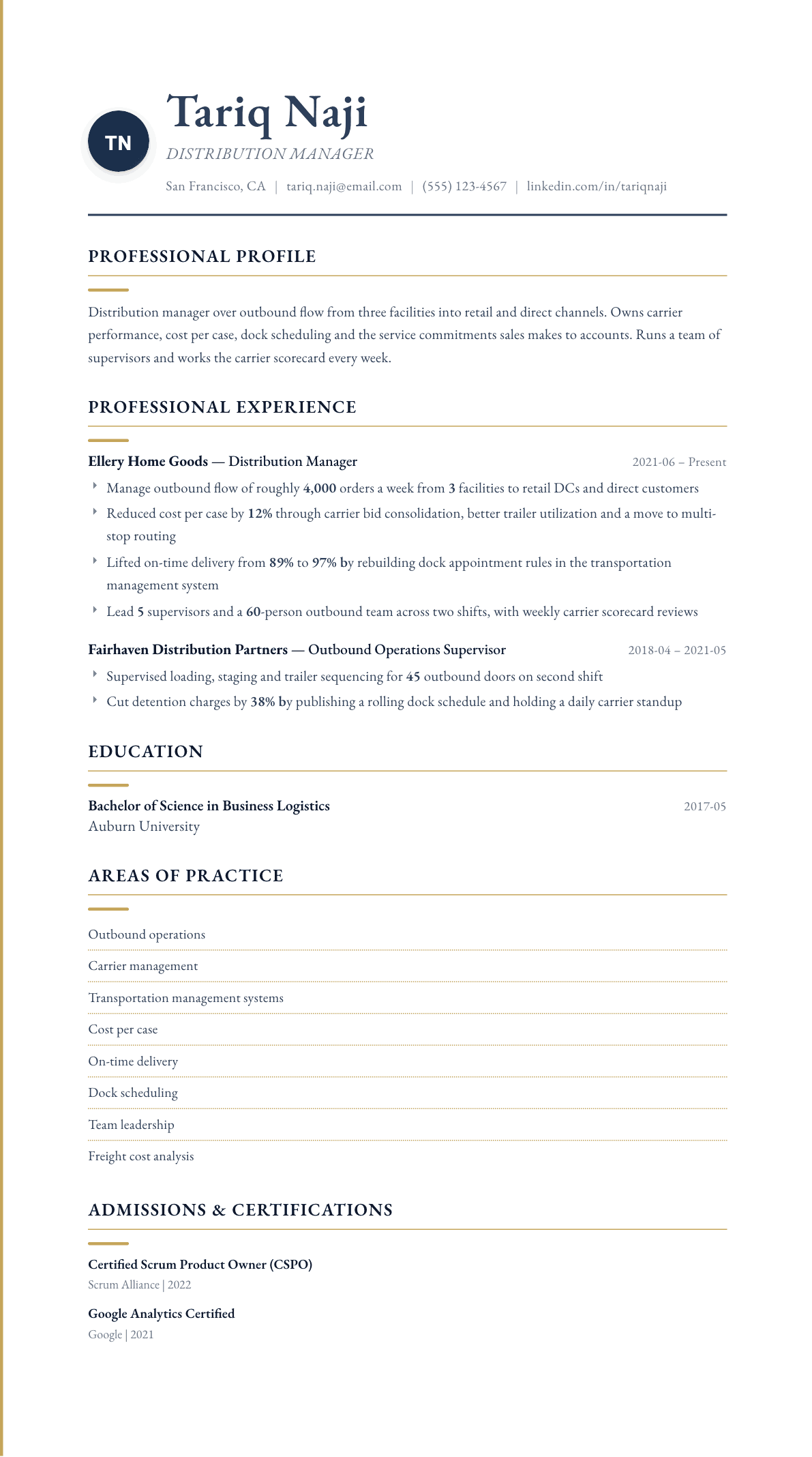
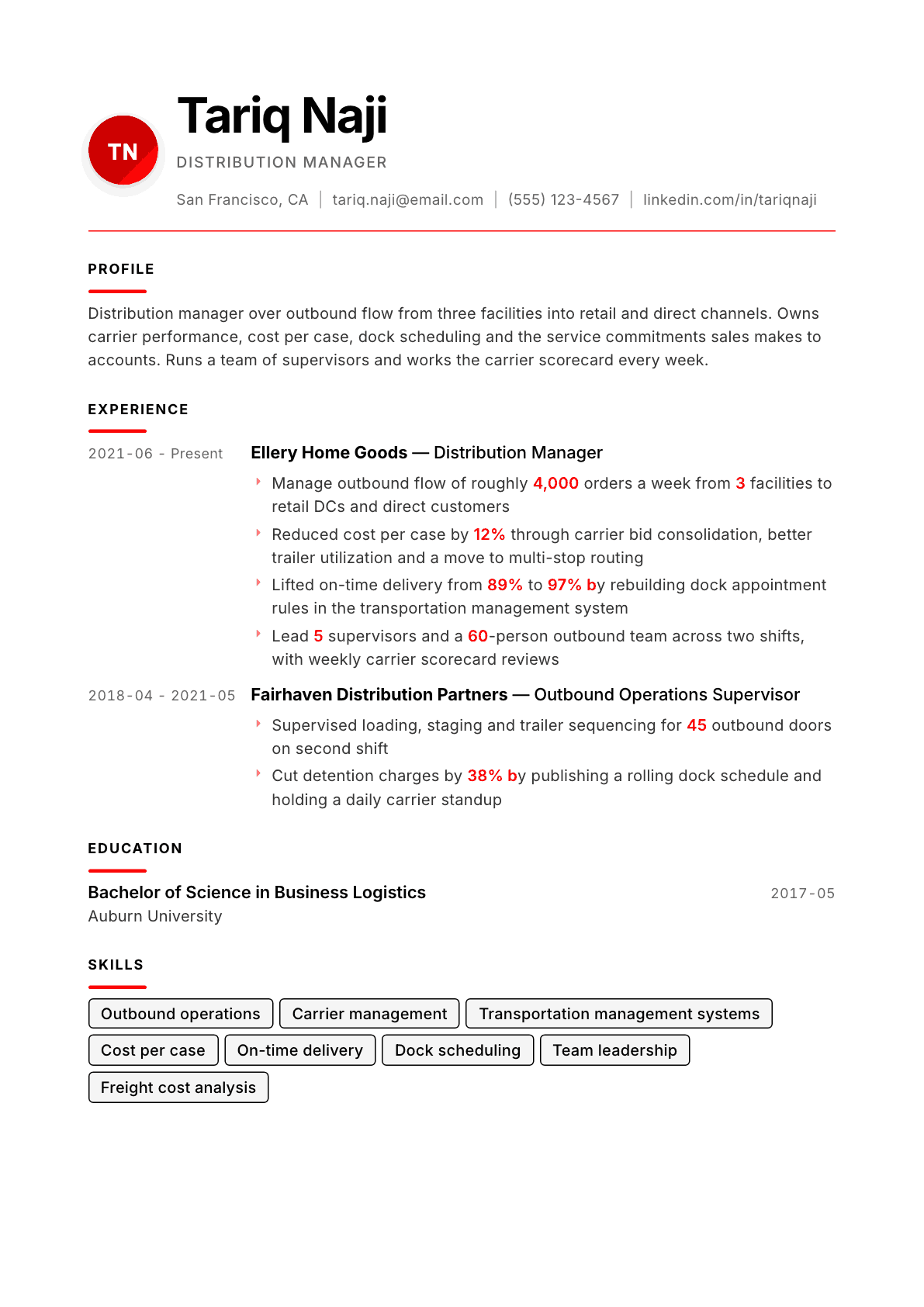
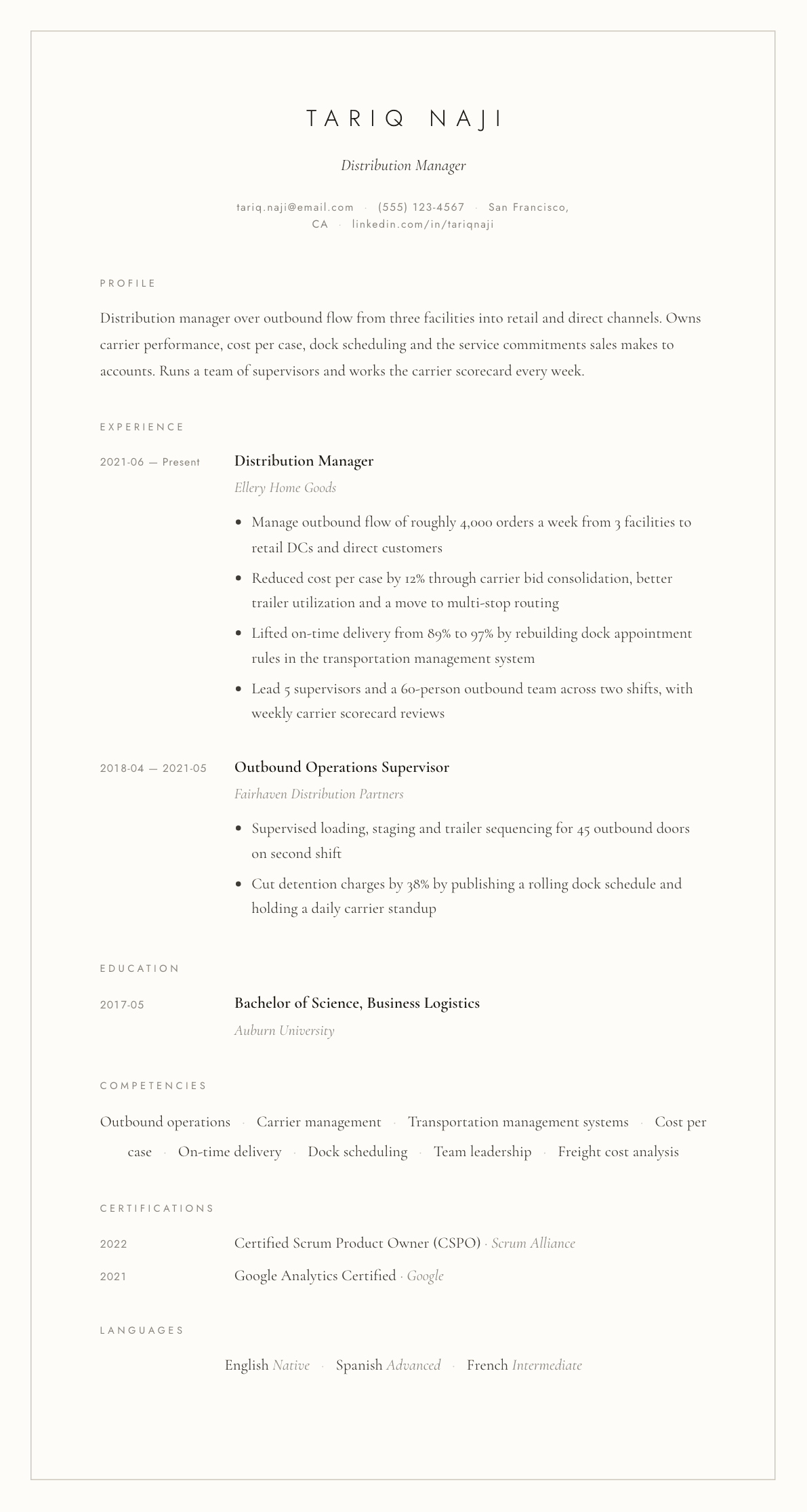
The same distribution manager content laid out in three CVBooster templates, so you can see what the finished document looks like before you write a word.
Example Distribution Manager summary
Distribution manager with seven years running outbound operations across multiple facilities into retail and direct channels. Cut cost per case by double digits through carrier consolidation and better trailer utilization while lifting on-time delivery eight points. Leads supervisors across two shifts and holds carriers to a weekly scorecard. Seeking a regional distribution leadership role with network design exposure.
Skills to list on a Distribution Manager resume
- Outbound distribution
- Carrier sourcing and management
- Transportation management systems
- Warehouse management systems
- Cost per case analysis
- On-time delivery performance
- Dock scheduling
- Trailer utilization
- Freight cost control
- Route optimization
- Team leadership
- Safety compliance
- Continuous improvement
- Peak season planning
What actually gets this resume read
- Quantify flow at the top: orders, cases or pallets moved per week and the number of facilities you covered.
- Give a cost metric and a service metric together, because distribution leaders are judged on both at once.
- Name the transportation and warehouse systems you used, since Manhattan, Blue Yonder and Oracle appear in postings.
- Show carrier management specifically: bids, scorecards, detention, accessorial charges and contract compliance.
- State headcount and shift structure, because a manager running two shifts is a different hire than one running days.
- Include a bullet on a peak season or a network change, which is where distribution interviews spend most time.
How to write a distribution manager resume
A distribution manager sits where freight cost meets customer promise, and the resume has to prove you can hold both at once. The operations director reading your file is checking a simple pattern: did outbound cost per unit go down while on-time delivery went up, and can you explain the mechanism that made both move. Anyone can cut freight spend by degrading service, and every reader of this resume has watched someone try.
The second thing they check is whether you have actually managed carriers rather than merely booked them. Carrier bids, scorecards, detention and accessorial charges, tender acceptance and contract compliance are the real substance of the role. A resume that describes coordinating with carriers but never mentions a bid or a scorecard reads as a coordinator title with a manager label.
This guide sets out the layout an operations reader expects, how to present cost and service together, three summaries from a first supervisor step to a regional leader, before-and-after bullets, and the questions distribution managers ask when they rewrite for a bigger network.
Format: one to two pages with flow figures in every role
One page under five years of management, two after that. Reverse chronological, plain text, no columns. Open every role with a flow line: orders, cases or pallets moved per week, the number of facilities, the destination mix and the headcount reporting to you. Distribution is a volume business, and a reader who cannot find the volume will not read the bullets.
Put a systems line under the summary listing the transportation and warehouse management systems, the ERP and the reporting tool. Those product names are the first filter on nearly every posting in this field.
- Header: name, city and state, phone, email, and the channel mix such as retail distribution, wholesale or direct to consumer.
- Section order: summary, systems, professional experience, education, certifications.
- Add a short line on the regulatory environment if you handled hazardous materials, food safety or controlled goods.
Summary: network, volume, cost and service in three lines
Say what flows through your network, from how many sites, to which kinds of customers, and give one cost measure and one service measure. Cost per case, cost per order or freight cost as a share of revenue on one side, on-time delivery or on-time in-full on the other. A summary carrying both immediately separates you from the majority of files that carry neither.
Name the destination mix explicitly. Delivering into retail distribution centers with strict appointment windows and chargeback programs is a very different job from residential delivery or wholesale pickup, and employers screen hard on that difference.
Experience: carriers, cost structure and the peak
Give carrier management its own bullets. A bid you ran and how many lanes changed hands, a scorecard cadence and what happened to carriers who missed, detention and accessorial charges you drove down, tender acceptance you improved through better forecasting to carriers. These are the levers of the job and they are absent from most resumes in this category.
Then show structural cost work. Consolidating less than truckload freight into multi-stop truckloads, changing a mode, shifting a customer to a pool point, improving trailer cube utilization, or moving to a dedicated fleet for a repeatable lane. Each of those is a design decision, and each has a number attached that a finance partner will recognize.
Devote at least one bullet to peak. Retail and consumer businesses live or die in their busiest weeks, and how you staffed, secured capacity and protected service through a peak season is the single most predictive story an interviewer can hear. Describe the plan, not just the outcome.
- Report on-time delivery against the customer measurement, not your internal one, if the two differed.
- Name chargeback or compliance programs you managed, since retail penalties are a live cost line.
- State the team structure: supervisors, shifts, and whether you managed third-party labor as well as employees.
Systems, safety and credentials
Name the transportation management system by product, whether that is Manhattan Associates, Blue Yonder, Oracle Transportation Management, MercuryGate or e2open, and pair it with the warehouse system and the ERP. Say what you configured rather than only used, particularly around appointment rules, routing guides and rate tables.
Safety belongs on this resume because outbound operations involve dock work, powered equipment and driver interaction. Name the compliance framework you worked under, and if you managed a private or dedicated fleet, say whether you touched hours of service and driver qualification files. Recognized credentials include the CLTD from the Association for Supply Chain Management and the certified transportation professional designation from the National Private Truck Council.
Keywords in distribution postings
Outbound operations, carrier management, transportation management system, on-time delivery, cost per case, freight cost control, less than truckload consolidation, dock scheduling, trailer utilization, route optimization, load planning, accessorial charges, chargeback management and peak season planning. Mirror the ones that apply and prove them in the bullets underneath.
Distribution Manager resume summary examples
Outbound supervisor
Outbound operations supervisor with three years running loading, staging and trailer sequencing across 45 dock doors on second shift. Cut detention charges by 38% by publishing a rolling dock schedule and holding a daily carrier standup, and led a crew of 24 associates through two peak seasons without a service failure.
Site distribution manager
Distribution manager over outbound flow of roughly 4,000 orders a week from three facilities into retail distribution centers and direct customers. Reduced cost per case by 12% through carrier bid consolidation and multi-stop routing while lifting on-time delivery from 89% to 97%, leading five supervisors across two shifts.
Regional leader
Regional distribution manager covering eight states, three facilities and a mixed carrier and dedicated fleet model. Owns carrier strategy, routing guide design and the outbound cost line, and led a network change that moved two customer groups to pool distribution without a single missed delivery window during transition.
Work experience bullets: before and after
Before: Managed outbound distribution operations for the company.
After: Managed outbound flow of roughly 4,000 orders a week from 3 facilities into retail distribution centers and direct customers, with 5 supervisors and a 60-person team across two shifts.
Volume, facility count, destination mix and team structure let a reader size the operation in a single line.
Before: Reduced freight costs through carrier negotiations.
After: Cut cost per case by 12% by consolidating a 40-lane carrier bid, moving 18 lanes to multi-stop truckload and raising average trailer cube utilization from 68% to 81%.
Lane counts and a utilization figure show the structural change behind the saving rather than a negotiation claim.
Before: Improved delivery performance to customers.
After: Lifted on-time delivery from 89% to 97% against customer measurement by rebuilding dock appointment rules in the transportation management system and tightening the tender lead time to carriers.
Naming the customer measurement and two specific mechanisms makes the improvement defensible in an interview.
Before: Worked with carriers to resolve service issues.
After: Ran a weekly carrier scorecard on tender acceptance, on-time pickup and claims, moving 4 underperforming carriers off primary lanes at the following bid.
A cadence, named criteria and a consequence turn issue resolution into managed carrier performance.
Before: Handled increased volume during the holiday season.
After: Planned peak season capacity 14 weeks ahead by securing committed trailer pools, adding a weekend outbound shift and pre-building 30% of forecast volume, holding service flat through the busiest six weeks.
A lead time, three named actions and a service outcome describe a plan rather than survival of a busy period.
Hard skills
- Outbound distribution operations
- Carrier sourcing and bid management
- Transportation management systems
- Warehouse management systems
- Freight cost analysis
- Load planning and consolidation
- Dock scheduling and appointment rules
- Trailer utilization improvement
- On-time delivery measurement
- Retail compliance and chargebacks
- Peak season capacity planning
- Safety and regulatory compliance
Soft skills
- Supervisor coaching
- Carrier relationship management
- Decisiveness during disruption
- Customer communication
- Cost discipline
- Cross-shift consistency
Certifications worth listing
- Certified in Logistics, Transportation and Distribution (CLTD) (Association for Supply Chain Management)
- Certified Transportation Professional (CTP) (National Private Truck Council)
- SCPro Certification (Council of Supply Chain Management Professionals)
- Certified Six Sigma Green Belt (CSSGB) (American Society for Quality)
Mistakes that cost distribution manager candidates the interview
- Presenting a freight saving with no service figure beside it, which reads to any operations reader as a trade someone else had to absorb.
- Describing carrier work as coordination instead of naming bids, scorecards, tender acceptance and accessorial recovery.
- Leaving out weekly volume, so the reader cannot tell whether the operation moved a few hundred orders or several thousand.
- Ignoring retail compliance and chargebacks even though those penalties are often the most visible cost line to the customer team.
- Skipping peak season entirely, when it is the period that decides whether a distribution manager is trusted with a bigger network.
- Naming a transportation system without saying what you configured, which leaves the reader assuming you only ran reports from it.
Distribution Manager resume questions
What is the difference between a distribution manager and a logistics manager?
Distribution usually means outbound flow to customers, including carriers, dock scheduling and delivery performance. Logistics is often broader and includes inbound freight and international movement. Titles vary between employers, so define your scope in the summary rather than relying on the label.
Should I include freight spend on my resume?
Describe it structurally rather than as a headline currency figure: the modes you managed, the number of carriers and lanes, and whether the spend covered inbound as well as outbound. That sizes the role without inviting comparison against a company in a different revenue band.
How do I show carrier management if I used a third-party logistics provider?
Manage the provider the same way and describe it that way. Governance meetings, service level agreements, cost per unit targets, root cause reviews on missed deliveries and annual rate reviews are genuine carrier management, and employers with outsourced networks screen specifically for that experience.
Does a CLTD certification help for distribution roles?
It helps where the employer values formal grounding in transportation and warehousing, particularly if your background is operational rather than academic. It rarely wins the job on its own, so keep it in the education area and let the network results carry the file.
How do I move from a single site to a regional distribution role?
Show breadth before you have the title. Any work spanning sites counts: a carrier bid covering multiple facilities, a routing guide you standardized, a peak plan you coordinated across locations, or supervisors you developed who later ran their own operation.
Related resume examples
- Logistics Manager Resume example
- Operations Manager Resume example
- Distribution Center Manager Resume example
- Transportation Manager Resume example
- Logistics Intern Resume example
- Logistics Analyst Resume example