Shipping and Receiving Clerk Resume Examples: free score
Build a Dock Clerk Resume That Shows Paperwork Control
By Mustafa Tarabya, founder of CVBooster · Published · Updated
Resume example for a dock clerk handling inbound and outbound freight, with document keywords, system skills to list, and a guide to each section.
Sample resumes for a shipping and receiving clerk
The same shipping and receiving clerk content laid out in three CVBooster templates, so you can see what the finished document looks like before you write a word.
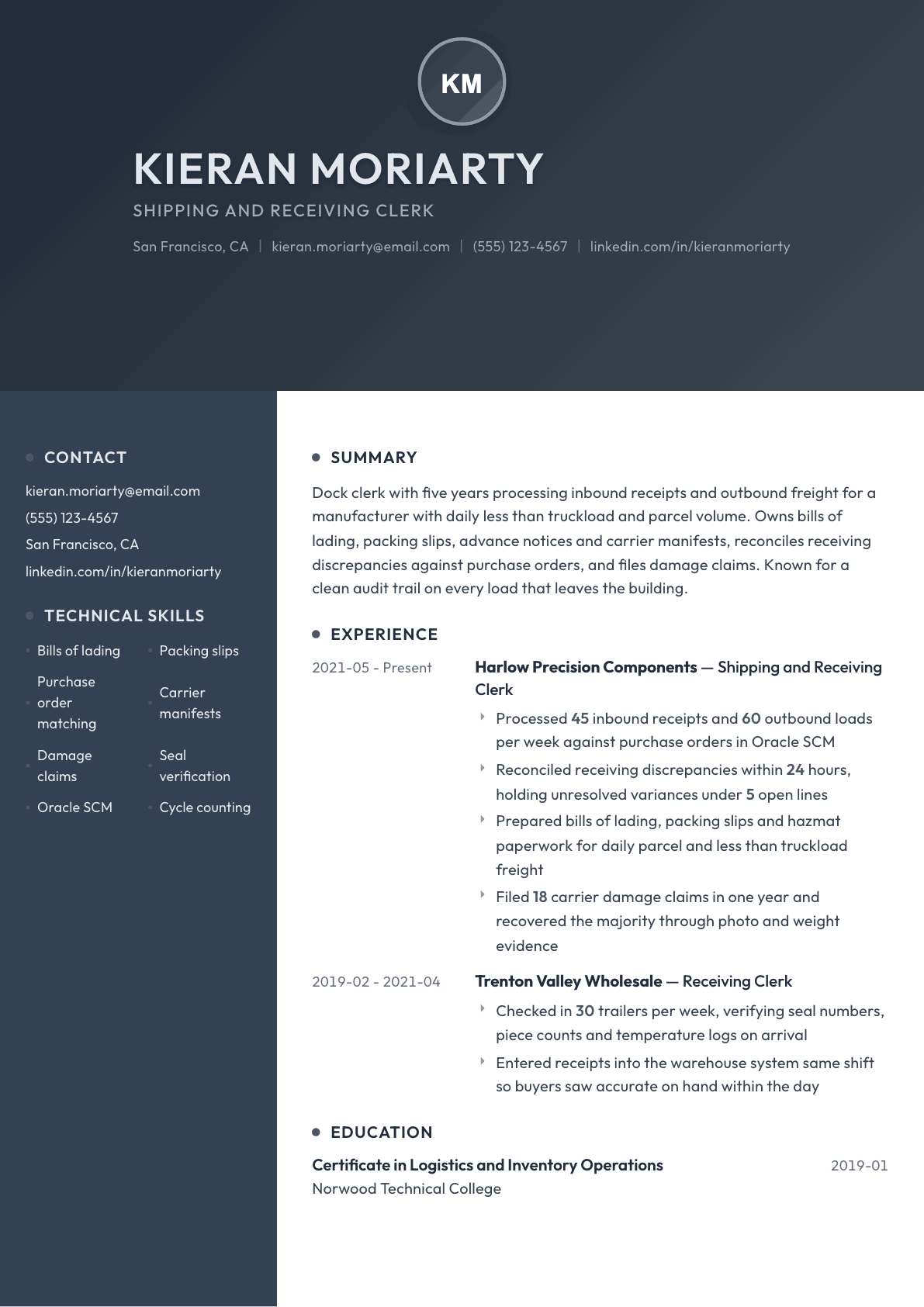
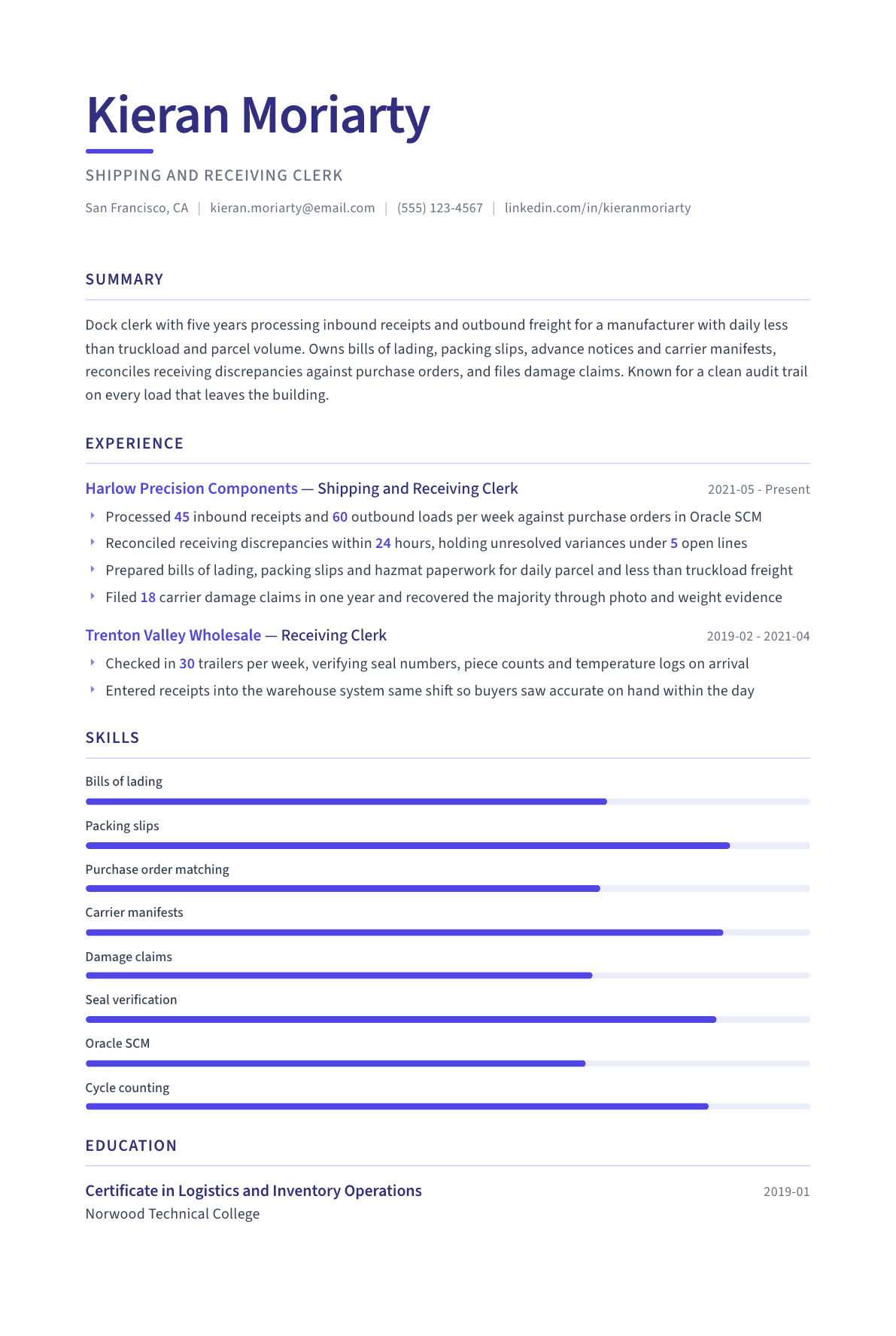
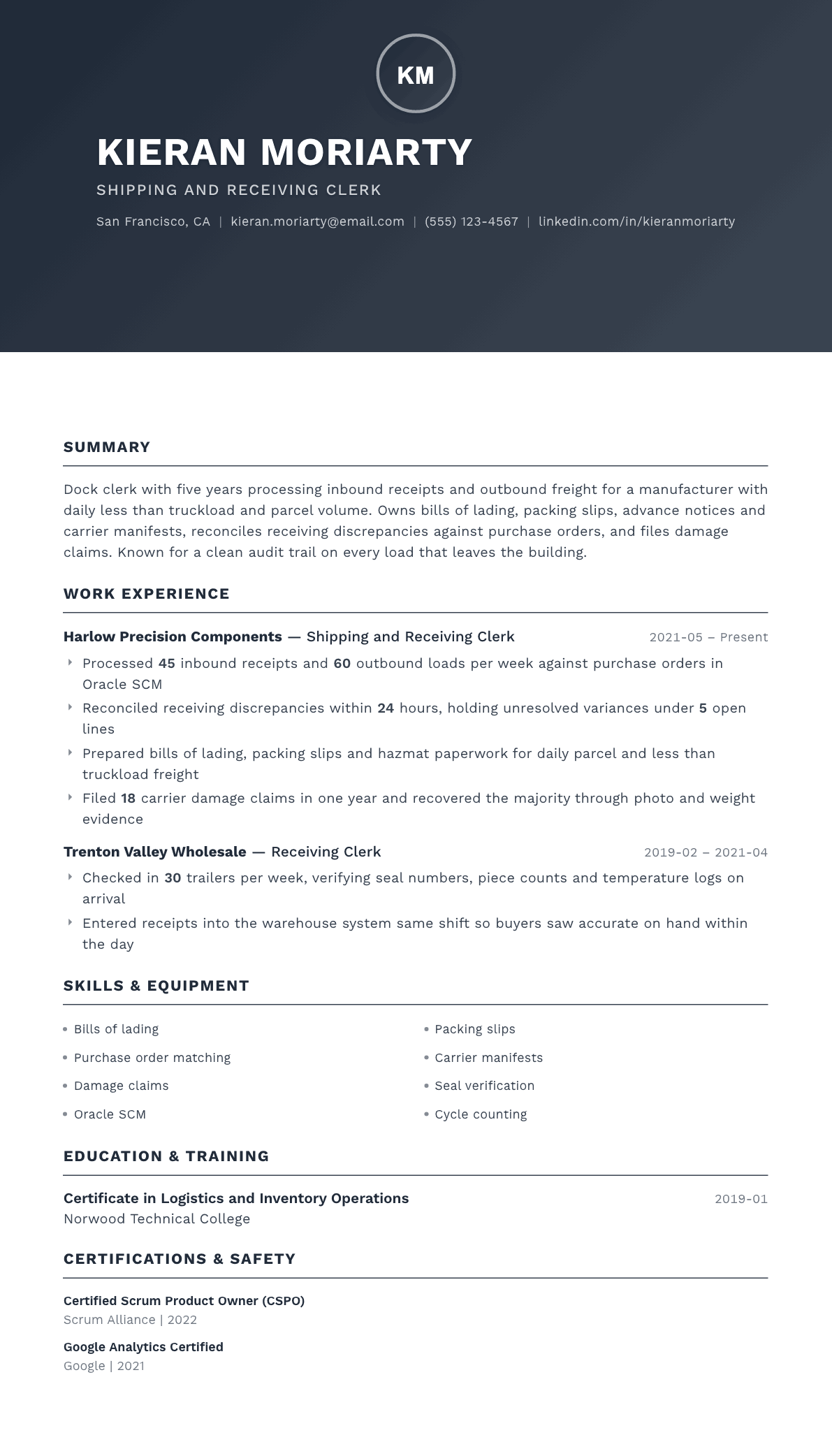
Example Shipping and Receiving Clerk summary
Dock clerk with five years handling inbound receipts and outbound freight for a precision manufacturer, processing 45 receipts and 60 loads per week in Oracle SCM. Owns bills of lading, packing slips, carrier manifests and hazmat paperwork, closes receiving discrepancies inside a day, and filed 18 carrier damage claims with a strong recovery record. Seeking a senior dock or inventory control role.
Skills to list on a Shipping and Receiving Clerk resume
- Bill of lading preparation
- Packing slip verification
- Purchase order matching
- Advance notice processing
- Carrier manifest reconciliation
- Receiving discrepancy resolution
- Freight damage claims
- Seal and count verification
- Hazmat documentation
- Cycle counting
- Oracle SCM
- Warehouse management systems
- Parcel and less than truckload processing
- Inventory record accuracy
- Dock scheduling
What actually gets this resume read
- Name every document you own by its real name: bill of lading, packing slip, advance notice, manifest, customs form.
- Give inbound and outbound volume per week, because the two sides of the dock are staffed and judged separately.
- Show how fast you close discrepancies, since an unreconciled receipt blocks payables and distorts on hand counts.
- List the enterprise system by product name, because clerks are screened on the platform the site already runs.
- Add carrier claim work with counts and recovery, as claims handling separates a clerk from a data entry hire.
- Mention hazmat, seal verification or temperature logging if you have done it, because those are audited controls.
How to write a shipping and receiving clerk resume
A shipping and receiving clerk role looks like a warehouse job and is really a records job. Freight moves either way, but what the employer is buying is an accurate paper trail: what arrived, whether it matched the purchase order, what left, on whose trailer, under whose signature, and where the proof sits when a customer disputes it three weeks later. Every strong resume for this role is built around that trail.
The reader is usually a materials manager, a plant controller or a logistics supervisor. What worries them is the cost of a bad clerk, and it is specific: receipts that sit unposted so buyers plan against wrong on hand figures, bills of lading with the wrong count so a claim cannot be won, hazmat paperwork that fails an audit, and discrepancies that quietly become inventory write offs at year end.
This guide sets out the sections a materials manager reads first, three example summaries from a first dock role to a senior clerk who owns claims and audits, before and after bullets that turn document handling into evidence, and the questions shipping and receiving clerks ask when one title covers both sides of the building.
Format: one page, documents and systems in the top third
One page, reverse chronological, single column. Manufacturers and distributors screen these applications through the same automated tools as every other role, and clerks lose disproportionately often because the document vocabulary sits in a decorated sidebar the parser skips.
Put two short lines under your header. The first names the documents you own: bills of lading, packing slips, purchase orders, advance ship notices, carrier manifests, commercial invoices, hazmat declarations. The second names the systems you post in. Between them they answer most of what the screener needs, and they load the page with the exact terms the posting was written from.
- Header: name, city, phone, email, shift availability, forklift or pallet jack certification.
- Document line and systems line, both before the summary.
- Sections: summary, experience, certifications, skills, education.
Summary: shipping, receiving, and the volume on each side
The title names two jobs, so say plainly whether you have worked shipping, receiving or both, and give the volume for each. Receipts a week and loads a week are the two numbers that size the job, and they are also how a manager works out whether you came from a plant with a few large deliveries or a distributor with constant parcel and less than truckload movement.
Add one control you owned. Closing discrepancies inside a day, filing and recovering carrier claims, verifying seals on every arrival, or keeping hazmat paperwork audit ready are all specific enough to be checked, and each one describes a risk you removed for a previous employer.
Experience: match, post, document, resolve
Write the inbound bullets as a sequence. Trailer arrives, seal and count are verified, freight is checked against the packing slip, the receipt is matched to the purchase order, exceptions are raised, and the posting hits the system the same shift so buyers see accurate on hand. Naming that sequence tells a materials manager you understand why receiving timing matters to planning, which most applicants never show.
Write the outbound bullets around the paperwork that follows the freight: bill of lading preparation, count and weight verification, carrier manifest reconciliation, seal application and recording, and the proof of delivery you filed afterward. If you produced hazmat declarations or export documents, name the document types rather than saying international paperwork.
Discrepancies deserve their own bullets, because that is where a clerk creates or destroys value. Overages, shortages, damages, wrong item receipts and count disputes each have a resolution path through the buyer, the supplier or the carrier, and describing how fast you closed them, and how many stayed open, is the most persuasive thing you can put on the page.
Claims work is the senior signal. If you photographed damage, weighed pallets, gathered the delivery receipt notation and filed against a carrier, say how many claims and how they landed. Clerks who can win a claim are rare and everybody in materials management knows it.
Systems: name the platform and the transactions
Enterprise systems are the screening filter here. Name the platform by product, and then name the transactions you actually ran: goods receipt, purchase order match, transfer posting, delivery creation, goods issue, inventory adjustment. A clerk who lists transaction names is proving fluency, while a clerk who lists a product name alone may only have watched somebody else post.
Add the peripheral systems too. Carrier portals for label generation and tracking, a transportation management system if the site ran one, a dock scheduling tool, the scale and dimensioning equipment, and the label printers. Moving freight between buildings, cross-docking and yard moves all touch different tools, and naming them shows the range of dock work you have covered.
Compliance, certifications and the audit question
Hazardous materials paperwork is regulated and audited, so any training you hold in that area belongs high in the certification block along with the issuing body. Temperature logging for cold chain, seal integrity procedures and food safety documentation all work the same way: they are controls somebody will audit, and having run one before is a real advantage.
Forklift or pallet jack certification is worth listing even though this is a clerical role, because most shipping and receiving clerks move freight as well as paperwork. A clerk who can spot check a pallet without waiting for an operator is faster at resolving a count dispute, and managers hire for that.
Shipping and Receiving Clerk resume summary examples
First dock role
Warehouse worker with two years in receiving, moving into a clerical dock role. Checks piece counts against packing slips, records seal numbers on arrival, and enters receipts the same shift. Comfortable with handheld scanners and spreadsheets, certified on electric pallet jack, available for early starts.
Three years on both sides
Shipping and receiving clerk handling 30 inbound trailers and 40 outbound loads a week for a wholesale distributor. Matches receipts to purchase orders in the enterprise system the same shift, prepares bills of lading and carrier manifests, and closes count discrepancies with buyers inside 24 hours.
Senior clerk, claims and audit
Senior shipping and receiving clerk with seven years at a precision manufacturer, processing 45 receipts and 60 outbound loads a week in Oracle SCM. Owns hazmat documentation, keeps unresolved variances under five open lines, and filed 18 carrier damage claims last year with a strong recovery record.
Work experience bullets: before and after
Before: Received deliveries and checked paperwork.
After: Checked in 30 trailers a week, verified seal numbers, piece counts and temperature logs on arrival, and posted receipts to the purchase order the same shift.
The volume, the three checks and the posting timing show a controlled process instead of a general duty.
Before: Prepared the shipping paperwork for outgoing freight.
After: Prepared bills of lading, packing slips and hazmat declarations for daily parcel and less than truckload freight, verifying counts and weights against the pick list before the driver signed.
Naming the documents and the verification before signature is what protects a claim months later.
Before: Resolved issues with orders.
After: Worked overages, shortages and damages with buyers and suppliers inside 24 hours, holding unresolved variances under five open lines at any time.
A resolution window and a standing threshold turn problem solving into a service level you maintained.
Before: Dealt with carriers about damaged freight.
After: Filed 18 carrier damage claims in a year using photographs, weight records and delivery receipt notations, recovering the majority of the claimed value.
The evidence you gathered explains why the claims succeeded, which is the part a manager cannot train quickly.
Before: Entered data into the computer system.
After: Ran goods receipts, purchase order matches and inventory adjustments in Oracle SCM, keeping unposted receipts at zero at the end of each shift.
Transaction names plus an end of shift standard prove system fluency rather than generic data entry.
Hard skills
- Bill of lading preparation
- Packing slip and purchase order matching
- Advance ship notice processing
- Carrier manifest reconciliation
- Seal verification and recording
- Overage, shortage and damage resolution
- Freight damage claims
- Hazardous materials documentation
- Goods receipt and inventory posting
- Cycle counting
- Dock appointment scheduling
- Pallet jack and forklift operation
Soft skills
- Accuracy under time pressure
- Firmness with drivers
- Clear written notes
- Follow through on open items
- Coordination with buyers
- Calm handling of disputes
Certifications worth listing
- DOT Hazardous Materials Employee Training (U.S. Department of Transportation)
- Dangerous Goods Regulations Training (International Air Transport Association)
- Certified Logistics Technician (CLT) (Manufacturing Skill Standards Council)
- OSHA 10-Hour General Industry (OSHA Outreach Training Program)
Mistakes that cost shipping and receiving clerk candidates the interview
- Listing duties without a single document name, in a role whose entire value is document control.
- Giving no volume for either side of the dock, so the reader cannot tell a plant from a distribution operation.
- Skipping the enterprise system and its transactions, which is the first filter most manufacturers apply.
- Treating discrepancies as an afterthought when they are the reason the position exists.
- Leaving hazmat or cold chain documentation off the page when it is regulated, audited and hard to hire for.
- Presenting the role as pure data entry, which invites a lower offer than the responsibility deserves.
Shipping and Receiving Clerk resume questions
Is a shipping and receiving clerk role a warehouse job or an office job?
It is both, and the resume should say so. Most clerks split their time between a desk posting receipts and the dock verifying counts, so list your system transactions and your equipment certification on the same page.
What documents should I name on the resume?
Every one you actually handled: bills of lading, packing slips, purchase orders, advance ship notices, carrier manifests, delivery receipts, commercial invoices and hazmat declarations. These are the exact terms postings are written from and screened against.
How do I show accuracy in this role?
Use standing thresholds rather than adjectives: unposted receipts at zero by end of shift, open variances under a set number, discrepancies closed within a day. Those describe a service level a manager can hold you to.
Do I need forklift certification for a shipping and receiving clerk job?
It is frequently listed as preferred rather than required, and it makes you materially more useful because you can verify or restage a pallet yourself. If you hold it, put it in the header area rather than the bottom of the page.
How do I move from clerk to inventory control or logistics coordination?
Emphasize the analytical half of the job: discrepancy root causes, cycle count results, claims recovery, supplier performance patterns you spotted. Those are the skills an inventory control or coordination role hires for, and clerks already practice them daily.
Related resume examples
- Warehouse Worker Resume example
- Customs Broker Resume example
- Receiving Clerk Resume example
- Freight Coordinator Resume example
- Logistics Intern Resume example
- Shipping Coordinator Resume example