Mail Room Clerk Resume Examples: the lines they read
Deliver a Strong Mail Room Clerk Resume
By Mustafa Tarabya, founder of CVBooster · Published · Updated
Create a mail room clerk resume highlighting your mail processing, package handling, and office logistics skills.
Sample resumes for a mail room clerk
The same mail room clerk content laid out in three CVBooster templates, so you can see what the finished document looks like before you write a word.
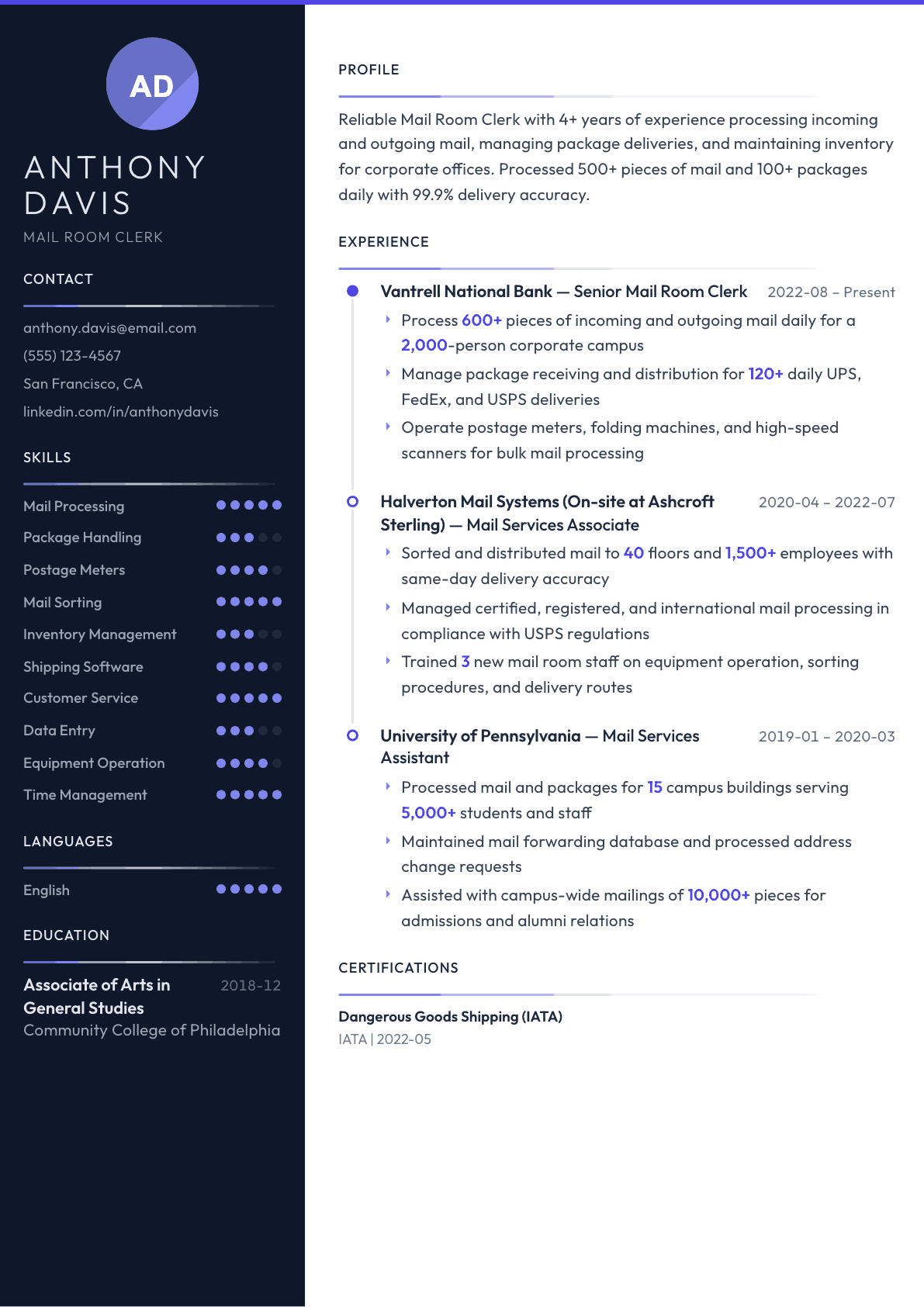
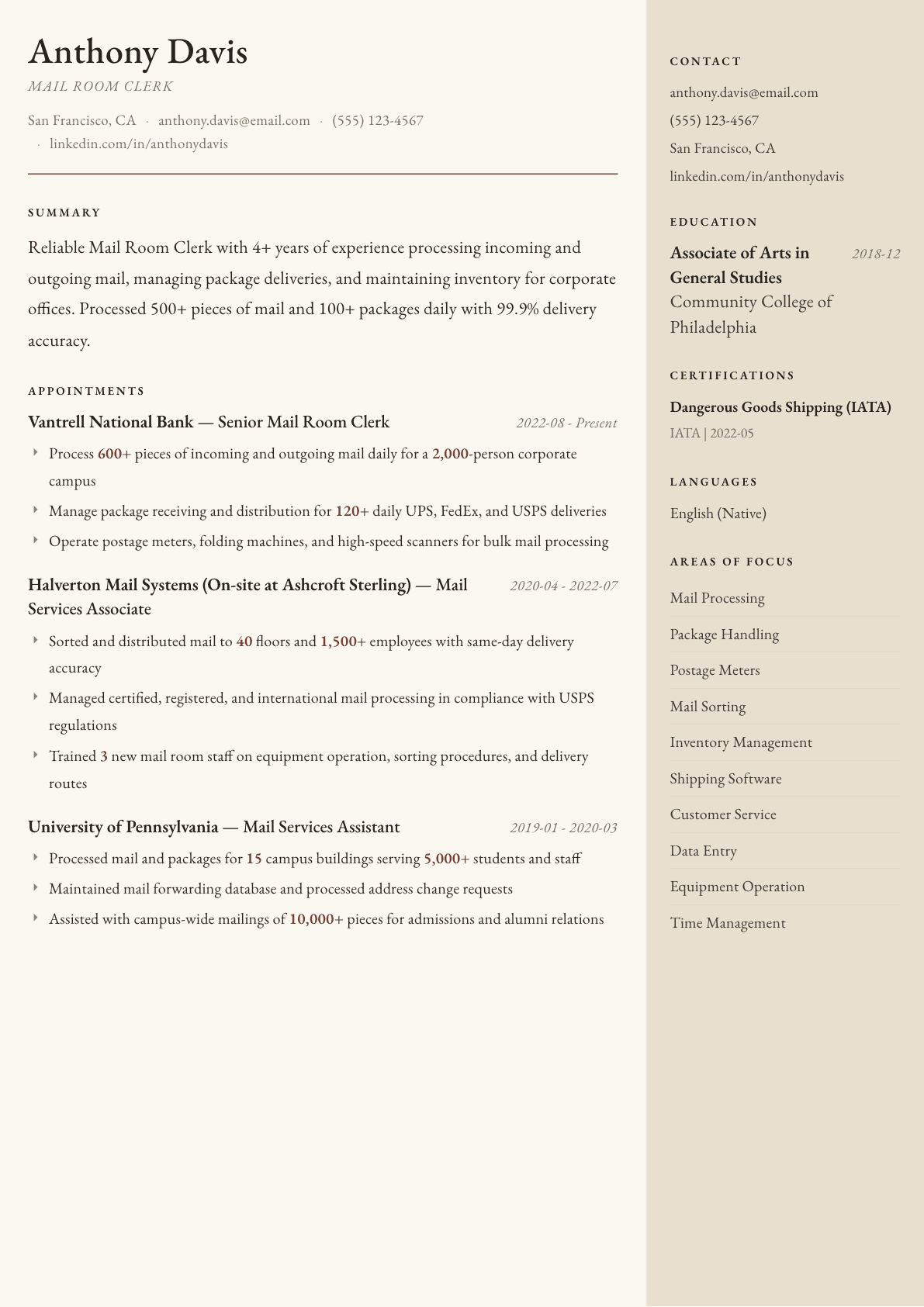
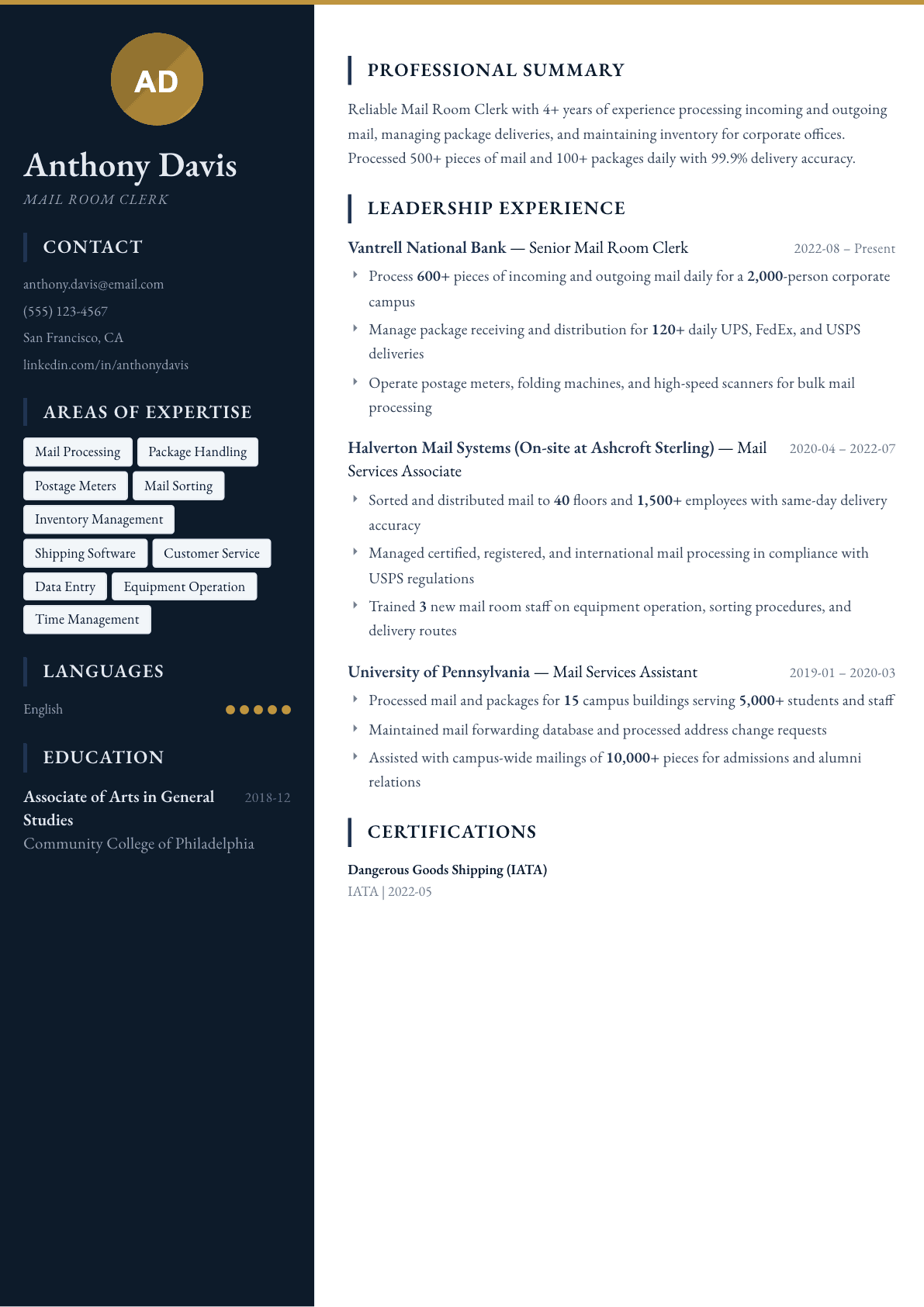
Example Mail Room Clerk summary
Mail services clerk, 4 years on corporate campuses of up to 2,000 staff, sorting 600 pieces and 120 carrier deliveries a day with a signed chain of custody on every accountable item. Runs the postage meter, inserter and bulk scanner, handles certified, registered and international mail, and has trained three new clerks on the routes.
Skills to list on a Mail Room Clerk resume
- Mail Processing
- Package Receiving & Distribution
- Postage Meters (Pitney Bowes)
- Mail Sorting & Routing
- Shipping Software
- Inventory Management
- Data Entry
- Equipment Operation
- Customer Service
- USPS Regulations
- Record Keeping
- Material Handling
- Time Management
- Attention to Detail
What actually gets this resume read
- Quantify your daily volume: pieces of mail processed, packages handled, floors or departments served.
- Highlight accuracy rates and delivery timeliness metrics.
- Include equipment experience: postage meters, folding machines, inserters, scanners.
- Mention shipping software: Pitney Bowes SendPro, Stamps.com, UPS WorldShip, FedEx Ship Manager.
- Show reliability: perfect attendance records, on-time delivery percentages.
How to write a mail room clerk resume
A mail room clerk resume is read by a facilities or administrative services supervisor who has one recurring nightmare: a legal notice, a check or a controlled substance shipment that arrives and cannot be found. Everything she looks for on your resume traces back to that. Volume you can handle, accuracy you can prove, and whether you understand chain of custody on accountable items.
The job has also changed. Inbound letter mail has fallen while parcel volume has climbed, so mail rooms now run package tracking software, locker systems and recipient notifications alongside the sorting table. A resume that describes only sorting and delivery reads as ten years out of date, even when the person writing it is doing the modern version of the job every day.
This guide covers how to write volume and accuracy honestly, which equipment and software to name, how to handle the confidentiality and safety side that supervisors quietly screen for, and how to position the role as a step into facilities or logistics rather than a dead end.
Format: one page, plain, and easy for a supervisor to scan
One page, reverse chronological, no graphics. Mail room postings are often screened by an administrative services coordinator working through dozens of applications between other duties, so a clean single column with clear job headings is worth more than any design choice.
Give every job the site it covered: building count, floor count, headcount served, and whether it was a corporate campus, a university, a hospital or a law firm. Those settings have genuinely different rules, and the reader is looking for the one closest to hers.
- Header: name, city and state, phone, email. Add a valid driver license line if the job includes a vehicle or courier runs.
- Order: summary, experience, equipment and systems, certifications, education.
- Every job needs daily mail volume, daily package volume, and the population served.
Summary: volume, accuracy and the sites you covered
Three lines with the two numbers that matter: pieces of mail and packages handled per day, and the population you delivered to. Add accuracy or a clean record on accountable mail. A supervisor with a backlog wants to know you can absorb her volume without needing a second hire.
If you have run a mail room alone rather than as part of a team, say it directly. Sole coverage means opening, sorting, metering, delivering, logging and closing without supervision, and it is the strongest single signal on an otherwise routine resume.
Experience: sorting, accountable mail, and the equipment that breaks
Start with throughput, then move to the categories that carry risk. Certified, registered, insured and international mail all have their own handling and signature requirements, and any clerk who has processed them without a lost item should say so. The same goes for legal service documents in a law firm and specimen or pharmacy shipments in a hospital, where a delay has consequences well beyond the mail room.
Outbound is where the money is. Postage meters, presort discounts, class selection, address verification and permit mailings are all cost levers, and a clerk who has chosen the right class or cleaned an address list has done real work for the budget.
Equipment deserves its own bullets. Metering systems, folder inserters, tabbers, high speed scanners and shredders all break in ways that stop the day, so name the machines you have operated and any first line maintenance or vendor calls you handled.
- Daily inbound and outbound volume with the sites and headcount served.
- Accountable mail handling: certified, registered, insured, international, and the log or signature system used.
- Package intake: tracking software, recipient notification, locker or pickup counter operation, and unclaimed package procedure.
- Bulk mail projects: piece counts, class and presort choices, and the deadline you hit.
Systems, safety and confidentiality
Name the tracking and notification software you have used, the postage system, and any facilities ticketing tool where mail requests arrived. Add the physical side honestly: lifting limits you can meet, pallet jack or hand truck use, forklift certification if you hold one, and dock work. Facilities supervisors have to fill shifts that involve moving heavy pallets of paper and they screen for this.
Confidentiality is the quiet requirement. Mail rooms open and route legal correspondence, payroll, medical documents and executive mail. A line stating that you handled confidential and executive correspondence under a documented procedure tells the reader you understand that the contents of the envelope are not your business.
Turning the role into a step, not a stop
Mail room work sits at the bottom of the facilities and logistics ladder, and the people who climb it are the ones who took on inventory, dispatch, receiving, asset tagging, office supply ordering or reception coverage. If you have done any of that, give it a bullet, because it is the bridge to a receiving and distribution coordinator or facilities assistant posting.
Training others is the other bridge. A clerk who wrote the delivery route sheet or trained new staff on the meter has demonstrated the supervisory instinct that gets someone promoted to mail room lead.
Mail Room Clerk resume summary examples
First mail room job
Warehouse and stockroom worker moving into mail services, with two years sorting and staging inbound freight and a clean attendance record across 18 months of early shifts. Comfortable lifting 50 pound parcels, operating a pallet jack and working from a printed route sheet.
Three years in
Mail room clerk sorting and distributing mail to 40 floors and 1,500 employees with same-day delivery accuracy. Processes certified, registered and international mail to postal requirements, operates the meter and folder inserter, and trained three new staff on sorting and route procedures.
Lead clerk, corporate campus
Lead mail room clerk processing 600 pieces of mail and 120 carrier deliveries daily for a 2,000 person corporate campus. Runs metering, bulk mail projects and package tracking, keeps the accountable mail log with no lost items on record, and schedules two clerks across delivery routes.
Work experience bullets: before and after
Before: Sorted and delivered mail to employees in the building.
After: Sorted and delivered 600 pieces of daily mail across 40 floors on two timed routes, serving 1,500 employees with same-day delivery on everything received before the afternoon cutoff.
Volume, floors, route structure and the cutoff turn a duty into a throughput a supervisor can compare with her own.
Before: Handled certified and registered mail.
After: Logged and released certified, registered and insured mail against signature, maintaining the accountable item log with no unresolved items across three years.
The log, the signature step and the clean record address the exact risk the hiring supervisor worries about.
Before: Used the postage machine for outgoing mail.
After: Operated the postage meter and folder inserter for daily outbound, selecting class and presort options on an 8,000 piece admissions mailing that met its drop deadline.
Naming the equipment, the choices and a real project shows cost awareness rather than button pressing.
Before: Received packages from delivery drivers.
After: Received and logged 120 daily carrier deliveries in the package tracking system, sending automated recipient notifications and clearing the unclaimed shelf on a weekly cycle.
The system, the notification and the unclaimed process describe a modern parcel operation instead of a receiving desk.
Before: Trained other staff in the mail room.
After: Trained three new clerks on meter operation, sorting sequence and the four delivery routes, then wrote the one-page route sheet still used for coverage during absences.
The written artifact proves the training outlived the session and reduced the risk of an uncovered shift.
Hard skills
- High volume mail sorting
- Accountable mail logging
- Certified, registered and international mail
- Postage meter operation
- Folder inserter and tabbing equipment
- Bulk and presort mailings
- Package tracking and recipient notification software
- Address verification and forwarding databases
- Courier and interoffice pouch scheduling
- Outbound label and carrier manifest preparation
- Inventory and supply stock control
- Pallet jack and hand truck operation
- Document shredding and secure disposal
Soft skills
- Accuracy under repetition
- Discretion with confidential mail
- Punctuality on timed routes
- Physical stamina
- Clear handoff to recipients
- Working unsupervised
Certifications worth listing
- OSHA 10-Hour General Industry (OSHA Outreach Training Program)
- Powered Industrial Truck Operator Certification (Employer training program under OSHA standards)
- Adult First Aid, CPR and AED (American Red Cross)
Mistakes that cost mail room clerk candidates the interview
- Leaving daily volume off the resume, which makes a two-person branch office and a corporate campus mail room look the same.
- Describing only sorting and delivery while ignoring parcel intake, tracking software and recipient notification, the part of the job that has grown.
- Failing to mention accountable mail. It is the highest risk task in the room and the one a supervisor will ask about first.
- Skipping the equipment names, so the reader cannot tell whether you will need training on the meter and inserter from day one.
- Omitting the physical requirements you meet when the posting lists a lifting limit and dock work.
- Never mentioning confidentiality, in a role that routinely handles legal, payroll and executive correspondence.
Mail Room Clerk resume questions
How do I estimate daily mail volume if nobody counted it?
Use a defensible proxy: trays or bins processed per shift, floors and headcount served, or carrier deliveries received. Say how you arrived at the figure in the interview, because a supervisor respects an estimate with a method more than a suspiciously round claim.
Does a mail room clerk resume need a high school diploma listed?
Yes, list it, since most postings state it as the minimum and an applicant tracking screen may filter on it. Keep it to one line at the bottom unless you have relevant coursework or a logistics certificate worth naming.
What should I do about gaps between short mail room contracts?
Group temporary assignments under the staffing agency that placed you, with the client sites listed underneath. That turns a run of short entries into one continuous engagement and explains the movement without drawing attention to it.
How do I move from mail room clerk to a facilities or logistics role?
Lead with the adjacent work you already do: receiving, inventory counts, supply ordering, asset tagging, vendor and carrier coordination. Those bullets are what a receiving and distribution or facilities assistant posting screens for, and most clerks already have them.
Should I mention driving for the role?
If you have made courier runs between sites or driven a company vehicle, yes, with your license class and a clean record note. Many mail services postings include inter-site runs, and the applicant who already drives saves the employer a scheduling problem.
Related resume examples
- Data Entry Clerk Resume example
- Office Coordinator Resume example
- Receptionist Resume example
- Office Assistant Resume example
- Office Clerk Resume example
- Front Desk Receptionist Resume example