Master's Student Resume Examples: the lines they read
Write a Master's Student Resume Built for the Job Market
By Mustafa Tarabya, founder of CVBooster · Published · Updated
Master's student resume example with capstone work, specialization courses and keywords, plus a guide to timing applications around graduation.
Sample resumes for a master's student
The same master's student content laid out in three CVBooster templates, so you can see what the finished document looks like before you write a word.
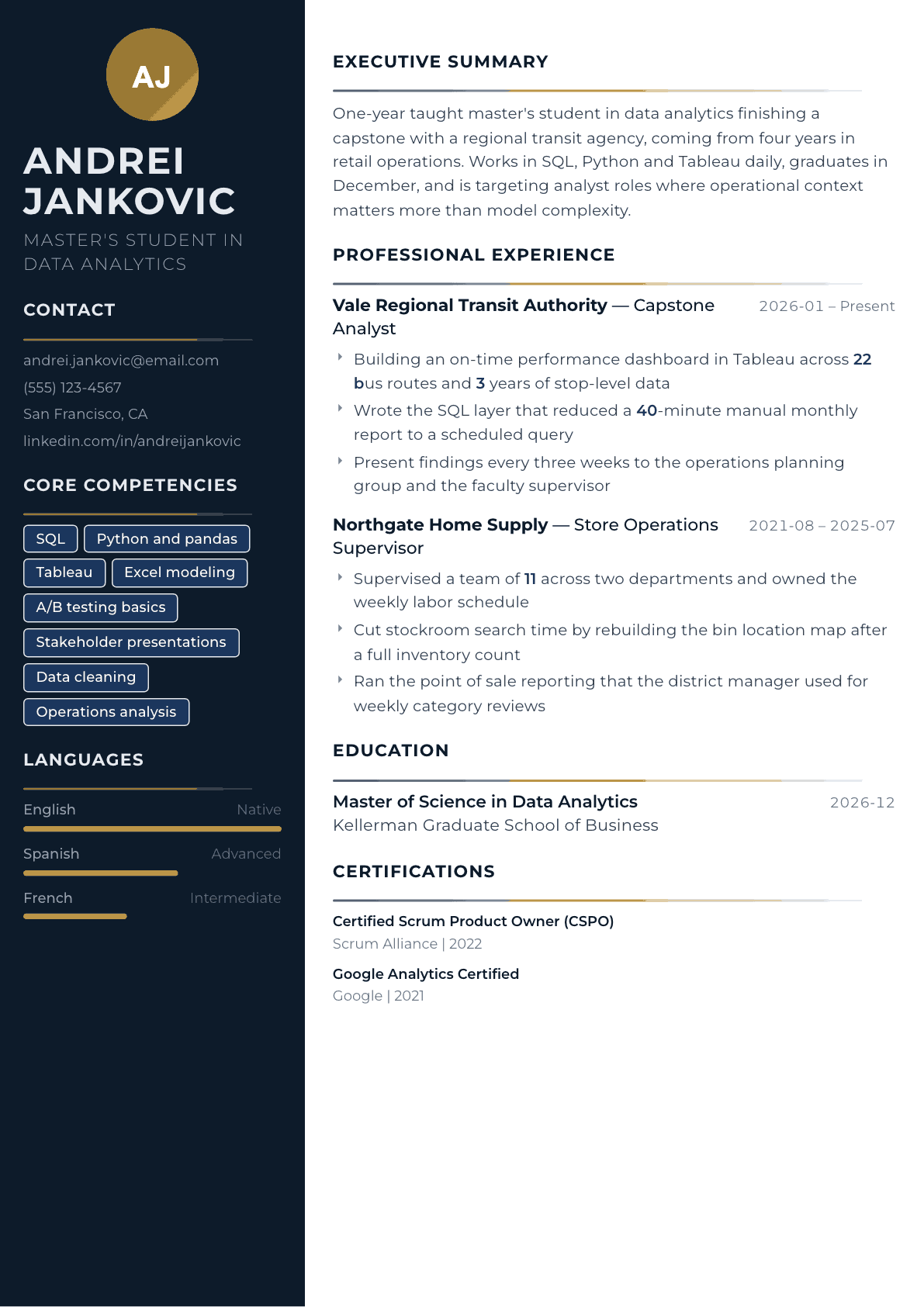
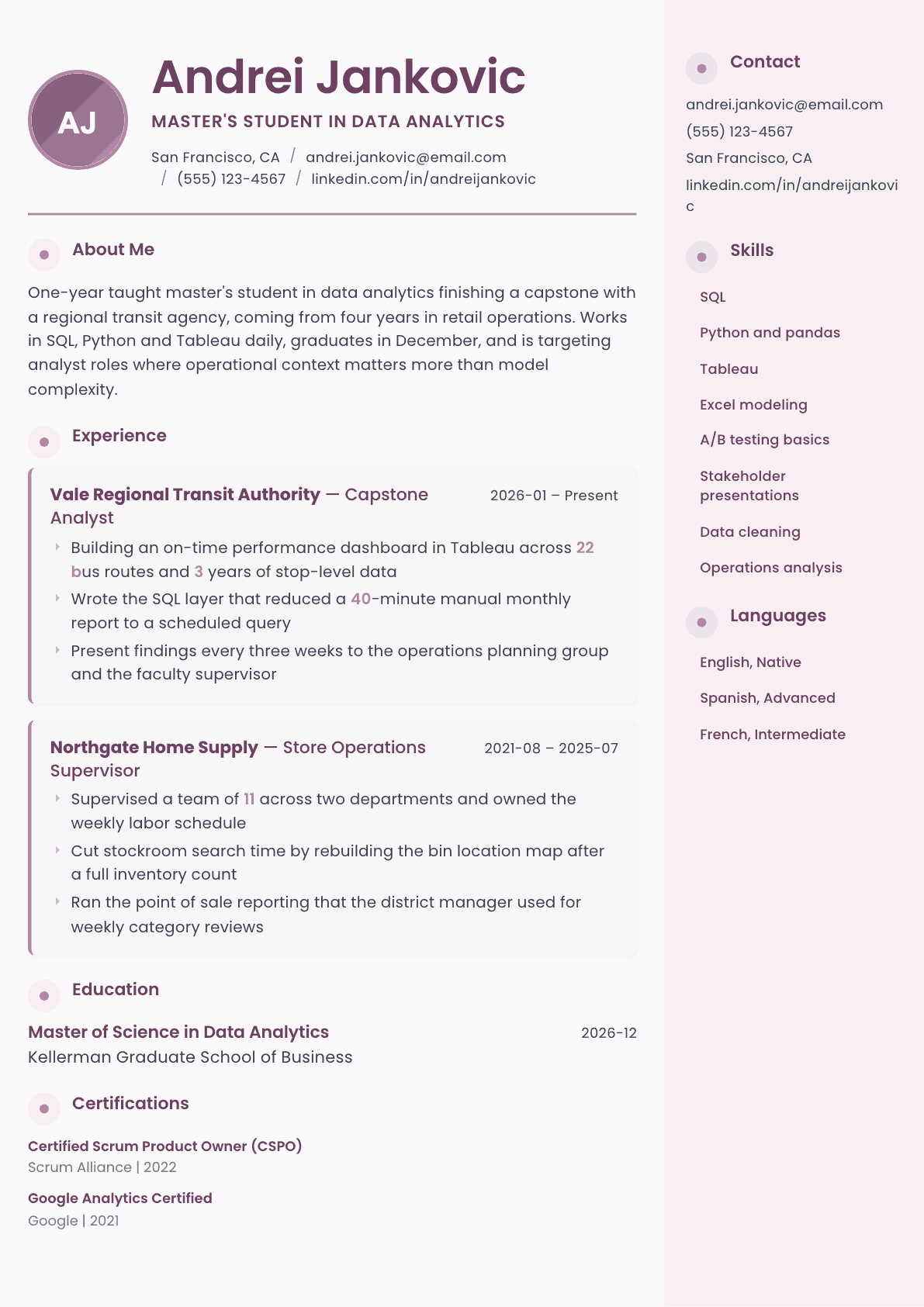
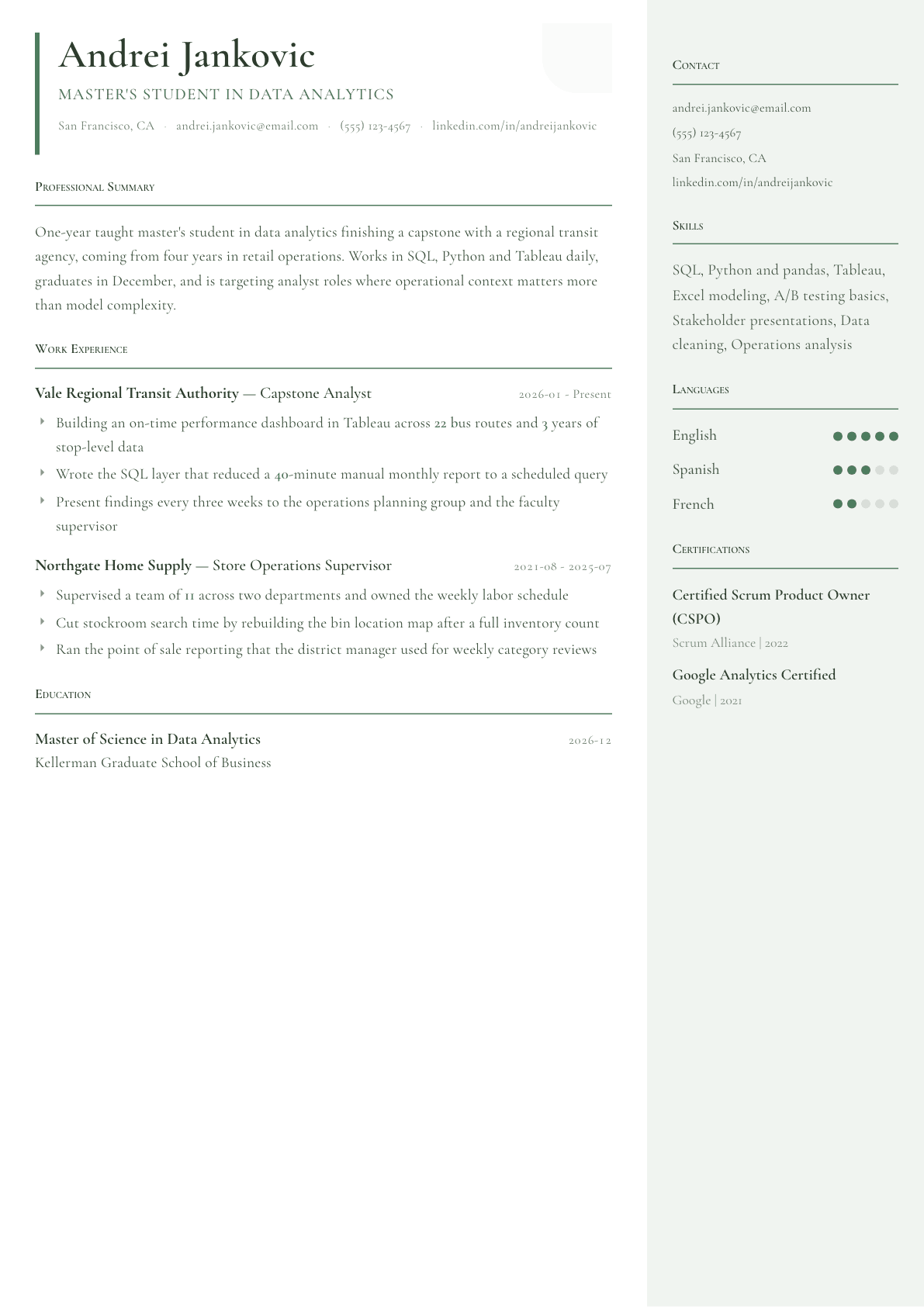
Example Master's Student summary
Taught master's student in data analytics graduating in December, with four years of retail operations supervision before the degree. Currently building an on-time performance dashboard for a regional transit agency across twenty-two routes, and replaced a manual monthly report with a scheduled SQL job. Works in SQL, Python and Tableau, and reads operational data with the eye of someone who ran a floor team.
Skills to list on a Master's Student resume
- Capstone project delivery
- SQL querying
- Python for analysis
- Tableau dashboards
- Excel modeling
- Statistics coursework
- Research methods
- Stakeholder presenting
- Data cleaning and validation
- Business case writing
- Operations knowledge
- Group project leadership
- Time management across terms
What actually gets this resume read
- Put your graduation month in the header, because a recruiter is checking it against a start date on the requisition.
- Give the capstone or thesis a client, a dataset and a deliverable, so it reads as a project rather than a course.
- List only the specialization courses that name a method the posting asks for, and skip the core requirements.
- Keep your pre-master's work experience on the page, since it is what separates you from a fresh undergraduate.
- Say whether the degree is taught or research based, because the two suggest very different first jobs.
- Name the version of the tools you use, since a hiring team cares whether you learned them on real data.
How to write a master's student resume
A hiring manager reading a master's student's resume has one suspicion she is trying to resolve: that the degree bought vocabulary rather than capability. She has interviewed candidates who can define a technique cleanly and have never applied it to messy data, a real deadline or a stakeholder who changed the requirements halfway through. Your page has to defuse that suspicion in the first third.
The material to do it with is usually already there and usually mishandled. A taught master's runs one or two years and ends in a capstone or thesis, often with an external client attached. Most students describe that work as a module. It is a project with a sponsor, a dataset, a delivery date and someone who had to be persuaded, and written that way it does more for an application than the degree title ever will.
This guide covers where the graduation month belongs, how to write a capstone as client work, what to do with the years you worked before the degree, how part-time study should appear beside a job, and the timing questions master's students ask when the course ends out of step with the hiring calendar.
Format: graduation month in the header, experience still leads
Put the degree, the institution and the expected graduation month in the header block or the first education line. A recruiter is checking it against a requisition start date, and a master's student who leaves it out gets read as available at some unknown point, which is the same as unavailable.
Unlike an undergraduate resume, education does not have to sit above experience here. If you worked before the degree, or you are working through it, the experience section is the stronger opening and should go first. The degree is the reason you are eligible for the role. The work is the reason anyone should believe you can do it.
Two pages are acceptable when you have several years of prior employment. One page is right if the degree follows straight from an undergraduate program with only internships behind it.
- Degree name, specialization and expected graduation month, in that order.
- Whether the program is taught or research based, since the two imply different first roles.
- A specialization course line, limited to the courses that name a method the posting asks for.
- Study mode when it is not obvious: full time, part time, evening, or while employed.
The capstone or thesis is client work, so write it that way
Name the sponsor or the domain, the data you were given, what you built, who you presented to and how often. A dashboard built for a regional transit agency across twenty-two bus routes and three years of stop-level data is a piece of consulting. The same work described as a capstone project in data analytics is a line on a transcript.
The cadence matters as much as the artifact. Presenting to an operations group every three weeks means you handled feedback from people who were not grading you, which is precisely the experience a manager doubts you have. Say who was in the room.
End with what changed. A manual monthly report replaced by a scheduled query, a recommendation the sponsor adopted, a measurement that settled an internal argument. If the project ended without a result, describe the decision it informed instead, honestly, rather than inventing an outcome that will not survive an interview question.
The years before the degree are your advantage, not your past
Master's students who came from another field routinely bury their previous career at the bottom of the page, which throws away the only thing that separates them from every recent undergraduate applying for the same role. Four years supervising a store team, three years in a clinic, two years teaching: that is judgment, headcount and exposure to consequences.
Rewrite those roles in the vocabulary of where you are going rather than deleting them. A store operations supervisor who owned a weekly labor schedule and rebuilt a bin location map was doing capacity planning and data quality work. Keep the true title, then let the bullets speak in the new field's language.
If the previous career is genuinely irrelevant, compress it to a single line with dates and title rather than removing it. An unexplained gap raises a question that the truth answers easily.
- Keep prior job titles accurate, and translate the bullets rather than the titles.
- Give headcount, budget or volume from the previous role, since those scale numbers still count.
- Compress unrelated early jobs into one line, but never leave a hole in the dates.
- Show any point where the old career and the new one touched, because that is your credibility.
Studying part time while employed
Say it plainly on the page: pursuing the degree part time in the evenings while working full time. Managers read this as evidence of stamina and time discipline, and they will not infer it if you list the degree with no mode attached. It also explains a graduation date further out than the program length would suggest.
Where the coursework has already fed the job, say so in a bullet inside the job rather than inside the education section. A forecasting method learned in a term and applied to your employer's own numbers the following month is the strongest possible answer to the theory-without-practice suspicion.
Timing, keywords and where the applications go
Programs that finish in December or at midsummer land out of step with graduate hiring cycles built around a spring finish. Plan for that. Apply to rolling and experienced-hire postings rather than waiting for a cohort intake that opened before your term started, and make your availability month explicit so a recruiter does not assume the usual date.
Mirror the posting's technical vocabulary exactly in a skills block: the query language, the visualization tool, the statistical package, the cloud platform. Add the version or environment where it is meaningful. A master's student who lists tools without ever attaching one to a deliverable has written the same page as everyone else in the cohort.
Master's Student resume summary examples
Straight from an undergraduate degree
Master's student in data analytics graduating in June, continuing directly from an economics degree. Completed a term project modeling energy consumption across 40 municipal buildings and a summer internship cleaning survey data for a housing charity. Works in SQL, Python and Tableau, available full time from July.
Career switcher finishing the degree
Taught master's student in data analytics graduating in December, with four years of retail operations supervision beforehand. Building an on-time performance dashboard for a regional transit agency across twenty-two routes, and replaced a manual monthly report with a scheduled SQL job. Reads operational data like someone who ran a floor team.
Studying part time while working
Operations manager of nine years completing a master's in supply chain part time in the evenings, graduating in May. Applied the network optimization method from the autumn term to a live depot consolidation that removed one facility from the route plan. Targeting a planning role with regional scope.
Work experience bullets: before and after
Before: Completed a capstone project in data analytics.
After: Built an on-time performance dashboard in Tableau for a regional transit agency, covering 22 bus routes and three years of stop-level data, presented every three weeks to the operations planning group.
A sponsor, a scope and a review cadence make a capstone read as client work rather than coursework.
Before: Learned SQL during my degree.
After: Wrote the SQL layer that reduced a 40-minute manual monthly report to a scheduled query the planning team now runs unattended.
The tool is attached to a specific task and a before and after, which is what a manager evaluates.
Before: Previously worked in retail before starting my degree.
After: Supervised a team of 11 across two departments and owned the weekly labor schedule for a home supply store with 4,000 active stock lines.
Headcount, ownership and scale carry into any operations role, where a job title alone carries nothing.
Before: Studying part-time alongside my job.
After: Completing a part-time master's in the evenings while working full time, and applied the term forecasting method to my employer's own demand data the following month.
Stating the mode explains the timeline and proves the coursework has already met real data.
Before: Presented my findings to the class.
After: Presented three route consolidation options to the agency planning group and the faculty supervisor, and the option adopted removed a duplicate stop pair from the winter schedule.
An audience outside the classroom and an adopted outcome answer the doubt about practical application.
Hard skills
- Capstone and thesis delivery
- SQL querying
- Python for analysis
- Tableau dashboards
- Excel modeling
- Applied statistics
- Research methods
- Data cleaning and validation
- Business case writing
- Stakeholder presenting
- Process mapping
- Survey and interview design
Soft skills
- Balancing study with employment
- Working to a sponsor deadline
- Handling feedback from a client
- Leading a mixed-ability group project
- Translating theory into a practical recommendation
- Independent learning between terms
Certifications worth listing
- Certified Associate in Project Management (Project Management Institute)
- Tableau Desktop Specialist (Tableau)
Mistakes that cost master's student candidates the interview
- Omitting the graduation month, which leaves a recruiter unable to match you to a requisition start date.
- Describing the capstone as a module with a title instead of a sponsored project with data and a delivery.
- Pushing years of prior employment to the bottom of the page, which erases the only edge over an undergraduate applicant.
- Listing every core course, when only the specialization modules that match the posting carry any weight.
- Failing to say the degree is part time while employed, so a long timeline looks like a slow one.
- Listing tools in a skills block without ever attaching one of them to something you delivered.
- Waiting for a graduate cohort intake when the program finishes in December and rolling postings are the better route.
Master's Student resume questions
Where should a master's degree go if I already have work experience?
Keep experience first and place education immediately after it, with the expected graduation month visible. Employers hiring for anything beyond an entry role read work history first, and the degree functions as a qualifier rather than as the headline of the page.
How do I write a thesis that is still in progress?
Give the research question, the data or population, the method, and the submission month. Describe what has already been completed in past tense and what remains in one clause. A reader wants scope and a finish date, not a promise of future contribution.
Should I list every course from my master's?
No. Choose three or four specialization courses whose names match the methods in the posting and drop the core requirements every student in the program completed. Better still, attach a course to something you produced with it and let the output do the work.
Does a master's degree let me apply for mid-level roles?
Sometimes, and it depends entirely on what sits beside it. A degree plus several years of relevant employment can reach a mid-level posting. A degree straight after an undergraduate program with only internships behind it competes for entry roles regardless of the qualification.
My program ends in December and most schemes start in September, what do I do?
Target rolling and experienced-hire postings rather than cohort intakes, state your availability month explicitly so nobody assumes a spring finish, and start applying about three months before submission when employers can still hold a start date open.