Business Student Resume Examples: the lines they read
Business Student Resume for Internship Recruiting Season
By Mustafa Tarabya, founder of CVBooster · Published · Updated
Business student resume example with case competition results, Excel modeling, club leadership and internship keywords, plus a step-by-step guide.
Sample resumes for a business student
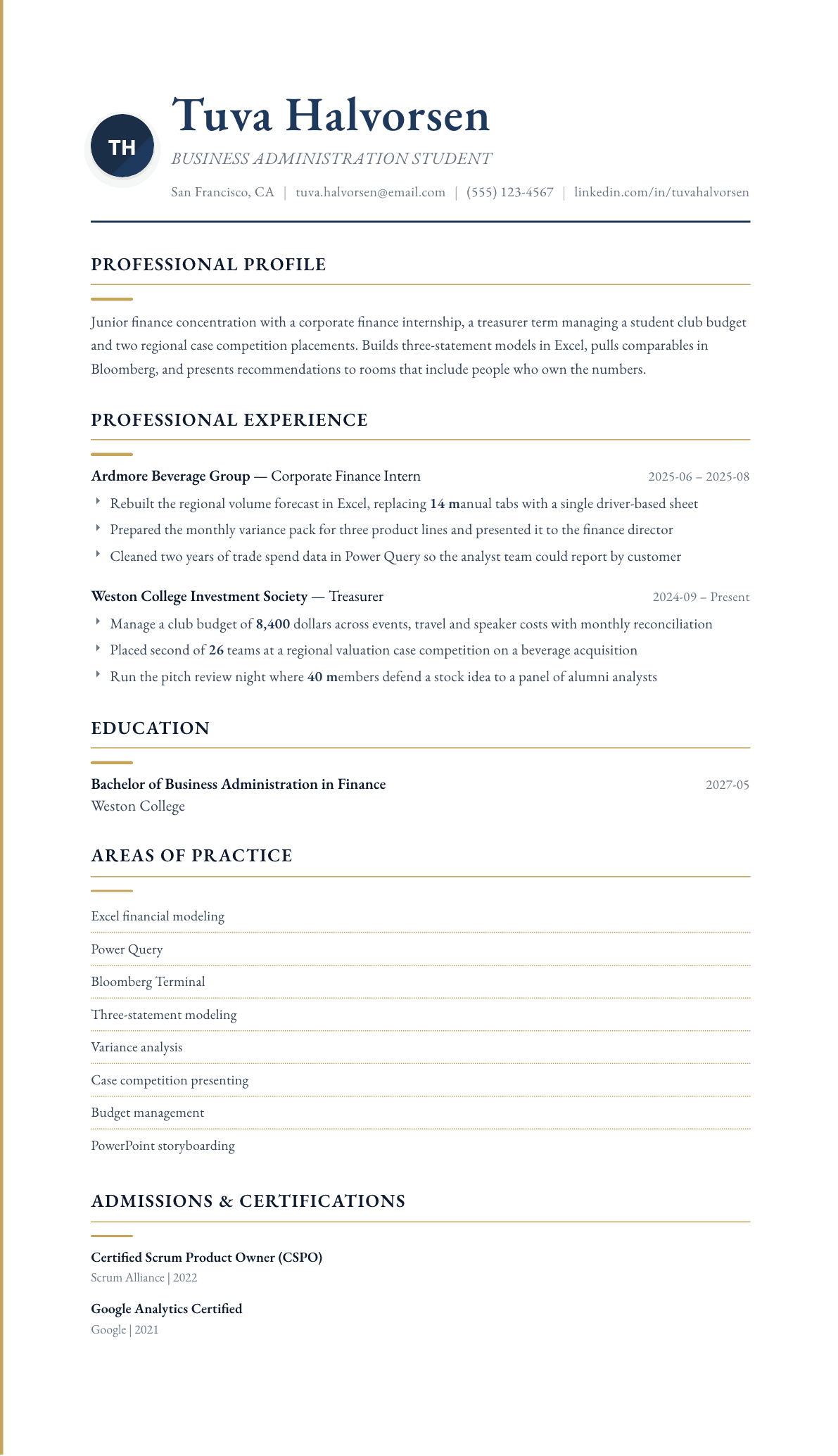
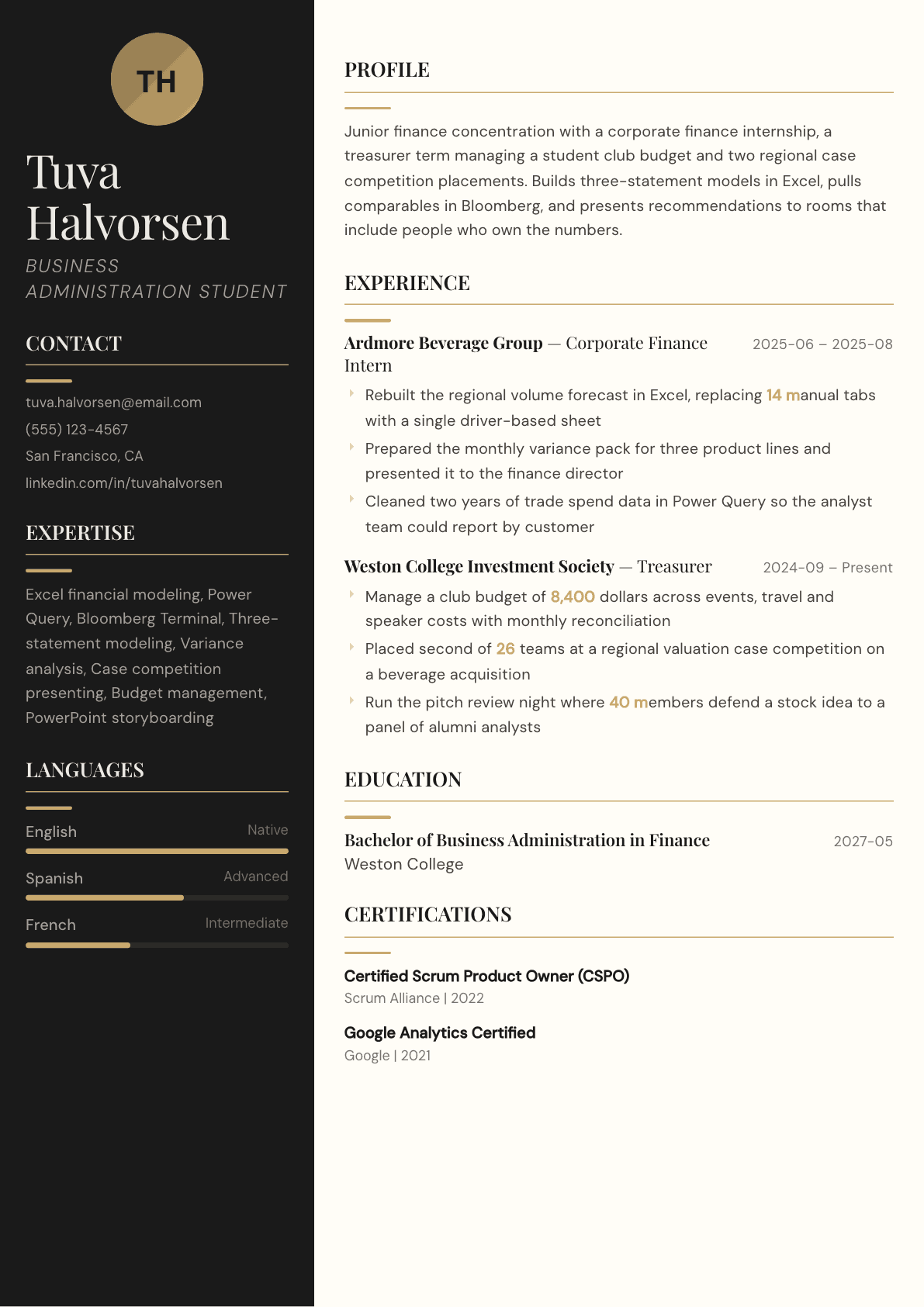
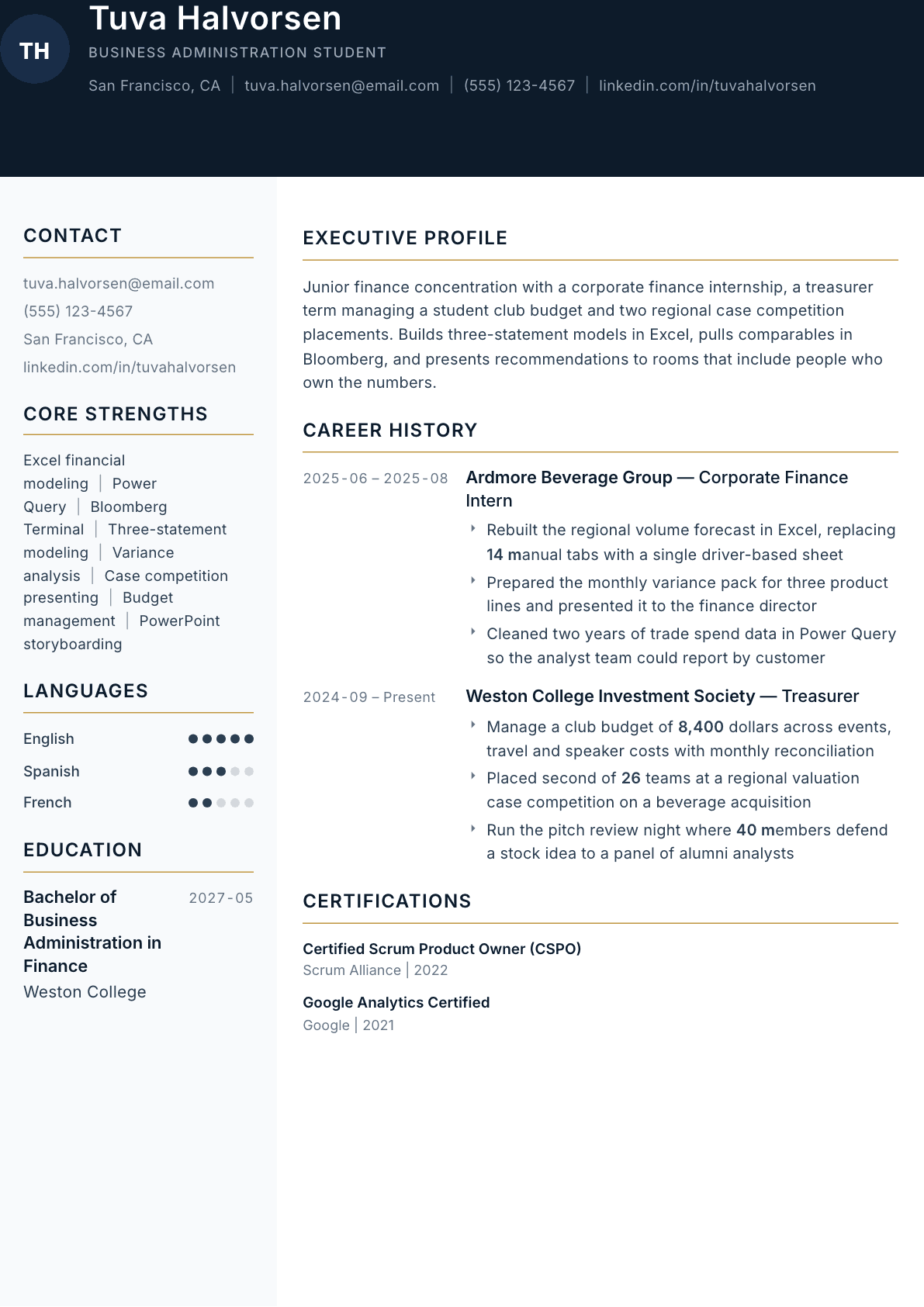
The same business student content laid out in three CVBooster templates, so you can see what the finished document looks like before you write a word.
Example Business Student summary
Junior business student concentrating in finance, with a corporate finance internship, a club treasurer term and two case competition placements. Rebuilt a regional forecast into a driver-based Excel model, prepared monthly variance packs for three product lines, and defends recommendations in front of alumni analysts. Comfortable in Bloomberg, Power Query and Tableau. Seeking a summer analyst internship in corporate finance.
Skills to list on a Business Student resume
- Financial modeling in Excel
- Three-statement and DCF modeling
- Variance and budget analysis
- Power Query and data cleaning
- Bloomberg Terminal navigation
- Market and competitor research
- Case competition analysis
- Executive presentation design
- Club budget management
- Accounting fundamentals
- Tableau dashboards
- SQL basics
- Meeting and event coordination
- Stakeholder communication
What actually gets this resume read
- Lead with your concentration and expected graduation, because recruiting calendars are built around class year.
- Put case competition placements with the field size, since second of 26 reads differently from participation.
- Show Excel depth by naming what you built: a driver model, a variance pack, a reconciliation workbook.
- Give club leadership a budget figure or a member count so it reads as management rather than membership.
- Name the data tools you actually touched, whether Bloomberg, Power Query, Tableau or a general ledger system.
- Translate a retail or hospitality job into business terms: cash handling, scheduling, inventory and margin.
- Keep the page to one sheet through junior year, since campus recruiters screen in stacks and read the top third.
How to write a business student resume
Business school recruiting runs on a calendar, and the calendar is brutal. Banks and consultancies open applications for a summer that is still a year away, campus recruiters read hundreds of near-identical pages in a single afternoon, and the sort happens in the top third of the sheet: class year, concentration, one internship, one thing that shows you can carry a number. Everything below that is read only if the top third earned it.
Business student resumes fail in a predictable way. They describe involvement rather than output. Being a member of the investment society, attending a case competition, assisting with a project: none of those tell a recruiter whether you can build a model, defend an assumption, or run a budget that has to reconcile. The best pages read like a short record of things the student was actually accountable for.
This guide covers the format campus recruiters expect, how to write internships, clubs and competitions so they carry weight, three summaries across a first-year, a junior in recruiting season and a final-year student with a return offer, and the questions business students ask when the page is not converting.
Format: one page, education first, everything else in the order they read it
One page until you graduate. Education sits at the top with your degree, concentration, institution and expected graduation month, plus grade point average while it clears the screening floor your target firms use. Add test scores only where the sector actually asks for them, and never invent a scale.
Below that: professional experience, then leadership and activities, then skills and interests in a single closing line. Keep the section order stable across every application. Recruiters reading a stack in one sitting rely on position to find things, and a page that reorders itself creatively costs them time you do not have.
- Education block: degree, concentration, expected graduation month, grade point average when it helps.
- Experience entries lead with the function, since a finance internship and a marketing internship are read by different teams.
- Leadership entries carry a budget figure, a member count or an event size so they read as management.
- Closing line for languages, technical tools and two genuine interests that give an interviewer somewhere to start.
Internships: name the deliverable, not the department
The strongest internship bullets name a thing that existed at the end of the summer. A rebuilt forecast model, a variance pack that went to a director, a cleaned data set the analyst team now reports from, a market scan that changed a pricing decision. Write the deliverable, the tool, and who used it after you left.
Quantify the way finance people quantify: the number of tabs replaced, the product lines covered, the accounts reconciled, the hours of manual work removed. Avoid inflating a figure you cannot walk through, because the standard technical interview question is to explain how you got it.
A retail, hospitality or campus job counts, and belongs on the page translated into business terms. Cash handling becomes reconciliation, scheduling becomes labor planning, inventory counts become stock control and shrink. Recruiters who worked those jobs read them as evidence of accountability rather than as filler.
Clubs and case competitions: results, field size and what you owned
Case competitions are worth real space if you write them properly. Give the field size, the placement, the case subject and your role on the team. Placing second of twenty-six teams on a beverage acquisition case tells a recruiter more than a line about strong analytical skills ever will, and it gives your interviewer an obvious opening question.
Club leadership needs a number attached. A treasurer entry with the budget managed and the reconciliation cadence is management experience. A president entry with member count, event count and attendance is management experience. The same titles with no numbers read as a signature on a form.
- Competition entries: field size, placement, case subject, your section of the analysis and the deck.
- Treasurer or finance roles: budget managed, reconciliation frequency, what you reported and to whom.
- Event roles: attendance, sponsor count, and anything you negotiated or booked yourself.
- Society roles: what you built that outlasted your term, whether a pitch process, a mentorship pairing or a member database.
Technical skills the interview will actually test
Excel is claimed by every applicant and tested by a few firms. Make yours credible by naming what you have built rather than a proficiency level: a driver-based forecast, a three-statement model, a discounted cash flow, a reconciliation workbook with a check row that ties. If you use Power Query, index and match, or dynamic array functions, say so, because those separate a modeler from a spreadsheet user.
Then list the data tools honestly: Bloomberg navigation, Tableau or Power BI dashboards, SQL at the level you can actually write, an accounting system you have posted in. A student who says SQL basics and can explain a join is safer than one who claims proficiency and freezes on a technical screen.
Keywords, screens and tailoring for the sector
The vocabulary differs sharply by sector even inside one business school. Corporate finance postings say variance, forecast, close, budget owner. Consulting postings say hypothesis, workstream, client interview, synthesis. Marketing postings say segmentation, funnel, campaign performance, brief. Read three postings in your target sector, take their nouns, and use the ones you have honestly earned.
Tailoring means reordering, not rewriting. Move the closest internship or competition to the top of its section, swap two coursework titles, adjust the skills line to the tools that posting names. Business students who send one identical page to banking, consulting and brand management are losing to classmates who spend ten minutes on the reorder.
Business Student resume summary examples
First-year student
First-year business administration student with two years of retail supervision behind school, now running the finance committee for the campus entrepreneurship society. Comfortable in Excel with pivot tables and lookup functions, taking the accounting and statistics sequence this year, and seeking a first summer internship in finance or operations.
Junior in recruiting season
Junior concentrating in finance with a corporate finance internship, a club treasurer term and two regional case competition placements. Rebuilt a volume forecast into a single driver-based model, prepared monthly variance packs for three product lines, and works in Excel, Power Query and Bloomberg. Seeking a summer analyst position.
Final year with a return offer
Final-year finance student holding a return offer from a corporate finance summer program, where the trade spend cleanup delivered is still the basis for customer level reporting. Led a six-person case team to a regional final and now chairs the pitch review night for a forty-member investment society.
Work experience bullets: before and after
Before: Assisted the finance team with reporting.
After: Prepared the monthly variance pack for three product lines and presented it to the finance director, flagging two adverse volume variances that had been carried without comment for a quarter.
Naming the output, the audience and what you caught turns assistance into ownership of a recurring deliverable.
Before: Built financial models in Excel.
After: Rebuilt a regional volume forecast in Excel, replacing 14 manual tabs with one driver-based sheet, and documented the assumptions so the analyst team could update it without me.
The before and after structure plus the handover shows model building rather than spreadsheet work.
Before: Participated in a case competition.
After: Placed second of 26 teams at a regional valuation competition, owning the comparable company analysis and the synergy assumptions defended in the final round.
Field size, placement and your specific section give an interviewer an obvious and answerable question.
Before: Was treasurer of a student club.
After: Managed an 8400 dollar club budget across events, travel and speaker fees with monthly reconciliation, and closed the year within budget after renegotiating two venue contracts.
A budget figure, a control cadence and a negotiated saving read as accountability instead of a title.
Before: Worked part time at a coffee shop during school.
After: Ran opening shifts at a cafe while carrying a full course load, handling till reconciliation, stock counts and the weekly waste report used to adjust the bakery order.
Translated into reconciliation, stock control and reporting, a service job becomes commercial evidence.
Hard skills
- Excel modeling with driver-based structure
- Three-statement and discounted cash flow modeling
- Variance and budget analysis
- Power Query and data cleaning
- Bloomberg Terminal navigation
- Tableau or Power BI dashboards
- SQL fundamentals
- Market and competitor research
- Valuation comparables analysis
- Executive presentation design
- Budget management and reconciliation
- Accounting fundamentals
Soft skills
- Defending an assumption without getting defensive
- Presenting to a room that owns the numbers you just analyzed
- Splitting work across a case team under a deadline
- Asking a question before building the wrong model
- Following up after a coffee chat without being a nuisance
Certifications worth listing
- Bloomberg Market Concepts (Bloomberg)
- Microsoft Office Specialist: Excel Associate (Microsoft)
- Google Analytics Certification (Google)
Mistakes that cost business student candidates the interview
- Listing club memberships with no budget, headcount or event size, which reads as a list of things you signed up for.
- Claiming advanced Excel without naming a model you built, then being asked to walk through one in the interview.
- Leaving the retail or hospitality job off the page when it is the only evidence of sustained work under pressure.
- Writing a case competition as participation instead of giving the field size, the placement and the section you owned.
- Sending one page to banking, consulting and marketing when the three sectors use different vocabulary entirely.
- Padding to a second page with high school achievements once you are past your first year of university.
Business Student resume questions
When should a business student start applying for summer internships?
Earlier than feels reasonable, because finance and consulting recruiting opens roughly a year before the internship starts. Have a page ready before the term begins in your sophomore year, and update it after every project rather than the night before a deadline.
Should I list my grade point average if it is average?
Leave it off once it sits below the floor your target firms screen against, and let the internship and competition results carry the page. Do not replace it with a major grade point average unless you label the scale clearly, since an unlabeled figure looks like a dodge.
How do I make club leadership look like real management experience?
Attach numbers and outcomes. A budget managed with a reconciliation cadence, a member count with retention, an event with attendance and sponsors. Then add one thing that outlasted your term, such as a process or a database the next committee inherited.
Do I need a cover letter for campus recruiting?
Send one whenever the application allows it, and keep it to three short paragraphs: why this firm and this function, one piece of evidence from your page expanded, and what you want to learn. Generic letters are read as effort, which is still worth something.
How do I explain a semester with no internship?
Fill it with something on the page rather than explaining it in prose. A research assistantship, a student-run fund, a small business you helped with bookkeeping, or a data project you finished all read as productive use of the term.