College Graduate Resume Examples: the lines they read
Turn a College Degree Into a Resume Employers Shortlist
By Mustafa Tarabya, founder of CVBooster · Published · Updated
College graduate resume example and guide covering degree placement, coursework, capstone projects, internships and the keywords campus recruiters search.
Sample resumes for a college graduate
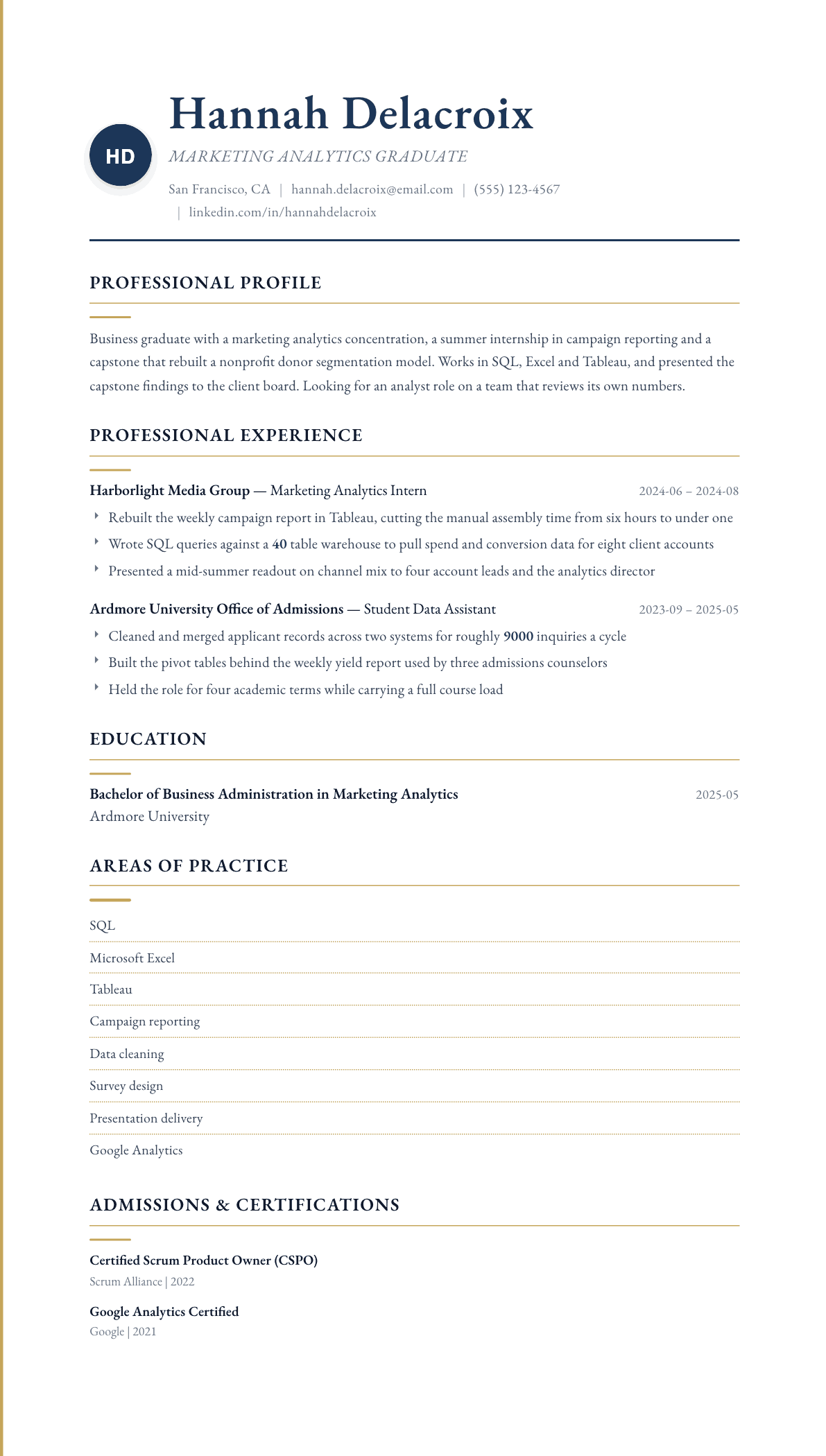
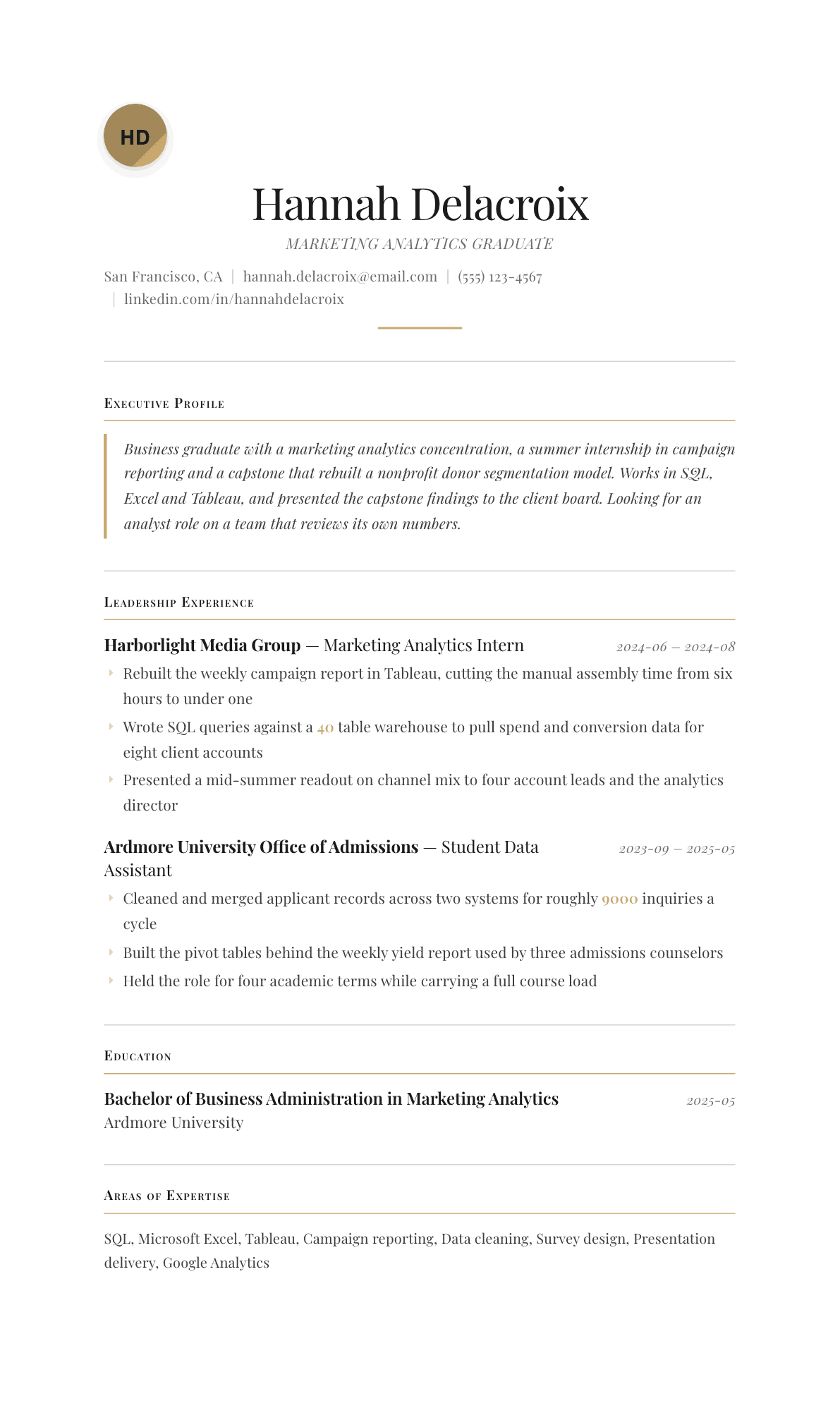
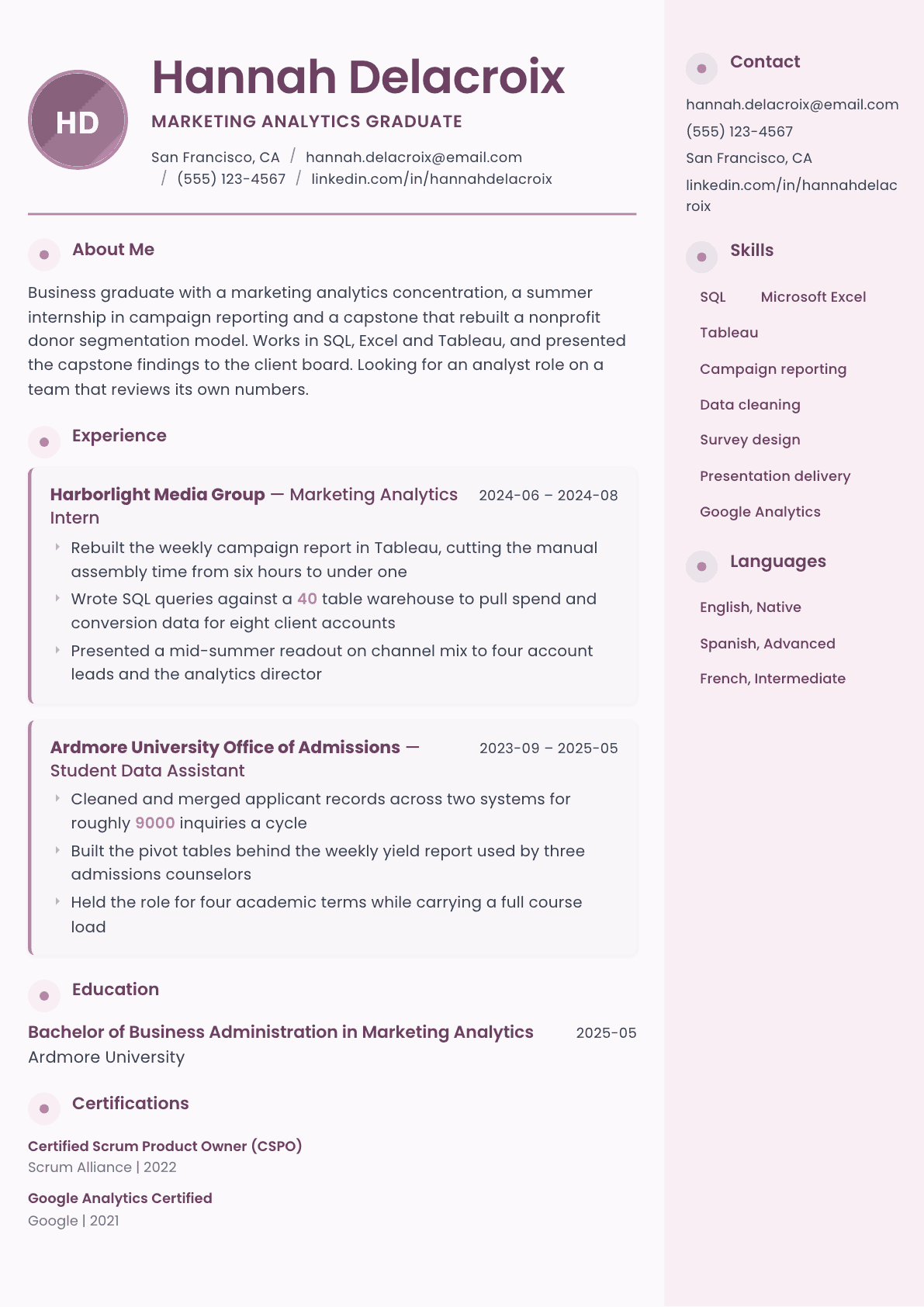
The same college graduate content laid out in three CVBooster templates, so you can see what the finished document looks like before you write a word.
Example College Graduate summary
Business graduate with a marketing analytics concentration, a summer internship rebuilding client campaign reporting in Tableau, and four academic terms in a campus admissions office cleaning applicant data. Capstone project rebuilt a nonprofit donor segmentation model and was presented to the client board. Comfortable in SQL and Excel, and used to defending a number in front of people who will act on it.
Skills to list on a College Graduate resume
- SQL
- Microsoft Excel modeling
- Tableau
- Google Analytics
- Data cleaning and validation
- A/B test reading
- Survey design
- Campaign reporting
- Presentation and readout delivery
- Research methods
- Academic writing
- Project scoping
- Group project coordination
- Time management across deadlines
What actually gets this resume read
- Keep education at the top until you have a year of full time work, and put your concentration next to the degree.
- List four to six courses only when they name the skill in the job posting, and skip the introductory ones.
- Give your capstone or thesis a project entry with the client, the method and what the reader did with your finding.
- Write internships like real jobs, with the team you sat on, the tools you used and what changed after you left.
- Include campus work such as a lab, a library desk or an admissions office, because four terms in one role proves reliability.
- Name your GPA only when it is strong, and put honors, scholarships or a dean list line next to it.
- Match the posting language exactly for tools you truly know, since campus recruiters filter on the tool names first.
How to write a college graduate resume
A college graduate resume is judged on a different axis than an experienced one. The recruiter is not weighing your track record, because you do not have one yet. She is weighing your raw material: the degree and its concentration, the difficulty of what you completed, the internships that put you inside a real team, and the one project where you produced something a stranger could evaluate.
This matters because graduate hiring runs on volume. A campus recruiter fills a cohort from hundreds of near identical pages, all listing a bachelor degree, a summer internship and the same four adjectives. The pages that survive are the ones that make the reader stop at a specific artifact: a capstone with a named client, a lab technique, a language pair, a query you wrote against a real warehouse, a piece of work that existed outside a syllabus.
This guide is for the graduate applying inside the first months after commencement, while the degree is still the strongest thing on the page. It covers when education stays on top, which coursework is worth listing, how to write a capstone or thesis as a project, how internships and campus jobs should be described, and how to signal readiness for a structured graduate program without inflating what you did.
Education stays on top, and it says more than the degree name
While your degree is the strongest credential you own, education sits above experience. Give the institution, the full degree name, the concentration or major, the graduation month, and any honors designation. A concentration is not decoration: an economics degree with an econometrics concentration reads differently to an analytics team than a general one, and the reader will not assume it.
Add a minor when it supports the target role, a study abroad term when the language is relevant, and a thesis or capstone title when it is substantive. Include the grade point average when it is competitive and leave it off when it is not, since an absent figure is far less damaging than a weak one sitting under a bold heading.
- Degree, concentration, institution and graduation month, in that order.
- Honors, scholarships and dean list terms, kept to one line.
- Four to six relevant courses only, chosen against the posting, with introductory ones removed.
- Thesis or capstone title, and the method or tooling behind it.
- Academic exchange or research terms when they add a language or a technique.
Coursework earns its place only when it names a skill the job asks for
A relevant coursework line is useful when it is targeted and useless when it is exhaustive. Choose the courses that name a tool or method in the job posting, such as regression analysis, financial modeling, organic chemistry laboratory, or database systems. Drop the survey courses everyone in your program took, because they tell the reader nothing except that you completed a degree they can already see.
A better move than a course list is a projects section. A course produces a grade, and a project produces an artifact. Turn the strongest two into entries with a client or a data source, the method, what you built, and what the audience did with it. That structure reads like work experience because it is the closest thing to it you have.
Internships and campus jobs: describe the team, not the assignment
Write an internship the way you would write a job. Name the team you sat on, the systems you were given access to, the deliverable you owned, and what happened to it after your last day. An intern who says the report she rebuilt is still run every Monday has answered the doubt every recruiter carries about whether interns produce anything durable.
Campus employment is underrated and most graduates bury it. Four terms at a library desk, an admissions office or a research lab, held while carrying a full course load, is a longer continuous work record than most of your competition can show. Say the term count and the hours a week alongside the duties, because the duration is the point.
Where the experience is thin, quantify honestly. A ten week internship is a ten week internship, and inflating it into a strategic role is transparent to anyone who has managed interns. Reviewers respond well to a graduate who is precise about scope, because precision is itself a signal about how you will report on your own work.
Signals a graduate program screener is actually hunting for
Structured graduate schemes screen for a small set of proxies: quantitative comfort, written clarity, evidence you can work in a team you did not choose, and evidence you finish things. Every section of the page should be feeding one of those four. A group project with a fixed deadline and a difficult teammate is on point. A hobby list is not.
Leadership in a society, a sports team or a student business is worth space when you describe the operating detail: the budget you administered, the members you recruited, the event you ran and how many attended. The interest is not in the title. It is in whether you have ever been responsible for something continuing after you got bored of it.
- Quantitative evidence: a statistics sequence, a modeling tool, a lab method, a query language.
- Written evidence: a thesis, a published article, a client facing report, an editing role.
- Team evidence: a group project with a real deadline, a committee seat, a competition entry.
- Completion evidence: a role held for multiple terms, a project delivered to an external party.
- Tool names spelled exactly as the posting spells them, since graduate applications are filtered in bulk.
Layout, length and the details that get graduate resumes discarded
One page, no exceptions at this stage. Use one font, consistent date alignment on the right, and no photograph unless the country you are applying in expects one. Recruiters reviewing a large cohort read the same page shape hundreds of times, and anything unusual costs attention you would rather spend on the capstone entry.
The details that quietly disqualify a graduate are almost never about content. A university email address that expires in weeks, a file named final version two, a summary written for a different employer, an unexplained gap between graduation and the application date. Fix all four before you send anything, and set up a durable email address you will still hold next year.
College Graduate resume summary examples
Graduating with an internship
Business graduate with a marketing analytics concentration, a summer internship rebuilding client campaign reporting in Tableau, and four academic terms in a campus admissions office cleaning applicant records. Capstone rebuilt a nonprofit donor segmentation model and was presented to the client board. Comfortable in SQL and Excel.
Graduating with two internships
Mechanical engineering graduate with two industry placements totaling 9 months, one in tooling design and one in process improvement on an assembly line. Cut a fixture changeover from 22 minutes to 14 during the second placement. Holds SolidWorks and GD&T coursework and a senior design project delivered to an external sponsor.
Graduating with honors and research
Biochemistry graduate with honors, 3 semesters in a structural biology lab and a first author poster at a regional conference. Trained in protein purification, western blot and cell culture, and ran the lab reagent inventory. Seeking a research associate seat in an industry laboratory.
Work experience bullets: before and after
Before: Completed a capstone project for my degree.
After: Rebuilt a donor segmentation model for a local nonprofit as a capstone, clustering 14 years of gift records and presenting three donor tiers to the client board.
A named client, the data and the audience turn an academic requirement into deliverable work.
Before: Interned at a media company over the summer.
After: Rebuilt the weekly campaign report in Tableau during a ten week internship, cutting manual assembly from six hours to under one, and the report is still run each Monday.
Duration, tool, time saved and survival after you left address every doubt about intern output.
Before: Worked part time at the university.
After: Held a student data assistant role for four academic terms while carrying a full course load, merging applicant records across two systems for about 9000 inquiries a cycle.
Term count next to a full course load proves endurance that a duty list alone cannot.
Before: Member of the student investment club.
After: Managed a 6 person research pod in the student investment club, presenting two equity pitches a semester to a committee that allocated a real portfolio.
Team size, output cadence and real money show responsibility rather than membership.
Before: Strong analytical and communication skills.
After: Wrote SQL against a 40 table warehouse to pull spend and conversion data for eight client accounts, then presented a channel mix readout to four account leads.
The claim is replaced by the query, the scope and the audience who had to act on it.
Hard skills
- SQL and relational database basics
- Microsoft Excel modeling and pivot tables
- Data visualization in Tableau or Power BI
- Statistical analysis coursework
- Research design and survey methods
- Academic and report writing
- Presentation and readout delivery
- Laboratory or field methods relevant to the degree
- Google Workspace and Microsoft 365
- Version control basics
- Second language proficiency
Soft skills
- Working with a group you did not choose to a fixed deadline
- Taking feedback on a draft without defending it
- Managing several deadlines that land in the same week
- Asking a supervisor for scope before starting
- Explaining a technical result to a non technical audience
Mistakes that cost college graduate candidates the interview
- Listing every course from the transcript instead of the four that match the posting.
- Writing an internship as duties assigned rather than as a deliverable that outlived the placement.
- Burying multi term campus employment at the bottom when its duration is the strongest reliability signal you have.
- Keeping a grade point average on the page when it is weak, where silence would have cost nothing.
- Sending a page still built around your degree program rather than around the role you are applying for.
- Using a university email that expires before the hiring process finishes.
- Padding to a second page with high school achievements that stopped being relevant at commencement.
College Graduate resume questions
How long should education stay at the top of my resume?
Until you have about a year of full time professional work. At that point the job becomes the stronger evidence and education moves below it, keeping only the degree, the institution and the graduation year without the coursework block.
Do I include a capstone or thesis on a college graduate resume?
Yes when it involved a real dataset, an external client or a method the employer uses. Give it a project entry with the question, the method and the outcome rather than a title, because the title alone tells a recruiter nothing.
What if I never had an internship?
Lead with campus employment, research assistance, competition entries and any project delivered to someone outside your program. Recruiters accept substitutes when they carry a deadline, an external audience and a result you can describe precisely.
Should I apply with the same resume to every graduate scheme?
Keep one master page and change the summary, the coursework selection and the skills order for each posting. The projects and internships stay the same, but which of them appears first should follow the requirements listed in the advert.
Is a projects section better than a skills list for a new graduate?
A projects section is stronger because it proves the skills instead of asserting them. Keep a short skills block for keyword matching, then let two well written projects carry the argument that you can produce something usable.