Medical Office Manager Resume Examples: read this first
Run a Well-Ordered Practice with a Medical Office Manager Resume
By Mustafa Tarabya, founder of CVBooster · Published · Updated
Build a medical office manager resume showcasing your expertise in practice operations, billing oversight, staff management, and regulatory compliance.
Sample resumes for a medical office manager
The same medical office manager content laid out in three CVBooster templates, so you can see what the finished document looks like before you write a word.
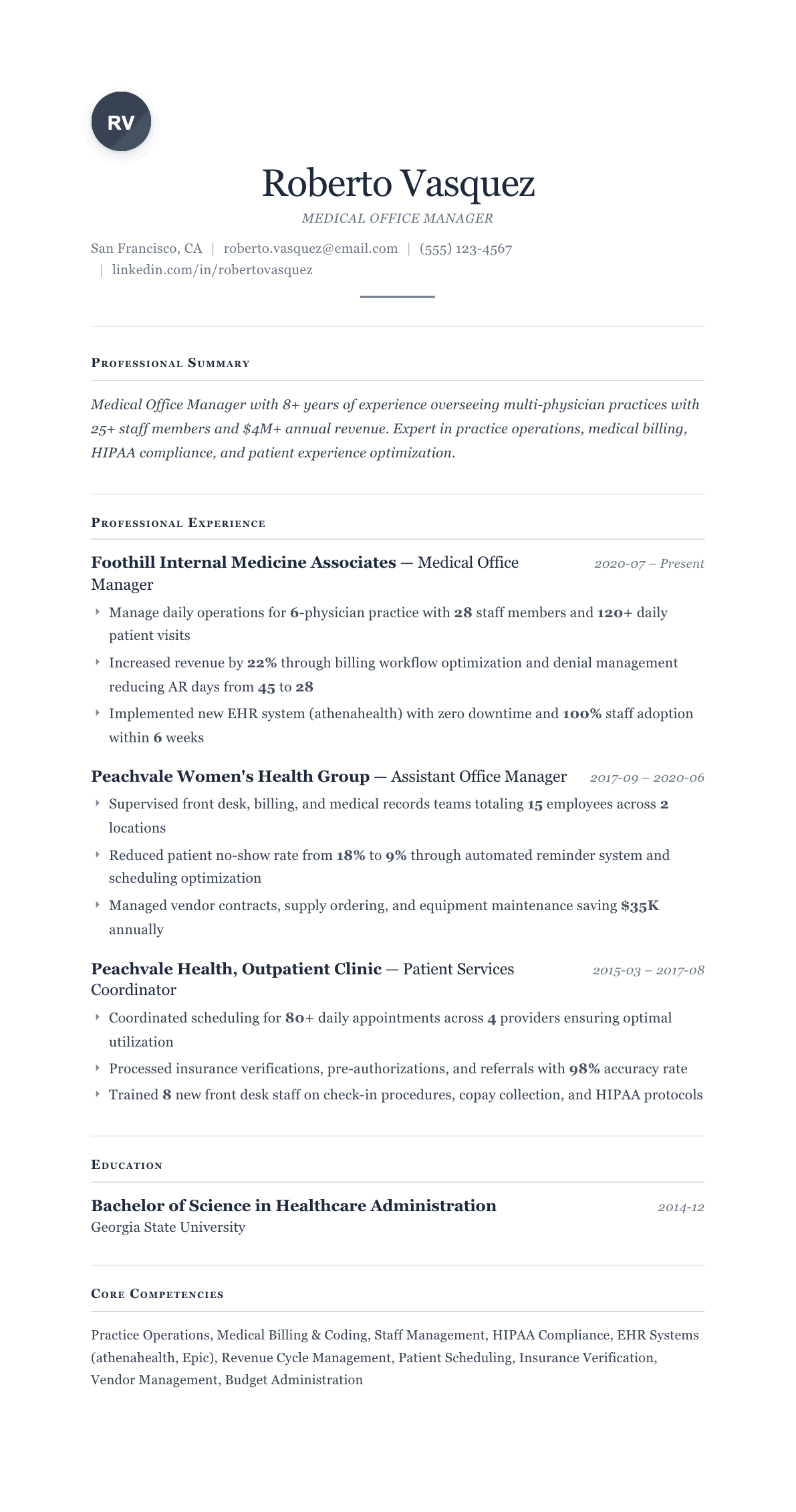
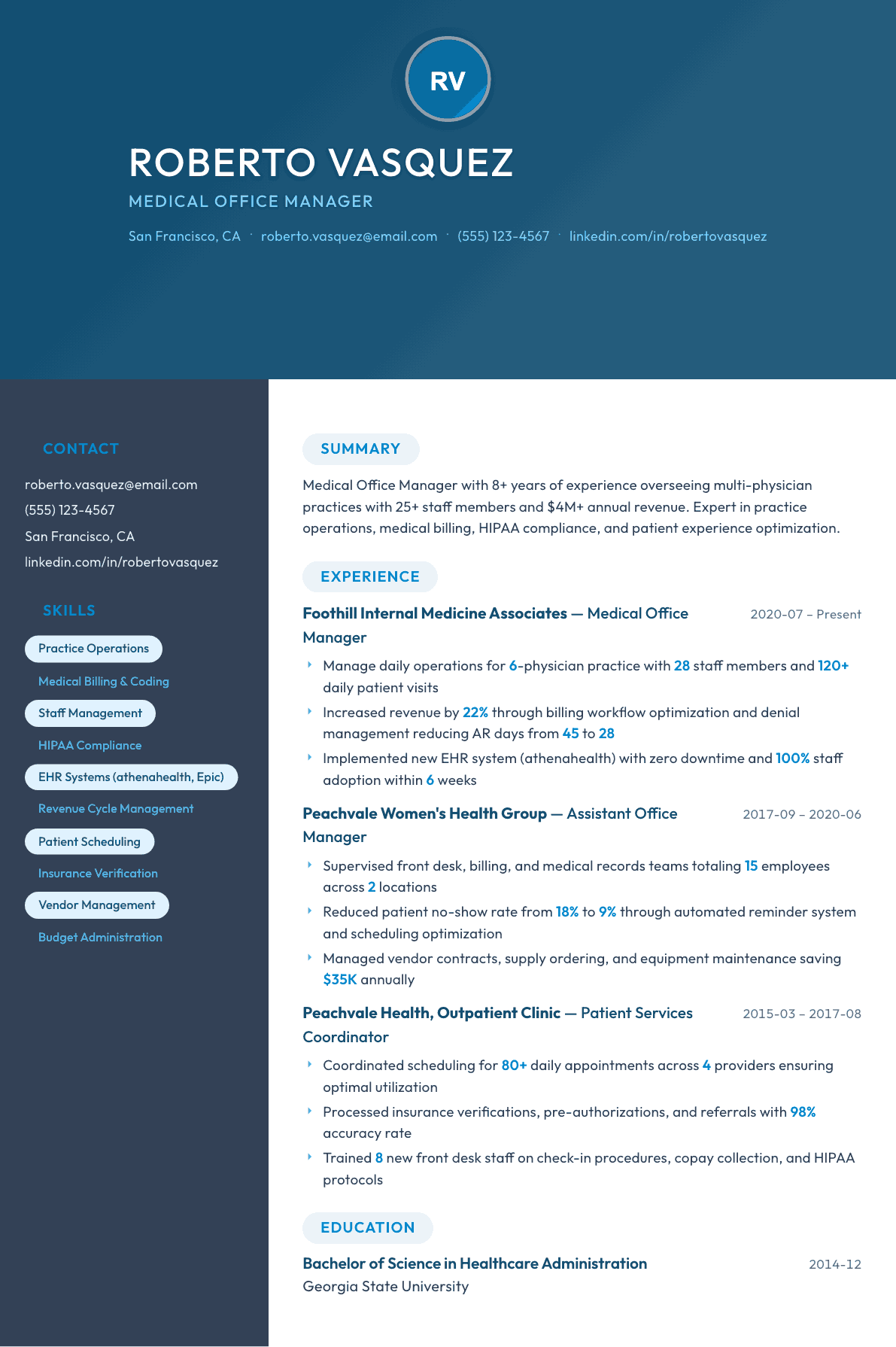
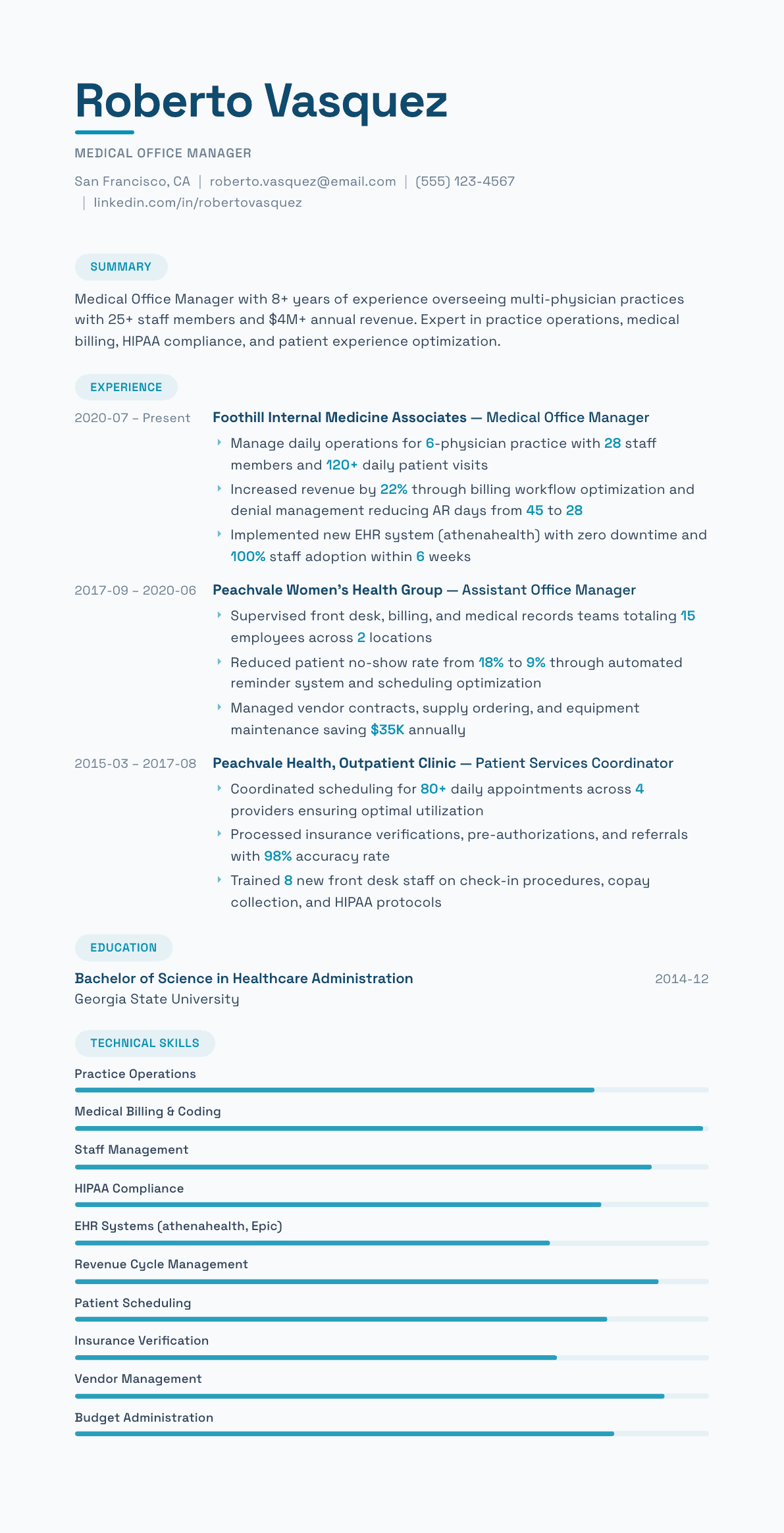
Example Medical Office Manager summary
Medical Office Manager with 8 years of experience overseeing multi-physician practices with 25+ staff and $4M+ revenue. Reduced AR days by 38% and patient no-shows by 50% while maintaining 100% HIPAA compliance.
Skills to list on a Medical Office Manager resume
- Practice Operations Management
- Medical Billing & Coding
- Staff Hiring & Management
- HIPAA Compliance
- EHR Systems (athenahealth, Epic)
- Revenue Cycle Management
- Patient Scheduling
- Insurance Verification & Auth
- Vendor & Supply Management
- Budget & Financial Reporting
- Quality Improvement
- Credentialing
What actually gets this resume read
- Specify practice size: number of physicians, staff, daily patient volume, and annual revenue.
- Highlight revenue cycle improvements: reduced AR days, increased collections, denial management.
- Include EHR implementation or migration experience. Medical offices value it highly.
- Demonstrate HIPAA compliance knowledge and any audit preparation experience.
- Show patient experience metrics: no-show rate reductions, wait time improvements, satisfaction scores.
How to write a medical office manager resume
A medical office manager resume is usually read by a practice owner, a physician partner or a regional director of operations, and the question behind their eyes is simple: will hiring this person make the practice quieter and the revenue cycle cleaner. They are looking for the size of the practice you ran, the specialty, the staff headcount, the systems you administered, and evidence that you understand where money leaks out of a clinic.
This role sits on top of three separate machines: the front office, the revenue cycle and the clinical staff schedule. A resume that only describes one of them reads as an office coordinator rather than a manager. The strongest files show scheduling and patient flow, billing and collections, compliance, and people management, with a number attached to each.
This guide covers the section order practice owners expect, how to size your practice in a way the reader can compare, how to write revenue cycle results without inventing figures, and the questions office managers ask when they move between specialties or from a hospital clinic to private practice.
Format: two pages is normal, practice profile before the bullets
Use reverse chronological order and allow a second page once you have run more than one practice. This is an operations role, and operations resumes carry more surface area than clinical ones because each practice has to be described before the results make sense.
Under each employer, write a one line practice profile: the specialty, the number of providers, the staff headcount you supervised, the number of locations and the daily patient volume. Without those numbers a reader cannot tell whether you managed a solo dermatology office or a six physician internal medicine group with twenty eight staff.
- Header: name, city and state, phone, email, and any coding or practice management credential.
- Sections in this order: summary, core competencies, professional experience, systems, education and certifications.
- Keep a short systems block so the electronic health record and clearinghouse names are findable without reading every bullet.
Summary: specialty, provider count, staff count, what you fixed
Four lines at most. Name the specialty, the size of the practice, the scope you owned and one operational result you are known for. "Practice manager for a six provider internal medicine group with twenty eight staff, owning front office, billing and credentialing" gives a reader the whole shape of the job before a single bullet.
Specialty matters more than candidates think. Orthopedics with imaging and durable medical equipment, obstetrics with global maternity billing, behavioral health with authorization requirements, and a surgical practice with facility coordination each carry different operational risk. Say which one you know.
Revenue cycle: the section that gets you interviewed
This is where a practice owner slows down. Write about days in accounts receivable, the clean claim rate, denial rate and denial management, aging buckets, patient collections at the point of service, and the credentialing and payer enrollment work that determines whether a new provider can bill at all.
Say what you changed and how. Reworking the front end so eligibility and benefits are verified before the visit, building a denial worklist by payer and reason code, moving copay collection to check in, or renegotiating a clearinghouse relationship are concrete levers. Give the before and after on a metric such as days in accounts receivable rather than a currency amount, which reads as unverifiable.
Credentialing deserves its own bullet if you have done it. Provider enrollment with commercial payers, Medicare and Medicaid, plus revalidation deadlines, is a job most managers dread and many practices have no one to handle.
People, patient flow and compliance
Name the headcount you hired, trained, scheduled and evaluated, and the roles: front desk, medical assistants, billers, referral coordinators, medical records. Turnover and retention are fair to mention because a practice owner has felt the cost of a revolving front desk.
On patient flow, the metrics people recognize are no show rate, cycle time from check in to check out, template utilization, and third next available appointment. Any of these framed as a before and after is stronger than a claim about efficiency.
Compliance belongs in its own bullet: HIPAA training and safeguards, OSHA requirements for the clinical area, incident logs, chart audits, and the preparation you led for an accreditation or payer audit. Physicians hire managers who reduce their exposure.
Systems and the vocabulary the posting will use
Name the electronic health record and practice management system by product, because migration experience is worth money: athenahealth, Epic, eClinicalWorks, NextGen, Kareo, AdvancedMD or Greenway. Add the clearinghouse, the patient engagement or reminder tool, the phone system, and the payroll or scheduling platform you administered.
Practice postings repeat a predictable vocabulary: revenue cycle management, prior authorization, eligibility verification, coding and charge entry, accounts receivable follow up, provider credentialing, patient satisfaction, staff supervision, inventory and vendor management, and quality reporting. Use the phrasing the posting uses once in the competencies block and once inside a bullet that proves it.
If you led an electronic health record implementation or conversion, that single line often earns the interview. Give the practice size, the go live timeline and what happened to productivity during the transition.
Medical Office Manager resume summary examples
Moving up from the front desk
Patient services coordinator of three years stepping into practice management, currently scheduling four providers and eighty visits a day, training new front desk hires, and running eligibility and prior authorization for a busy family medicine clinic. Completed a practice management certificate and studying for a coding credential.
Managing a single site
Medical office manager for a six provider internal medicine practice with twenty eight staff and roughly 120 visits daily, owning front office, billing oversight, credentialing and compliance. Reduced days in accounts receivable from forty five to twenty eight through denial management and front end eligibility checks.
Multi-site practice administrator
Practice administrator across three orthopedic locations with fourteen providers and sixty employees, accountable for revenue cycle, staffing models, payer contracts and facility operations. Led an electronic health record conversion across all sites and rebuilt the credentialing calendar after two revalidation lapses.
Work experience bullets: before and after
Before: Managed the daily operations of a medical office.
After: Ran daily operations for a six physician internal medicine practice with twenty eight employees and roughly 120 patient visits a day across two locations.
Provider count, headcount and visit volume let an owner compare your practice with theirs.
Before: Improved billing and collections.
After: Cut days in accounts receivable from forty five to twenty eight by building a denial worklist by payer and reason code and moving eligibility checks to two days before the visit.
A named metric with a before and after, plus the mechanism, is what a practice owner can trust.
Before: Reduced patient no-shows.
After: Brought the no show rate down from 18% to 9% using automated text reminders, a same day waitlist and a rebooking script for the front desk.
The rate change and the three specific tactics show an operator, not a bystander.
Before: Implemented a new EHR system.
After: Led the practice onto athenahealth in six weeks: mapped templates with each provider, trained twenty eight staff in three cohorts, and kept the schedule at full capacity through go live week.
Timeline, training plan and the productivity outcome turn a project mention into proof you can run one.
Before: Handled insurance credentialing for providers.
After: Owned commercial, Medicare and Medicaid enrollment for eleven providers, rebuilt the revalidation calendar, and closed two lapsed enrollments that had been blocking claims for months.
It names the payer types, the volume and a specific problem solved, which is what makes credentialing credible.
Hard skills
- Revenue cycle management
- Accounts receivable and denial management
- Provider credentialing and payer enrollment
- Eligibility verification and prior authorization
- Medical coding oversight
- Electronic health record administration
- Staff scheduling and payroll
- HIPAA and OSHA compliance
- Vendor and supply contract management
- Patient scheduling and template design
- Budgeting and financial reporting
- Quality reporting and chart audits
Soft skills
- De-escalating patient complaints
- Physician partnership
- Hiring and retention
- Written process discipline
- Cross-team coordination
- Calm during system outages
Certifications worth listing
- Certified Medical Manager (CMM) (Professional Association of Health Care Office Management)
- Certified Medical Practice Executive (CMPE) (American College of Medical Practice Executives)
- Certified Professional Coder (CPC) (AAPC)
- Certified Professional Biller (CPB) (AAPC)
- Certified Healthcare Access Manager (CHAM) (National Association of Healthcare Access Management)
Mistakes that cost medical office manager candidates the interview
- Describing duties without sizing the practice, so the reader cannot tell a solo office from a fourteen provider group.
- Leaving the revenue cycle out entirely and writing only about scheduling and supplies, which reads as a coordinator resume.
- Claiming a revenue increase in currency terms with no mechanism, when days in accounts receivable and denial rates are the numbers owners believe.
- Skipping the names of the electronic health record and practice management systems, which is the first filter for a practice on the same platform.
- Ignoring credentialing and payer enrollment even when you have done it, because many practices are hiring specifically for that gap.
- Listing compliance as a keyword with no audit, training program or chart review behind it.
Medical Office Manager resume questions
Do I need a coding certification to be a medical office manager?
It is not required, but a coding or billing credential makes your oversight of the revenue cycle believable and often decides between two similar candidates. A practice management credential carries more weight once you are running multiple providers or sites.
How do I show results without giving away practice financials?
Use operational ratios instead of currency. Days in accounts receivable, clean claim rate, denial rate, no show rate, staff turnover and cycle time all show impact and none of them expose a private practice balance sheet.
Does specialty experience matter when applying to a different type of practice?
It matters for billing complexity more than for daily operations. Explain the transferable machinery, then name the specialty risk you already handle, such as prior authorization volume, surgical scheduling or global billing periods, and say which parts you would learn.
How long should a medical office manager resume be?
One page early on, two pages once you have managed several practices, a conversion project or multiple sites. Keep the practice profile lines short so the second page carries results rather than restated duties.
Should I include staff headcount and turnover numbers?
Yes on headcount, and yes on retention when it is good. A practice owner who has lost three front desk staff in a year reads a retention number as directly relevant, and it is one of the few people metrics that is easy to verify in a reference call.