Medical Assistant Resume Examples: the lines they read
Medical Assistant Resume Examples, Entry Level to Lead
By Mustafa Tarabya, founder of CVBooster · Published · Updated
Medical assistant resume examples from entry level to lead: an externship based sample for new graduates, job description bullets, certification wording and EHR keywords.
Sample resumes for a medical assistant
The same medical assistant content laid out in three CVBooster templates, so you can see what the finished document looks like before you write a word.
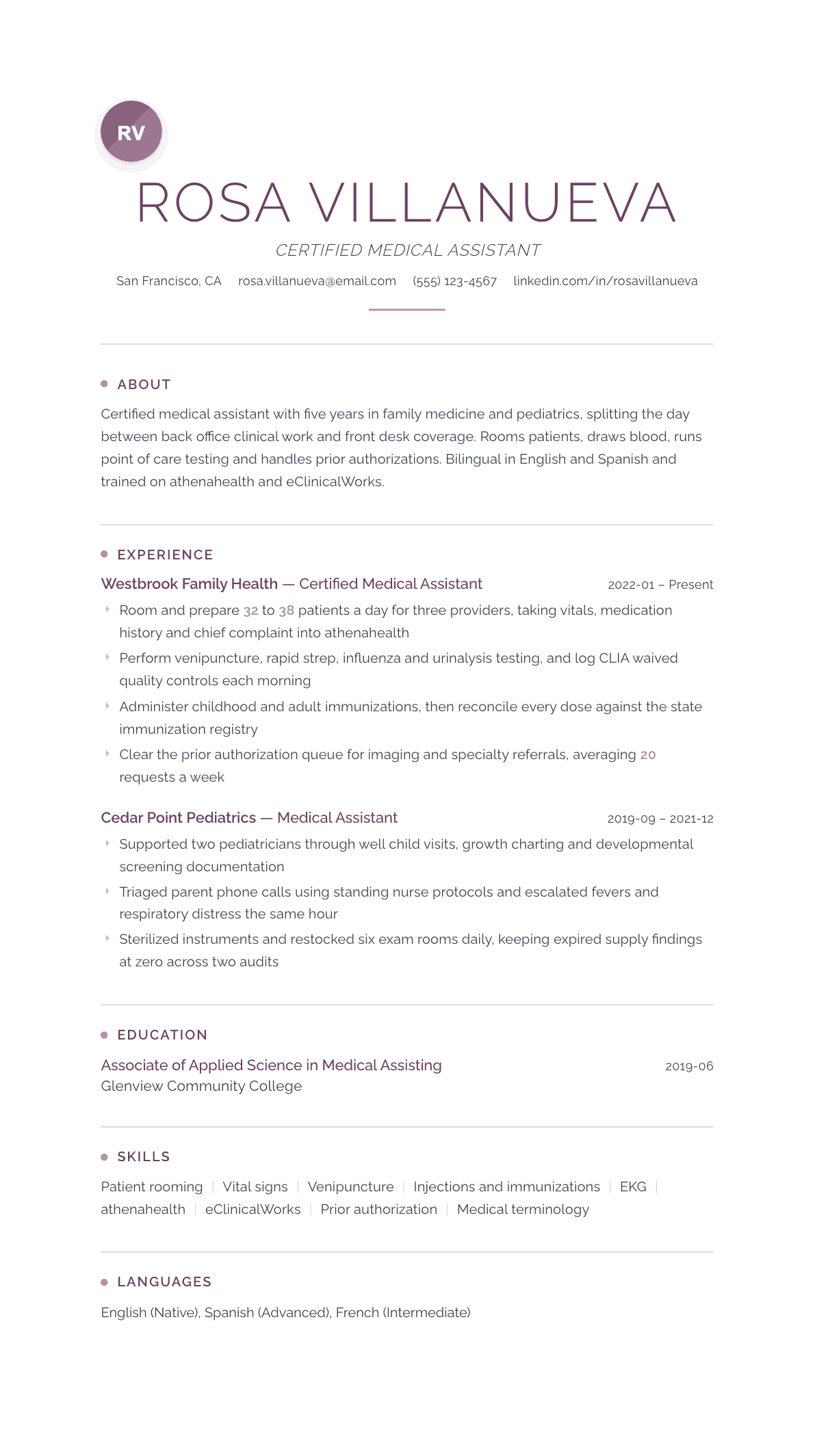
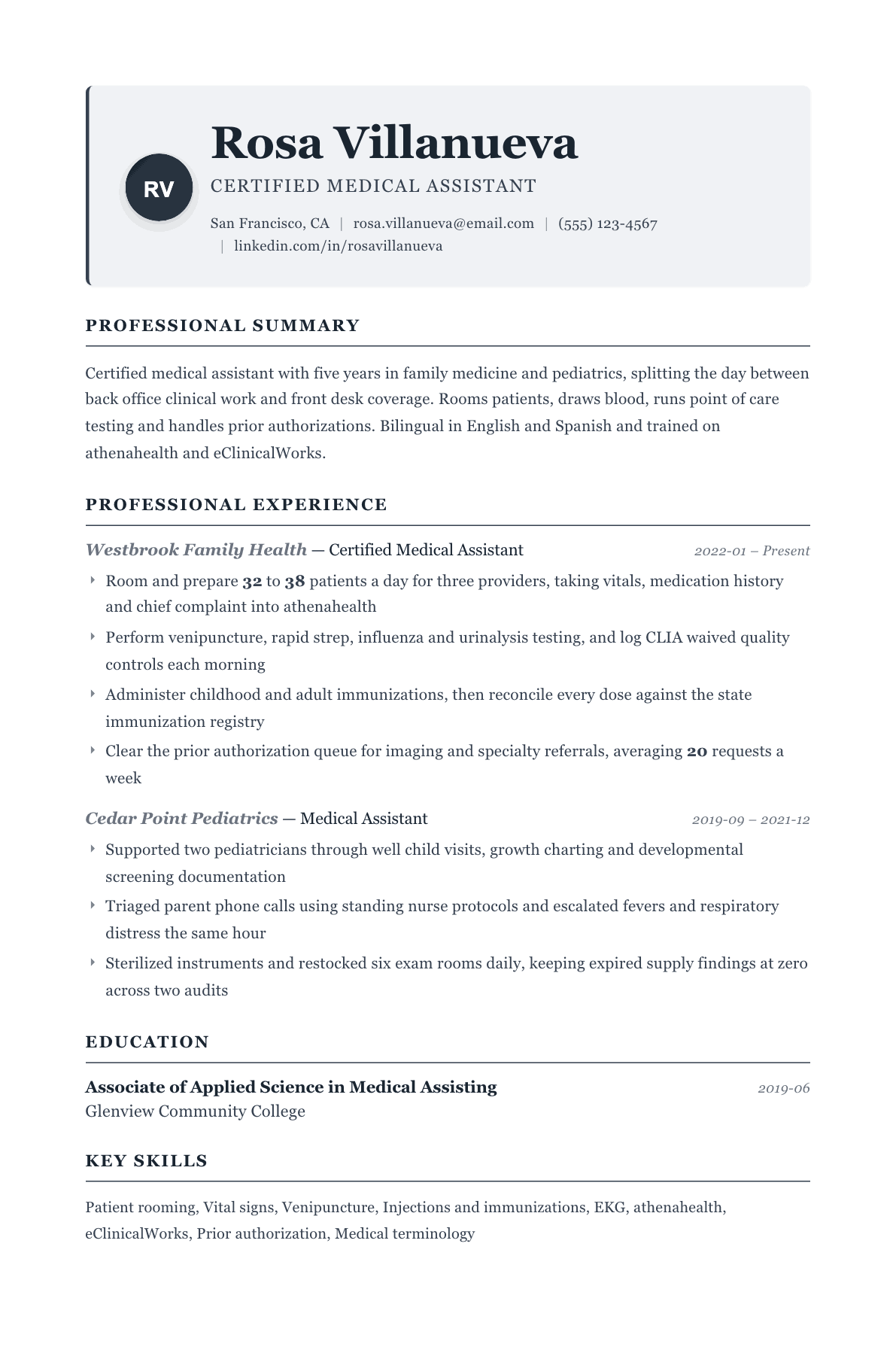
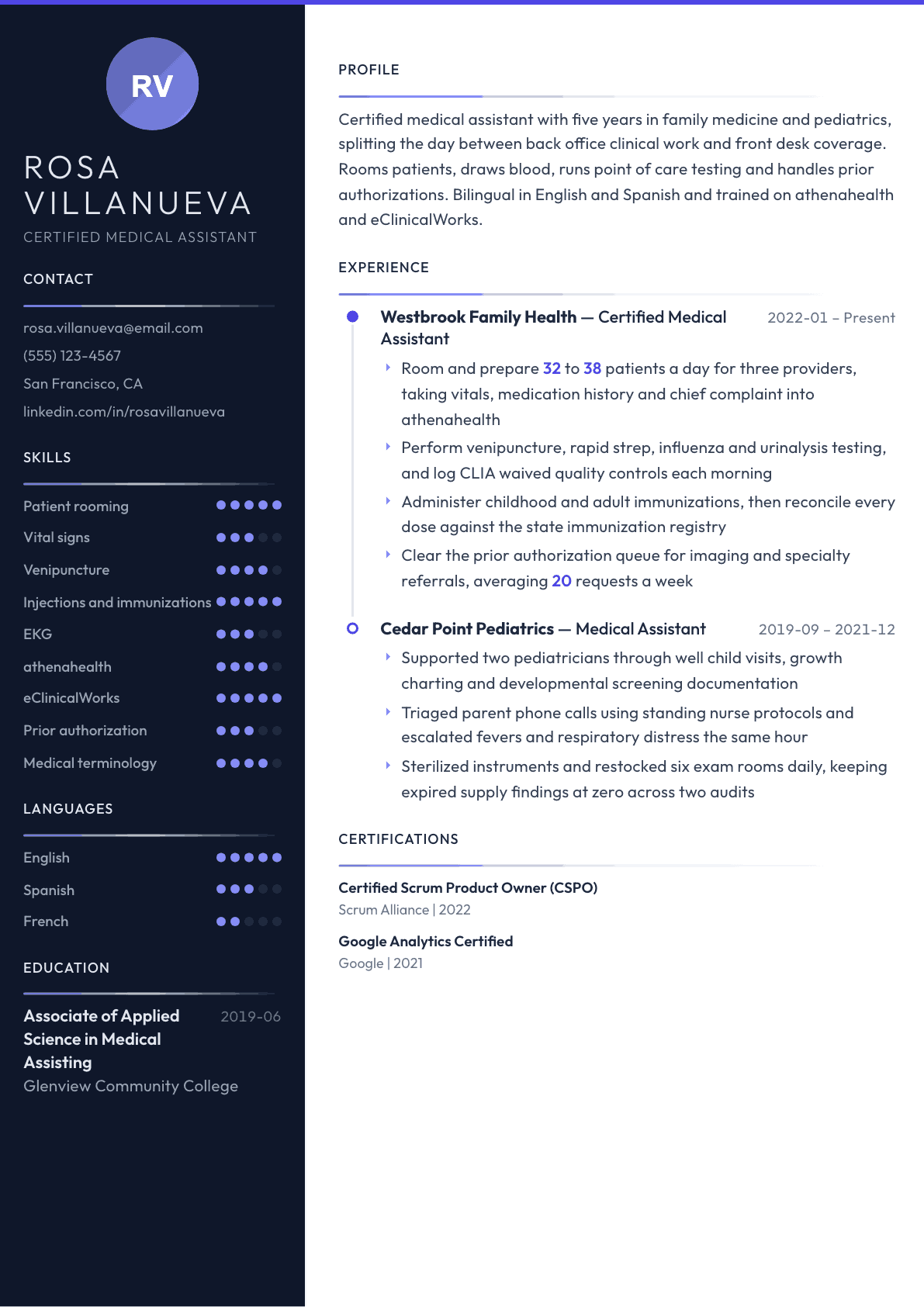
Example Medical Assistant summary
Certified Medical Assistant with five years across family medicine and pediatrics, rooming more than thirty patients a day for a three provider practice. Strong on venipuncture, immunizations, EKG and point of care testing, plus the administrative side: prior authorizations, insurance verification and referral tracking. Bilingual in English and Spanish. Looking for a clinical role in a primary care group with a busy panel.
Skills to list on a Medical Assistant resume
- Patient rooming and intake
- Vital signs measurement
- Venipuncture and capillary draws
- Intramuscular injections
- Immunization administration
- EKG acquisition
- Point of care testing
- Specimen collection and labeling
- Sterilization and autoclaving
- Medical terminology
- Electronic health records
- Prior authorization
- Insurance verification
- Appointment scheduling
- HIPAA compliance
- Inventory and supply stocking
What actually gets this resume read
- Split your bullets into clinical and administrative work, because most clinic postings hire for both halves of the job.
- Put your CMA or RMA certification and the certifying body in the header line, not buried at the bottom of page one.
- Name the electronic health record by product name, since clinic managers filter resumes on the system they already run.
- Give patient volume per day and how many providers you supported, which tells a manager the pace you can hold.
- List the specific point of care tests and injections you are checked off on rather than writing clinical procedures.
- Mention a second language if you speak one, because bilingual medical assistants get pulled out of the pile first.
How to write a medical assistant resume
Medical assistant openings are usually filled by a clinic manager who is short staffed this week. She is not reading for polish. She is reading for whether you can be dropped into a rooming rotation on Monday, draw blood without a second attempt, and clear a referral queue in the afternoon without asking three questions per patient.
The job splits into a clinical half and an administrative half, and most practices hire for both. A resume that only describes vitals and rooming reads as half a candidate, and one that only describes scheduling and insurance reads like a front desk application.
What follows is the section order clinic managers expect, an entry level medical assistant resume sample built from an externship, how to write bullets that carry patient volume and procedure names, what certification wording gets read correctly, and the five questions medical assistants ask most when writing this resume.
Format: one page, certification in the header
One page, reverse chronological, no columns. Clinic applicant tracking systems are often a basic module inside the practice management suite, and they mangle tables and icon rows. Plain headings and a single column parse cleanly every time.
Put your credential right after your name: Rosa Villanueva, CMA (AAMA) or Terrence Boyd, RMA (AMT). The parenthetical body matters, because a certified medical assistant credential from one body and a registered medical assistant credential from another are checked differently by a compliance office.
- Header: name with credential, city and state, phone, email, languages spoken.
- Section order: summary, certifications, clinical experience, skills, education, externship if recent.
- New graduates move the externship above work history and describe the specialties rotated through.
Summary: specialty, volume, and both halves of the job
Three lines. Name the specialties you have worked in, how many patients a day you room, how many providers you support, and the clinical procedures you are checked off on. A manager reading family medicine, pediatrics, thirty to thirty five patients a day, three providers already knows whether her pace matches yours.
Close the summary with the administrative half: prior authorizations, insurance verification, referral coordination or scheduling. Practices that run lean need one person who can cross the hallway, and saying so plainly is worth more than any adjective.
Experience: procedures by name, patients by number
Each job gets the practice type, the specialty, the provider count and the daily patient volume, then three to five bullets. Lead with the clinical work: rooming and intake, vitals, medication reconciliation, venipuncture, injections, immunizations, EKG acquisition, spirometry, ear lavage, suture removal, wound dressing and point of care testing.
Point of care testing deserves its own mention because it is regulated. Say which waived tests you run, whether you log the daily quality controls, and whether you have been through a survey. That detail marks you as someone who understands the compliance side of the back office.
Then the administrative bullets: prior authorization submissions and their weekly count, referral tracking, insurance eligibility checks, patient callbacks under standing protocols, and record requests. Keep them concrete. Assisted with office duties is invisible on the page.
- Name the electronic health record: Epic, athenahealth, eClinicalWorks, NextGen, Cerner Ambulatory, Practice Fusion.
- State the specialty of every clinic, because a dermatology back office and a pediatric one share very little.
- Include immunization registry work, recall lists and chronic care gap closure if you have done them.
Entry level medical assistant resume: externship, certification and scope
An entry level medical assistant resume has no long work history to lean on, so the externship does the job of the first position. Give the site type, the specialties, the total hours and the procedures a preceptor signed off, then put your program, its accrediting body and your exam status directly under it. A clinic manager hiring a new graduate is asking one question: how much will I have to teach this person before she can room patients alone.
List the credential, the certifying body and the current status. If your program was accredited, name the accrediting body, since some states and many hospital systems require graduation from an accredited program before they will hire.
Add anything that widens your scope: a phlebotomy certificate, a limited x-ray operator permit where your state issues one, BLS certification, and any state specific medication administration training. Each of those removes a training cost for the practice, which is exactly why it belongs on the page.
The sample below is an invented entry level medical assistant resume for a new graduate with no paid clinical job yet. Copy the structure, not the facts.
- Header: Dana Whitfield, CCMA (NHA), Columbus, Ohio, phone, email, English and Spanish.
- Summary: Medical assistant graduate of an accredited diploma program with a 180 hour externship in family medicine. Signed off on rooming, vitals, venipuncture, injections and twelve lead EKG, and trained on eClinicalWorks. Available for full time back office work, including Saturday clinics.
- Externship, family medicine practice with four providers: Roomed up to 18 patients a shift under supervision, recording vitals, history and medication lists in the record before the provider entered.
- Externship bullet two: Completed supervised venipuncture and capillary draws on adults and children, labeled specimens and logged them for the outside lab.
- Earlier job, retail pharmacy cashier: Handled insurance questions and prescription pickups for about 60 customers a shift, which is front desk experience a clinic can use on day one.
Skills and the keywords clinics search on
Keep the skills section to real, checkable things: rooming, vital signs, venipuncture, intramuscular and subcutaneous injections, EKG, sterilization and autoclaving, specimen handling, medical terminology, the health record product, scheduling and prior authorization. Leave out team player and detail oriented, which every applicant claims and no manager believes.
Mirror the posting language once. Practices copy phrases like back office support, patient intake, clinical documentation, HIPAA compliance and insurance verification from a template, and matching those exact terms once in the summary and once in a bullet is enough.
Medical assistant job description for a resume
The medical assistant job description for a resume is the job posting turned into your own bullets: the clinical and administrative duties you actually did, with the setting, the volume and the systems named. The O*NET occupation summary describes the role as one that will "Perform administrative and certain clinical duties under the direction of a physician." Your bullets should show both halves of that sentence.
Copy the duty words from the posting you are answering, such as rooming, vitals, injections, EKG, phlebotomy, scheduling and prior authorizations, then add who, how many and which system. Below are job description bullets written for a family medicine clinic, ready to adapt.
- Rooms twenty five to thirty patients a day for two family medicine physicians, taking vitals, history and medication lists in the electronic health record before the provider enters.
- Administers intramuscular and subcutaneous injections and vaccines, documents lot numbers in the record and reports to the state immunization registry.
- Performs venipuncture and point of care tests, including glucose, strep and urine dipstick, and labels and logs specimens for the outside lab.
- Records twelve lead EKGs for the physician to read and prepares patients and rooms for minor procedures, including sterile setup and instrument cleaning.
- Schedules follow up visits and referrals, submits prior authorization requests and checks insurance eligibility at check in.
- Calls patients with normal results and refill approvals under provider protocols, and routes abnormal results and urgent messages to the provider the same day.
- Restocks exam rooms, checks expiration dates and logs refrigerator temperatures for vaccine storage every morning.
Medical Assistant resume summary examples
Recent graduate
Medical assistant graduate of an accredited program with a 200-hour externship in family medicine and urgent care. Checked off on rooming, vitals, venipuncture, injections and EKG, and trained on eClinicalWorks. CMA exam scheduled. Looking for a back office role in a primary care practice with a strong onboarding structure.
Four years in
Certified medical assistant with four years in family medicine, rooming 30 to 35 patients a day for three providers. Independent on venipuncture, immunizations, EKG and waived point of care testing, and clears roughly 20 prior authorizations a week. Bilingual in English and Spanish. Seeking a clinical role in a larger primary care group.
Lead medical assistant
Lead medical assistant with nine years across pediatrics and internal medicine, now supervising six back office staff at a two-site practice. Owns the rooming workflow, immunization registry reconciliation, vaccine cold chain logs and new hire competency sign-off. Ran the practice through its last accreditation survey without a clinical finding.
Work experience bullets: before and after
Before: Roomed patients and took vital signs.
After: Roomed 32 to 38 patients a day for three providers, recording vitals, medication reconciliation and chief complaint directly into athenahealth before the provider entered.
Volume, provider count and the named record system turn a routine task into a measure of the pace you hold.
Before: Performed lab work and blood draws.
After: Performed venipuncture and capillary draws on adults and children, ran rapid strep, influenza and urinalysis testing, and logged daily quality controls for all waived tests.
Naming the tests and the quality control logging shows you understand the regulated side of point of care work.
Before: Handled insurance and referrals.
After: Cleared roughly 20 prior authorization requests a week for imaging and specialty referrals, tracking each to approval and calling patients with the outcome.
A weekly count and a closed loop show ownership of a queue rather than occasional help with paperwork.
Before: Gave shots to patients.
After: Administered childhood and adult immunizations under standing orders, then reconciled every dose against the state immunization registry the same day.
The standing orders and the registry reconciliation prove the workflow, not just the injection technique.
Before: Kept exam rooms clean and stocked.
After: Stocked and turned over six exam rooms daily, autoclaved instruments on a logged cycle, and kept expired supply findings at zero across two internal audits.
A logged cycle and an audit result make a housekeeping bullet into evidence of reliability.
Hard skills
- Patient rooming and intake
- Vital signs measurement
- Venipuncture and capillary draws
- Intramuscular and subcutaneous injections
- Immunization administration
- EKG acquisition
- Waived point of care testing
- Specimen collection and handling
- Autoclaving and instrument sterilization
- Electronic health record documentation
- Prior authorization submission
- Insurance eligibility verification
- Medical terminology and coding basics
- Vaccine storage and cold chain logs
Soft skills
- Patient rapport at speed
- Phone triage under standing protocols
- Provider handoff communication
- Calm handling of upset patients
- Task switching between back and front office
- Training new back office staff
Certifications worth listing
- Certified Medical Assistant (CMA) (American Association of Medical Assistants)
- Registered Medical Assistant (RMA) (American Medical Technologists)
- Certified Clinical Medical Assistant (CCMA) (National Healthcareer Association)
- National Certified Medical Assistant (NCMA) (National Center for Competency Testing)
- Basic Life Support (BLS) (American Heart Association)
Mistakes that cost medical assistant candidates the interview
- Writing only the clinical half of the job when the posting clearly asks for front office coverage too, which reads as an incomplete candidate.
- Listing the credential as CMA with no certifying body, forcing a compliance office to email you before your file can move.
- Leaving out patient volume per day, which is the fastest way for a manager to judge whether you can handle her schedule.
- Describing the electronic health record as EHR experience instead of naming the product the practice already runs.
- Padding the skills list with generic traits while omitting the specific procedures and waived tests you are checked off on.
- Hiding a second language at the bottom of the page when bilingual staff are pulled to the top of most clinic piles.
- Using an icon-heavy template that the practice management applicant module strips down to unreadable text.
Medical Assistant resume questions
Do I need to be certified to get a medical assistant job?
Not everywhere, but certified applicants move first in most markets and some employers require it outright. If you are not certified yet, state that your exam is scheduled and name the credential you are sitting for, which reads far better than silence on the subject.
Should my resume list clinical and administrative work separately?
Group them within each job rather than splitting the whole resume. Lead each position with clinical bullets and close with administrative ones. That keeps the chronology intact while still showing a manager that you cover both halves of the back office.
How do I write an entry level medical assistant resume with no experience?
Lead with your externship as if it were a job. Give the site type, the specialties you rotated through, the total hours and the procedures you were signed off on. Then list your program, the accrediting body, and the health record system you trained on during class.
How do I turn a medical assistant job description into resume bullets?
Take the duties listed in the posting, keep only the ones you have actually done, and rewrite each as a past or present tense bullet with the setting, a realistic daily volume and the system or equipment you used. Use the posting words exactly, such as rooming or prior authorizations, so screening software finds them.
Does specialty experience matter when I am applying to a different clinic type?
It matters, so address it directly in your summary. Name the transferable procedures, say which parts of the new specialty you have touched, and lead your bullets with the closest work you have done. A pediatrics assistant applying to internal medicine leads with injections, EKG and chronic care recalls.