Medical Records Clerk Resume Examples: read this first
Build a Medical Records Clerk Resume Around Accuracy and Release of Information
By Mustafa Tarabya, founder of CVBooster · Published · Updated
Medical records clerk resume examples covering chart requests, release of information, EHR indexing and privacy keywords employers scan.
Sample resumes for a medical records clerk
The same medical records clerk content laid out in three CVBooster templates, so you can see what the finished document looks like before you write a word.
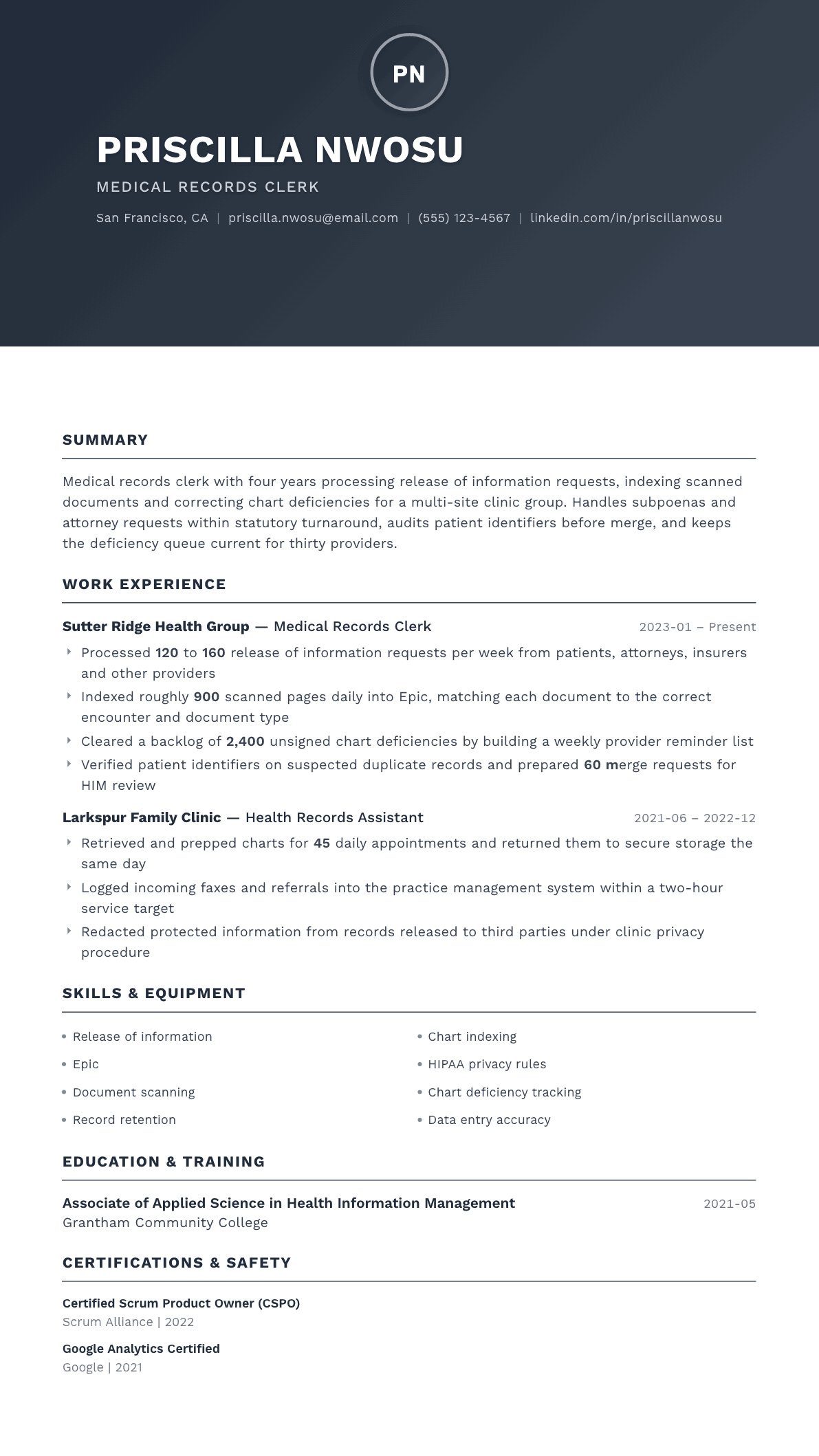
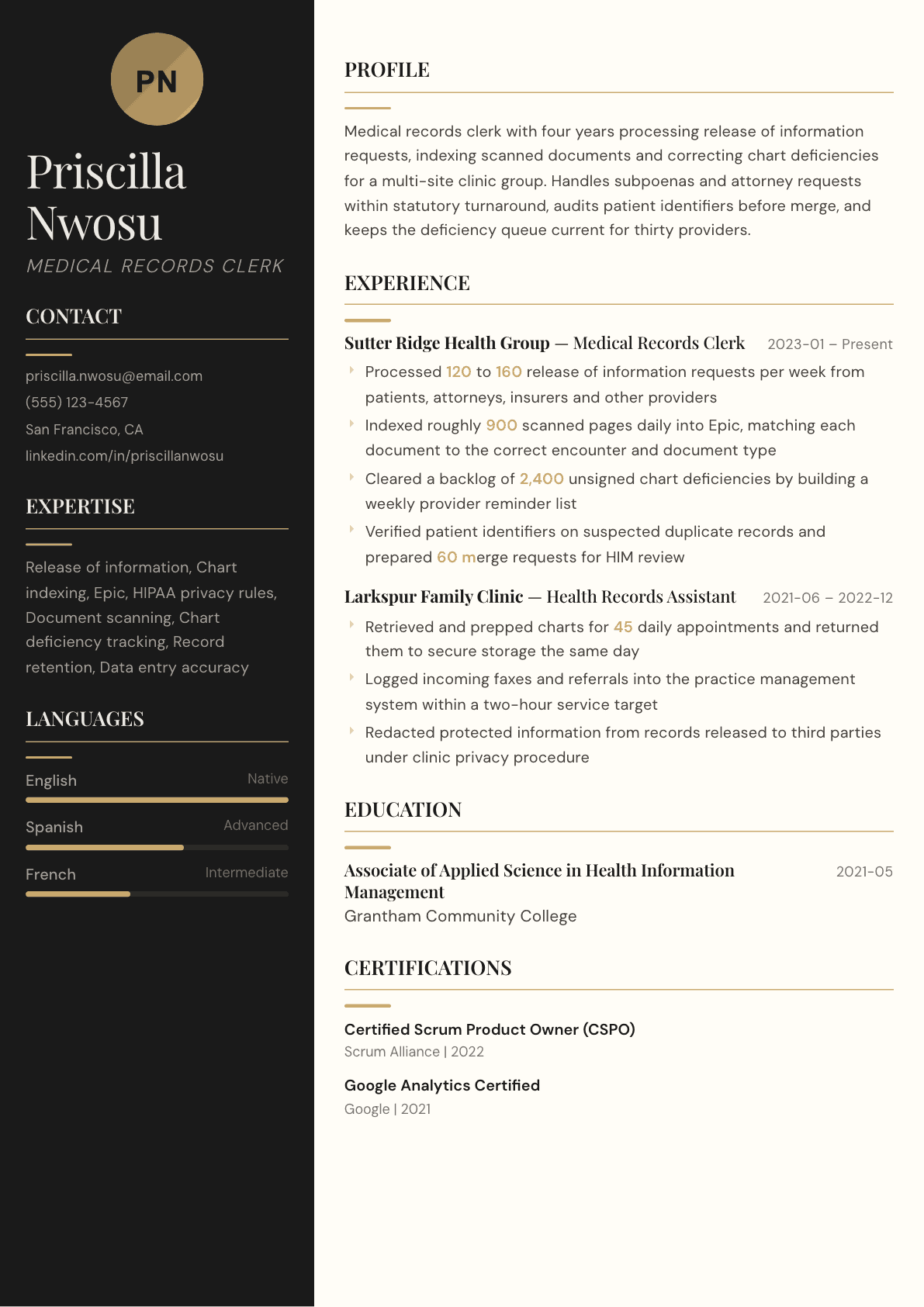
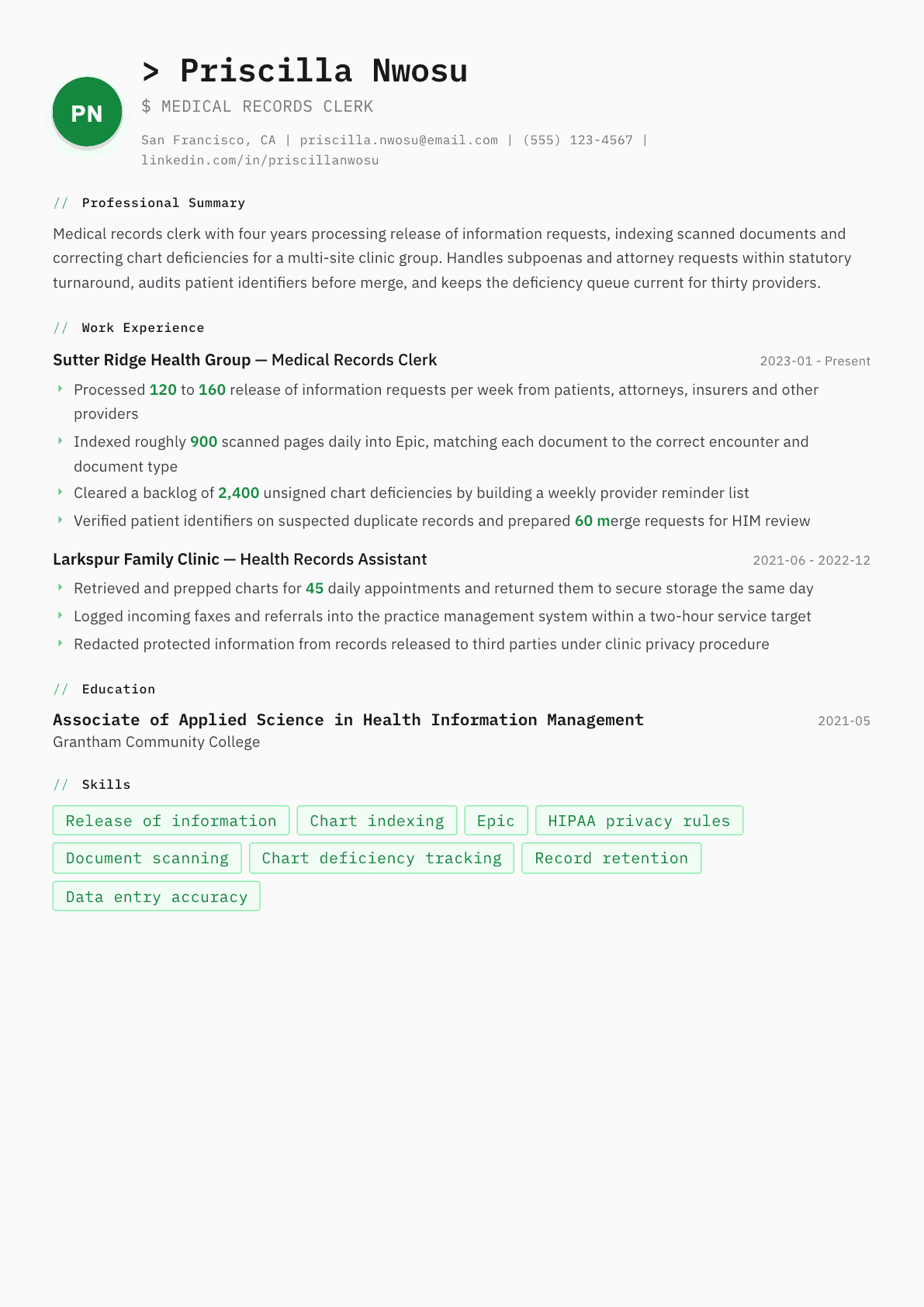
Example Medical Records Clerk summary
Medical records clerk with four years in a multi-site clinic group, processing more than one hundred release of information requests each week and indexing several hundred scanned pages a day into Epic. Cleared a long-standing chart deficiency backlog, prepared duplicate merge requests for review, and handles attorney and insurer requests inside statutory turnaround while keeping authorizations valid.
Skills to list on a Medical Records Clerk resume
- Release of information
- HIPAA privacy compliance
- Authorization review
- Chart indexing and scanning
- Document imaging
- Chart deficiency management
- Duplicate record identification
- Record retention schedules
- Epic
- Meditech
- Subpoena processing
- Redaction
- Data entry accuracy
- Medical terminology
What actually gets this resume read
- Lead with request volume and turnaround time, since that pair tells a records supervisor how much you can handle.
- Name the electronic record and document imaging systems you used, because those terms drive the first screen.
- Show privacy knowledge by referencing authorization review, redaction and the minimum necessary standard.
- Include work on chart deficiencies, duplicates and merges, as those tasks separate a clerk from a file room assistant.
- Mention subpoena and attorney request handling if you have it, because those requests carry legal deadlines.
- Quantify indexing or scanning throughput per day so accuracy claims have something concrete behind them.
How to write a medical records clerk resume
A medical records clerk resume is read by a health information supervisor who is worried about two things: whether requests will go out on time, and whether anything will be released that should not have been. Speed without privacy discipline is a liability, and privacy discipline without throughput leaves a queue nobody can clear. The resume has to show both.
The work itself is more technical than the job title suggests. Release of information carries statutory deadlines and valid authorization requirements. Indexing a scanned page to the wrong encounter creates a chart error that a clinician may act on. Duplicate records inside the patient index are a patient safety problem, not a filing problem. Write the resume as though the reader already knows that, because they do.
This guide covers the section order records supervisors expect, how to quantify request and indexing volume, how to describe privacy work precisely, and the questions clerks ask when they want to move up into a health information technician role.
Format: one page, request volume in the first context line
Use reverse-chronological order and keep it to one page unless you have more than a decade of health information work. Under each employer, open with a context line naming the setting, the number of providers or sites covered, and the weekly request volume, then use bullets for the specific duties.
Setting matters more than it looks. A single-provider clinic, a multi-site group and a hospital health information department run different request types, different retention rules and different systems. State which one you came from so the reader can map your experience onto theirs.
- Header: name, city and state, phone, email, and any health information credential.
- Section order: summary, systems, experience, education, certifications.
- Context line per employer: setting, sites or providers covered, requests per week.
Release of information: requesters, authorizations, deadlines
Break the request volume down by requester type, because each one has different rules: patients, other treating providers, attorneys, insurers, disability determination and law enforcement. A clerk who has handled subpoenas and attorney requests is bringing legal deadline discipline that a purely patient-facing clerk has not yet been tested on.
Then describe the checks you run before anything leaves the building: authorization validity and expiration, matching identifiers, scope of the request, redaction of information the authorization does not cover, and logging the disclosure. Naming those steps is the clearest way to prove privacy competence without claiming a compliance title you do not hold.
Indexing, scanning and chart integrity
Give daily indexing or scanning throughput with the document types, since matching a loose result to the correct encounter and document type is the accuracy-sensitive part of the job. If you worked a quality queue where mis-indexed documents were corrected, say so, because that is chart integrity work.
Deficiency management and duplicate identification are the two duties that separate a records clerk from a file room assistant. Describe how you tracked unsigned notes and missing signatures across providers, and how you verified identifiers before sending a suspected duplicate forward for merge review.
- Pages or documents indexed per day and the document types involved.
- Deficiency tracking method and the number of providers covered.
- Identifier checks applied before a duplicate record was escalated.
Systems, retention and the physical file room
Name the electronic record and the document imaging system exactly as the vendors write them, such as Epic, Meditech, Cerner or OnBase, and add the release of information module if your department used one. Filters search for those strings, and a supervisor reading a familiar system name assumes a short training period.
Retention and destruction still matter in mixed paper and electronic environments. Describe the retention schedule you worked under, how you prepared records for offsite storage or destruction, and how you tracked chart checkout if a physical file room was still in use.
Keywords and credentials the screen is looking for
Records postings recycle the same phrasing: release of information, protected health information, minimum necessary, authorization, chart deficiency, document imaging, record retention, medical terminology, data entry accuracy. Use the ones that are true of your work once in the summary and once inside a bullet where they are demonstrated.
Credentials are optional at clerk level and decisive one step up. If you have completed a health information program or hold a registered technician credential, list it with the issuing body, because it is the standard route from records clerk into a technician or analyst posting.
Medical Records Clerk resume summary examples
First records role
Health information management graduate with a clinic externship prepping charts for daily appointments, logging incoming faxes and referrals, and scanning documents into the electronic record. Trained in medical terminology, privacy rules and authorization review, and seeking a first medical records clerk position in an outpatient group.
Two years in
Health records assistant with two years in a family clinic, retrieving and prepping charts for 45 daily appointments, logging referrals within a two-hour service target, and redacting information from records released to third parties. Comfortable with authorization review and same-day return to secure storage.
Four years and moving up
Medical records clerk processing 120 to 160 release requests a week for a multi-site clinic group and indexing several hundred scanned pages a day into Epic. Cleared a long-standing chart deficiency backlog, prepares duplicate merge requests for review, and handles attorney and insurer requests inside statutory turnaround.
Work experience bullets: before and after
Before: Processed medical records requests for patients and other offices.
After: Processed 120 to 160 release of information requests per week from patients, treating providers, attorneys and insurers, verifying authorization validity and scope before each release.
Volume plus requester types plus the check performed shows both throughput and privacy discipline in one line.
Before: Scanned documents into the electronic health record.
After: Indexed roughly 900 scanned pages daily into Epic, matching each document to the correct encounter and document type, and corrected mis-indexed items surfaced by the daily quality queue.
Daily throughput with the matching step and the correction loop turns scanning into described chart integrity work.
Before: Helped providers complete their charts.
After: Cleared a backlog of about two thousand unsigned chart deficiencies by building a weekly provider reminder list and tracking each item to signature.
Naming the backlog size and the mechanism used shows a system you built rather than a task you performed.
Before: Checked for duplicate patient records.
After: Verified name, date of birth and identifier matches on suspected duplicate records and prepared 60 merge requests with supporting evidence for health information review.
The verification steps and the escalation path show you understand duplicates as a safety issue with a review process.
Before: Followed privacy rules when releasing records.
After: Redacted information outside the scope of each authorization, applied the minimum necessary standard to provider requests, and logged every disclosure in the accounting of disclosures.
Three named privacy practices are verifiable, where a general statement about following rules is not.
Hard skills
- Release of information processing
- Authorization review and validation
- Redaction of protected health information
- Chart indexing and document imaging
- Chart deficiency tracking
- Duplicate record identification
- Record retention and destruction schedules
- Accounting of disclosures logging
- Epic
- Meditech
- Medical terminology
- High-accuracy data entry
Soft skills
- Discretion with sensitive records
- Steady accuracy under queue pressure
- Clear phone communication with requesters
- Deadline tracking
- Coordination with providers and clinic staff
- Escalation judgment
Certifications worth listing
- Registered Health Information Technician (RHIT) (American Health Information Management Association)
- Certified Electronic Health Records Specialist (CEHRS) (National Healthcareer Association)
- Certified Release of Information Specialist (CRIS) (Alliance for Health Information Operations and Standards (AHIOS))
Mistakes that cost medical records clerk candidates the interview
- Describing the job as filing and data entry, which erases the authorization, redaction and disclosure logging that make the role skilled.
- Giving no request volume or turnaround, so a supervisor cannot judge whether you can carry their queue.
- Leaving out the electronic record and imaging system names that applicant tracking filters search for.
- Ignoring deficiency management and duplicate work, which are the duties that qualify you for a technician posting.
- Claiming a privacy officer or compliance title when the actual work was applying department procedure correctly.
- Listing the clinic name with no setting detail, so the reader cannot tell a single office from a multi-site group.
Medical Records Clerk resume questions
What should a medical records clerk put at the top of the resume?
A short summary naming the setting, weekly release of information volume, the electronic record you work in, and the requester types you handle. A supervisor deciding whether to read further wants scale and system fluency in the first two lines.
How do I show privacy knowledge without a compliance title?
Describe the checks you actually perform: authorization validity and expiration, identifier matching, scope of request, redaction of anything outside that scope, and disclosure logging. Named practices demonstrate competence far better than a sentence claiming knowledge of privacy law.
Do I need a certification to be a medical records clerk?
Usually no at entry level, though a health information program or a records credential shortens the screen and matters much more for the technician role above it. List anything real with its issuing body and leave short unaccredited courses off.
How do I move from records clerk to health information technician?
Build the resume around the technical duties rather than the clerical ones: deficiency analysis, duplicate identification, indexing quality corrections and disclosure logging. Then add the associate degree or registered technician credential, which most technician postings treat as a requirement.
Should I list typing speed and data entry accuracy?
Yes if you can state them concretely, since indexing and request processing are volume jobs where accuracy is the whole product. Pair the figure with throughput, such as pages indexed per day, so the reader sees speed and precision together.