Medical Director Resume Examples: the lines they read
Write a Medical Director Resume for Clinical Leadership Roles
By Mustafa Tarabya, founder of CVBooster · Published · Updated
Medical director resume example covering quality oversight, provider supervision, board credentials and a guide to writing each executive section.
Sample resumes for a medical director
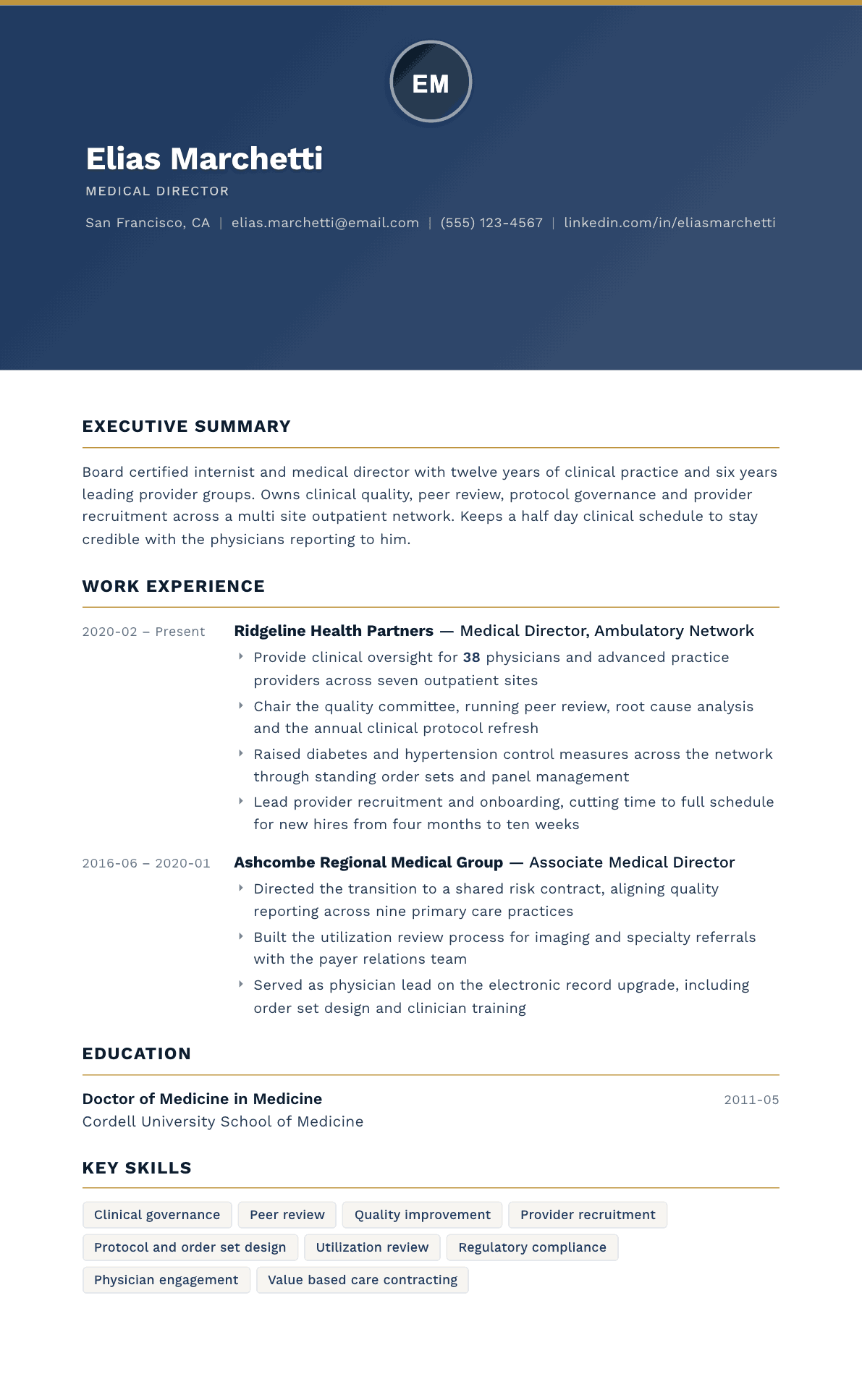
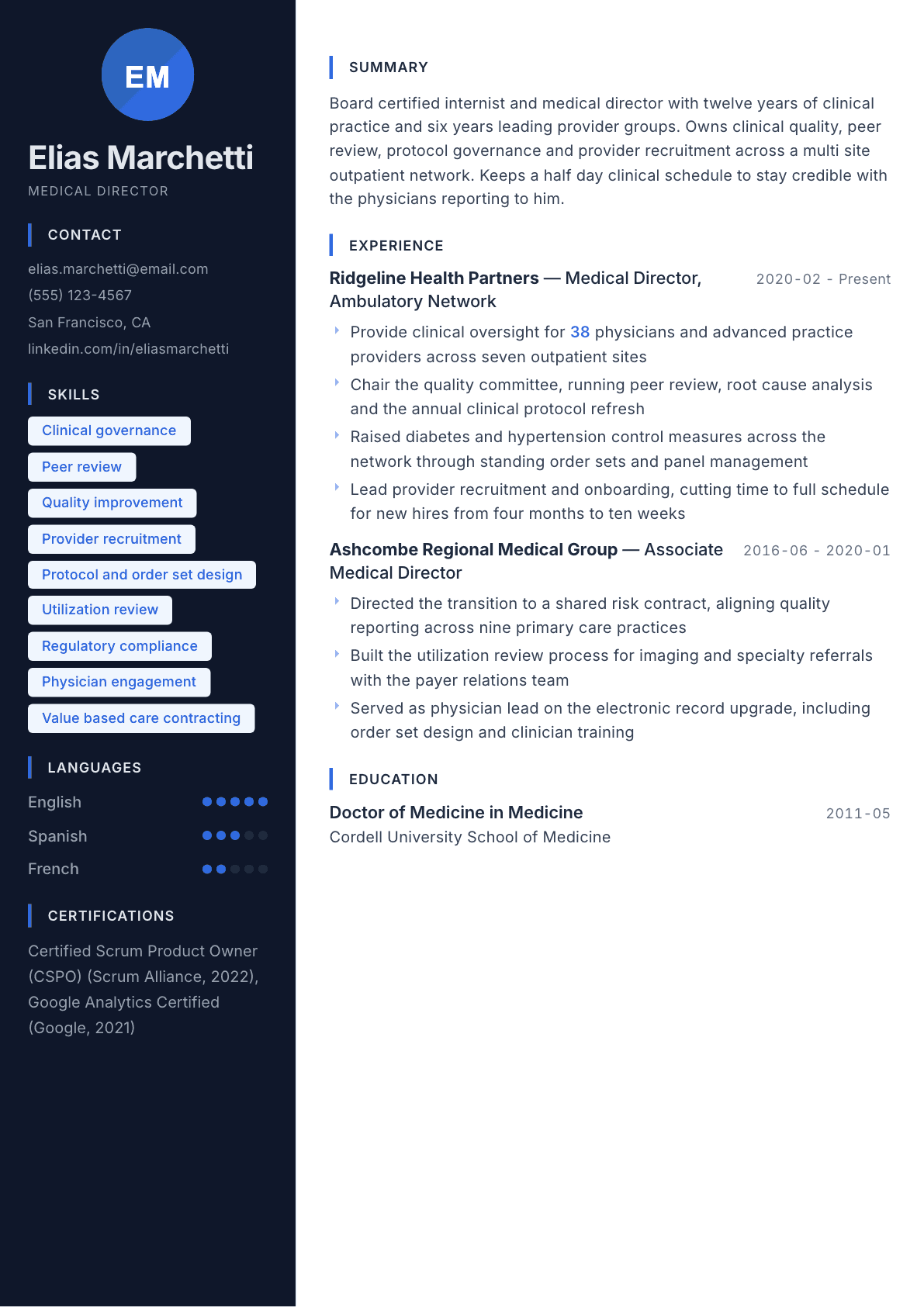
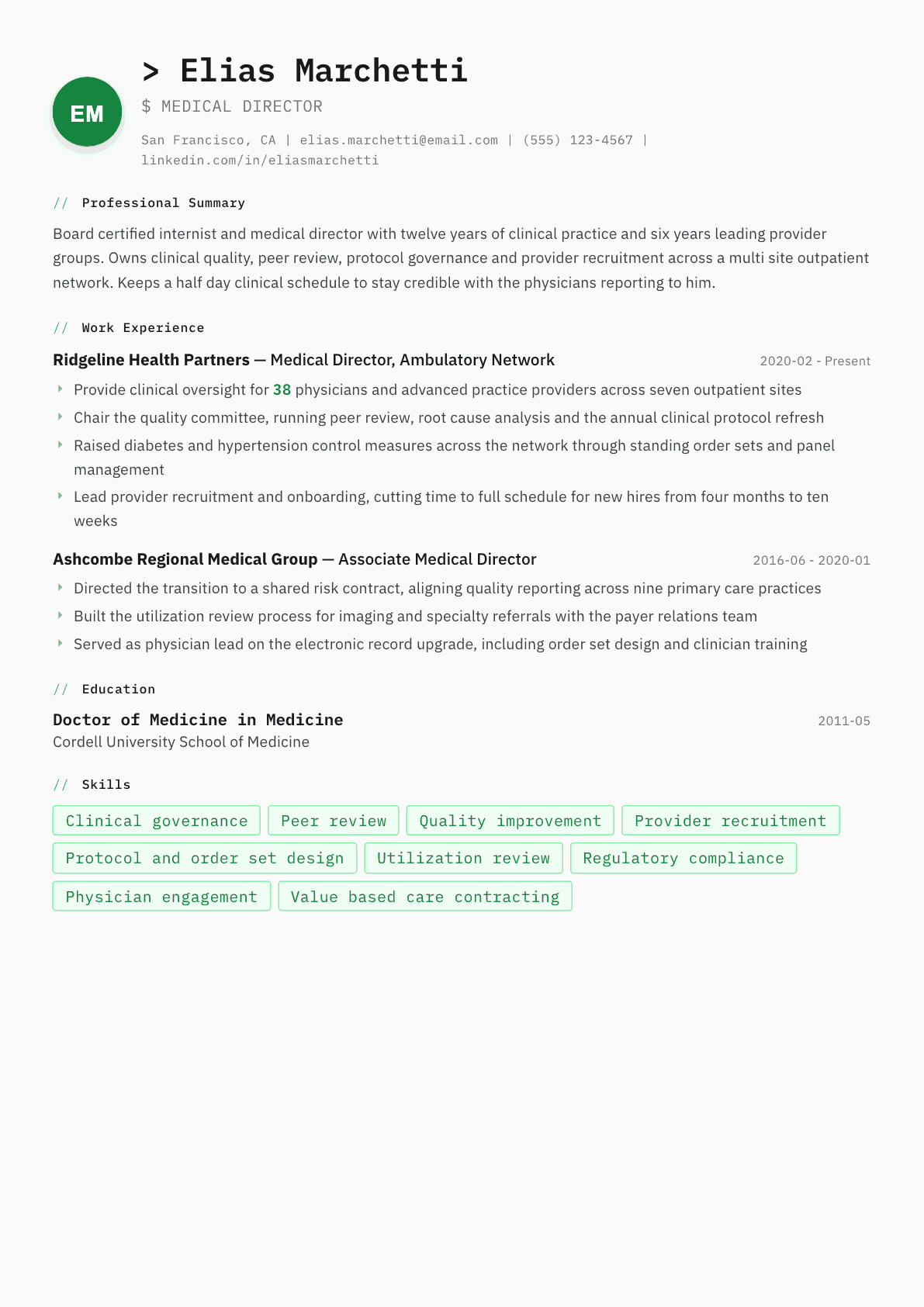
The same medical director content laid out in three CVBooster templates, so you can see what the finished document looks like before you write a word.
Example Medical Director summary
Board certified physician executive with twelve years of clinical practice and six years directing multi site ambulatory care. Owns quality, peer review, protocol governance and provider recruitment for a network of nearly forty clinicians. Led a successful move into shared risk contracting and rebuilt onboarding so new providers reach a full panel faster. Still practices one half day a week to keep clinical judgment sharp.
Skills to list on a Medical Director resume
- Clinical governance and oversight
- Medical staff peer review
- Quality and safety improvement
- Clinical protocol development
- Provider recruitment and retention
- Physician performance management
- Utilization and case review
- Regulatory and accreditation readiness
- Value based care and quality contracts
- Credentialing and privileging
- Budget and service line planning
- Electronic health record governance
- Patient safety event review
- Board and executive reporting
What actually gets this resume read
- Open with your board certification and license states, because credentialing questions block everything else in this hire.
- State the size of what you govern: provider headcount, site count, service lines and the patient population served.
- Separate clinical leadership from administration, showing quality outcomes on one side and budget or contracts on the other.
- Name the committees you chaired, since medical staff governance experience is the core of the role.
- Keep a short clinical practice line, because boards want a director who still sees patients or recently did.
- Include regulatory and accreditation work such as survey readiness, credentialing oversight and compliance investigations.
How to write a medical director resume
A medical director resume is read by two very different groups. A search committee or a chief medical officer reads it for leadership: what you govern, what you have changed, and whether physicians follow you. A credentialing office reads it for completeness: board certification, license history, training dates and any gap that needs explaining. Both readings have to succeed.
The most common failure is a physician curriculum vitae submitted unchanged. A vitae is built to be exhaustive, listing every publication, poster and committee in chronological order. A director search wants scope, accountability and results in the first third of the first page, with the academic record moved behind it. The content is largely the same, the priority order is not.
This guide sets out how to reorganize the file for a leadership hire, with example summaries for a first director role through a system level position, before and after bullets that show governance rather than clinical volume, and the questions physicians ask when they move from practice into administration.
Format: a leadership resume in front, the vitae behind it
Two pages for the leadership document. Reverse chronological, plain headings, and a credentials block at the top with board certification and the certifying board, license states, and any additional qualification the posting names. Keep the full vitae as a second attachment for credentialing and academic review, and say on the resume that it is available.
Immediately under the summary, add a scope block. Provider headcount you oversee, number of sites or beds, service lines, patient volume and budget accountability if you hold it. A committee reads that block first and everything after it is interpreted through those numbers.
- Header: name with degree and board status, city and state, phone, email, license states.
- Sections: summary, scope of responsibility, leadership experience, clinical practice, credentials, education and training, selected committee and academic work.
- Keep publications to a short selected list on the resume and put the complete record in the vitae.
Summary: specialty, years leading, what you own
Four lines. Name the specialty and board certification, the years in clinical practice, the years in formal leadership, and what you are accountable for. Accountability is the word that matters. Chairing a committee is participation. Owning quality outcomes for a network of clinicians is accountability, and search committees read for the second.
Add whether you still practice and how much. Physician groups are cautious about directors who left the clinic years ago, because clinical credibility is what makes protocol changes acceptable to the people who have to follow them.
Experience: governance, quality, people, and the business
Each leadership role needs the organization type, the scope you held, and who you reported to. Then structure the bullets into four themes so the reader can find what the posting emphasizes.
Clinical governance: protocols and order sets you built or refreshed, peer review and case review processes you chaired, credentialing and privileging oversight, and the medical staff bylaws work you touched. Quality and safety: the measures you moved, the event review process you ran, root cause analyses you led, and accreditation or survey readiness you owned. People: physician and advanced practice provider recruitment, onboarding, performance management, difficult conversations about behavior or competence, and retention. Business: budget accountability, service line planning, payer contracting input, utilization review and coding accuracy work.
Where you can attach a result, attach it. Improvement in a chronic disease control measure, a reduction in time to full schedule for new hires, or a successful accreditation survey are the kinds of outcomes a committee can verify and discuss.
Clinical practice, credentials and the credentialing office
Keep a short clinical practice section stating your current specialty work, the setting and the share of your week it occupies. This section is short by design. Its purpose is credibility, not detail, and the vitae carries the rest.
Then a complete credentials section: board certification with the certifying board and status, license states, controlled substance registration status, and life support cards where relevant to your specialty. Give the dates for residency and any fellowship. Credentialing offices flag unexplained time, so account for gaps in one plain line rather than leaving them to be discovered.
Committees, teaching and the selected record
Medical staff governance experience is the core qualification for many director roles, so list the committees you have served on and separately the ones you chaired. Chairing a credentials committee, a pharmacy and therapeutics committee, a quality committee or a peer review committee is direct evidence you can hold the role.
Add teaching and mentoring briefly: residents and students supervised, faculty appointment if you hold one, and any formal leadership training such as a physician leadership course or an executive degree. Then a short selected publications and presentations list, only where it supports the role you are seeking.
Medical Director resume summary examples
First director role
Board certified family physician with nine years in practice and three years as a site lead for a four physician clinic. Chairs the group quality committee, rebuilt the chronic disease recall process, and completed a physician leadership certificate. Seeking a medical director role in an ambulatory network while maintaining clinical practice.
Network medical director
Board certified internist and medical director with twelve years in practice and six leading provider groups. Accountable for clinical quality, peer review, protocol governance and provider recruitment across seven outpatient sites and 38 clinicians. Practices one half day a week and led the group into a shared risk contract.
System or chief level
Physician executive with twenty years of clinical and administrative leadership across hospital and ambulatory settings. Has led medical staff governance for a two hospital system, owned a service line budget, directed accreditation readiness through two survey cycles, and built a physician leadership development pipeline.
Work experience bullets: before and after
Before: Oversaw physicians in the practice.
After: Provided clinical oversight for 38 physicians and advanced practice providers across seven outpatient sites, including annual performance review, scope of practice decisions and competency follow up.
Headcount, site count and the specific oversight activities define real accountability rather than a title.
Before: Was involved in quality improvement.
After: Chaired the quality committee, running monthly peer review, event analysis and the annual protocol refresh, and moved diabetes and hypertension control measures through standing order sets and panel management.
Naming the committee, the cadence and the mechanism shows you led the work rather than attended it.
Before: Helped recruit new doctors.
After: Led provider recruitment and onboarding end to end, redesigning the first ninety days so new hires reached a full schedule in ten weeks instead of four months.
A measurable operational result is the kind of evidence a search committee can probe in an interview.
Before: Worked on the electronic record project.
After: Served as physician lead for the electronic record upgrade, owning order set design, clinical decision support rules and clinician training, with adoption tracked by specialty after go live.
Physician lead with named deliverables is a governance role, not participation in a project.
Before: Managed relationships with insurers.
After: Directed the transition to a shared risk contract across nine primary care practices, aligning quality reporting and building the utilization review process with payer relations.
Contract type, practice count and the process built demonstrate business accountability, which many director roles require.
Hard skills
- Clinical governance and oversight
- Medical staff peer review
- Quality and patient safety improvement
- Clinical protocol and order set development
- Credentialing and privileging oversight
- Provider recruitment and performance management
- Utilization and case review
- Accreditation and regulatory survey readiness
- Value based contract performance
- Service line and budget planning
- Electronic health record clinical governance
- Root cause and event analysis
Soft skills
- Physician influence without direct authority
- Difficult conversations about competence
- Executive and board communication
- Consensus building across specialties
- Sound judgment under regulatory scrutiny
- Mentoring emerging physician leaders
Certifications worth listing
- Board Certification in a Specialty (American Board of Medical Specialties member board)
- Certified Physician Executive (CPE) (American Association for Physician Leadership)
- Certified Professional in Healthcare Quality (CPHQ) (National Association for Healthcare Quality)
- Certified in Healthcare Compliance (CHC) (Health Care Compliance Association)
- Advanced Cardiovascular Life Support (ACLS) (American Heart Association)
Mistakes that cost medical director candidates the interview
- Submitting an unchanged curriculum vitae, which buries scope and accountability behind pages of chronological academic detail.
- Describing clinical volume at length while never stating how many clinicians or sites you are responsible for.
- Confusing committee membership with committee leadership, when search committees specifically look for the second.
- Leaving board certification status and license states off the top, which stalls the file in the credentialing office.
- Omitting the business side of the role, since most director positions carry budget, contract or utilization accountability.
- Failing to explain a gap in training or practice dates, which a credentialing review will find and question anyway.
Medical Director resume questions
Should I send a resume or a curriculum vitae for a medical director role?
Send a two page leadership resume and offer the full vitae as an attachment. The resume gives a search committee scope and results quickly, while the vitae satisfies credentialing and any academic reviewer who needs the complete record.
How much clinical practice should a medical director keep?
That depends on the organization, but state whatever you do. Many groups prefer a director who still sees patients because protocol changes land better when they come from someone carrying the same schedule constraints as the clinicians affected.
What if I have never held a formal leadership title?
Build the resume around the governance work you have already done: committee chairing, protocol writing, peer review participation, mentoring, quality projects and site lead duties. Then add any formal leadership training you have completed to signal intent.
How do I present quality results without overclaiming?
Name the measure, the intervention you led and the direction of change, and be ready to explain the population and confounders. Attributing a whole organizational result to yourself is the fastest way to lose credibility in an interview.
Does an executive degree help for a medical director position?
It helps for larger systems and for roles carrying budget and contract accountability. It is rarely required. Practical governance experience, quality results and physician credibility usually weigh more heavily in a search than an additional degree.