Unit Secretary Resume Examples: the lines they read
Write a Unit Secretary Resume That Shows You Can Run the Nurses Station
By Mustafa Tarabya, founder of CVBooster · Published · Updated
Unit secretary resume examples with order entry, admission and transfer workflow, staffing support and the keywords hospital units screen for.
Sample resumes for a unit secretary
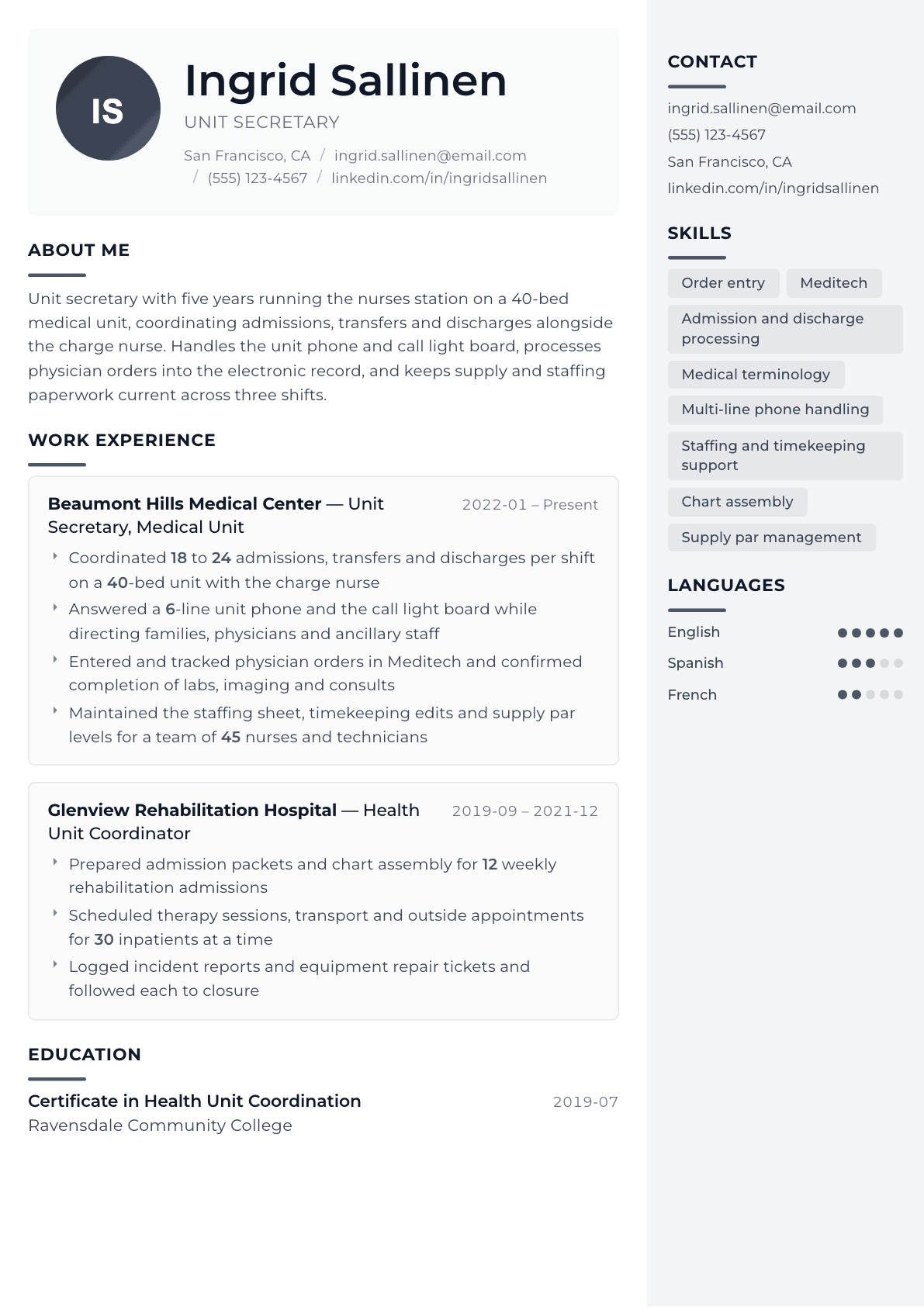
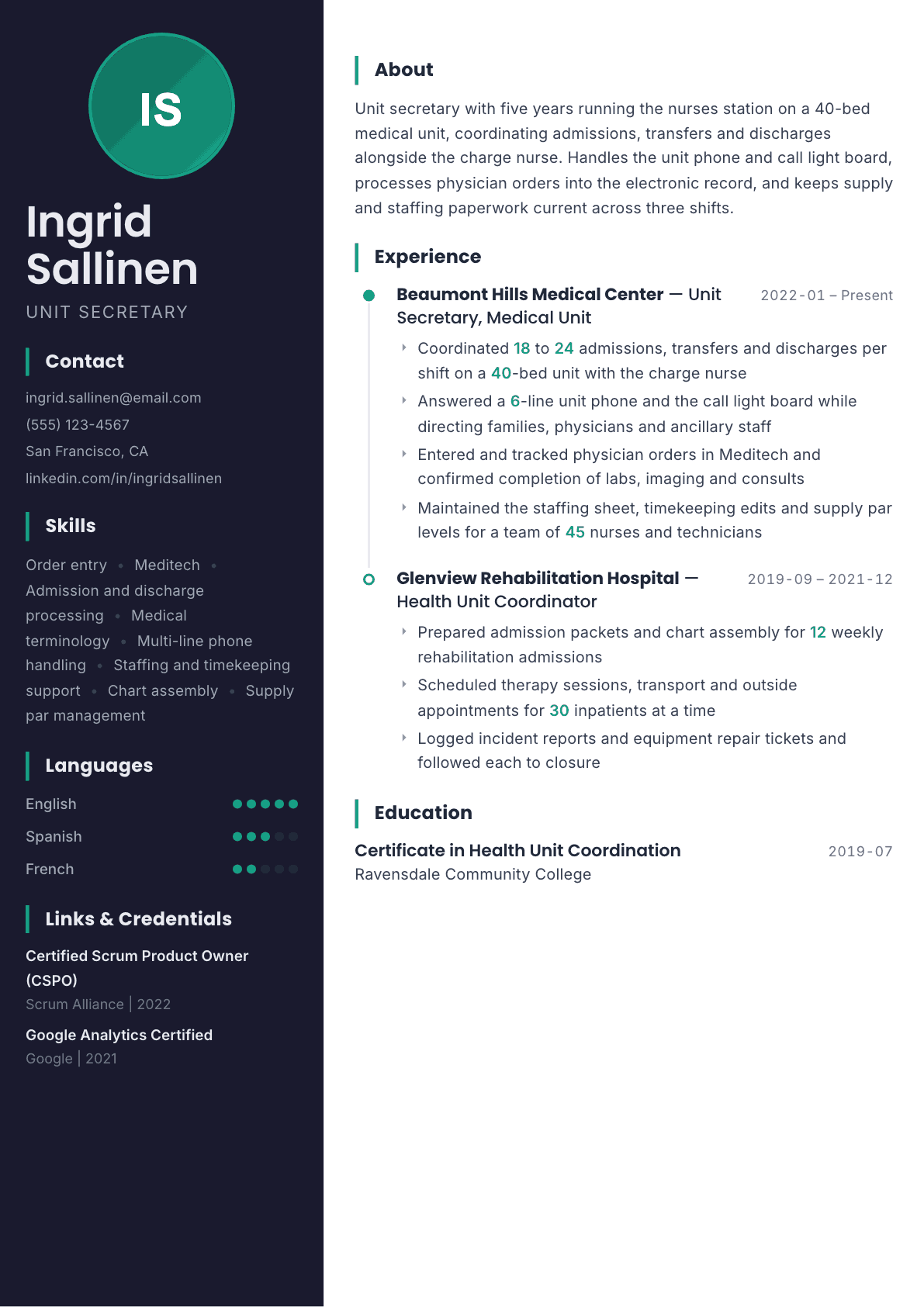
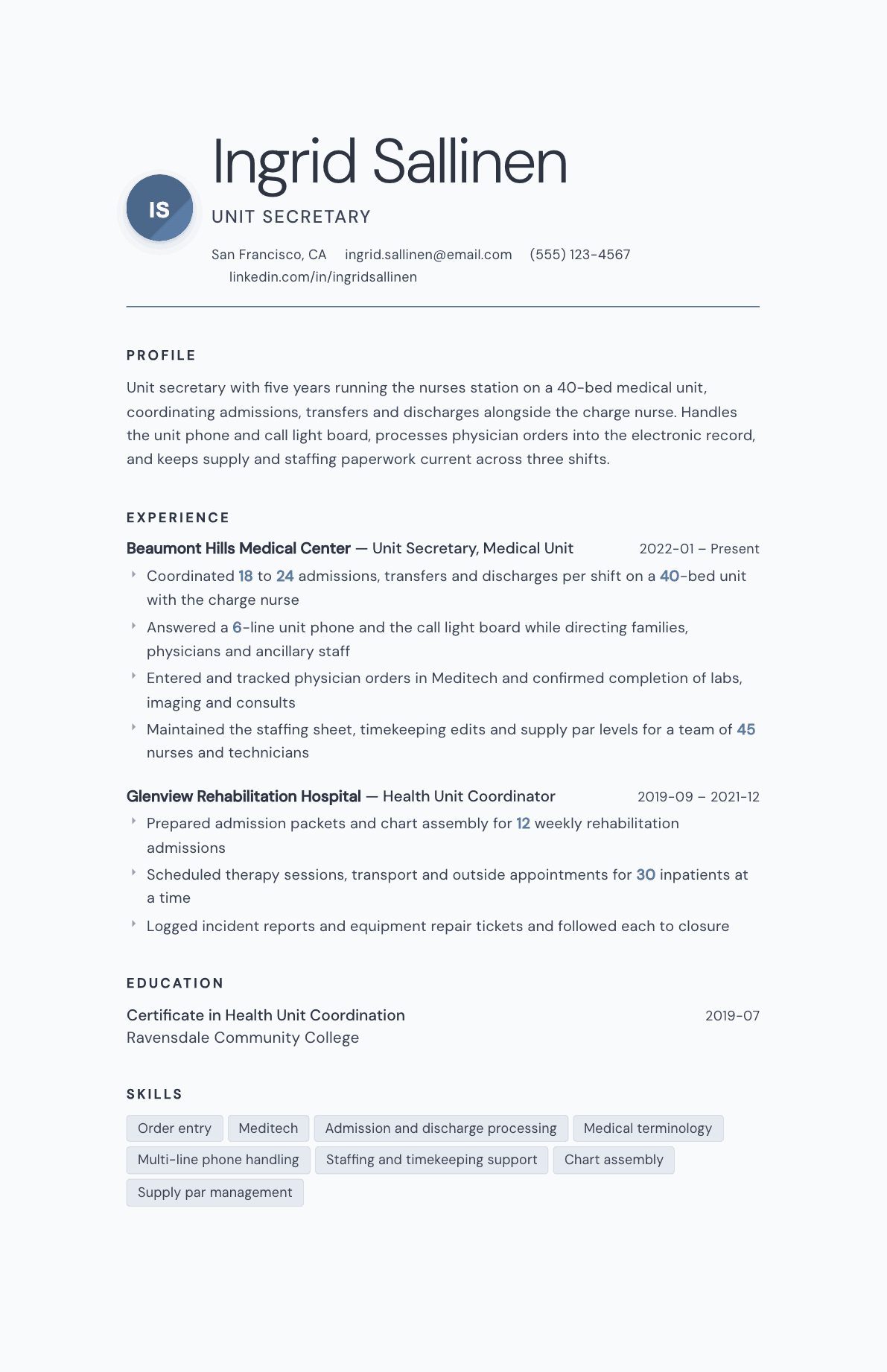
The same unit secretary content laid out in three CVBooster templates, so you can see what the finished document looks like before you write a word.
Example Unit Secretary summary
Unit secretary with five years on a 40-bed medical floor, coordinating around twenty admissions, transfers and discharges every shift with the charge nurse. Runs a six-line phone and the call light board, enters and tracks physician orders in Meditech, and keeps staffing sheets, timekeeping edits and supply par levels current for a team of forty-five clinical staff.
Skills to list on a Unit Secretary resume
- Order entry and transcription
- Admission, transfer and discharge processing
- Chart assembly and thinning
- Multi-line phone and call light board
- Medical terminology
- Meditech
- Epic
- Staffing sheet maintenance
- Timekeeping support
- Supply par level management
- Appointment and transport scheduling
- Incident report logging
- HIPAA compliance
- Interdisciplinary communication
What actually gets this resume read
- State the unit type and bed count, because a 40-bed medical floor and an eight-bed ICU are different jobs.
- Count admissions, transfers and discharges per shift, since that flow is the core of the role.
- Name the electronic record and any order entry duties you held, because order handling varies by hospital policy.
- Include phone lines, call light board and visitor traffic to show the interruption load you work under.
- List staffing sheet, timekeeping and supply ordering work, as those tasks often decide who gets the offer.
- Add certification such as health unit coordinator training with the issuing body if you completed a program.
How to write a unit secretary resume
The unit secretary holds the nurses station together. Admissions arrive, transfers leave, physicians want a chart, a family is at the desk, three phone lines are lit and the call light board is going. A nurse manager reading your resume is asking one question: can this person keep the flow moving on my floor without pulling a nurse off patient care to help.
Because the job is defined by interruption, the resume has to show volume and simultaneity, not a list of clerical tasks. Bed count, admissions and discharges per shift, phone lines, the number of staff whose schedule and timekeeping you supported: those figures describe the role in the terms a charge nurse uses.
This guide covers the section order hospital units expect, how to write order handling without overstating your scope, how to show you can absorb the interruption load, and the questions unit secretaries ask when they are moving between unit types or aiming at a technician or coordinator role.
Format: one page, with the unit in the job title
One page, reverse-chronological, plain single-column layout. Write the job title with the unit attached: unit secretary, medical floor, or health unit coordinator, rehabilitation. Follow it with a context line giving bed count, shift length and the size of the clinical team you supported.
Hospital applicant tracking systems parse a plain document reliably and a designed one badly. Keep the dates on the left or immediately after the employer, and avoid graphics entirely, because a dropped date on a support role resume reads as an unexplained gap.
- Header: name, city and state, phone, email, and any health unit coordinator credential.
- Section order: summary, station skills and systems, experience, education, credentials.
- Context line per employer: unit type, bed count, staff supported, shift pattern.
Patient flow: admissions, transfers and discharges per shift
This is the core measure of the job. Give the number of admissions, transfers and discharges you coordinated per shift, and say who you coordinated with: the charge nurse, bed management, transport, environmental services and the receiving unit. Flow work is a chain and naming the links proves you have run it.
Add what you prepared around each movement: admission packets, chart assembly, armbands, bed assignments, transfer paperwork and the calls that had to happen before a patient could leave the floor. Those details separate someone who has run a busy station from someone who has covered one occasionally.
Order handling: describe your actual scope
Order responsibility varies by hospital policy, and overstating it is a fast way to lose credibility. Say precisely what you did: entered orders under nursing direction, transcribed paper orders in a downtime procedure, tracked order completion for labs, imaging and consults, or notified the nurse when a result posted.
Tracking is the part most resumes skip and managers value. A unit secretary who confirms that an ordered study actually happened, and chases the ones that did not, prevents delays that show up in length of stay. Write that as a duty with the volume behind it.
- The exact order role your policy allowed, stated in the policy's own terms.
- Order types you tracked to completion, such as labs, imaging and consults.
- Downtime procedures you followed when the electronic record was unavailable.
Communication load: phones, call lights and the desk
Give the phone line count, the call light board, the pager or secure messaging system and the visitor traffic together, because the point is simultaneity. A reader who sees six lines, a call board and a family at the desk understands the interruption level without being told the job was busy.
Say who you routed to and how you triaged. Directing a physician to the right nurse, taking a clinical message accurately without practicing outside your role, and knowing which calls interrupt a nurse immediately are judgment skills, and they are what a manager is really screening for.
Staffing, supplies and the administrative backbone
The tasks that decide many hiring decisions are the least glamorous: maintaining the staffing sheet, entering timekeeping edits, ordering supplies to par level, logging equipment repairs and preparing incident reports for review. Give the number of staff covered and the frequency, because a charge nurse who no longer has to do that work will notice.
Add scheduling of therapy sessions, transport and outside appointments if your unit required it, along with any chart assembly and thinning you handled. These duties show you can carry a workload beyond the phone, which is the argument for a lead or coordinator posting later.
Unit Secretary resume summary examples
New to hospital work
Health unit coordination certificate graduate with front desk and multi-line phone experience in a professional office. Trained in medical terminology, order transcription and privacy rules, with a completed clinical practicum on a medical floor. Seeking a first unit secretary role on an acute inpatient unit.
Two years, rehabilitation unit
Health unit coordinator with two years at a rehabilitation hospital preparing admission packets and chart assembly for about twelve weekly admissions. Schedules therapy sessions, transport and outside appointments for 30 inpatients at a time, and logs incident reports and equipment repair tickets through to closure.
Five years, medical floor
Unit secretary running the nurses station on a 40-bed medical unit, coordinating 18 to 24 admissions, transfers and discharges per shift with the charge nurse. Answers a six-line phone and the call light board, tracks orders in Meditech to completion, and maintains staffing, timekeeping and supply par levels for 45 staff.
Work experience bullets: before and after
Before: Handled admissions, discharges and transfers on the unit.
After: Coordinated 18 to 24 admissions, transfers and discharges per shift on a 40-bed medical unit, working with the charge nurse, bed management, transport and environmental services on each movement.
Volume, bed count and the named partners show you have run the flow chain rather than filed paperwork about it.
Before: Answered phones and the call light system.
After: Answered a six-line unit phone and the call light board simultaneously while directing physicians, families and ancillary staff, and triaged which calls interrupted a nurse immediately.
Line count and the triage judgment describe the interruption load and how you managed it.
Before: Entered orders into the computer system.
After: Entered and tracked physician orders in Meditech under nursing direction and confirmed completion of labs, imaging and consults, chasing outstanding studies before the end of each shift.
Stating the supervision scope keeps the claim accurate, and the tracking duty shows the part that prevents delays.
Before: Kept the unit supplied and helped with scheduling.
After: Maintained the staffing sheet, timekeeping edits and supply par levels for a team of 45 nurses and technicians, and logged equipment repair tickets through to closure.
Team size and named administrative duties show a workload a charge nurse no longer has to carry.
Before: Prepared paperwork for new patients.
After: Prepared admission packets and assembled charts for twelve weekly rehabilitation admissions, verifying armbands, consent forms and bed assignments before each arrival.
Weekly volume and the specific checks turn generic paperwork into a described intake process.
Hard skills
- Admission, transfer and discharge coordination
- Order entry and tracking under nursing direction
- Chart assembly and thinning
- Multi-line phone and call light board operation
- Medical terminology
- Meditech
- Epic
- Staffing sheet maintenance
- Timekeeping edits
- Supply par level management
- Transport and appointment scheduling
- Incident report logging
Soft skills
- Composure during simultaneous demands
- Accurate message taking
- Triage judgment on interruptions
- Friendly handling of anxious families
- Reliable handoff at shift change
- Teamwork with nursing staff
Certifications worth listing
- Certified Health Unit Coordinator (CHUC) (National Association of Health Unit Coordinators)
- Basic Life Support (BLS) (American Heart Association)
- Certified Medical Administrative Assistant (CMAA) (National Healthcareer Association)
Mistakes that cost unit secretary candidates the interview
- Writing the role as general clerical work, which hides the patient flow coordination that is the actual job.
- Leaving out bed count and movements per shift, so a manager cannot tell a quiet unit from a high-turnover floor.
- Overstating order responsibility beyond what hospital policy allowed, which an interviewer will catch immediately.
- Skipping the staffing, timekeeping and supply duties that often decide who gets the offer.
- Failing to name the electronic record, which is one of the few hard filters applied to this role.
- Describing the unit as busy instead of giving the phone lines, call board and traffic that prove it.
Unit Secretary resume questions
What is the most important thing on a unit secretary resume?
The unit type with its bed count, paired with admissions, transfers and discharges per shift. Those figures tell a charge nurse whether you have already handled the turnover on their floor, which is the question behind the interview.
Do I need a health unit coordinator certification?
Many hospitals hire without one and train on the unit, while some prefer or require it. If you completed an accredited program or hold the credential, list it with the issuing body, since it removes any doubt about terminology and order handling.
How do I describe order entry without overstating my role?
Use the words your hospital policy used: entered under nursing direction, transcribed during downtime, or tracked to completion. Precision protects you in the interview and signals that you understand the boundary between clerical support and clinical responsibility.
How do I move from a rehabilitation unit to an acute floor?
Lead with the transferable core: intake preparation, scheduling, phone triage and administrative duties. Then be direct about the difference in pace, and point at the highest turnover period you covered along with any acute terminology you already use daily.
What role can a unit secretary move into next?
Common next steps are patient care technician with a nurse aide credential, patient coordinator or scheduler in an outpatient practice, and health information roles. Build toward one by naming the duties that overlap with it and adding the matching credential.