Medical Scribe Resume Examples: the lines they read
Create a Medical Scribe Resume That Proves Charting Speed and Accuracy
By Mustafa Tarabya, founder of CVBooster · Published · Updated
Medical scribe resume examples with EHR systems, charting volume, specialty terminology and the keywords clinic recruiters search.
Sample resumes for a medical scribe
The same medical scribe content laid out in three CVBooster templates, so you can see what the finished document looks like before you write a word.
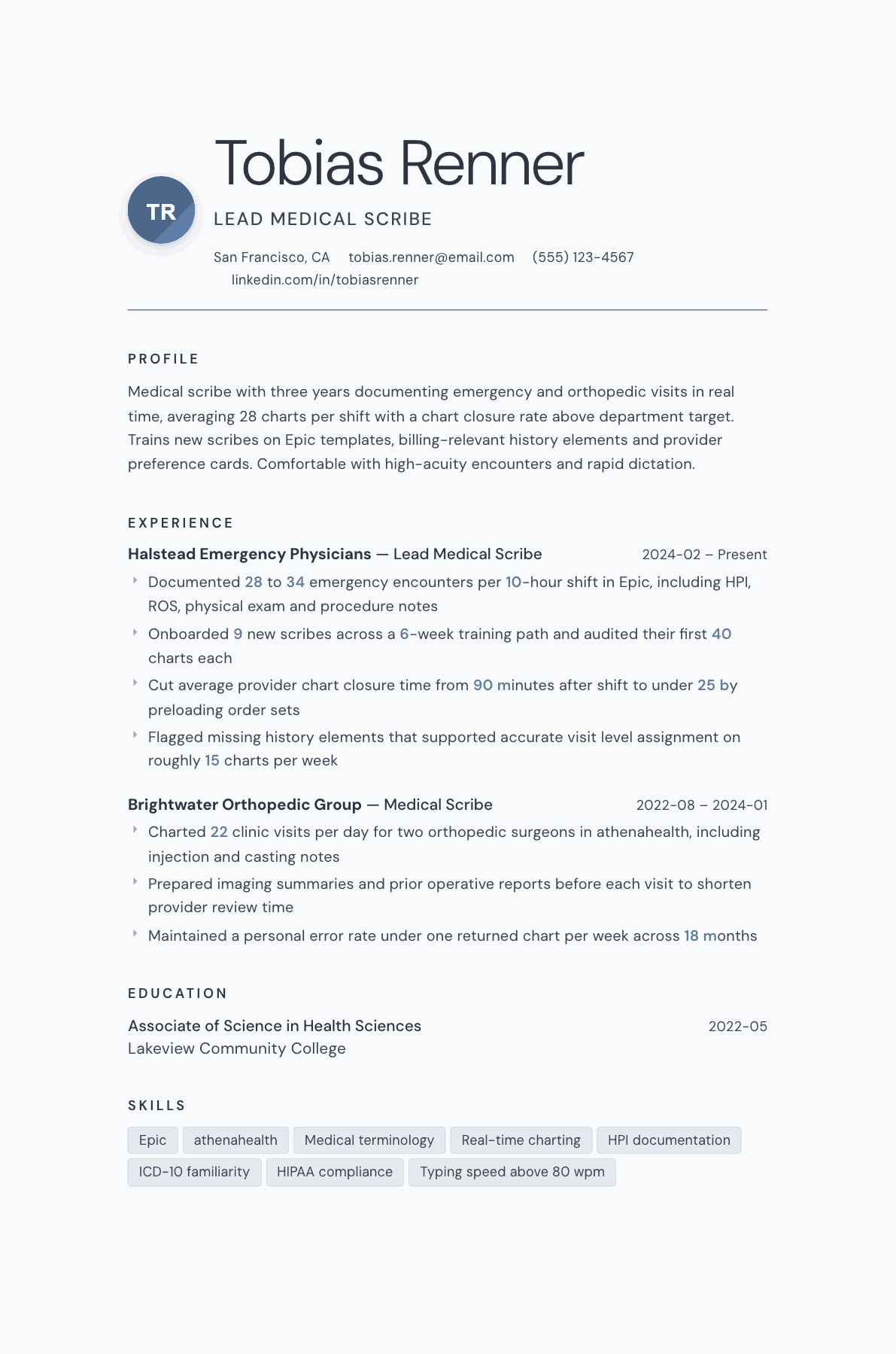
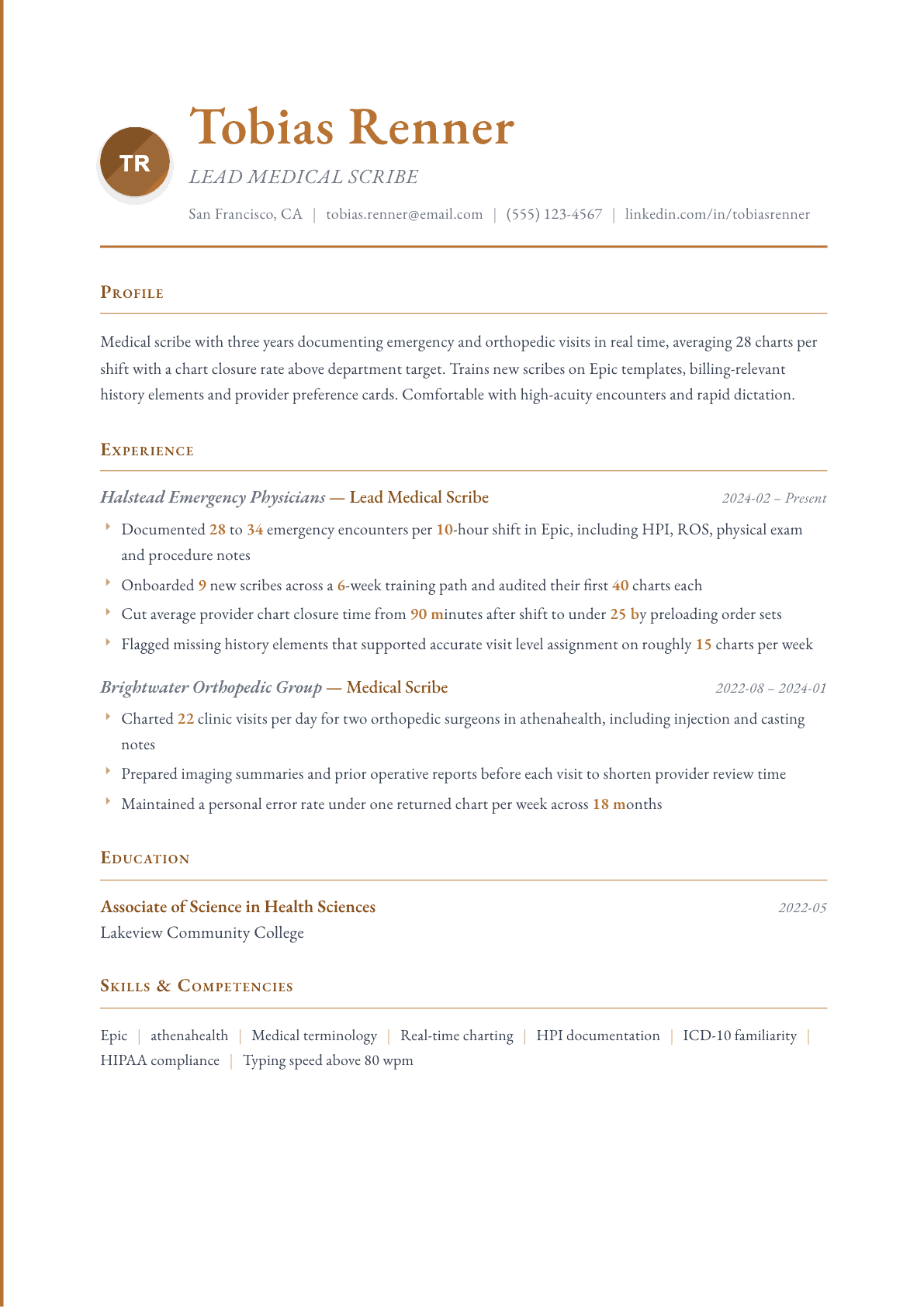
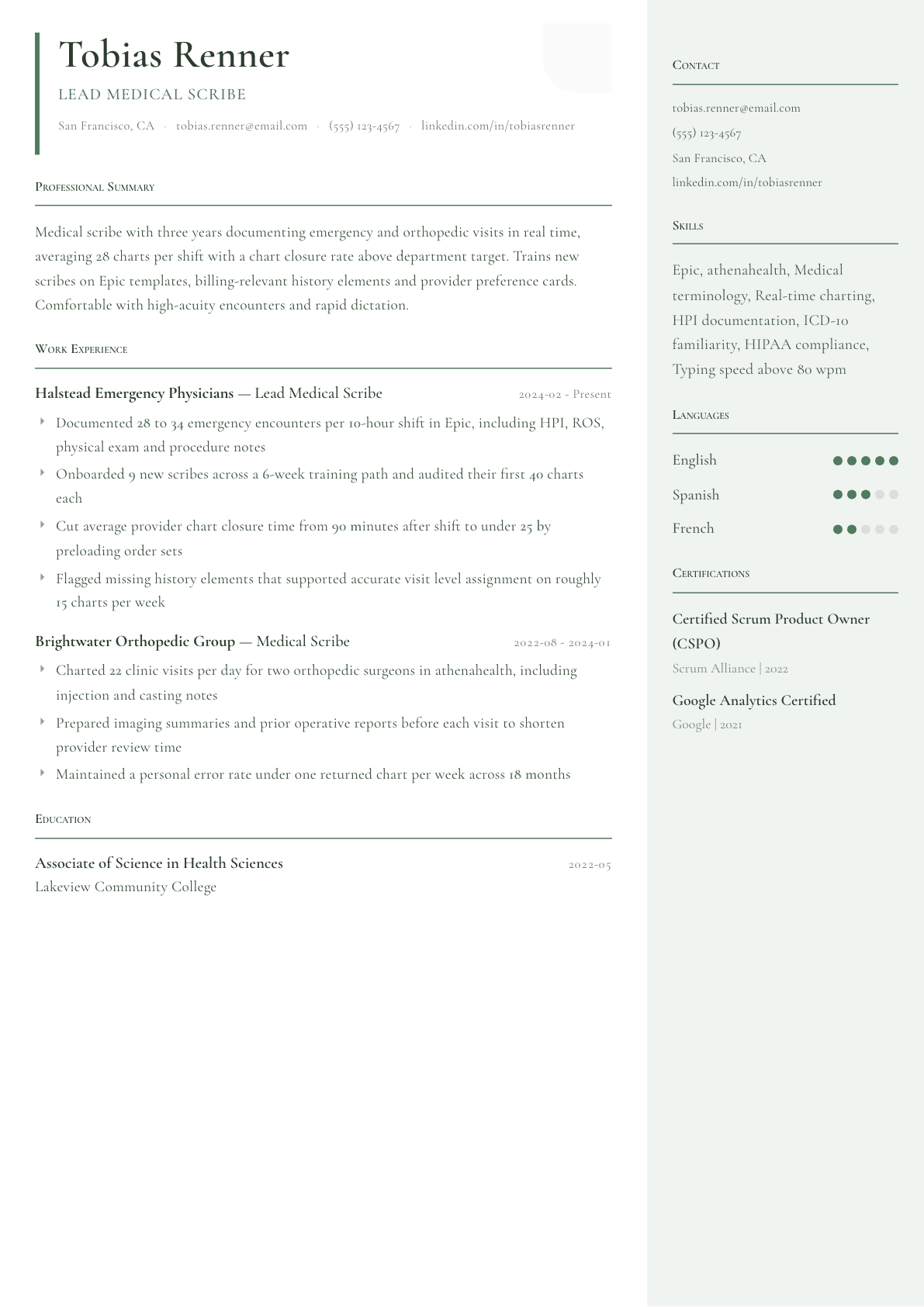
Example Medical Scribe summary
Lead medical scribe with three years in emergency and orthopedic settings, documenting up to 34 encounters per shift in Epic and athenahealth. Trains and audits new scribes, builds provider preference templates, and keeps returned charts under one per week. Strong grasp of medical terminology, procedure note structure and the history elements that support accurate visit coding.
Skills to list on a Medical Scribe resume
- Real-time clinical documentation
- Epic
- athenahealth
- Cerner
- Medical terminology
- History of present illness
- Review of systems
- Procedure note documentation
- ICD-10 familiarity
- CPT familiarity
- HIPAA compliance
- Chart auditing
- Scribe training
- Typing speed
What actually gets this resume read
- State the specialty you scribed in, because emergency, orthopedic and dermatology charting look nothing alike.
- Give charts per shift and the electronic record you used, since that is the first thing a manager checks.
- Mention chart closure time or turnaround, because that number is the whole reason clinics hire scribes.
- List training or auditing of other scribes separately, as it is the fastest route to a lead scribe posting.
- Name your typing speed and any transcription or terminology coursework near the skills section for keyword matching.
- If you are using the role as a step toward clinical school, keep patient exposure hours in a short separate line.
How to write a medical scribe resume
A medical scribe is hired to give a provider their evening back. That is the entire economic argument for the role, and it is what a scribe manager reads for. Charts per shift, accuracy, how fast the provider can close a note after the last patient leaves: those three facts decide the interview, and most scribe resumes never mention any of them.
The second thing a hiring manager checks is setting. Emergency documentation, orthopedic clinic documentation and dermatology documentation share a vocabulary and almost nothing else. A scribe who charted 30 emergency encounters a shift is not automatically ready for a surgical clinic, and a resume that hides the specialty forces the reader to assume the harder answer.
This guide covers how to state charting volume credibly, which electronic record details matter, how to describe accuracy without inventing a metric, and how to position the role when you are using it as a step toward clinical school.
Format: one page, with the setting visible in every job title
One page is right for almost every scribe. Use reverse-chronological order and write the job title with the specialty attached, so it reads as emergency department scribe or orthopedic clinic scribe rather than the generic term. That single edit answers the reader's first question before they reach the bullets.
Keep a short skills block near the top with the electronic record systems, then experience, then education. Certifications and any clinical coursework go at the end unless a posting names one as a requirement.
- Header: name, city and state, phone, email, and the specialty you currently document.
- Section order: summary, systems and skills, experience, education, certifications.
- One line per employer with the practice type and provider count you supported.
Volume and turnaround: the numbers that get you called
Give charts per shift and the shift length together, because 25 charts in ten hours and 25 charts in six hours describe different speeds. Add the provider count if you floated between physicians, and the encounter type if you handled procedures, trauma activations or postoperative visits alongside routine ones.
Then give turnaround. Chart closure time after the end of a shift is the metric clinics track, and if you never saw the number, describe the practice instead: preloading order sets, drafting the assessment during the exam, finishing the note before the provider leaves the room. Never invent a figure you cannot explain in an interview.
Documentation depth: name the parts of the note you own
A scribe who writes the history of present illness is doing different work from one who fills a template. Say which components you compose: the history, the review of systems, the physical exam as dictated, procedure notes, results review, the medical decision making narrative. Note whether the provider edits or simply signs.
Mention the elements that support accurate visit level assignment, since capturing a complete history is where scribing pays for itself. Describe it as flagging missing history elements for the provider, which is accurate, rather than claiming you assign codes, which is a coder's job and a compliance problem if you say it loosely.
- The note components you draft without prompting.
- Order entry duties and whether they were entered under provider direction.
- Prior record review, imaging summaries and preparation done before the visit.
Systems and terminology: exact vendor names, spelled their way
Write Epic, Cerner, athenahealth, Meditech and eClinicalWorks exactly as the vendors write them, because applicant tracking filters match strings. Add the modules if you know them, such as the emergency department track board or a specialty-specific note template you built.
Terminology is the other screening axis. Say where your vocabulary is strongest: cardiology, orthopedics, dermatology, emergency medicine. Add typing speed if it is genuinely above average, and any transcription, anatomy or terminology coursework that supports the claim.
Training, auditing and the path beyond scribing
Onboarding other scribes is the fastest route from a general posting to a lead or chief scribe role. Describe the length of the training path, the number of trainees and whether you audited their early charts, since that is supervisory work under a different name.
Many scribes are pre-medical, pre-physician assistant or pre-nursing. Keep that in a short line near education rather than framing the whole resume around it. A manager hiring for a two-year commitment reads an application that is openly a stepping stone with less enthusiasm than one that leads with competence and mentions the plan once.
Medical Scribe resume summary examples
First scribe role
Health sciences graduate with completed medical terminology and anatomy coursework, typing at 85 words per minute, and 120 hours of clinical volunteering in an emergency department. Trained on Epic basics and seeking a first medical scribe position in emergency or urgent care documentation.
Two years in
Medical scribe with two years in an orthopedic clinic, charting 22 visits per day for two surgeons in athenahealth including injection, casting and postoperative notes. Prepares imaging summaries and prior operative reports before each visit, and holds a returned chart rate under one per week.
Lead scribe
Lead medical scribe documenting 28 to 34 emergency encounters per ten-hour shift in Epic, covering high-acuity resuscitations and bedside procedures. Onboarded nine scribes through a six-week training path, audits their first 40 charts, and cut average provider chart closure from 90 minutes to under 25.
Work experience bullets: before and after
Before: Documented patient visits for physicians in the electronic health record.
After: Documented 28 to 34 emergency encounters per ten-hour shift in Epic, drafting the history of present illness, review of systems, physical exam and procedure notes in real time during the visit.
Volume, shift length, system and the specific note components replace a description that fits any scribe anywhere.
Before: Helped providers finish their charts faster.
After: Reduced average provider chart closure time from 90 minutes after shift end to under 25 by preloading order sets and completing the assessment narrative before the provider left the room.
A before and after number with the method behind it turns a claim into a result the manager can price.
Before: Trained new scribes on the job.
After: Onboarded nine new scribes through a six-week training path covering terminology, provider preference templates and note structure, then audited the first 40 charts each produced.
Trainee count, program length and an auditing duty show supervisory responsibility rather than casual help.
Before: Kept charts accurate and complete.
After: Flagged missing history and exam elements on roughly 15 charts per week for provider review, and maintained a returned chart rate under one per week across 18 months.
A weekly count and a sustained error rate give accuracy a shape that a general claim never has.
Before: Prepared information before appointments.
After: Built pre-visit summaries of prior imaging, operative reports and outside records for 22 daily orthopedic visits, shortening provider chart review at the start of each encounter.
Naming the source documents and the daily volume shows preparation work with a measurable payoff.
Hard skills
- Real-time clinical documentation
- History of present illness drafting
- Review of systems documentation
- Procedure note documentation
- Medical terminology
- Anatomy and physiology vocabulary
- Epic
- athenahealth
- Cerner
- Order entry under provider direction
- Chart auditing
- HIPAA compliance
Soft skills
- Listening accuracy under interruption
- Working invisibly during patient encounters
- Adapting to provider preferences
- Discretion with sensitive information
- Training and feedback delivery
- Sustained concentration across long shifts
Certifications worth listing
- Basic Life Support (BLS) (American Heart Association)
- Certified Medical Administrative Assistant (CMAA) (National Healthcareer Association)
Mistakes that cost medical scribe candidates the interview
- Omitting the specialty you documented, which forces a manager to assume your vocabulary does not transfer to their clinic.
- Writing charts documented with no shift length attached, so the number proves nothing about your speed.
- Claiming you assigned billing codes, which is a coder's responsibility and reads as a compliance risk.
- Listing the electronic record as EHR software instead of naming Epic, Cerner or athenahealth the way a filter searches for them.
- Building the entire resume around applying to clinical school, which tells the manager you will leave before the training pays back.
- Leaving out training and auditing work, which is the clearest evidence you are ready for a lead scribe posting.
Medical Scribe resume questions
What numbers should a medical scribe put on a resume?
Charts per shift with the shift length, the number of providers supported, and chart closure or turnaround time if you saw it. Those three tell a manager your throughput. Everything else on the page supports or explains them.
Do I need certification to work as a medical scribe?
Most employers train in house and do not require a credential, though completed medical terminology and anatomy coursework strengthens an application noticeably. Where you hold a real certification, list it with the issuing body and leave unaccredited course badges off.
How do I move from a clinic scribe role to an emergency department scribe role?
Lead with the transferable parts: note structure, terminology breadth, typing speed and system fluency. Then name the acuity gap honestly and point at any high-volume or unpredictable work you handled, since emergency managers screen mainly for pace tolerance.
Should I mention that scribing is preparation for medical school?
Mention it once, in a short line near education, and never as the theme of the document. Managers invest weeks in training and prefer candidates who lead with competence, so let the plan appear as context rather than as the reason you applied.
How do I describe accuracy without inventing a statistic?
Describe practices and observable outcomes: returned charts per week, addendum frequency, audits you passed, or the review process you followed before signing over a note. A concrete practice is more persuasive than a number the interviewer cannot trace.