Health Information Technician Resume Examples: free score
Write a Health Information Technician Resume for HIM Departments
By Mustafa Tarabya, founder of CVBooster · Published · Updated
Health information technician resume examples with coding audits, data integrity work, registry reporting and HIM keywords recruiters use.
Sample resumes for a health information technician
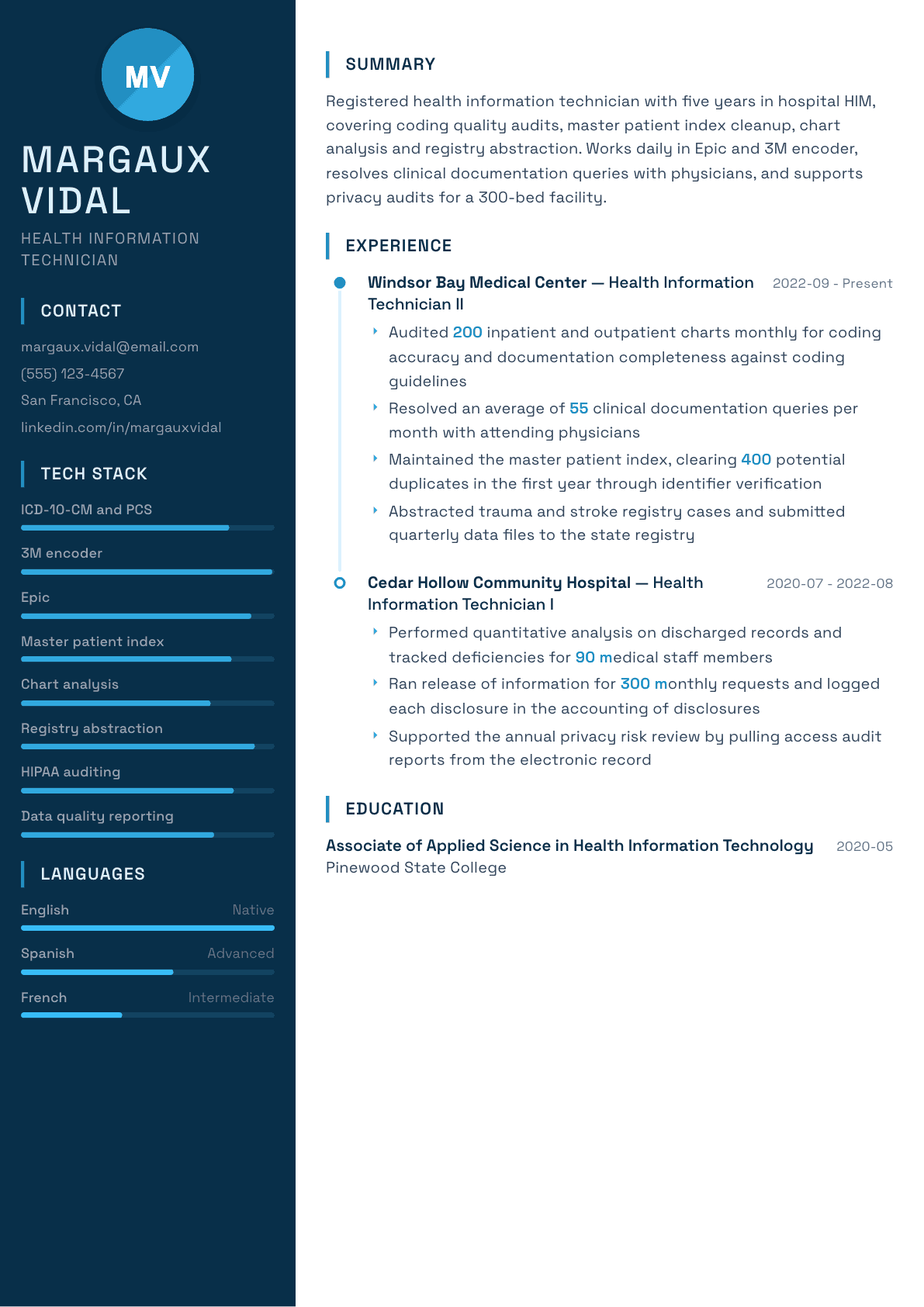
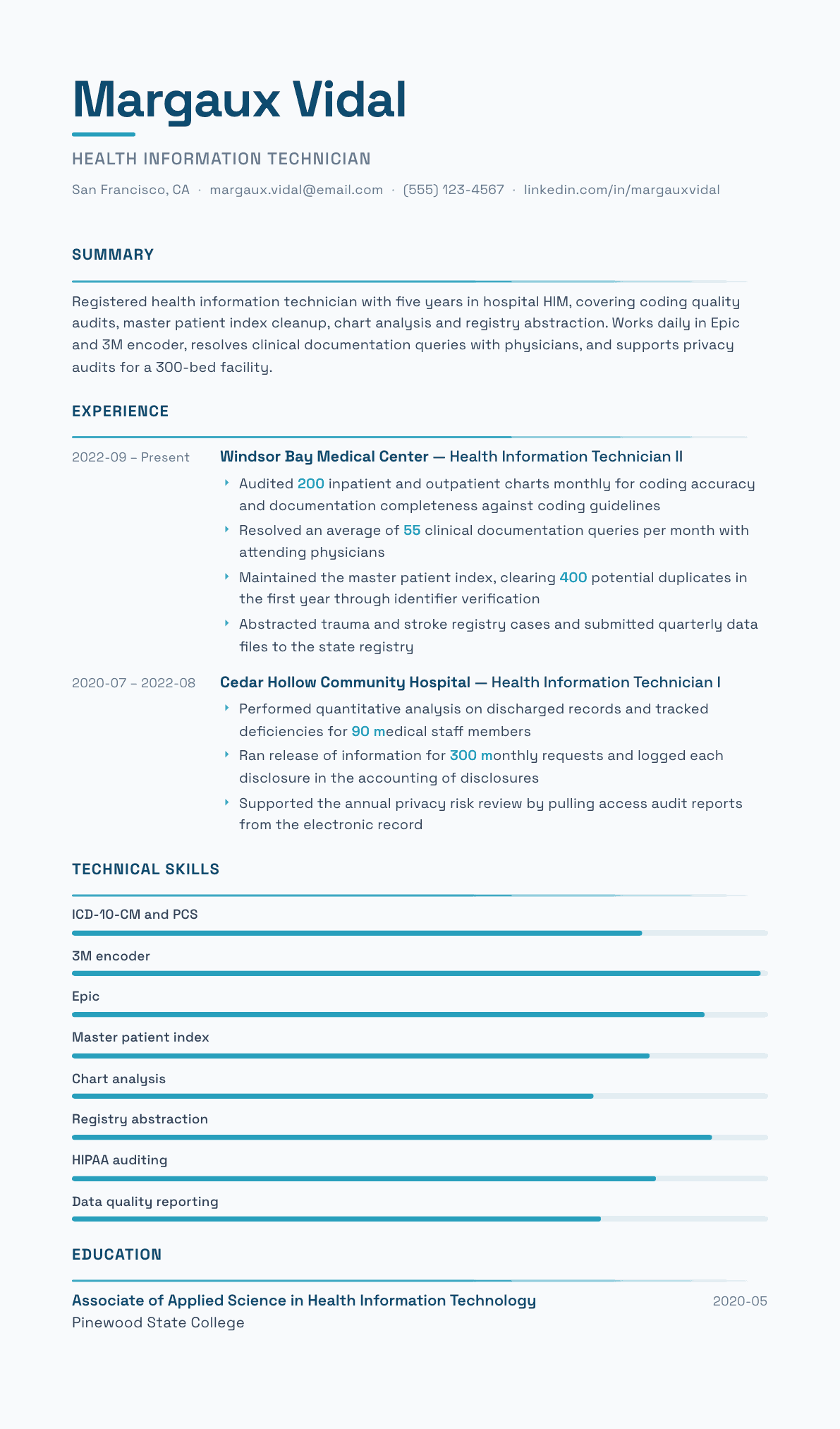
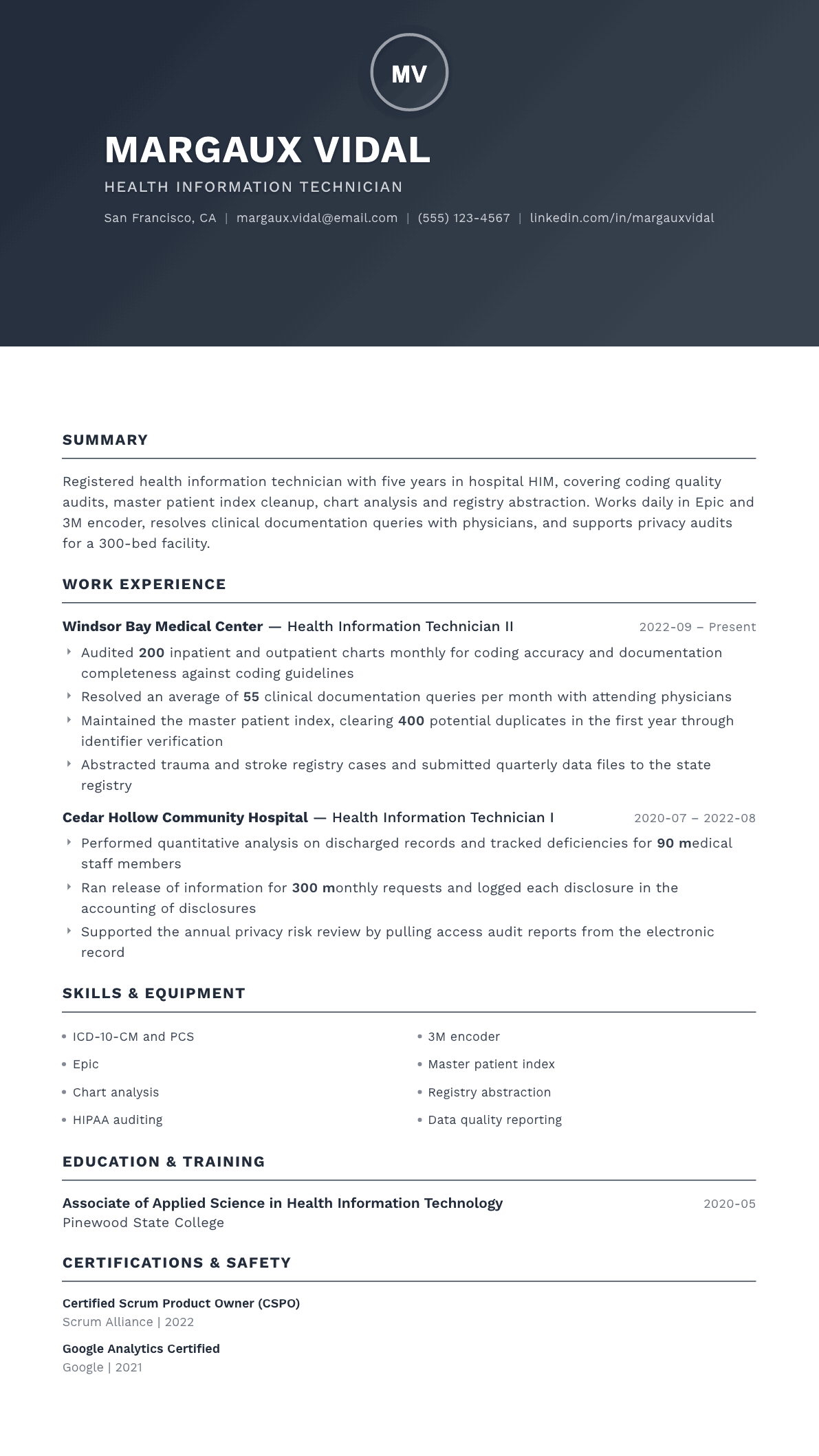
The same health information technician content laid out in three CVBooster templates, so you can see what the finished document looks like before you write a word.
Example Health Information Technician summary
Registered health information technician with five years in hospital HIM at a 300-bed facility. Audits two hundred charts a month for coding accuracy, resolves physician documentation queries, maintains the master patient index, and abstracts trauma and stroke registry cases for state submission. Daily user of Epic and a 3M encoder, with hands-on privacy audit and disclosure logging experience.
Skills to list on a Health Information Technician resume
- ICD-10-CM coding
- ICD-10-PCS coding
- CPT coding
- Coding quality auditing
- Clinical documentation queries
- Master patient index maintenance
- Quantitative chart analysis
- Registry abstraction
- Release of information
- HIPAA privacy auditing
- Accounting of disclosures
- 3M encoder
- Epic
- Data quality reporting
- Record retention
What actually gets this resume read
- Put the RHIT credential and its issuing body in the header, because HIM postings routinely require it.
- Separate coding work, data integrity work and privacy work, since departments hire against those three lanes.
- Quantify audit volume and query resolution, as those are the numbers an HIM director tracks each month.
- Name the encoder, electronic record and registry software you have used, spelled the way vendors spell them.
- Describe master patient index cleanup with the identifier checks you applied, not just the number of merges.
- Include any reporting you produced for quality, registry or regulatory submission with the receiving body named.
How to write a health information technician resume
A health information technician sits between the clinical record and everything that depends on it: coding accuracy, reimbursement, registries, quality reporting and privacy auditing. Hiring managers in a health information department read a resume looking for which of those lanes you have actually worked, because a technician who audits coding all day and one who maintains the patient index all day are not interchangeable hires.
The credential is the second filter. Many postings name the registered health information technician credential outright, and the ones that do not still expect an accredited associate degree. Put the credential in the header, because a filter that misses it will not care how good the rest of the page is.
This guide covers how to organize the resume around the department lanes, which volumes and audit numbers to quantify, how to describe data integrity work so it reads as skilled, and the questions technicians ask when they want to move toward coding, informatics or privacy roles.
Format: credential in the header, lanes as sections
Reverse-chronological, one page under ten years. Write your credential after your name the way the department writes it, then open the file with a short summary naming the facility size, the systems and the lanes you cover. A technician at a 300-bed hospital and one at a two-site clinic group are describing different jobs.
Inside each employer, group bullets by lane rather than listing tasks in the order you happened to do them. Coding and documentation work, data integrity work, release and privacy work, and reporting work each deserve their own bullet so a manager filling one gap can find it instantly.
- Header: name, RHIT or other credential, city and state, phone, email.
- Section order: summary, credentials, systems, experience, education.
- Context line per employer: facility type, bed count or site count, department size.
Coding audits and documentation queries
Audit work is measured in charts. Give the monthly review volume, whether the charts were inpatient, outpatient or both, and what you audited against: official coding guidelines, payer policy, or an internal accuracy target. Add what happened with the findings, since an audit that produced no feedback loop is only a count.
Documentation queries are the visible half of the job to clinicians, so write them carefully. Give the monthly query volume, the query types you send, and the response rate if the department tracked it. A technician who can write a compliant, non-leading query to a busy attending is doing skilled work and should say so plainly.
Data integrity: the patient index, analysis and duplicates
Master patient index maintenance is the highest-risk routine task in health information, because a merged record that should not have merged is a patient safety event. Describe the identifier verification you apply, the volume of potential duplicates you resolve, and whether you prepare merges for review or execute them yourself.
Quantitative and qualitative chart analysis belongs here too: deficiency tracking across the medical staff, incomplete record notification, and the suspension process if your facility runs one. Give the number of clinicians covered, because that is the scale a director recognizes.
- Potential duplicates worked per period and the identifier checks applied.
- Deficiency analysis volume and the number of medical staff covered.
- Any index cleanup project with the approach you used and the outcome.
Registries, reporting and regulatory submission
Abstraction is a distinct skill and a strong differentiator. Name the registries you have abstracted for, such as trauma, stroke or cancer, the case volume per period, and the body the file was submitted to. Abstraction requires reading a chart against a defined data dictionary, which is precisely the ability an informatics or quality team wants next.
Any recurring report you produced counts: coding accuracy summaries, deficiency dashboards, disclosure logs, turnaround statistics. Say who received it and what decision it fed, because a report with a named audience reads as influence rather than as a spreadsheet you maintained.
Privacy, systems and keywords
Privacy work should be described by the mechanism: access audit reports pulled from the electronic record, disclosure accounting, authorization review, and support for the annual risk review. That is the language a compliance-minded director uses and the language postings copy.
Name systems exactly: Epic, Cerner, Meditech, 3M encoder, OnBase. Add the coding classification systems you work in, ICD-10-CM, ICD-10-PCS and CPT, since postings list them individually and filters match them individually.
Health Information Technician resume summary examples
New graduate
Health information technology graduate with an accredited associate degree and a hospital practicum covering chart analysis, deficiency tracking and release of information. Trained in ICD-10-CM, ICD-10-PCS and CPT, comfortable in Epic, and preparing to sit for the registered health information technician examination.
Two years in
Health information technician at a community hospital performing quantitative analysis on discharged records, tracking deficiencies for 90 medical staff members, and running about 300 release requests a month with disclosure logging. Supports the annual privacy review by pulling access audit reports from the electronic record.
Five years, HIM lead track
Registered health information technician auditing 200 charts a month for coding accuracy at a 300-bed facility, resolving 55 physician documentation queries monthly, and maintaining the master patient index. Abstracts trauma and stroke registry cases for quarterly state submission and works daily in Epic and a 3M encoder.
Work experience bullets: before and after
Before: Reviewed charts for coding accuracy.
After: Audited 200 inpatient and outpatient charts monthly against official coding guidelines for accuracy and documentation completeness, and returned findings to the coding team as a monthly summary.
Volume, chart type, the standard applied and the feedback loop turn a review claim into a described audit program.
Before: Sent queries to physicians about documentation.
After: Resolved an average of 55 clinical documentation queries a month with attending physicians, writing compliant non-leading queries for specificity, clinical validation and present on admission status.
Query volume and the named query types show technical command of a task clinicians judge closely.
Before: Maintained the patient index and fixed duplicates.
After: Cleared 400 potential duplicate records in the first year by verifying name, date of birth and identifier matches, then documenting each merge decision for supervisor review.
The verification method and the documented decision trail address the patient safety risk a director worries about.
Before: Worked with the trauma and stroke registries.
After: Abstracted trauma and stroke registry cases against the national data dictionary and prepared quarterly submission files for the state registry, reconciling validation errors before each upload.
Naming the dictionary, the recipient and the error reconciliation step shows abstraction rather than data entry.
Before: Helped with privacy audits.
After: Pulled electronic record access audit reports for the annual privacy risk review, flagged unusual access patterns for the privacy officer and logged every third-party disclosure in the accounting of disclosures.
Three named privacy mechanisms make the contribution concrete instead of a general claim of assistance.
Hard skills
- ICD-10-CM coding
- ICD-10-PCS coding
- CPT coding
- Coding quality auditing
- Clinical documentation query writing
- Master patient index maintenance
- Quantitative and qualitative chart analysis
- Registry abstraction
- Release of information
- HIPAA access auditing
- 3M encoder
- Epic
Soft skills
- Precision across repetitive review
- Diplomatic physician communication
- Confidentiality judgment
- Working to submission deadlines
- Explaining findings to non-coders
- Cross-department coordination
Certifications worth listing
- Registered Health Information Technician (RHIT) (American Health Information Management Association)
- Certified Coding Associate (CCA) (American Health Information Management Association)
- Certified Coding Specialist (CCS) (American Health Information Management Association)
- Certified Professional Coder (CPC) (AAPC)
- Certified in Healthcare Privacy and Security (CHPS) (American Health Information Management Association)
Mistakes that cost health information technician candidates the interview
- Leaving the health information credential out of the header, where the first automated screen looks for it.
- Blending coding, data integrity, privacy and reporting duties into one undifferentiated list of tasks.
- Giving no audit or query volume, so a director cannot size your workload against their department.
- Describing index cleanup as fixing duplicates without the identifier checks that make a merge defensible.
- Omitting registry abstraction, which is the strongest differentiator for quality and informatics postings.
- Naming software generically as an EHR instead of the exact vendor and encoder a posting filters on.
- Claiming a privacy officer role when the work was pulling audit reports and logging disclosures under one.
Health Information Technician resume questions
Do I need the RHIT credential for a health information technician job?
Many postings require it outright and most of the rest treat it as preferred, so put it in the header when you hold it. If you are eligible but not yet certified, write that you are preparing for the examination with your expected sitting period.
What volumes should a health information technician quantify?
Charts audited per month, documentation queries resolved per month, potential duplicates worked, release requests handled and registry cases abstracted per quarter. Those five numbers let a director map your workload directly onto an open position.
How is this role different from a medical coder on a resume?
A coder resume is built around production, accuracy rate and code set depth. A technician resume covers a wider surface: auditing rather than assigning, index integrity, chart analysis, registries and privacy. Show breadth across those lanes, with depth in at least one.
How do I move from this role into health informatics?
Foreground the data work: registry abstraction against a data dictionary, index integrity projects, recurring reports and any query or report you built inside the electronic record. Then add analytics tooling you can genuinely use, since informatics teams screen on that first.
Should I list every system I have touched?
List the ones you used regularly enough to work in unaided, with the modules where you know them. A long list of systems seen once weakens the strong entries, and interviewers routinely pick a name at random and ask what you did in it.