Medical Biller Resume Examples: the lines they read
Medical Biller Resume Examples for Medical Billing Jobs
By Mustafa Tarabya, founder of CVBooster · Published · Updated
Medical billing resume examples with a full billing specialist sample, claim volume, denial appeals, payer mix and the keywords revenue cycle managers search.
Sample resumes for a medical biller
The same medical biller content laid out in three CVBooster templates, so you can see what the finished document looks like before you write a word.
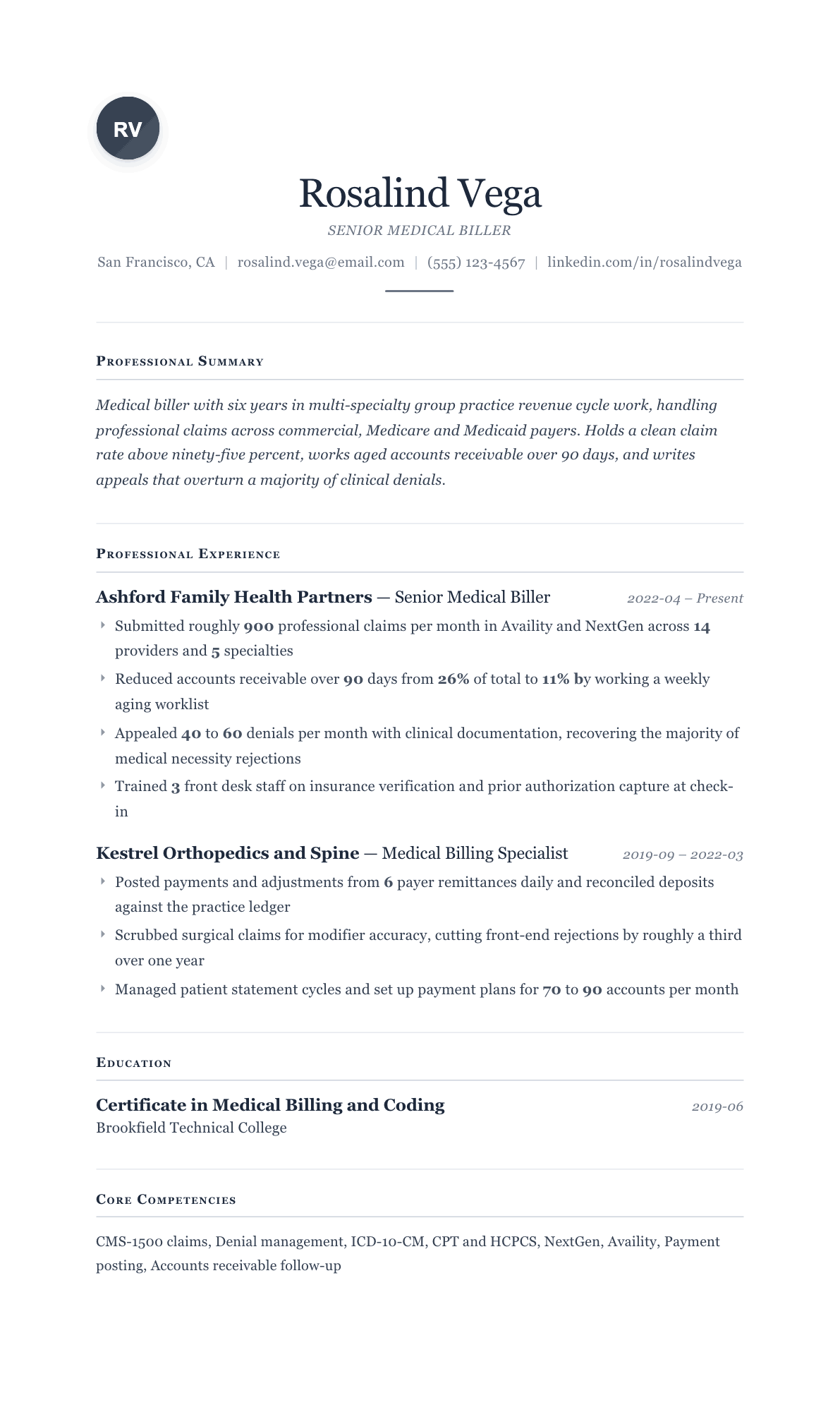
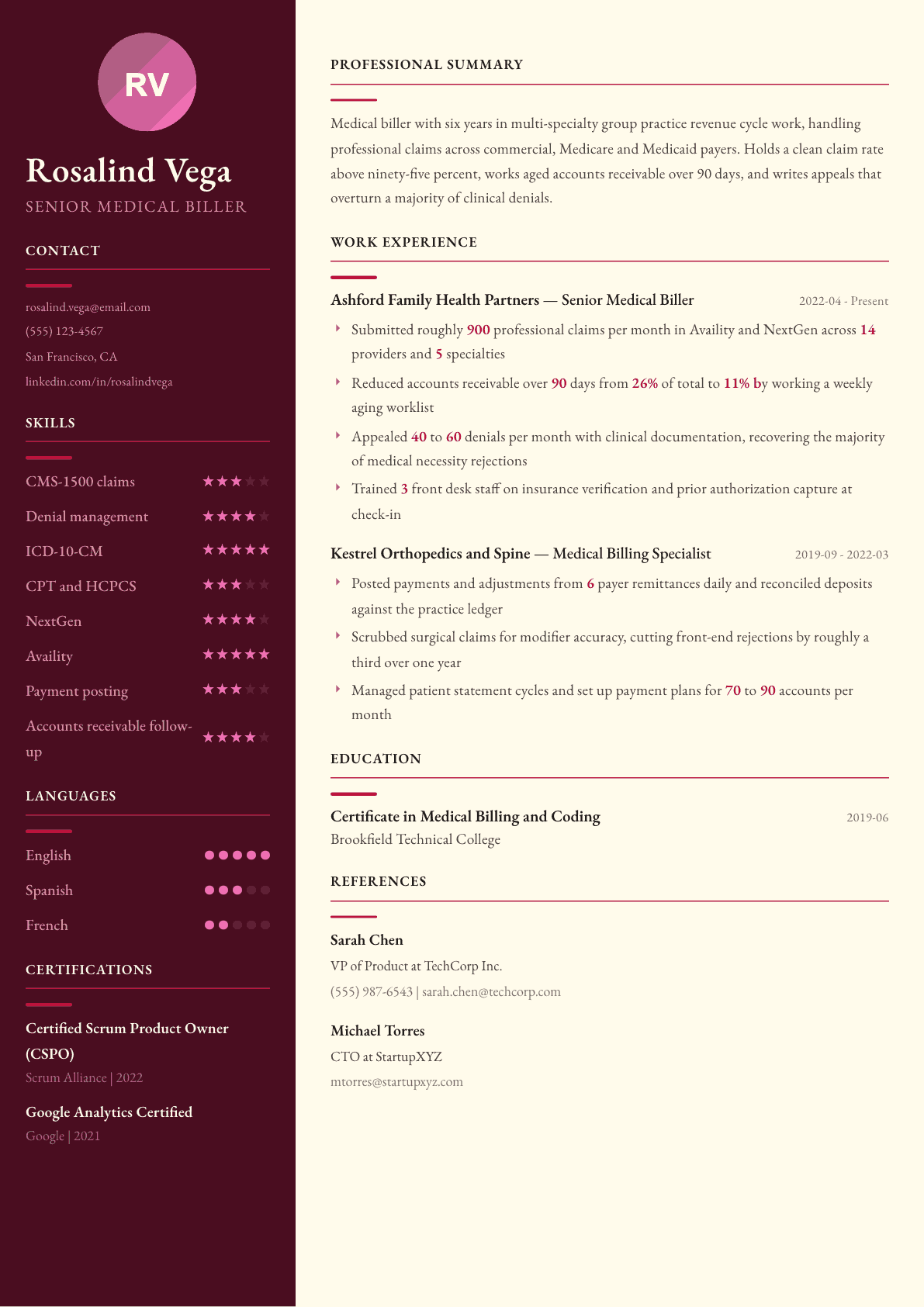
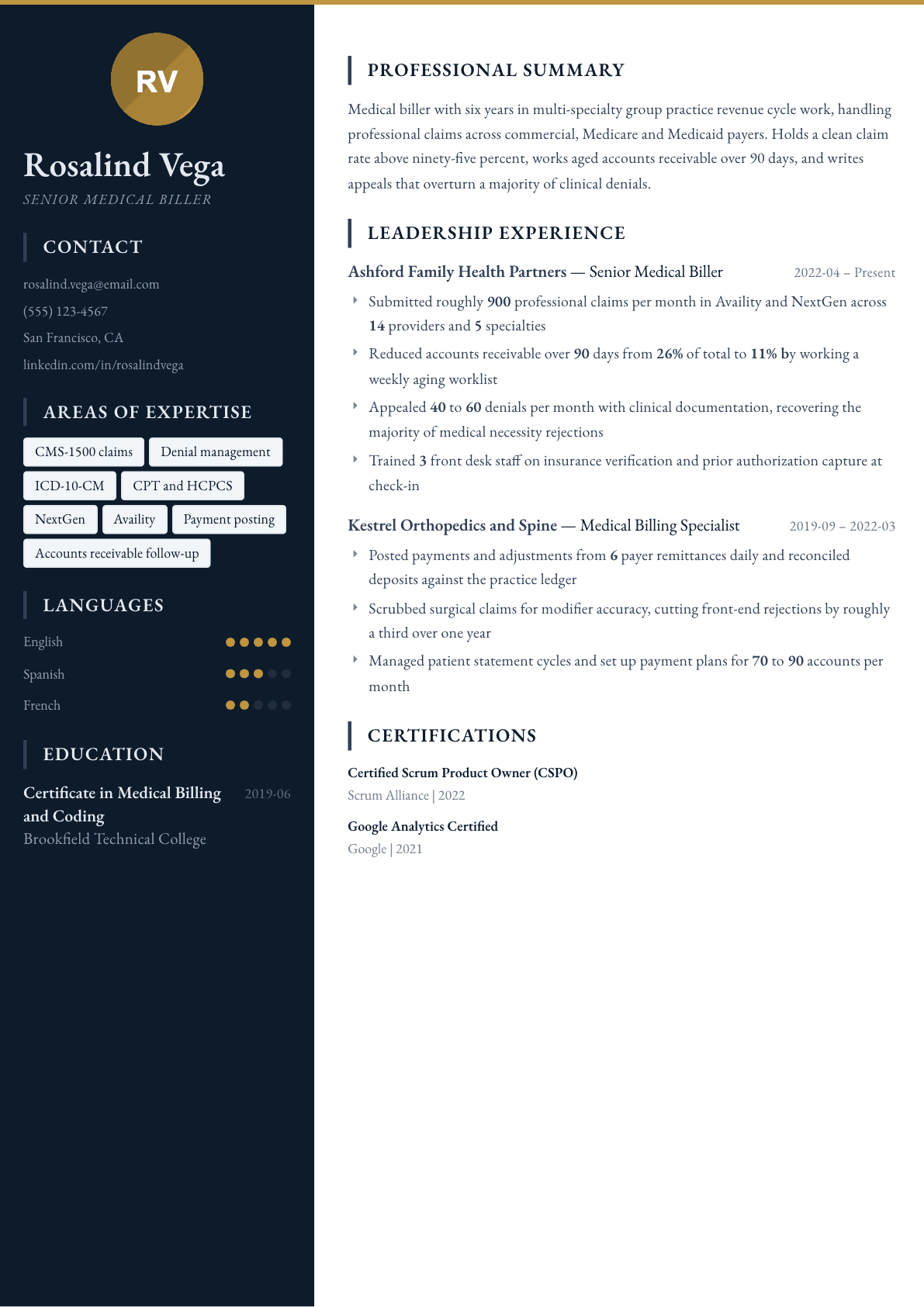
Example Medical Biller summary
Senior medical biller with six years across family medicine and orthopedic practices, submitting about 900 professional claims a month through a clearinghouse for 14 providers. Cut aged accounts receivable by more than half in two years and recovers the majority of medical necessity denials on appeal. Fluent in ICD-10-CM, CPT modifiers, Medicare rules and payer portal workflows.
Skills to list on a Medical Biller resume
- CMS-1500 and UB-04 claims
- ICD-10-CM coding
- CPT and HCPCS coding
- Modifier application
- Denial management and appeals
- Accounts receivable follow-up
- Payment posting and reconciliation
- Insurance eligibility verification
- Prior authorization
- Electronic remittance advice
- NextGen
- Availity
- Medicare and Medicaid billing
- HIPAA compliance
- Patient statement cycles
What actually gets this resume read
- Open with claim volume, payer mix and specialty, because those three facts define whether your experience transfers.
- Quantify clean claim rate, days in accounts receivable and denial overturn results rather than listing billing duties.
- Name the practice management and clearinghouse systems you have worked in, since employers screen on those exact words.
- Separate front-end work such as eligibility and prior authorization from back-end collections and appeals.
- Add credentials such as CPB or CPC with the issuing body, as many revenue cycle postings filter on them.
- Show compliance awareness by naming HIPAA and payer audit response work you have handled directly.
How to write a medical biller resume
Revenue cycle managers hire a medical biller to move money that is already earned. So the resume that gets a call is the one that answers three questions immediately: how many claims you touch, for which payers, and what happens to the ones that come back denied. A page of billing duties answers none of them.
The second filter is setting. Professional billing for a family practice, facility billing for a hospital, and surgical billing with modifier-heavy claims are three separate skill sets with three separate denial patterns. A biller who worked orthopedic surgical claims should say so, because that experience is worth more to an orthopedic group than a longer general history.
This guide covers the metrics a revenue cycle director actually tracks, how to write denial and appeals work so it reads as expertise, which systems to name, and the credential questions billers ask when a posting says certification preferred.
Format: a one-page file with the payer mix on the first line
Reverse-chronological, one page for under ten years, two after that. Under each employer write a single context line before the bullets: practice type, provider count, specialties, monthly claim volume and payer mix. That line does more work than the four bullets under it, because it lets a manager judge transferability in one read.
Keep certifications and systems in short blocks that a filter can find. Avoid columns and graphics. Billing departments run high-volume applicant tracking, and a parsed resume that loses your certification line is a resume that never reaches a human.
- Header: name, city and state, phone, email, and your billing certification if you hold one.
- Section order: summary, certifications, systems, experience, education.
- Context line per employer: specialty, providers, claims per month, payer mix.
The metrics that matter: clean claims, aging, denial outcomes
Three numbers carry a biller resume. Clean claim rate on first submission tells a manager how much rework you generate. Days in accounts receivable, or the share of the balance sitting past 90 days, tells them how well you work an aging list. Denial overturn results tell them whether your appeals are argued or merely resubmitted.
If you did not have access to department dashboards, use what you can defend: claims submitted per month, denials worked per month, the aging buckets you owned, the number of providers on your desk. Precise scope beats a borrowed metric you cannot explain when an interviewer asks how it was calculated.
Denials and appeals: name the reason codes and the argument
Denial work separates a biller from a data entry clerk, so give it its own bullets. Say which denial families you handle: medical necessity, timely filing, coordination of benefits, bundling and modifier edits, prior authorization missing, non-covered service. Each one requires a different fix, and naming them proves you know the difference.
Then describe the appeal itself. Pulling the operative report, citing the payer policy, attaching the referring documentation and tracking the reconsideration deadline is real work, and a bullet that shows the sequence reads far stronger than one that says appealed denied claims.
- Denial categories you work and the monthly volume of each if you tracked it.
- The documentation you assemble for a clinical appeal.
- Payer portals and reconsideration timelines you managed against.
Front-end work: eligibility, authorization, and why it belongs here
Most denials are created at check-in, not at submission, so front-end experience raises your value. Describe eligibility verification, benefit checks, prior authorization capture and patient responsibility estimates, and mention if you trained front desk staff to collect the information that stopped a denial family at the source.
Patient-facing collection work belongs in this section as well: statement cycles, payment plans, financial hardship referrals and the tone you use on a balance call. Practices care about that because collection is where a billing role touches patient satisfaction.
Systems, coding literacy and compliance
Name the practice management system, the clearinghouse and the payer portals exactly: NextGen, Availity, eClinicalWorks, Kareo, Waystar, Meditech. Add the specific modules or reports you used, since a manager reading a familiar report name assumes a short onboarding.
A biller is not a coder, but coding literacy is expected. Say that you read ICD-10-CM and CPT well enough to spot a mismatch, that you apply modifiers correctly on resubmission, and that you query the coder rather than changing a code yourself. Compliance sentences should be equally specific: HIPAA minimum necessary, payer audit responses, refund and overpayment handling.
Medical billing resume sample: a billing specialist moving to a larger group
Medical billing resumes look alike at a glance, so the sample below shows the order that makes one readable in a few seconds: the credential and setting in the header, a context line under each employer, then claims, denials and money. Postings use medical biller, medical billing specialist and billing representative for the same desk, so copy the title from the posting into your header.
The person and employers are invented. Keep the order and replace every figure with one you can explain in the interview.
- Header and summary: Janelle Ortiz, CPB, Medical Billing Specialist. Four years billing for a six provider cardiology practice, about 750 professional claims a month across Medicare, Medicaid and five commercial payers. Ready to move to a multispecialty group.
- Medical Billing Specialist, Riverside Heart Associates, four years. Submits claims through Availity, works the rejection queue daily and posts payments from electronic remittance advice.
- Works the denial list by category every week: prior authorization, medical necessity and bundling edits, with appeals built from the visit note and the payer policy.
- Owns the 60 to 120 day aging bucket and calls stalled payers on a fixed weekly schedule.
- Earlier: Patient Account Representative, Lakeside Family Medicine, two years, eligibility checks, statements and payment plans.
Medical Biller resume summary examples
First billing role
Medical billing and coding certificate graduate with a CPB credential and a six-month practice externship posting payments and verifying eligibility for a family clinic. Comfortable reading ICD-10-CM and CPT, working a CMS-1500 claim form line by line, and following up on rejections through a clearinghouse portal.
Three years in
Medical biller with three years in a four-provider orthopedic practice, submitting roughly 600 professional claims a month and scrubbing surgical claims for modifier accuracy. Posts payments from six payer remittances daily, reconciles deposits against the ledger, and manages patient statement cycles and payment plans.
Senior biller
Senior medical biller handling about 900 claims a month for 14 providers across five specialties. Cut accounts receivable over 90 days from a quarter of the balance to about a tenth by working a weekly aging list, and overturns the majority of medical necessity denials through documented clinical appeals.
Work experience bullets: before and after
Before: Submitted insurance claims for the practice.
After: Submitted roughly 900 professional claims per month through Availity for 14 providers across five specialties, covering commercial, Medicare and Medicaid payers.
Volume, clearinghouse, provider count and payer mix let a manager judge whether the experience transfers to their practice.
Before: Worked on denied claims and appeals.
After: Worked 40 to 60 denials a month by category, pulling operative reports and payer medical policy for necessity appeals and correcting modifier and bundling edits before resubmission.
Naming the denial families and the documentation used shows argued appeals rather than blind resubmission.
Before: Reduced outstanding accounts receivable.
After: Reduced accounts receivable over 90 days from 26% of the total balance to 11% in two years by working a weekly aging worklist and escalating stalled payer claims through portal reconsideration.
A before and after figure on a metric managers already track, plus the method, makes the improvement credible.
Before: Verified patient insurance information.
After: Verified eligibility and benefits for roughly 70 daily visits and trained three front desk staff to capture prior authorization numbers at check-in, cutting authorization denials at the source.
Connecting front-end capture to a specific denial family shows you understand where rework is created.
Before: Posted payments and handled patient balances.
After: Posted payments and contractual adjustments from six payer remittances daily, reconciled deposits against the practice ledger, and set up payment plans for 70 to 90 patient accounts a month.
Daily remittance count, reconciliation duty and account volume turn routine tasks into a described workload.
Hard skills
- CMS-1500 and UB-04 claim submission
- ICD-10-CM literacy
- CPT and HCPCS literacy
- Modifier application
- Denial management and appeals
- Accounts receivable follow-up
- Payment and adjustment posting
- Electronic remittance advice reconciliation
- Insurance eligibility and benefit verification
- Prior authorization
- Medicare and Medicaid billing rules
- Clearinghouse and payer portal workflows
Soft skills
- Persistence on aged accounts
- Payer phone negotiation
- Clear explanation of balances to patients
- Attention to detail across repetitive work
- Cross-team communication with coders and front desk
- Deadline discipline
Certifications worth listing
- Certified Professional Biller (CPB) (AAPC)
- Certified Professional Coder (CPC) (AAPC)
- Certified Coding Associate (CCA) (American Health Information Management Association)
- Certified Revenue Cycle Representative (CRCR) (Healthcare Financial Management Association)
Mistakes that cost medical biller candidates the interview
- Listing billing duties with no claim volume, so a manager cannot tell a two-provider clinic from a fourteen-provider group.
- Leaving out the payer mix, which is the single fastest way for a reader to judge whether your denial experience applies.
- Describing appeals as a single activity instead of naming the denial categories that require different arguments.
- Writing EHR or billing software rather than the exact vendor names that applicant tracking filters match against.
- Claiming to change diagnosis codes, which crosses into coding responsibility and reads as a compliance problem.
- Quoting a department clean claim rate you never calculated and cannot explain when an interviewer asks about the denominator.
- Hiding front-end eligibility and authorization work, which is where most preventable denials are stopped.
Medical Biller resume questions
Do I need a certification to get hired as a medical biller?
Many postings list one as preferred rather than required, but a CPB or CPC noticeably shortens the screening. If you hold one, put it in the header and in a certifications block with the issuing body so both the filter and the human find it.
What is the most important number on a medical biller resume?
Monthly claim volume, because everything else scales from it. Follow it with days in accounts receivable or the share of balance past 90 days, then denial outcomes. Three defensible numbers beat a page of duties that could describe any billing desk.
How do I write a billing resume with no experience?
Lead with the certificate or credential, then the externship or practicum with real tasks and volumes, then any customer service and collections work. Name the systems you trained on and show you can read a claim form line by line.
What should medical billing resumes include?
Your billing credential and setting in the header, a summary with monthly claim volume and payer mix, a context line under each employer, then bullets on claim submission, denials and appeals, accounts receivable follow-up and payment posting. Add the clearinghouse and practice management system by name, and list coding literacy, not coding authority.
How do I move from professional billing to hospital facility billing?
Name the transferable mechanics first: aging worklists, remittance posting, appeals and payer portals. Then acknowledge the format gap between the professional claim and the facility claim, and point at any revenue code, chargemaster or inpatient exposure you already have.