Mental Health Technician Resume Examples: free ATS score
Write a Mental Health Technician Resume for Inpatient Units
By Mustafa Tarabya, founder of CVBooster · Published · Updated
Mental health technician resume example with unit detail, safety checks, restraint training, behavioral health keywords and a full writing guide.
Sample resumes for a mental health technician
The same mental health technician content laid out in three CVBooster templates, so you can see what the finished document looks like before you write a word.
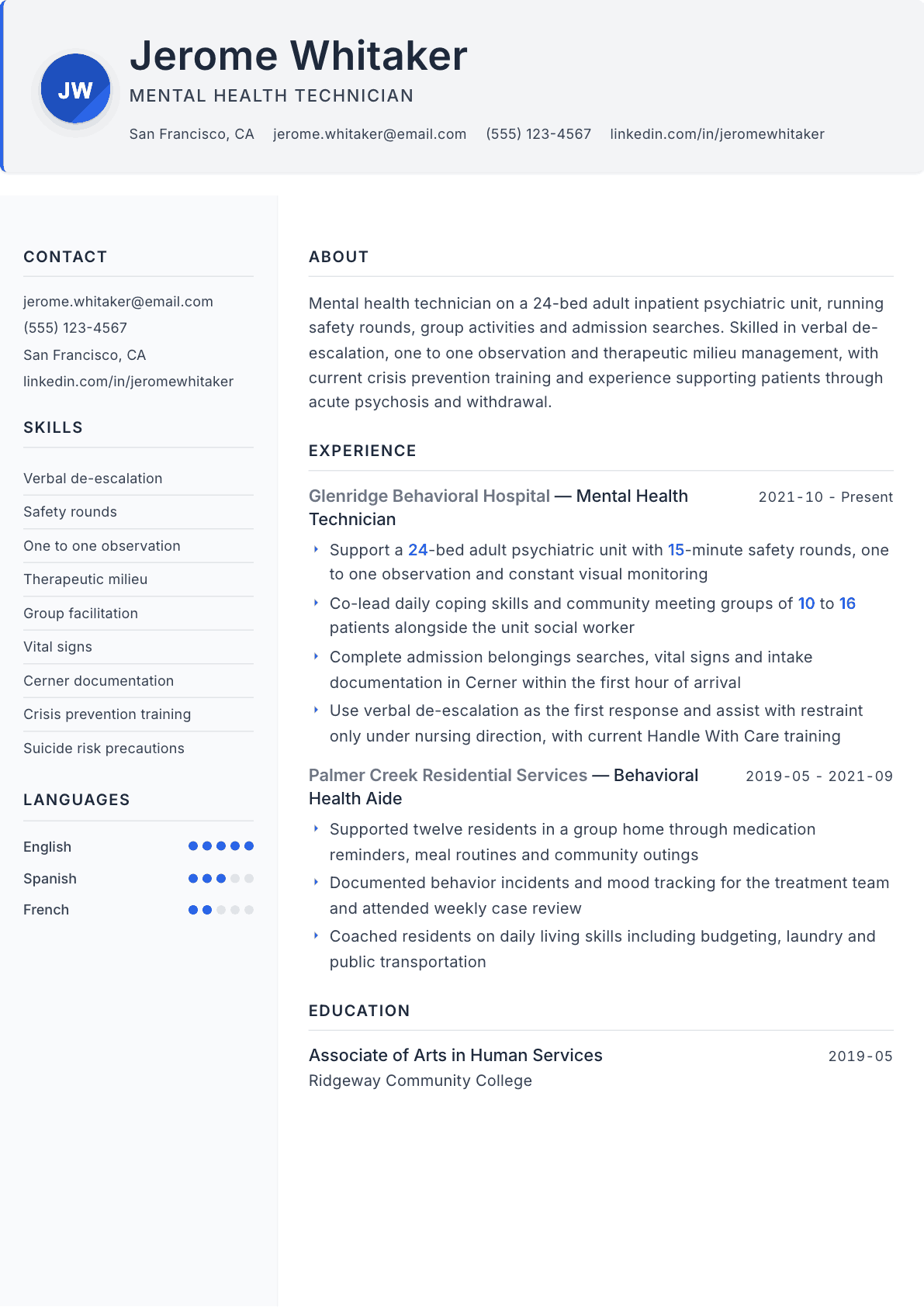
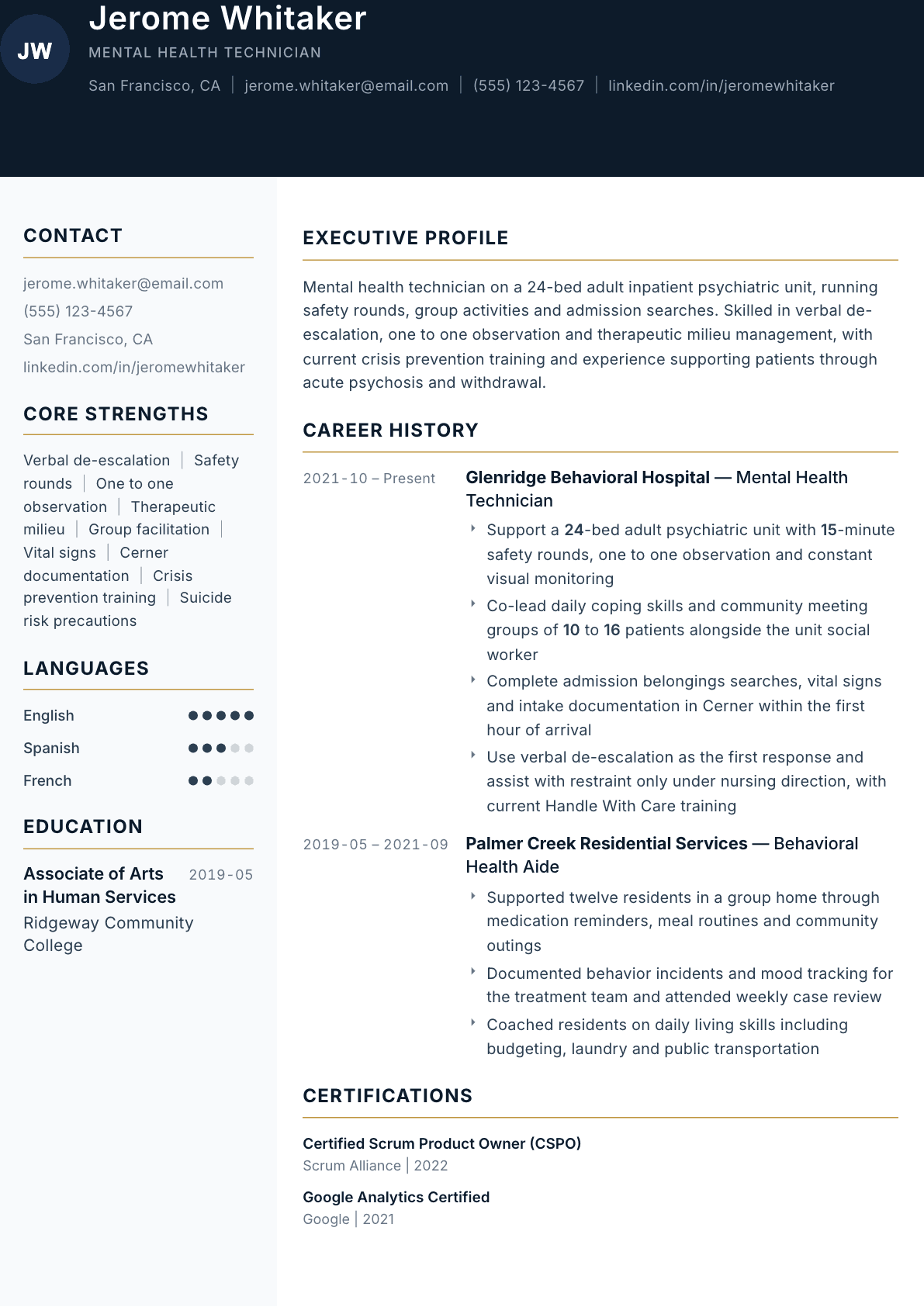
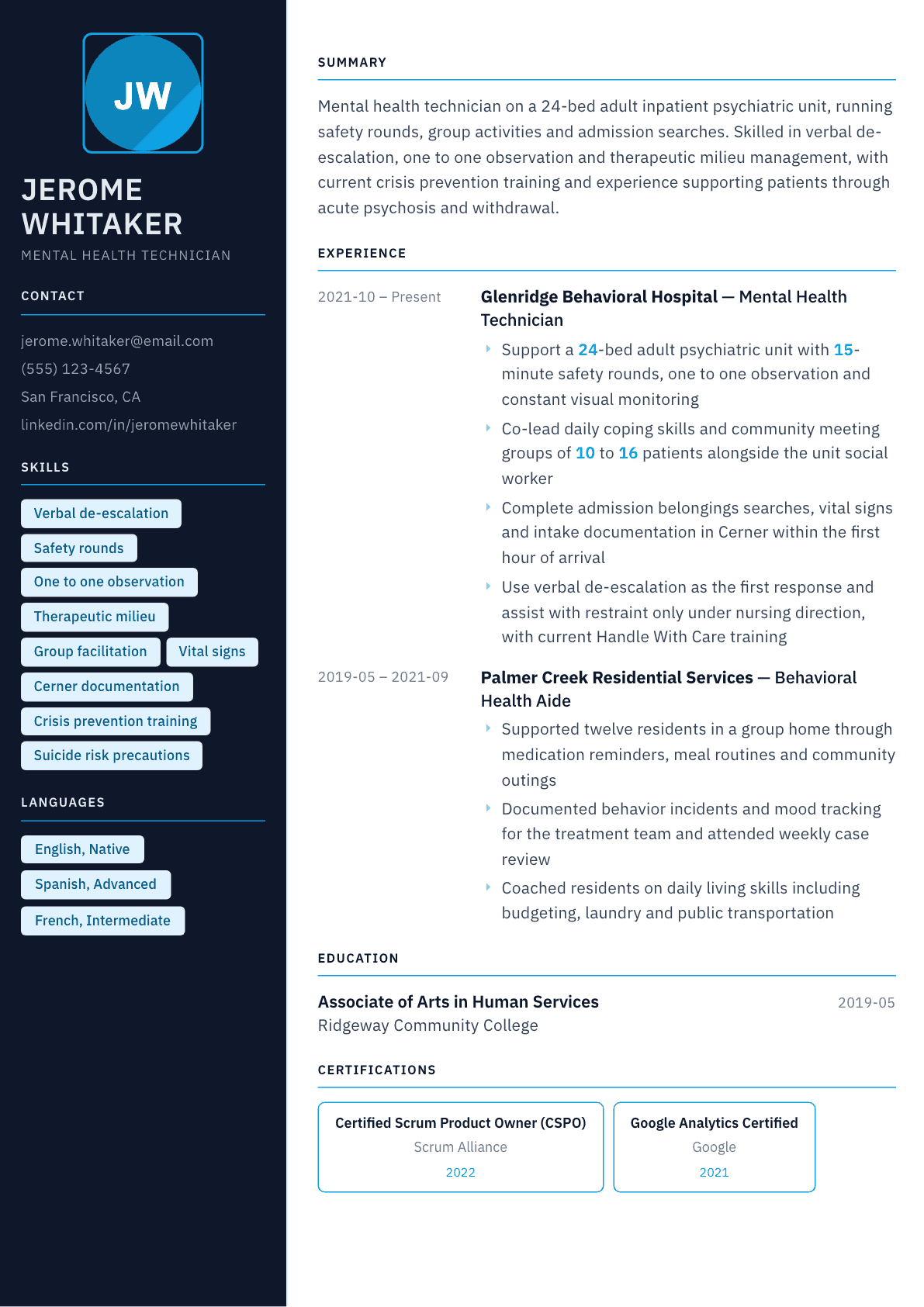
Example Mental Health Technician summary
Mental health technician with five years on adult inpatient psychiatric and residential units, most recently a twenty four bed acute unit. Runs fifteen minute safety rounds and one to one observation, co-leads daily coping skills groups, and completes admission searches and intake documentation. Relies on verbal de-escalation first, with current crisis prevention certification and experience through acute psychosis and withdrawal.
Skills to list on a Mental Health Technician resume
- Verbal de-escalation
- Crisis intervention
- Safety rounds and checks
- One to one observation
- Therapeutic milieu management
- Group facilitation
- Suicide precautions
- Vital signs monitoring
- Admission searches
- Behavioral documentation
- Activities of daily living support
- Restraint and seclusion protocols
- Substance withdrawal monitoring
- Treatment team collaboration
What actually gets this resume read
- Name the unit type and bed count in every job, since adult inpatient, adolescent, geriatric psychiatry and detox are staffed very differently.
- List your crisis intervention training by program name and expiration, because units cannot schedule you without a current card.
- Show de-escalation as your primary tool and restraint as the exception, which is exactly how a nurse manager wants to read it.
- Include observation levels you have covered, such as 15-minute checks, line of sight and one to one, with the populations involved.
- Mention group work you have co-led, because technicians who can hold a group are worth more than technicians who only observe.
- Add your documentation system and any vital signs, phlebotomy or CNA skills you carry into the behavioral health setting.
How to write a mental health technician resume
A mental health technician resume is read by a charge nurse or a unit director who is trying to answer one question: will this person keep the milieu calm on a hard night. Everything else is secondary. The unit type, the bed count, the observation levels you have covered and the crisis training you carry tell them more than any description of compassion.
The second thing they check is whether you can do the paperwork and the tasks that surround the calm. Admission searches, vital signs, meal and fluid documentation, behavior charting, group co-facilitation and accurate handoff at shift change are the structure of the shift. Technicians who write only about talking with patients look like volunteers rather than staff.
This guide covers how to present unit experience, which trainings to list and how, three summary examples from a first behavioral health job to a lead technician, bullet rewrites that show safe practice, and the questions technicians ask when they apply to hospitals, residential programs or detox units.
Format: one page, training cards visible near the top
One page, single column, plain layout. Behavioral health hospitals hire through the same applicant systems as acute care, and dates get scrambled by columns. Put your city and shift availability in the header, because night and weekend coverage is the hardest thing these units staff.
Create a short certifications block above experience with the crisis intervention program name, your life support card and any nursing assistant or medication aide credential. A unit cannot put you on the schedule without current cards, so a reader looks for them early.
- Header: name, city and state, phone, email, shift availability.
- Certifications: crisis intervention program, life support, aide credentials, expirations.
- Sections: summary, certifications, experience, skills, education.
Summary: unit type, bed count, population, primary tool
Name the setting precisely. Adult inpatient psychiatry, adolescent unit, geriatric psychiatry, detox and withdrawal management, crisis stabilization, residential treatment and partial hospitalization are staffed with different skills, and directors do not read across them generously.
Give the bed count and the population, then state that de-escalation is your first response. Close with any secondary clinical skill you carry, such as vital signs, phlebotomy or personal care experience, because units value technicians who can handle the physical side of a psychiatric admission.
Experience: observation levels, groups, admissions, documentation
Start each job with the unit and bed count, then describe the observation levels you have covered. Routine rounds at a set interval, line of sight and one to one are three different assignments, and being trusted with a one to one is a signal about your judgment.
Cover the admission process. Belongings and contraband searches, skin assessment, vital signs, orientation to the unit and intake documentation within the first hour show that you handle the highest risk window on any psychiatric unit.
Then the milieu work. Groups you co-lead and their size, activity scheduling, meal and fluid monitoring, sleep charting, and how you handle two patients escalating at once. Add the documentation system and how quickly you complete behavior notes, since incident charting is reviewed after every event.
Finish with safety. Say plainly that verbal de-escalation comes first and that physical intervention happens under nursing direction within your training. Name the program, the refresher schedule and any debriefing you take part in afterward.
Trainings and clinical add-ons worth listing
Crisis intervention programs go by brand, and units hire for the one they use. Name yours exactly with the certifying organization and the expiration. If you have completed more than one over your career, list them all, because a technician who can pick up a new curriculum quickly is easier to onboard.
Beyond crisis training, list suicide risk protocols you follow, ligature risk environmental checks, contraband procedures, seclusion and restraint documentation, and any trauma informed care training. These are the words that appear in behavioral health job descriptions.
- Crisis prevention or safe physical intervention training, with organization and expiration.
- Life support certification and any nursing assistant credential.
- Suicide precaution protocols, ligature risk checks, contraband procedures.
- Trauma informed care, de-escalation coaching, peer support training.
Keywords behavioral health postings repeat
Common terms include therapeutic milieu, observation levels, de-escalation, crisis intervention, suicide precautions, restraint and seclusion, activities of daily living, behavior documentation, group facilitation, treatment team, vital signs and admission process. Use the ones you can defend and attach each to a bullet that proves it.
Mental Health Technician resume summary examples
First behavioral health job
Human services graduate with two years in a group home supporting adults with serious mental illness, moving into inpatient behavioral health. Experienced with medication reminders, daily living coaching and behavior documentation, holds current crisis prevention and life support cards, and available for nights and weekends.
Four years in
Mental health technician on a twenty four bed adult psychiatric unit, running fifteen minute safety rounds, line of sight and one to one observation. Completes admission searches, vital signs and intake documentation within the first hour, co-leads daily coping skills groups, and relies on verbal de-escalation before any physical intervention.
Lead technician
Lead mental health technician across an adult and an adolescent unit, coordinating technician assignments each shift and orienting new hires. Serves on the restraint reduction committee, leads post event debriefs with nursing, and maintains instructor level status in the hospital crisis intervention program.
Work experience bullets: before and after
Before: Monitored patients on a psychiatric unit.
After: Covered a 24-bed adult psychiatric unit with 15-minute safety rounds, line of sight assignments and one to one observation for patients on high suicide precautions.
Bed count and three named observation levels show the acuity you have actually been trusted with.
Before: Helped calm patients who were upset.
After: Used verbal de-escalation as the first response during escalations, offering choices, reducing stimulation and moving the conversation to a quiet space, with physical intervention only under nursing direction.
Concrete de-escalation steps and a clear scope boundary are what a nurse manager needs to read.
Before: Did admissions paperwork.
After: Completed belongings and contraband searches, skin assessment, vital signs and intake documentation within the first hour of every admission, flagging withdrawal signs to the nurse immediately.
Naming each admission task and the escalation habit shows command of the highest risk window on the unit.
Before: Ran groups with patients.
After: Co-led daily coping skills and community meeting groups of 10 to 16 patients alongside the unit social worker, adapting the activity when the milieu was unsettled.
Group size, frequency and the adaptation detail prove you can hold a room rather than sit in one.
Before: Wrote notes about patient behavior.
After: Documented behavior observations, sleep, intake and output in Cerner each shift and completed incident notes before end of shift so the treatment team had them at morning rounds.
The system, the data captured and the timing make documentation verifiable and useful to the next reader.
Hard skills
- Verbal de-escalation
- Observation levels and safety rounds
- Suicide precaution protocols
- Admission and contraband searches
- Vital signs monitoring
- Therapeutic milieu management
- Group co-facilitation
- Behavior and incident documentation
- Restraint and seclusion procedures
- Substance withdrawal observation
- Activities of daily living support
- Ligature risk environmental checks
Soft skills
- Calm presence under threat
- Boundary setting
- Nonjudgmental listening
- Teamwork at shift change
- Reliability on night shift
- Respect for patient dignity
Certifications worth listing
- Nonviolent Crisis Intervention (Crisis Prevention Institute)
- Handle With Care Behavior Management System (Handle With Care Behavior Management System)
- Certified Nursing Assistant (CNA) (State nurse aide registry)
- Basic Life Support (BLS) (American Heart Association)
- Mental Health First Aid (National Council for Mental Wellbeing)
Mistakes that cost mental health technician candidates the interview
- Leaving out unit type and bed count, so a director cannot tell adolescent residential work from an acute adult unit.
- Listing crisis training without the program name or expiration, when the card is what allows you to be scheduled.
- Writing about caring and compassion while skipping observation levels, admissions and documentation.
- Leading with restraint experience, which reads as a warning sign rather than a strength.
- Ignoring shift availability when nights and weekends are the shifts these units struggle hardest to fill.
- Describing group work without size or frequency, which leaves the reader unsure you have ever led one.
Mental Health Technician resume questions
What qualifications do I need to be a mental health technician?
Requirements vary by employer, but most want a high school diploma at minimum, current crisis intervention and life support cards, and some experience with vulnerable populations. A degree in psychology or human services helps, and a nursing assistant credential opens more units.
How do I write about restraint experience safely?
Frame it as the last option inside a trained procedure. Say that verbal de-escalation is your first response, that physical intervention happens under nursing direction, name your training program, and mention the documentation and debriefing that follow every event.
Does group home or residential work count for a hospital job?
It counts, and it often transfers well. Emphasize behavior documentation, de-escalation, daily living support, medication reminders and treatment team participation. Then acknowledge the acuity difference and point to any crisis training that prepares you for an acute unit.
Should I list one to one observation experience?
Absolutely, because being assigned a one to one means the unit trusted your judgment with the highest risk patient in the building. Say how long the assignments ran, the precautions in place and how you documented and handed off the observation.
How do I show I can handle nights on an acute unit?
State your night shift history with the unit type and length of service, describe the tasks that concentrate on nights such as sleep charting and hourly checks, and mention how you handle a full milieu with minimal staffing and no daytime support available.