Psychiatric Nurse Resume Examples: the lines they read
Build a Psychiatric Nurse Resume Around Safety and Judgment
By Mustafa Tarabya, founder of CVBooster · Published · Updated
Psychiatric nurse resume example with de-escalation, risk assessment, PMH-BC credentials and a guide to writing every section clearly.
Sample resumes for a psychiatric nurse
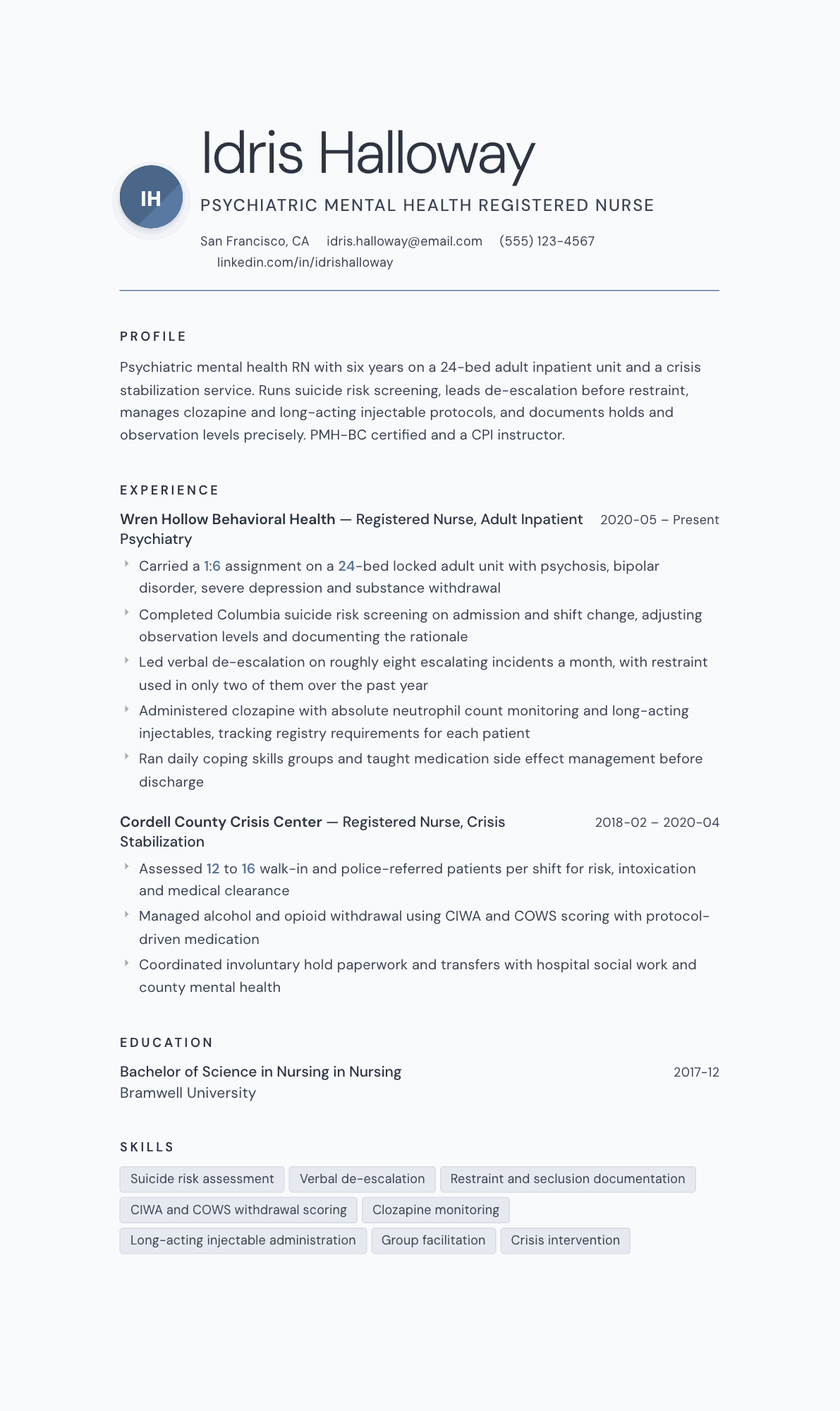
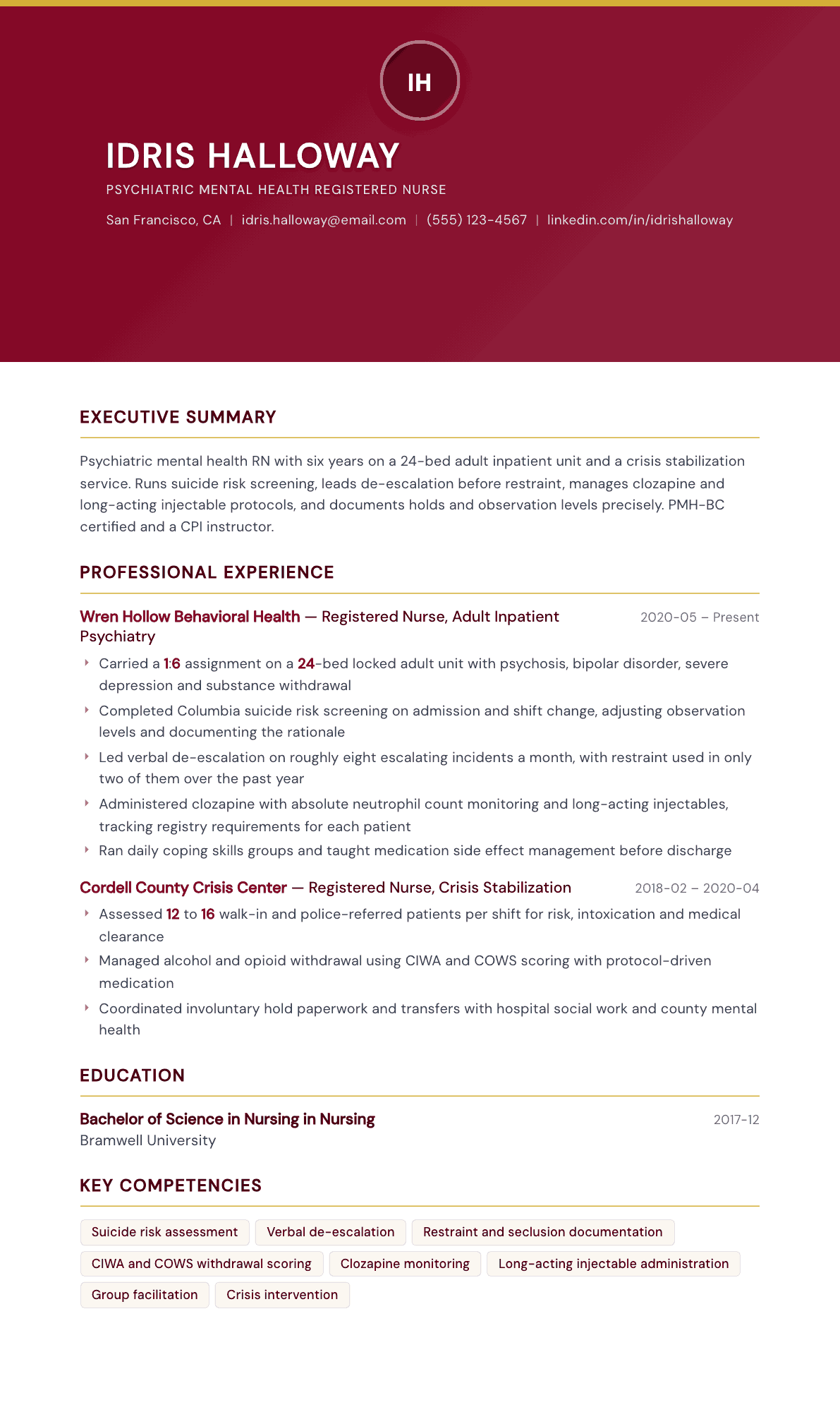
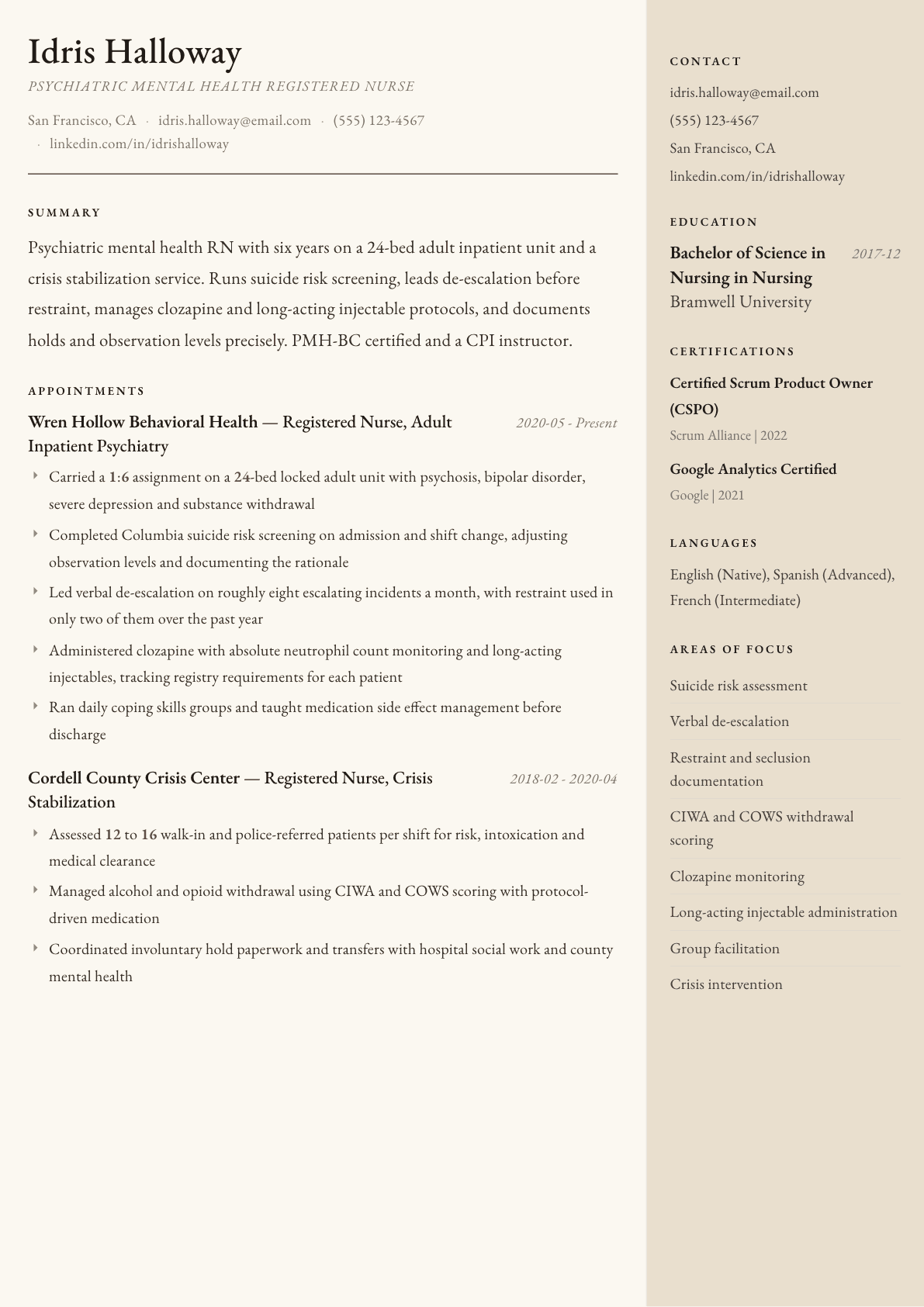
The same psychiatric nurse content laid out in three CVBooster templates, so you can see what the finished document looks like before you write a word.
Example Psychiatric Nurse summary
Psychiatric mental health nurse with six years across a 24-bed locked adult unit and a county crisis stabilization service. Screens risk with the Columbia tool, leads verbal de-escalation before any restraint, manages clozapine and long-acting injectables, and documents holds cleanly. PMH-BC certified and a CPI instructor for new staff. Seeking an adolescent inpatient unit with a strong therapeutic milieu.
Skills to list on a Psychiatric Nurse resume
- Suicide and violence risk assessment
- Verbal de-escalation
- Restraint and seclusion protocols
- Mental status examination
- Psychopharmacology
- Clozapine and ANC monitoring
- Long-acting injectable administration
- CIWA and COWS protocols
- Group therapy facilitation
- Trauma-informed care
- Involuntary hold documentation
- Safety rounds and observation levels
- Discharge and relapse planning
- Motivational interviewing
What actually gets this resume read
- Name the population and setting: locked adult inpatient, adolescent, geriatric psychiatry, crisis stabilization, or outpatient clinic.
- Show de-escalation with numbers, including how often you avoided restraint, because that is the metric leaders watch.
- List the risk tools you use by name, such as Columbia suicide screening, CIWA, COWS and the assault risk scale your unit uses.
- Describe your psychopharmacology depth, especially clozapine monitoring, long-acting injectables and metabolic screening.
- Put PMH-BC and your de-escalation training in a credentials block, since behavioral health managers look for both.
- Mention medical comorbidity work, because psychiatric patients arrive with diabetes, withdrawal and untreated wounds.
How to write a psychiatric nurse resume
Behavioral health hiring is a safety assessment. The manager reading a psychiatric nurse resume wants to know whether you can hold a milieu, whether you talk a patient down before you reach for a restraint, and whether your documentation would survive a regulatory review of a hold or a seclusion episode. Those three things decide the interview, and none of them are proven by the phrase "provided compassionate mental health care".
The second thing the reader needs is population and setting. A locked adult inpatient unit, an adolescent unit, geriatric psychiatry, crisis stabilization, a substance withdrawal service, a forensic unit, an emergency department behavioral hold area and an outpatient clinic all sit under this job title, and the risks and skills diverge sharply. Name yours in the first line of every job.
This guide covers the credential block, the unit line, how to write risk assessment and de-escalation bullets with real evidence, the psychopharmacology depth managers check for, two psych nurse resume examples written out in full, and the questions nurses ask when moving into or out of psychiatric practice. Mental health nurse and psychiatric nurse are the same job title on most postings, so everything here applies under either name.
Header and credentials: PMH-BC and your de-escalation training
Give your credentials after your name in the order degree, license, certification, then a block with the RN license and state, psychiatric mental health board certification if you hold it, a current de-escalation or crisis intervention training card, and life support certification. Behavioral health managers look for the de-escalation training as closely as they look for the specialty credential, because it is a condition of working on a locked unit.
Add trauma-informed care training, suicide prevention coursework and any substance use disorder training in the same block. In this specialty, coursework is a real signal of practice style rather than filler.
- Name with credentials, city and state, phone, email.
- Credentials: license and state, PMH-BC, crisis intervention training, BLS.
- Order: summary, certifications, psychiatric experience, education, skills.
- Say the population: adult, adolescent, geriatric, forensic, dual diagnosis.
The unit line: beds, locked or open, ratio, acuity
Open each job with the setting: bed count, whether the unit is locked, the ratio you carried, and the diagnoses you see. "Registered Nurse, 24-bed locked adult inpatient unit, 1:6 assignment, psychosis, bipolar disorder, severe depression and substance withdrawal" tells a reader everything she needs to place you.
Include whether the unit takes involuntary admissions and whether you work with law enforcement or emergency services on arrivals. A crisis stabilization nurse who assesses police-referred patients has a different daily reality from an outpatient clinic nurse, and both are worth naming precisely.
Risk assessment and de-escalation: the two bullets that matter most
Name the tools. Suicide risk screening with a validated instrument such as the Columbia protocol, violence and assault risk screening, withdrawal scoring with CIWA for alcohol and COWS for opioids, and mental status examination all give the reader an anchor. Then say what you did with the score: adjusted observation level, changed room placement, added a one-to-one, or documented the rationale for a change.
De-escalation is best shown as a ratio between incidents and restraint use. A psychiatric nurse who describes leading verbal de-escalation on roughly eight escalating incidents a month with restraint used in only a small number of them has stated the exact number every behavioral health leader tracks. Follow it with the technique, whether that is verbal redirection, sensory and comfort rooms, offering as-needed medication early, or a planned staff response.
Restraint and seclusion documentation deserves its own line. Face-to-face evaluation timing, continuous monitoring, release criteria and post-event debriefing are audited, and a nurse who names the sequence is telling the reader her charting will hold.
Psychopharmacology: where behavioral health nurses go deep
This is the clinical depth that distinguishes an experienced psychiatric nurse. Clozapine administration with absolute neutrophil count monitoring and registry requirements, long-acting injectable antipsychotics with their loading schedules and injection sites, lithium level monitoring, metabolic screening for patients on second-generation antipsychotics, and withdrawal protocol medication all belong in bullets.
Add the medical work, because psychiatric patients arrive with untreated diabetes, hypertension, wounds, pregnancy and intoxication. A behavioral health nurse who can manage a blood glucose, an abscess and a withdrawal at the same time as an acute psychosis is exactly who a unit wants on nights.
Groups, milieu and discharge planning
Say which groups you run and what they cover: coping skills, medication education, relapse prevention, discharge readiness. Group facilitation is a scheduled duty on most inpatient units and a genuine skill that many applicants leave off entirely.
Finish with the transition work. Coordinating outpatient follow-up appointments, arranging medication supply at discharge, communicating with case management and county services, and completing hold paperwork or transfers are the parts of the job that determine whether a patient comes back next week.
Mental health nurse resume examples, written out
Two complete examples, one inpatient and one outpatient, written as plain text in the order a behavioral health manager reads them. Both nurses are invented; copy the order and the detail, then swap in your own unit, tools and numbers.
Inpatient psych nurse resume example. Header: Andre Wallace, BSN, RN, PMH-BC, Denver, Colorado, phone and email, Colorado RN license, crisis intervention training current, BLS. Summary: Psychiatric registered nurse with five years on a 24-bed locked adult inpatient unit taking involuntary admissions, 1:6 on day shift, psychosis, mania, severe depression and alcohol withdrawal. Unit resource for clozapine monitoring and lead for the de-escalation refresher. Experience, Front Range Behavioral Hospital, Registered Nurse, five years, with the inpatient bullets listed under these examples.
Outpatient mental health nurse resume example. Header: Grace Kim, RN, Portland, Oregon, Oregon RN license, BLS, motivational interviewing training. Summary: Mental health nurse in a community clinic carrying a panel of patients on long-acting injectables, running the weekly injection clinic, metabolic screening and lithium level follow-up, and answering the nurse triage line for risk calls. Her bullets name panel size, injection clinic volume, the screening program she runs and how she coordinates with prescribers and case managers, the throughput figures an outpatient manager reads for.
- Inpatient: Complete suicide risk screening with the Columbia protocol on every admission and at each shift change for patients on elevated observation, adjusting observation level with the provider.
- Inpatient: Lead verbal de-escalation on escalating incidents across the shift, with restraint used rarely and every episode documented through face-to-face evaluation, monitoring and debrief.
- Inpatient: Administer clozapine with neutrophil count monitoring and long-acting injectable antipsychotics on their loading schedules, and teach each patient the side effects to report.
- Inpatient: Run the daily coping skills and medication education groups for up to twelve patients.
- Inpatient: Coordinate discharge with county case management, outpatient follow-up and a medication supply plan, and complete hold and transfer paperwork within the required timelines.
Psychiatric Nurse resume summary examples
New graduate
BSN graduate with a 160-hour capstone on a 20-bed adult behavioral health unit and a clinical rotation in a community mental health clinic. Trained in mental status examination, suicide risk screening and verbal de-escalation. Crisis intervention certified and seeking an inpatient psychiatric residency with strong preceptor support.
Six years in behavioral health
Psychiatric mental health nurse with six years across a 24-bed locked adult unit and a county crisis stabilization service. Screens risk with the Columbia tool, leads verbal de-escalation before any restraint, manages clozapine and long-acting injectables, and documents holds cleanly. Board certified and a crisis intervention instructor.
Behavioral health charge nurse
Charge nurse on a 32-bed adolescent and adult psychiatric service with fourteen years of practice, running assignments, admissions, hold documentation and the response team on nights. Rebuilt the unit observation level standard, teaches de-escalation to new staff, and holds psychiatric mental health board certification.
Work experience bullets: before and after
Before: Assessed patients for suicide risk.
After: Completed Columbia suicide risk screening on admission and at every shift change, adjusting observation levels and room placement and documenting the clinical rationale for each change.
Naming the tool, the frequency and the action taken shows a risk process rather than an intention to be careful.
Before: Used de-escalation techniques with agitated patients.
After: Led verbal de-escalation on roughly eight escalating incidents a month using early as-needed medication offers, sensory room diversion and a planned staff response, with restraint used in only two incidents across the year.
The incident count set against restraint use is the exact measure behavioral health leaders watch.
Before: Gave psychiatric medications.
After: Administered clozapine with absolute neutrophil count monitoring and registry compliance, and gave long-acting injectable antipsychotics on loading and maintenance schedules with site rotation tracked.
These two medication programs carry monitoring obligations that only an experienced psychiatric nurse manages independently.
Before: Helped patients going through withdrawal.
After: Scored alcohol and opioid withdrawal using CIWA and COWS at protocol intervals, medicating to symptom triggers and escalating to the provider when scores failed to fall.
Named scoring tools and the escalation trigger prove protocol-driven care instead of general supportive attention.
Before: Ran groups on the unit.
After: Facilitated daily coping skills and medication education groups for up to twelve patients, adapting content for cognitive impairment and active psychosis.
Group size and the adaptation for acuity show real facilitation skill rather than attendance at a scheduled activity.
Hard skills
- Suicide and violence risk assessment
- Mental status examination
- Verbal de-escalation
- Restraint and seclusion protocols
- Observation level management
- Psychopharmacology
- Clozapine and neutrophil count monitoring
- Long-acting injectable administration
- CIWA and COWS withdrawal scoring
- Group facilitation
- Involuntary hold documentation
- Discharge and relapse planning
Soft skills
- Therapeutic boundary setting
- Trauma-informed communication
- Staying regulated while a patient is not
- Motivational interviewing
- Team safety coordination
- Nonjudgmental engagement
Certifications worth listing
- PMH-BC (Psychiatric-Mental Health Nursing) (American Nurses Credentialing Center)
- Nonviolent Crisis Intervention (Crisis Prevention Institute)
- Certified Addictions Registered Nurse (CARN) (Addictions Nursing Certification Board)
- Basic Life Support (BLS) (American Heart Association)
- Mental Health First Aid (National Council for Mental Wellbeing)
Mistakes that cost psychiatric nurse candidates the interview
- Describing the work in adjectives about empathy instead of the risk tools, the ratios and the de-escalation record.
- Leaving out whether the unit was locked, voluntary or involuntary, which changes the entire nature of the job.
- Omitting restraint and seclusion documentation, when that charting is exactly what a regulator reviews.
- Skipping the psychopharmacology depth, especially clozapine monitoring and long-acting injectables.
- Forgetting the medical care you provide, which makes an experienced behavioral health nurse look narrow.
- Letting crisis intervention training lapse, which can disqualify an application for a locked unit outright.
Psychiatric Nurse resume questions
How do I move into psychiatric nursing from a medical unit?
Lead with the behavioral work you already do: delirium and agitation management, sitters and observation levels, alcohol withdrawal protocols, and de-escalation with confused patients. Then add crisis intervention training and any mental health clinical hours to show deliberate intent.
Should I put restraint numbers on my resume?
Yes, when they show restraint used rarely against a real incident count, because that ratio is the outcome behavioral health leaders manage. Never present raw restraint counts without the de-escalation context, since the number alone tells the reader nothing useful.
What do good psych nurse resume examples have in common?
A unit line for every job with beds, locked or open, ratio and diagnoses; named risk tools with what the nurse did with the score; de-escalation shown against restraint use; psychopharmacology depth; and the credentials block with PMH-BC and crisis intervention training near the top. Adjectives about empathy are absent.
How do I describe working with involuntary patients?
Describe the process rather than any case: assessment for hold criteria, completion and timing of the paperwork, coordination with the provider and county services, and transfer arrangements. That shows legal fluency without exposing anything about the patients themselves.
What should an outpatient behavioral health nurse emphasize?
Emphasize panel size, injection clinic volume, medication monitoring programs you run, telephone risk triage, and coordination with prescribers and case managers. Those numbers give an outpatient manager the throughput picture that inpatient bullets never provide.