Recreational Therapist Resume Examples: read this first
Write a Recreational Therapist Resume That Proves Clinical Intent
By Mustafa Tarabya, founder of CVBooster · Published · Updated
A recreational therapist resume example with assessment tools, program design and setting detail, plus keywords and a guide for CTRS hiring.
Sample resumes for a recreational therapist
The same recreational therapist content laid out in three CVBooster templates, so you can see what the finished document looks like before you write a word.
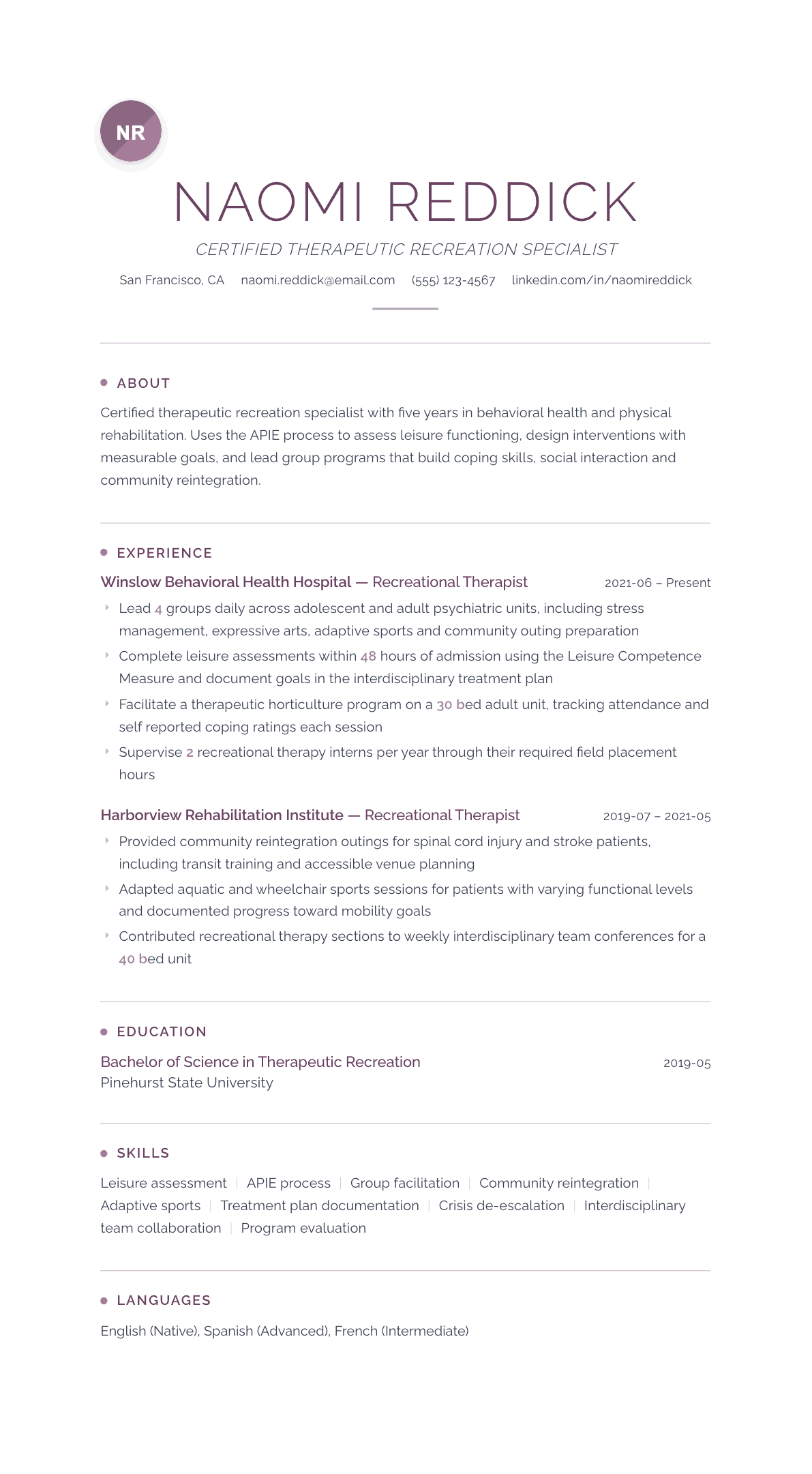
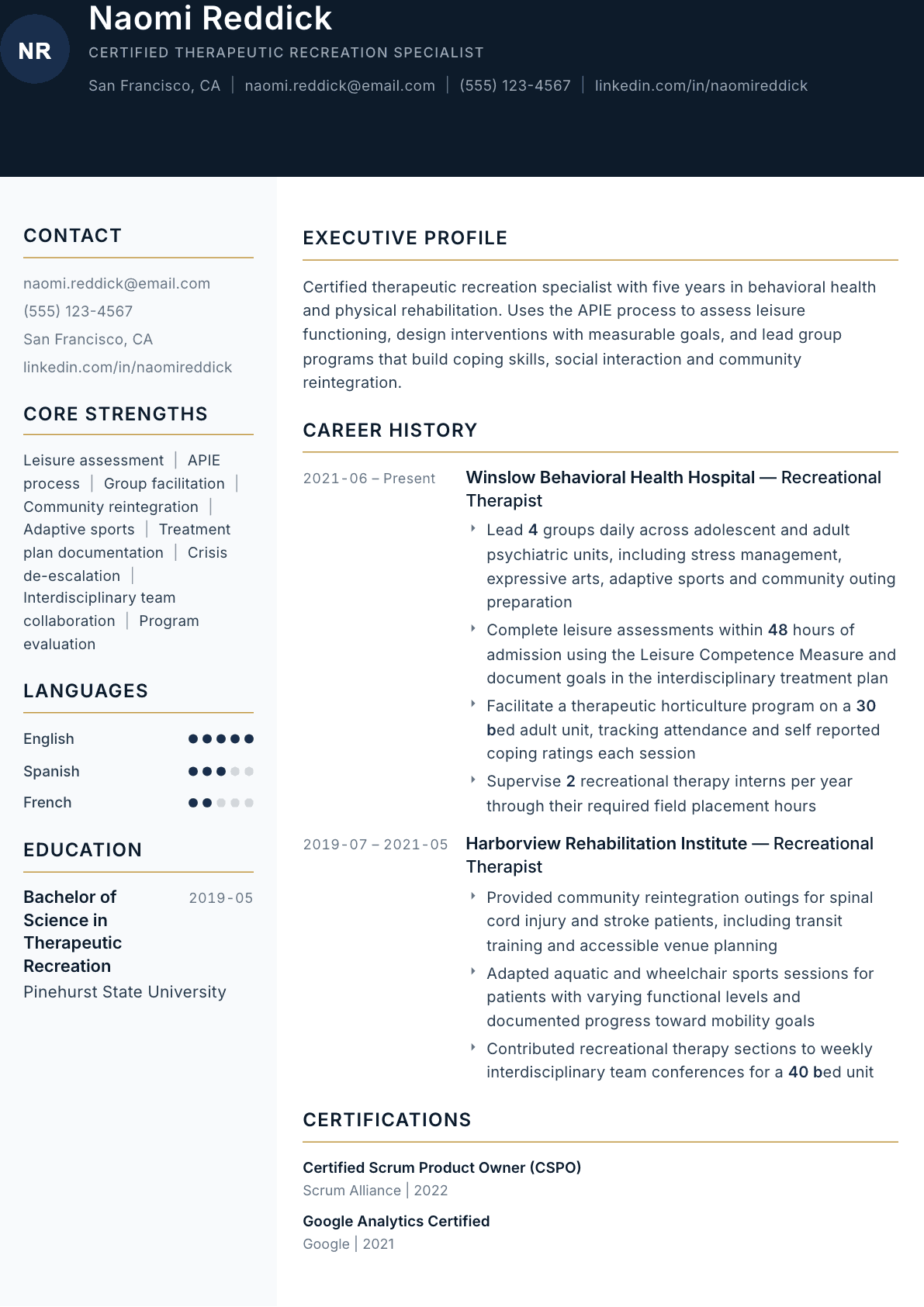
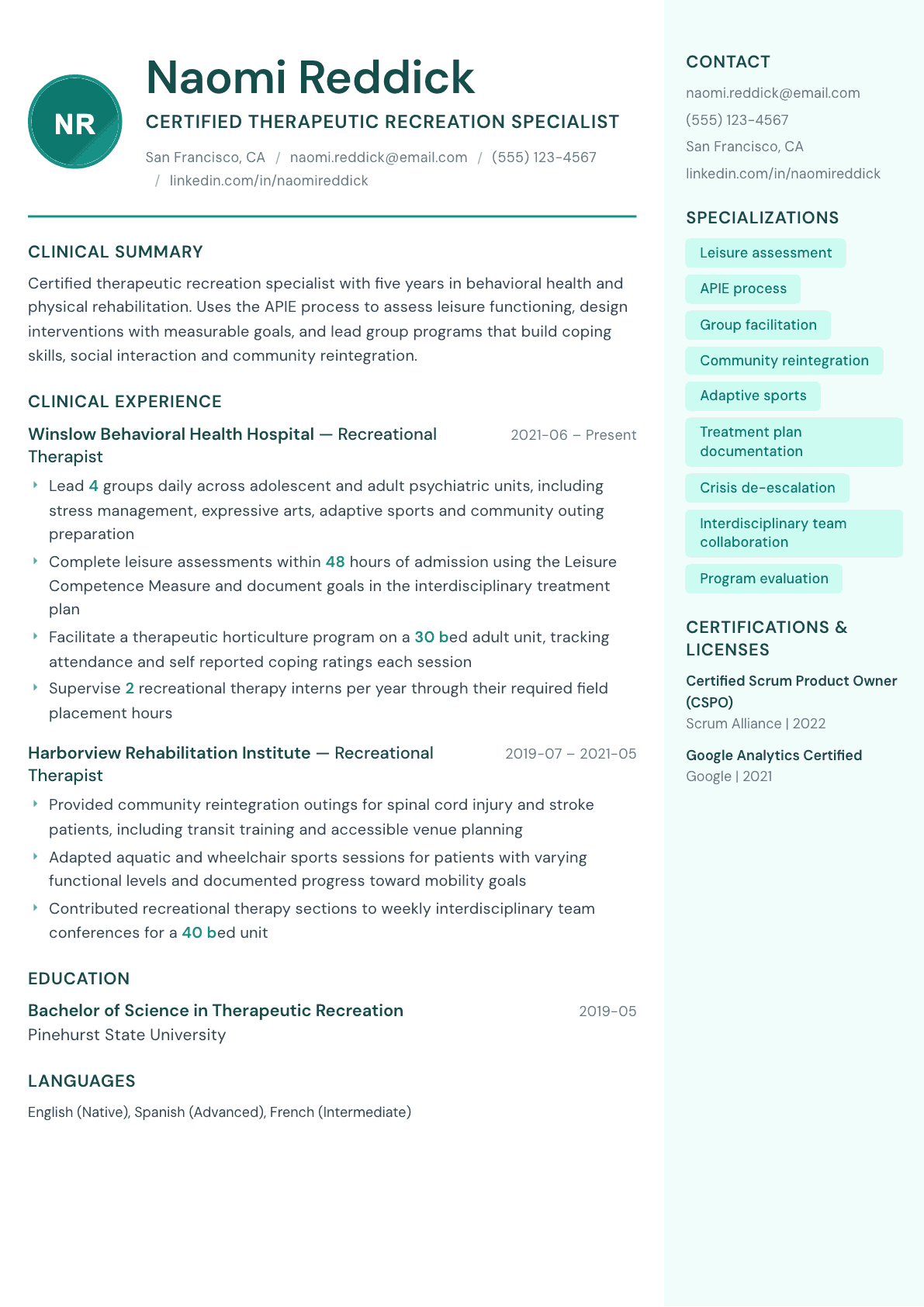
Example Recreational Therapist summary
Certified therapeutic recreation specialist with five years across inpatient behavioral health and physical rehabilitation. Assesses leisure functioning with standardized instruments, writes measurable goals into the interdisciplinary treatment plan, and leads daily groups in stress management, adaptive sports and community reintegration. Comfortable de-escalating on a locked unit and supervising interns through their field placement requirements.
Skills to list on a Recreational Therapist resume
- Leisure assessment
- APIE process
- Individualized treatment planning
- Group facilitation
- Adaptive sports and equipment
- Community reintegration outings
- Therapeutic horticulture
- Expressive arts interventions
- Social skills training
- Crisis de-escalation
- Behavioral observation
- Interdisciplinary documentation
- Program evaluation
- Intern supervision
What actually gets this resume read
- Put the CTRS credential beside your name, because it is the first thing a recreational therapy manager checks.
- Name your assessment instruments, since the Leisure Competence Measure and CERT show clinical rigor rather than activity planning.
- Describe interventions by their therapeutic goal, not just the activity, so the reader sees the clinical intent behind it.
- Give unit type and bed count, because behavioral health, physical rehabilitation and long term care hire on different evidence.
- Show documentation into the interdisciplinary treatment plan, which is what separates therapy from an activities program.
- Include any group sizes, session counts and populations, since staffing models are built on those exact numbers.
How to write a recreational therapist resume
The hardest problem a recreational therapist resume has to solve is the confusion between therapy and activities. Directors of rehabilitation, behavioral health managers and long term care administrators have all seen resumes that list bingo, movie night and craft supplies. The ones that get interviews list assessments, measurable treatment goals, documented interventions and discharge planning.
That is the whole strategy: describe the clinical process, not the activity calendar. Every intervention you write should carry the goal it served and the way progress was recorded. Adaptive kayaking is an activity; adaptive kayaking used to build sitting balance, upper body endurance and community reintegration confidence for a spinal cord injury caseload is therapy.
This guide sets out the section order these employers expect, three summaries from a new certified specialist through a program supervisor, before and after bullets built from group and individual sessions, and the questions therapeutic recreation professionals ask when their applications stall.
Format: credential beside your name, one page early on
Put the certified therapeutic recreation specialist credential directly after your name and add your state license or registration where your state requires one. That credential is the fastest filter in this field, and a resume without it visible in the header gets sorted into the activities pile.
Keep it to one page for the first several years. Under the summary, add a settings line naming the facility types and unit sizes you have worked in, since behavioral health, physical rehabilitation, long term care, pediatrics and community programs recruit on different evidence.
- Header: name, credential, state license status, city and state, phone, email.
- Order: summary, credentials, settings, clinical experience, internship, education, skills, certifications and training.
- New graduates keep the required internship above employment, with hours, supervisor credential and the populations served.
Summary: population, unit type, and the clinical process you follow
Three lines. The population and unit type comes first: an adolescent psychiatric unit, a thirty bed inpatient rehabilitation floor, a memory care neighborhood, a pediatric oncology service. Then the process. Naming the assessment, planning, implementation and evaluation sequence tells a reader you were trained rather than assigned.
Close with the interventions you are strongest in, whether that is expressive arts, adaptive sports, therapeutic horticulture, animal assisted intervention, aquatic programming, social skills groups or community reintegration outings. Be specific, because these are hired as distinct competencies.
Experience: assessment, goals, and documented progress
Start each role with the setting, the unit and the bed count. Then write bullets that follow a patient through your process. Completed a leisure assessment within forty eight hours of admission, wrote measurable goals into the interdisciplinary treatment plan, ran the intervention, and recorded progress against those goals is the arc every hiring manager wants to see.
Name your assessment instruments. The Leisure Competence Measure, the Comprehensive Evaluation in Recreational Therapy scale, the Free Time Boredom Measure and structured leisure interest inventories are real tools with real training behind them. Naming one moves you out of the activities category permanently.
Give group volume and composition. Four groups a day across two units, average group size, and the type of group each was tells a manager exactly how you would fit a staffing grid. Add the individual sessions and the discharge or community reentry work separately, because those take different skills.
Safety, behavior and interdisciplinary work
Behavioral health employers screen hard for de-escalation training and safety judgment. Name the crisis intervention curriculum you completed, describe how you managed a group when a participant escalated, and mention any experience with one to one observation, elopement risk or ligature awareness on a locked unit.
Then show the team. Recreational therapists sit in interdisciplinary conferences beside nursing, psychiatry, social work, occupational therapy and physical therapy. Describing what you contribute to those meetings, such as observed function during unstructured time, is evidence of a clinical role rather than a support one.
- Name the de-escalation or crisis curriculum and any restraint alternatives training.
- Describe risk assessment for community outings, including transportation and supervision ratios.
- List intern or student supervision, since it is common and it signals seniority.
Keywords and program evidence
Postings repeat therapeutic recreation, leisure assessment, treatment plan, group facilitation, community reintegration, adaptive equipment, behavioral observation, discharge planning and the certification acronym. Put each once in the skills block and once where it is doing real work in a bullet.
If you have built a program, describe it as a program. The population it served, the number of sessions, how you measured whether it worked, and whether it survived after you left. Long term care and behavioral health managers hire people who can start something and keep it running.
Recreational Therapist resume summary examples
Newly certified specialist
Certified therapeutic recreation specialist with a bachelor degree in therapeutic recreation and a 14 week internship on a 30 bed adult psychiatric unit. Trained in the assessment, planning, implementation and evaluation process, leisure assessment instruments, group facilitation and crisis de-escalation.
Five years in behavioral health
Recreational therapist with five years on adolescent and adult psychiatric units, leading 4 groups daily in stress management, expressive arts and adaptive sports. Completes leisure assessments within 48 hours of admission, writes measurable goals into the interdisciplinary treatment plan, and supervises interns each year.
Program supervisor
Therapeutic recreation supervisor with twelve years across inpatient rehabilitation and long term care. Manages a team of six specialists, redesigned the leisure assessment workflow to reduce admission to first session time, and built a community reintegration outing program with documented transportation and supervision protocols.
Work experience bullets: before and after
Before: Planned and led recreational activities for patients.
After: Led 4 groups daily across adolescent and adult psychiatric units, including stress management, expressive arts, adaptive sports and community outing preparation.
Group volume, unit types and the actual group content show a clinical schedule rather than an activity calendar.
Before: Assessed patients when they were admitted.
After: Completed leisure assessments within 48 hours of admission using the Leisure Competence Measure and documented measurable goals in the interdisciplinary treatment plan.
A named instrument, a timeframe and a documentation destination convert assessment from a claim into a process.
Before: Took patients on trips into the community.
After: Ran community reintegration outings for spinal cord injury and stroke patients, covering public transit training, accessible venue scouting and supervision ratios agreed with nursing beforehand.
The planning and safety detail is the part a manager is liable for, so it is the part worth writing down.
Before: Used gardening as therapy with residents.
After: Facilitated a weekly therapeutic horticulture program on a 30 bed adult unit, tracking attendance and self reported coping ratings to evaluate whether the intervention was working.
Attaching a measure to the intervention is what distinguishes a therapy program from a pleasant pastime.
Before: Handled difficult behaviors during group sessions.
After: De-escalated escalating participants during group using trained verbal intervention techniques, redirected the remaining group, and documented the antecedent and response for the treatment team.
The strong bullet shows the full sequence: intervention, group management and the record the team needs afterward.
Hard skills
- Leisure and recreation assessment
- Assessment planning implementation and evaluation process
- Individualized treatment plan writing
- Group facilitation
- Adaptive sports and equipment
- Community reintegration outings
- Therapeutic horticulture
- Expressive arts interventions
- Social skills training
- Behavioral observation and documentation
- Crisis de-escalation
- Program design and evaluation
Soft skills
- Reading a group and adjusting mid session
- Building rapport with reluctant participants
- Interdisciplinary communication
- Boundary setting with adolescents
- Creativity within a clinical goal
- Calm under behavioral escalation
Certifications worth listing
- Certified Therapeutic Recreation Specialist (CTRS) (National Council for Therapeutic Recreation Certification)
- Basic Life Support (BLS) (American Heart Association)
Mistakes that cost recreational therapist candidates the interview
- Listing activities instead of interventions, which puts your resume straight into the activity director pile.
- Leaving the certification acronym out of the header when it is the first filter every posting applies.
- Never naming an assessment instrument, so the reader cannot tell whether you were trained in the process at all.
- Omitting bed counts, unit types and group sizes, which is the information a staffing grid is built from.
- Skipping de-escalation and safety training on behavioral health applications where it is a screening requirement.
- Describing programs without any measure of whether they worked, which makes them impossible to evaluate.
Recreational Therapist resume questions
What is the difference between a recreational therapist and an activities director?
A recreational therapist assesses function, writes measurable goals into the treatment plan and documents progress against them. An activities director plans a calendar of events for enjoyment and engagement. Write your resume in the language of the first role.
Do I need the CTRS credential to get hired?
Most hospital, inpatient rehabilitation and behavioral health positions require it, and many long term care employers prefer it. If you are eligible but not yet certified, state your eligibility and your examination window rather than leaving the header blank.
How do I show outcomes when my interventions are hard to measure?
Use what you already collect: session attendance, participation ratings, self reported coping or mood scales, progress toward the goals written in the treatment plan, and successful community outings completed. Those are defensible because you recorded them yourself.
Should I list my internship on a recreational therapist resume?
Yes for the first few years. Give the facility type, the unit, the number of weeks, the supervisor credential and the populations you served, since the internship is the required clinical training behind the certification.
How do I move from long term care into behavioral health?
Lead with group facilitation volume, behavioral observation and any de-escalation training you hold. Name the psychiatric populations you have worked with even briefly, and add crisis intervention coursework so the change looks deliberate rather than accidental.