Behavioral Health Counselor Resume Examples: free score
Behavioral Health Counselor Resume Built for Clinical Screeners
By Mustafa Tarabya, founder of CVBooster · Published · Updated
Behavioral health counselor resume example with integrated care bullets, co-occurring disorder keywords, and a guide to writing each resume section.
Sample resumes for a behavioral health counselor
The same behavioral health counselor content laid out in three CVBooster templates, so you can see what the finished document looks like before you write a word.
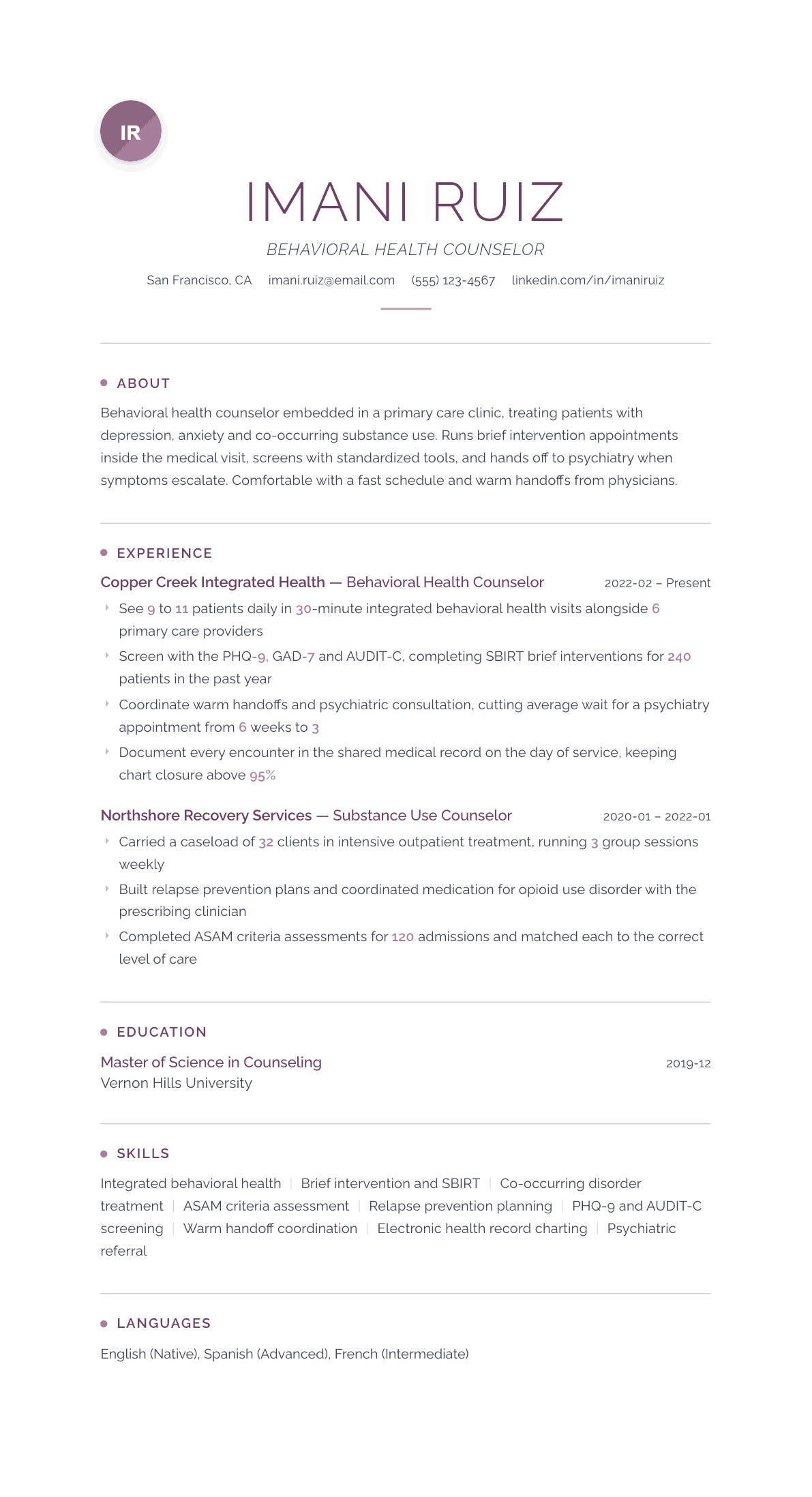
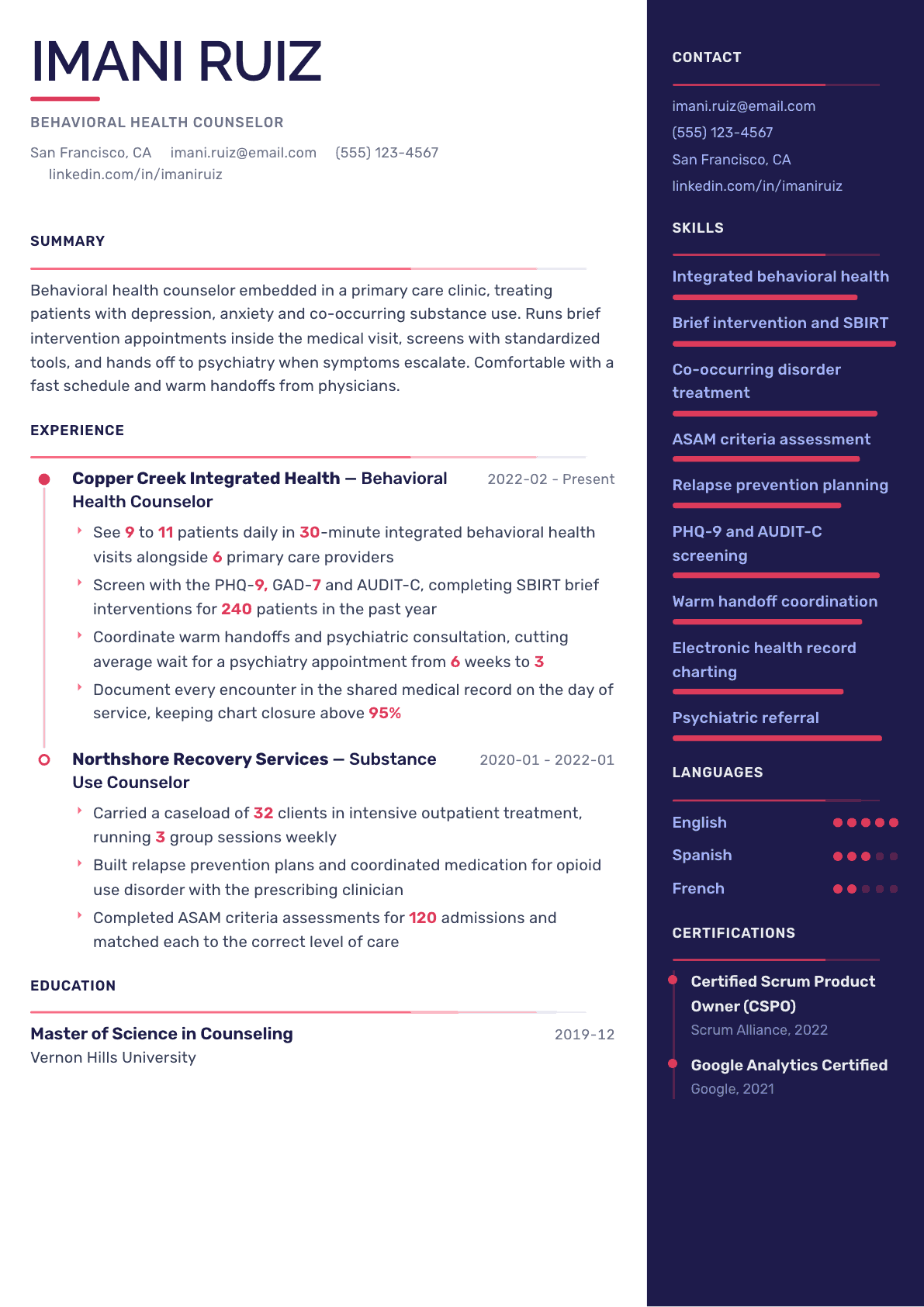
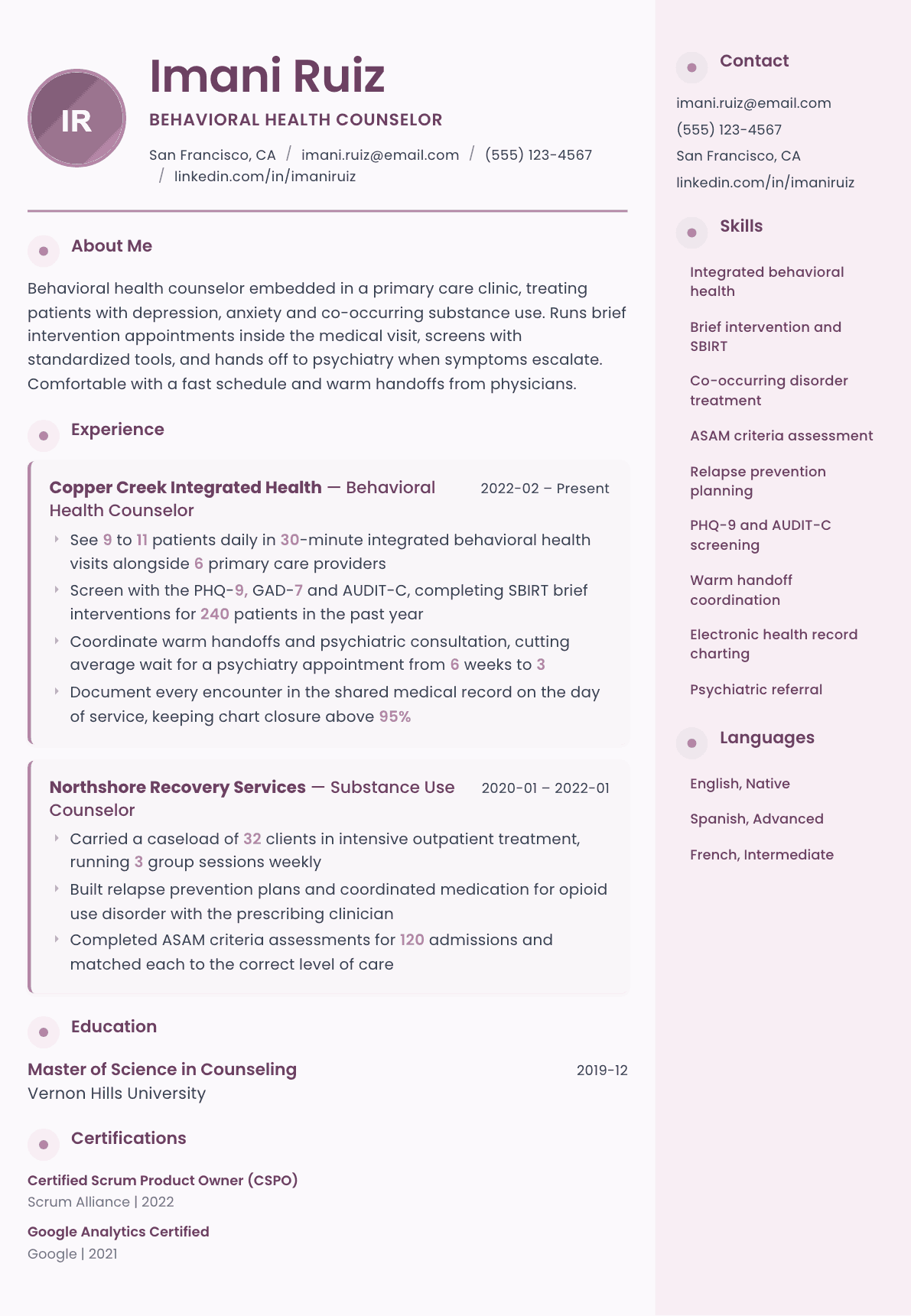
Example Behavioral Health Counselor summary
Behavioral health counselor with five years across integrated primary care and intensive outpatient treatment. Sees up to eleven patients a day in short consultation visits, screens with standardized tools, and delivers brief interventions for depression, anxiety and risky substance use. Places clients using level of care criteria and keeps same-day chart closure above the clinic target.
Skills to list on a Behavioral Health Counselor resume
- Integrated behavioral health
- Brief intervention and SBIRT
- Cognitive behavioral therapy
- Motivational interviewing
- Co-occurring disorder treatment
- ASAM criteria placement
- Relapse prevention planning
- Suicide risk screening
- Standardized outcome measures
- Care coordination and warm handoffs
- Psychiatric consultation referral
- Electronic health record documentation
- Group facilitation
- Crisis stabilization
What actually gets this resume read
- Say whether you worked in integrated primary care, outpatient behavioral health, or an inpatient unit, and the visit length.
- Show daily patient volume, because integrated care hires on throughput while outpatient hires on caseload depth.
- List the screening instruments you administer by name, since medical employers use those codes in their quality reports.
- Mention co-occurring substance use work and the level of care criteria you used to place clients.
- Include chart closure or documentation timeliness, because billing in a medical setting depends on same-day notes.
- Name your license or certification status clearly, including supervision if you are still accruing hours.
How to write a behavioral health counselor resume
Behavioral health counselor is a title that covers several very different jobs, and the first thing a hiring manager needs from your resume is which one you have done. Embedded in a primary care clinic you see nine or eleven patients a day in short consultation visits and hand off to a physician in the hallway. In an intensive outpatient program you carry a stable caseload, run groups and manage levels of care. On a crisis or inpatient unit you stabilize and place. Same title, three different working lives.
The second thing she needs is evidence that you work well inside a medical system. Behavioral health sits next to prescribers, quality reporting and billing, and counselors who cannot close a chart on the day of service create problems for everyone downstream. That is why documentation timeliness carries more weight here than in almost any other counseling role.
What follows is the section order a behavioral health director reads, three summaries across career stages, before-and-after bullets, and the questions counselors ask when they move between integrated care, substance use treatment and traditional outpatient work.
Format: name the model of care in the first line of every job
Reverse chronological, one page early and two once you have worked across more than one model. Open each job with the model: integrated primary care behavioral health, intensive outpatient, partial hospitalization, community mental health, or crisis stabilization. Then the visit structure, because a thirty-minute consultation visit and a fifty-minute therapy hour are different professional skills.
Keep the credential block near the top with license type, state, status and any addiction counseling certification. Medical employers credential behavioral health staff the same way they credential clinicians, and the process starts with that block.
- Header: name with credential, city and state, phone, email, license and certification status.
- Order: summary, credentials, behavioral health experience, education and supervised hours, skills.
- Say whether you have worked in a shared electronic health record with medical colleagues.
Summary: model, volume, populations, screening
One sentence for the model and volume, one for the populations, one for what you bring that is scarce. Nine to eleven brief visits daily beside six primary care providers, treating depression, anxiety and risky substance use, with placement decisions made using level of care criteria, is a complete professional picture in three clauses.
Name the screening instruments in the summary if they are central to your work. Medical organizations report on those measures, so a counselor who already administers them arrives useful on the first week rather than the second month.
Experience: throughput, handoffs and level of care
In integrated settings, lead with throughput and access. Patients seen per day, the referral route from the medical provider, how quickly a warm handoff turns into a completed visit, and what happened to the wait for psychiatry. Access improvement is the reason integrated positions get funded, so it should be the loudest thing on the page.
In substance use and outpatient settings, lead with caseload and level of care. Assessment volume, the criteria you applied when placing a client, group facilitation, relapse prevention planning, and coordination with prescribers around medication for opioid or alcohol use disorder. Say how many assessments you completed and how placement decisions were reviewed.
Across both, show the brief intervention work. Screening, brief intervention and referral to treatment is a defined practice, and a counselor who reports the volume of brief interventions delivered is speaking the language the funder uses in its own reports.
Documentation, coordination and quality reporting
Chart closure is the metric that separates a smooth integrated counselor from a difficult one. Give your same-day closure rate, the record you worked in, and any audit result. Then show coordination: consultation notes back to the referring provider, case discussion in the care team huddle, and the follow-up loop when a patient does not attend.
Quality reporting deserves a line if you touched it. Depression follow-up measures, substance use screening rates and behavioral health integration billing are all things a clinic reports on, and a counselor who understands why the screen has to be repeated at an interval is a counselor the medical director will defend at budget time.
- Same-day chart closure rate and the record system you documented in.
- Consultation notes and huddle participation with medical providers.
- Follow-up protocol for missed visits and patients lost between referral and first appointment.
Keywords and credentials that postings ask for
The vocabulary is drawn from medical and behavioral integration language: integrated behavioral health, brief intervention, warm handoff, co-occurring disorders, level of care criteria, relapse prevention, care coordination, motivational interviewing, measurement-based care, crisis stabilization. Use the ones that are true, once in the skills block and once inside a job as evidence.
For substance use roles, name your addiction credential precisely with its issuing body. State certification names vary, so write the credential as it appears on your certificate rather than an approximation, since credentialing staff match it against a registry.
Behavioral Health Counselor resume summary examples
New to behavioral health
Counseling graduate with 600 supervised hours in an outpatient behavioral health clinic, completing 180 direct contact hours and co-facilitating a relapse prevention group of 10. Trained in motivational interviewing and standard depression and alcohol screening tools. Seeking an integrated behavioral health position.
Five years across two models
Behavioral health counselor seeing 9 to 11 patients daily in 30-minute integrated visits beside 6 primary care providers, after 2 years in intensive outpatient treatment carrying 32 clients. Completed 240 brief interventions last year and keeps same-day chart closure above 95%.
Behavioral health lead
Behavioral health lead for a clinic network of 3 sites, supervising 5 counselors while carrying a reduced patient panel. Standardized screening intervals across all sites, built the psychiatry consultation pathway, and cut the average wait for a psychiatric appointment from 6 weeks to 3.
Work experience bullets: before and after
Before: Worked with patients in a primary care clinic.
After: Saw 9 to 11 patients daily in 30-minute integrated behavioral health visits alongside 6 primary care providers, taking referrals by warm handoff during the medical appointment.
Daily volume, visit length and the referral mechanism define an integrated post that a generic sentence hides.
Before: Screened patients for mental health and substance use issues.
After: Administered standard depression, anxiety and alcohol screening tools at every eligible visit and delivered 240 brief interventions across the year using a structured screening and referral model.
Instruments, the interval and the intervention count match how the clinic reports the work upward.
Before: Referred clients to the right level of treatment.
After: Completed 120 level of care assessments using recognized placement criteria and matched each admission to residential, intensive outpatient or standard outpatient treatment with supervisory review.
Assessment volume plus named criteria show a placement skill that substance use programs hire specifically for.
Before: Helped reduce the wait to see psychiatry.
After: Built a consultation pathway with the prescribing team including a shared triage note and a weekly review slot, cutting the average wait for a psychiatric appointment from 6 weeks to 3.
The mechanism explains the improvement, which turns a claimed result into a repeatable process.
Before: Kept charts up to date.
After: Documented every encounter in the shared medical record on the day of service, sustaining chart closure above 95% and clearing two consecutive internal audits.
Same-day closure and audit results are the documentation standard a medical employer actually enforces.
Hard skills
- Integrated behavioral health practice
- Screening, brief intervention and referral to treatment
- Motivational interviewing
- Cognitive behavioral therapy
- Co-occurring disorder treatment
- Level of care placement criteria
- Relapse prevention planning
- Suicide risk screening and safety planning
- Measurement-based care and standardized screens
- Care coordination and warm handoffs
- Group facilitation
- Shared electronic health record documentation
Soft skills
- Working at clinic pace without losing depth
- Concise verbal handoff to a physician
- Nonjudgmental substance use conversations
- Flexibility when a schedule collapses
- Consultation with prescribers as equals
Certifications worth listing
- National Certified Addiction Counselor (NCAC I) (National Certification Commission for Addiction Professionals)
- Master Addiction Counselor (MAC) (National Board for Certified Counselors)
- National Certified Counselor (NCC) (National Board for Certified Counselors)
Mistakes that cost behavioral health counselor candidates the interview
- Leaving the model of care unnamed, so a director cannot tell brief consultation work from a therapy caseload.
- Reporting a caseload in an integrated post where daily patient volume and access figures are what matter.
- Skipping the screening instruments by name when the clinic reports on those exact measures.
- Ignoring chart closure timeliness in a setting where billing and quality reporting depend on it.
- Writing an addiction credential loosely instead of exactly as it appears on the certificate.
- Presenting substance use work in moralizing language, which signals a poor fit with harm reduction practice.
Behavioral Health Counselor resume questions
What is the difference between a behavioral health counselor and a therapist role?
Behavioral health posts, especially integrated ones, run on shorter visits, higher daily volume, close coordination with medical providers and a strong screening component. Therapy roles run on longer sessions and a stable caseload. Write the resume for the pattern the posting describes rather than the title alone.
Do I need an addiction certification for behavioral health work?
Not always, but it opens doors in any program treating co-occurring disorders and is often required in substance use treatment settings. If you hold one, write it exactly as issued with the certifying body. If you are working toward one, say so with your current hours.
How do I show that I can handle the pace of integrated care?
Put daily patient volume, visit length and same-day chart closure on the page together. Those three numbers tell a medical director you can absorb warm handoffs without falling behind, which is the specific worry she has about hiring from a traditional therapy background.
How should I describe work with clients who relapsed?
Describe the clinical response rather than the outcome alone: how you revised the relapse prevention plan, adjusted the level of care, coordinated with the prescriber, and kept the client engaged. Programs hire counselors who treat a return to use as clinical information rather than a failure.
What supervised hours should I list if I am not yet licensed?
List total supervised hours, direct client contact hours, the supervision format and your supervisor credential, and name the settings where the hours were earned. In behavioral health, hours accrued in a medical or integrated setting carry particular weight because the working environment is hard to simulate.
Related resume examples
- Social Worker Resume example
- Case Manager Resume example
- Addiction Counselor Resume example
- Crisis Counselor Resume example
- Counselor Resume example
- Licensed Clinical Social Worker Resume example