Forklift Operator Resume Examples: the lines they read
Build a Forklift Operator Resume Warehouses Call Back
By Mustafa Tarabya, founder of CVBooster · Published · Updated
A forklift driver resume sample and forklift operator resume examples, with truck classes, certification placement, safety record bullets and keywords.
Sample resumes for a forklift operator
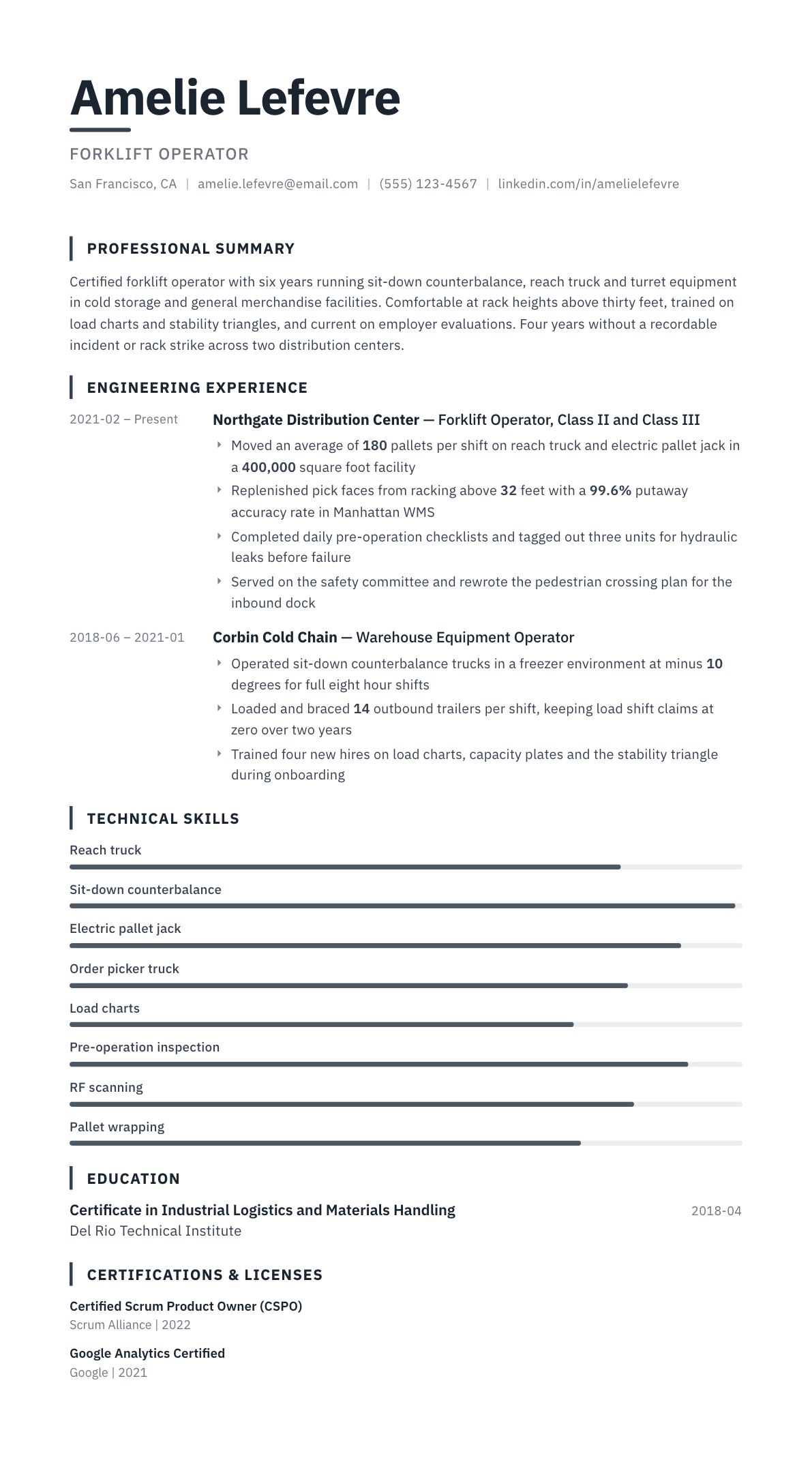
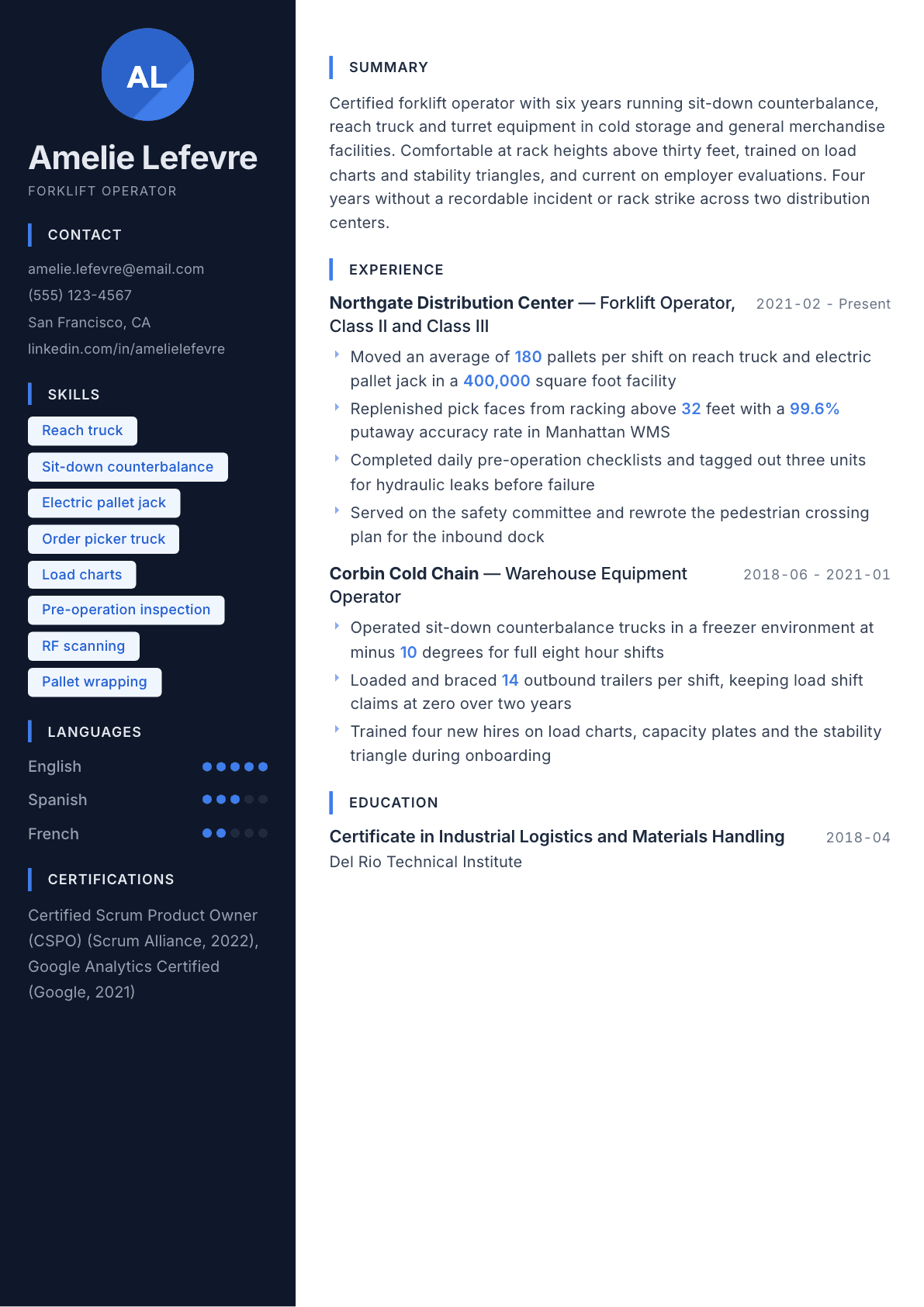
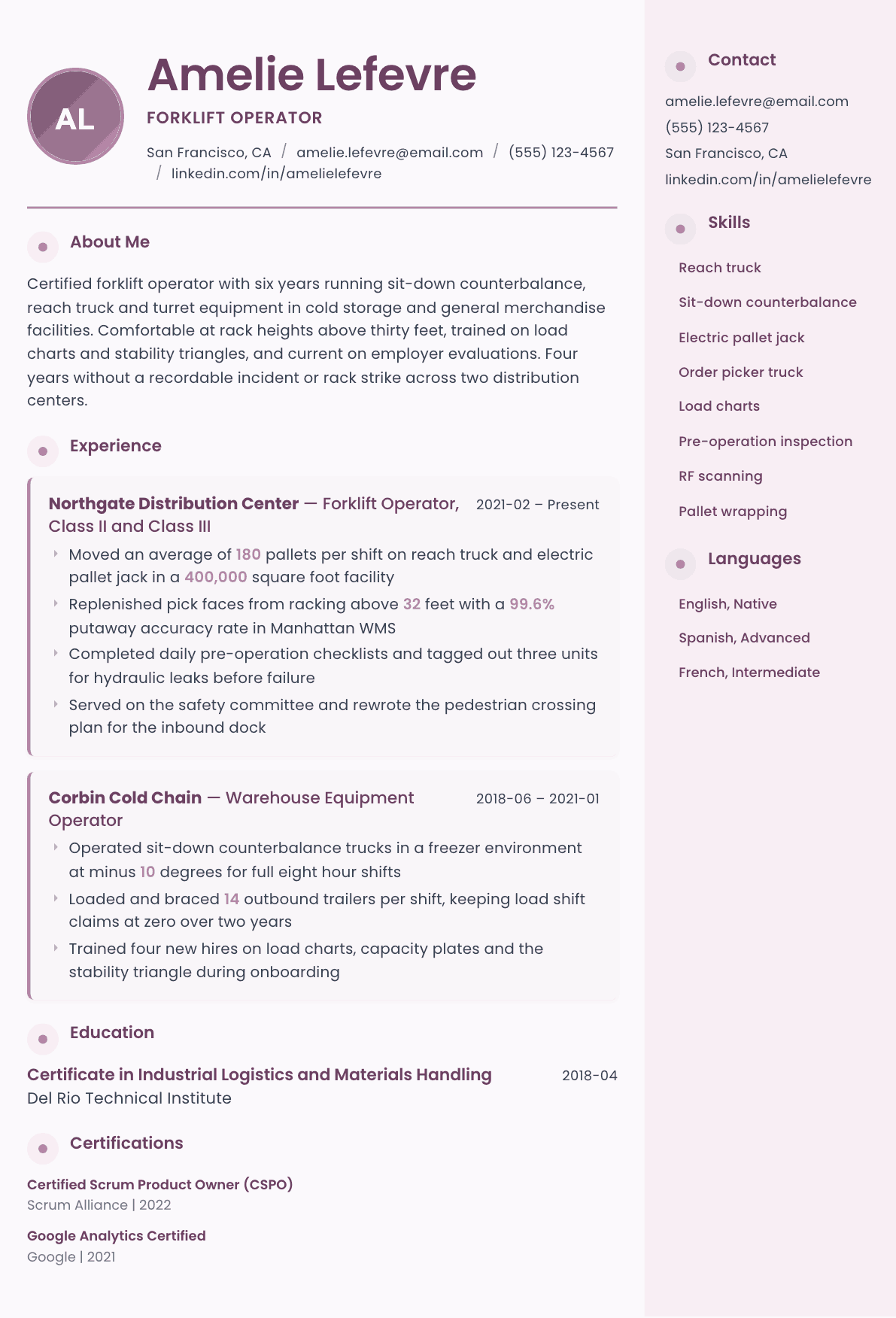
The same forklift operator content laid out in three CVBooster templates, so you can see what the finished document looks like before you write a word.
Example Forklift Operator summary
Certified forklift operator with six years on reach truck, counterbalance and turret equipment in cold storage and general merchandise distribution. Moves roughly 180 pallets per shift at rack heights above thirty feet with putaway accuracy near 99.6%. Four years incident free, current on employer evaluation, and experienced with RF scanning in Manhattan WMS. Looking for a second shift operator role at a high volume facility.
Skills to list on a Forklift Operator resume
- Sit-down counterbalance forklift
- Reach truck
- Order picker truck
- Turret truck
- Electric pallet jack
- Load chart interpretation
- Pre-operation inspection
- Pallet putaway and replenishment
- RF scanner operation
- Cycle counting
- Load bracing and dunnage
- Battery changing and charging
- Cold storage operations
- Hazard recognition
- WMS transactions
What actually gets this resume read
- Name every truck class you have run, because a reach truck operator and a turret operator are not interchangeable.
- State your certification and the date of your last employer evaluation, since operator credentials are employer specific.
- Give rack height, pallet volume per shift and putaway accuracy so a supervisor can size your throughput.
- Mention the environment: freezer, cooler, ambient, hazmat or outdoor yard changes who wants to interview you.
- List the warehouse management system you scanned into, since that shortens training time for the hiring site.
- Put incident-free years and safety committee work near the top, because operator safety history drives the decision.
How to write a forklift operator resume
Forklift operator hiring runs on two filters. A staffing coordinator or site recruiter screens for the certification, the truck classes and availability for the shift that is open. The operations supervisor who actually needs the seat filled reads for something narrower: which equipment you can climb onto tomorrow, at what rack height, in what temperature, and whether your safety history means an insurance conversation.
Most applications lose on the second filter. They say forklift certified and stop. Certification is employer specific and has to be refreshed by the site that hires you, so on its own it tells a supervisor almost nothing. What tells him something is the truck class, the mast height you worked at, the pallets you moved per shift, the environment, and the last time anything on your record went wrong.
Postings also call the job lift truck operator, powered industrial truck operator or reach truck driver, and a lift truck operator resume follows exactly the same rules. This guide walks the sections a warehouse screener reads in order, with example summaries from a newly certified operator through to a lead operator and trainer, before and after bullets built on real equipment work, and answers to the questions operators ask most. Some postings split the word as fork lift operator, and applicant tracking systems can treat the two spellings as different terms, so a fork lift operator resume should use the posting's spelling once in the summary and once in the skills list.
Format: one page, equipment visible in the top third
One page, reverse chronological, plain single column. Warehouse recruiters open dozens of these on a phone between dock walks, and a two column layout with icons often parses out of order in the applicant tracking system a large distribution network runs.
Put an equipment line directly under your header, before the summary. Something like sit-down counterbalance, reach truck, order picker, electric pallet jack, walkie rider. That single line answers the supervisor question that decides whether he keeps reading, and it puts every class keyword where the software finds it.
- Header: name, city, phone, email, shift availability, current certification status.
- Equipment line: every truck class you have run, named the way operators name them.
- Sections after that: summary, experience, certifications and training, skills, education.
Fork lift operator resume summary: classes, height, environment, record
Two or three lines carrying four facts: how long you have operated, which classes, the tallest rack you worked, and your incident history. An operator who says four years on reach truck and turret to thirty two feet in a freezer environment with no recordable incidents has already answered the interview.
If you are switching from one equipment family to another, say so and name what transfers. Someone moving from counterbalance to narrow aisle should point at load chart knowledge, pedestrian awareness and mast control rather than hoping the reader connects a sit-down truck to a turret.
Written out for a lift truck operator resume: Lift truck operator with four years on Class II narrow aisle reach trucks and Class IV sit down counterbalance, rack work to about 30 feet, ambient and freezer, no recordable incidents. Available for nights and weekend overtime.
Experience: volume, height, accuracy, environment
Head each job with the site type and size: a general merchandise distribution center, a cold chain facility, a manufacturing plant with an outdoor yard, a lumber yard with rough terrain trucks. Then the truck classes you ran there. The physical setting changes what an operator is worth, and a supervisor sizes it instantly.
The bullets need throughput and precision together. Pallets moved or putaways completed per shift is throughput. Putaway or replenishment accuracy in the warehouse system is precision. An operator who moves a lot and misplaces stock creates a cycle count problem, so both numbers matter, and the operators who name both stand out immediately.
Add the work around the driving. Battery changes and watering, daily pre-operation inspections, tagging out damaged units, load bracing on outbound trailers, and any safety committee or training role. Those bullets are what move an application from operator to lead operator.
Certification and training: exact, dated, and honest
Give the certification, who trained you and when your last evaluation was performed. Operator authorization is granted by an employer after training and practical evaluation, and it is periodically re-evaluated, so a card from a previous site does not carry over automatically. Saying that you understand this and are ready for site evaluation reads as competence rather than a gap.
Safety training in general industry belongs in the same block. Ten hour and thirty hour general industry courses, hazard communication, lockout and tagout awareness, first aid and CPR, and any train the trainer credential all earn their line. A trainer credential is the single fastest way to be read as a lead candidate.
Skills and systems: name the software, not just the truck
Warehouse work is scanned work. Say which warehouse management system you transacted in, whether you used a truck mounted terminal or a wrist scanner, and which transactions you owned: putaway, replenishment, cycle count, load confirm. Sites screen on their platform because it removes a week of training.
Keep the physical requirements factual and brief. Weight you lift regularly, hours on your feet, temperature ranges you have worked, and any respirator or hearing protection program you were enrolled in. Vague claims about being hardworking do nothing that a rate number does not do better.
Forklift driver resume sample and examples, written out
Employers post the same job as forklift driver, forklift operator and material handler, so a forklift driver resume should use the title from the posting in the summary and keep the truck classes, environments and record in the first lines. The two forklift driver resume examples below, each a complete forklift driver resume sample, show an entry level driver and an experienced driver, written as they sit on the page.
Example one, entry level: Luis Ortega, Forklift Driver. Warehouse associate with one year of picking and packing who completed employer forklift training and evaluation on sit down counterbalance and electric pallet jacks. Example two, experienced: Dana Whitfield, Forklift Driver. Seven years on reach trucks and order pickers in a grocery distribution center, including freezer work, applying for a lead driver role.
- Example one, summary: Forklift driver trained and evaluated on Class IV sit down counterbalance and Class III electric pallet jacks, loading and unloading trailers at the dock with no damage claims.
- Example one, experience: Warehouse Associate, regional parcel hub, one year: picked and packed about 150 orders a shift, then moved to dock forklift work after completing training.
- Example one: unloads floor loaded and palletized trailers, stages freight by lane and scans every pallet into the warehouse management system.
- Example two, summary: Forklift driver with seven years on Class II reach trucks and order pickers, working at rack heights up to thirty feet in ambient and freezer zones.
- Example two, experience: Forklift Driver, grocery distribution center, seven years: replenishes pick slots and puts away about 120 pallets a shift with location accuracy checked by cycle counts.
- Example two: trains new drivers on the reach truck and the daily pre shift inspection checklist, and fills in as shift lead on weekends.
- Both examples, certification line: employer forklift training and evaluation with the truck classes and the date of the last evaluation, plus any freezer, hazmat or first aid training.
Forklift Operator resume summary examples
Newly certified operator
Newly certified forklift operator trained on sit-down counterbalance and electric pallet jack, with two years of general warehouse work in receiving and putaway. Comfortable with RF scanning, load charts and daily pre-operation checks. Available for second or third shift and ready for site evaluation on reach truck.
Four years on multiple classes
Forklift operator with four years on reach truck, counterbalance and electric pallet jack in a general merchandise distribution center. Averages 160 putaways a shift at rack heights above thirty feet with replenishment accuracy near 99.5%. Three years with no recordable incident and no rack strike.
Lead operator and trainer
Lead forklift operator with nine years across cold storage and ambient distribution, running turret, reach and counterbalance equipment. Holds a train the trainer credential and has evaluated more than thirty operators. Sits on the site safety committee and redesigned the pedestrian crossing plan for the inbound dock.
Work experience bullets: before and after
Before: Operated forklift to move pallets around the warehouse.
After: Ran a reach truck for an average of 180 pallet moves per shift between receiving, reserve racking above thirty feet and pick face replenishment.
Class, volume and the flow between locations tell a supervisor what your shift actually produced.
Before: Followed all safety procedures.
After: Completed pre-operation checklists on every unit and tagged out three trucks for hydraulic leaks and worn forks before they reached a failure point on the floor.
A named catch turns compliance language into evidence that you inspect rather than sign the sheet.
Before: Used a scanner for inventory tasks.
After: Confirmed every putaway and replenishment through a truck mounted terminal in Manhattan WMS, holding location accuracy at 99.6% across the year.
The system, the device and an accuracy figure prove you protect inventory records, not just move freight.
Before: Loaded trucks at the dock.
After: Loaded and braced an average of 14 outbound trailers per shift, floor loading and pinwheeling mixed pallets so that damage claims on my loads stayed at zero for two years.
Loading technique plus a claims outcome shows the part of the work that costs money when it is done badly.
Before: Helped train other operators.
After: Trained and practically evaluated 12 new operators on load charts, capacity plates and the stability triangle, with all twelve cleared to run independently inside three weeks.
Counting the operators and naming what you taught turns a helper claim into a documented trainer role.
Hard skills
- Sit-down counterbalance forklift
- Reach truck
- Turret and narrow aisle truck
- Order picker truck
- Electric pallet jack and walkie rider
- Load chart and capacity plate reading
- Pre-operation inspection
- Pallet putaway and replenishment
- Load bracing and dunnage
- Battery change and watering
- RF and truck mounted scanning
- Cycle counting
- Cold storage operation
Soft skills
- Spatial judgment
- Pedestrian awareness
- Steady pace over a full shift
- Clear radio communication
- Coaching newer operators
- Reporting problems early
Certifications worth listing
- OSHA 10-Hour General Industry (OSHA Outreach Training Program)
- OSHA 30-Hour General Industry (OSHA Outreach Training Program)
- Certified Logistics Associate (CLA) (Manufacturing Skill Standards Council)
- Certified Logistics Technician (CLT) (Manufacturing Skill Standards Council)
- Adult First Aid, CPR and AED (American Red Cross)
Mistakes that cost forklift operator candidates the interview
- Writing forklift certified with no truck class, so the supervisor cannot tell a counterbalance operator from a turret operator.
- Leaving out rack height, which is the difference between floor level work and narrow aisle work at thirty feet.
- Claiming equipment you have only watched, since a practical evaluation on day one exposes it immediately.
- Skipping the environment, so a freezer facility cannot tell whether you have ever worked a full shift in the cold.
- Listing throughput with no accuracy figure, which reads as speed bought with misplaced stock.
- Burying a train the trainer credential at the bottom when it is the strongest line on the page.
Forklift Operator resume questions
Does my forklift certification transfer to a new employer?
The training carries over as proof of competence, but the authorization to operate does not. Each employer must train and practically evaluate you on its own equipment and site conditions, so list your card and add that you are ready for evaluation.
Which truck classes should I list on a forklift operator resume?
Every class you have genuinely run, named the way operators name them: sit-down counterbalance, reach truck, turret, order picker, walkie rider, electric pallet jack, rough terrain. Put the list high on the page because it is the first screening filter.
How do I show my safety record without sounding vague?
Give a period and a fact: three years without a recordable incident, no rack strikes, no damage claims on loads you built. Then add a practice behind it such as daily pre-operation checks or safety committee work so the record reads as habit.
What should a forklift driver resume include?
The job title from the posting, the truck classes you are trained on, the date of your last evaluation, the environments you have worked in such as dock, freezer or high racks, your volume per shift, your safety record and the warehouse systems or scanners you use. Keep it to one page.
Is a lift truck operator resume different from a forklift operator resume?
No. Lift truck and powered industrial truck are the terms many safety rules and manufacturers use, and some employers post under them, but the job and the screen are the same. Use the posting's own title in your summary where it is true, list truck classes by number and name, and keep forklift in your skills line as well so both searches find you. If you also want to move up, add one bullet on training new operators or running a shift's load plan.
Related resume examples
- Warehouse Worker Resume example
- Logistics Coordinator Resume example
- Warehouse Associate Resume example
- Material Handler Resume example
- Receiving Clerk Resume example
- Order Picker Resume example