Music Producer Resume Examples: the lines they read
Build a Music Producer Resume That Hits All the Right Notes
By Mustafa Tarabya, founder of CVBooster · Published · Updated
Create a standout music producer resume showcasing production credits, studio expertise, and chart performance for record labels, studios, and independent artists.
Sample resumes for a music producer
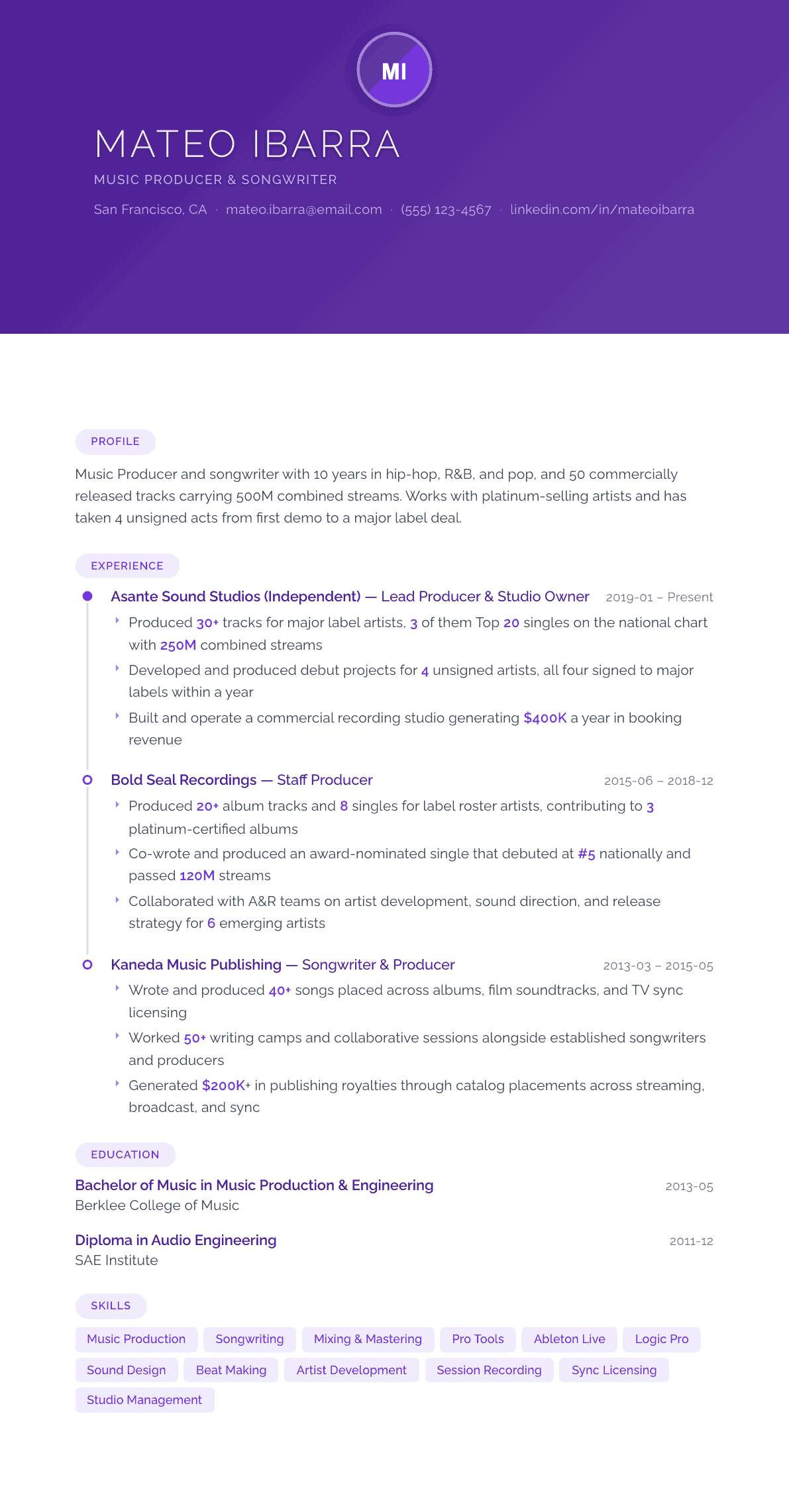
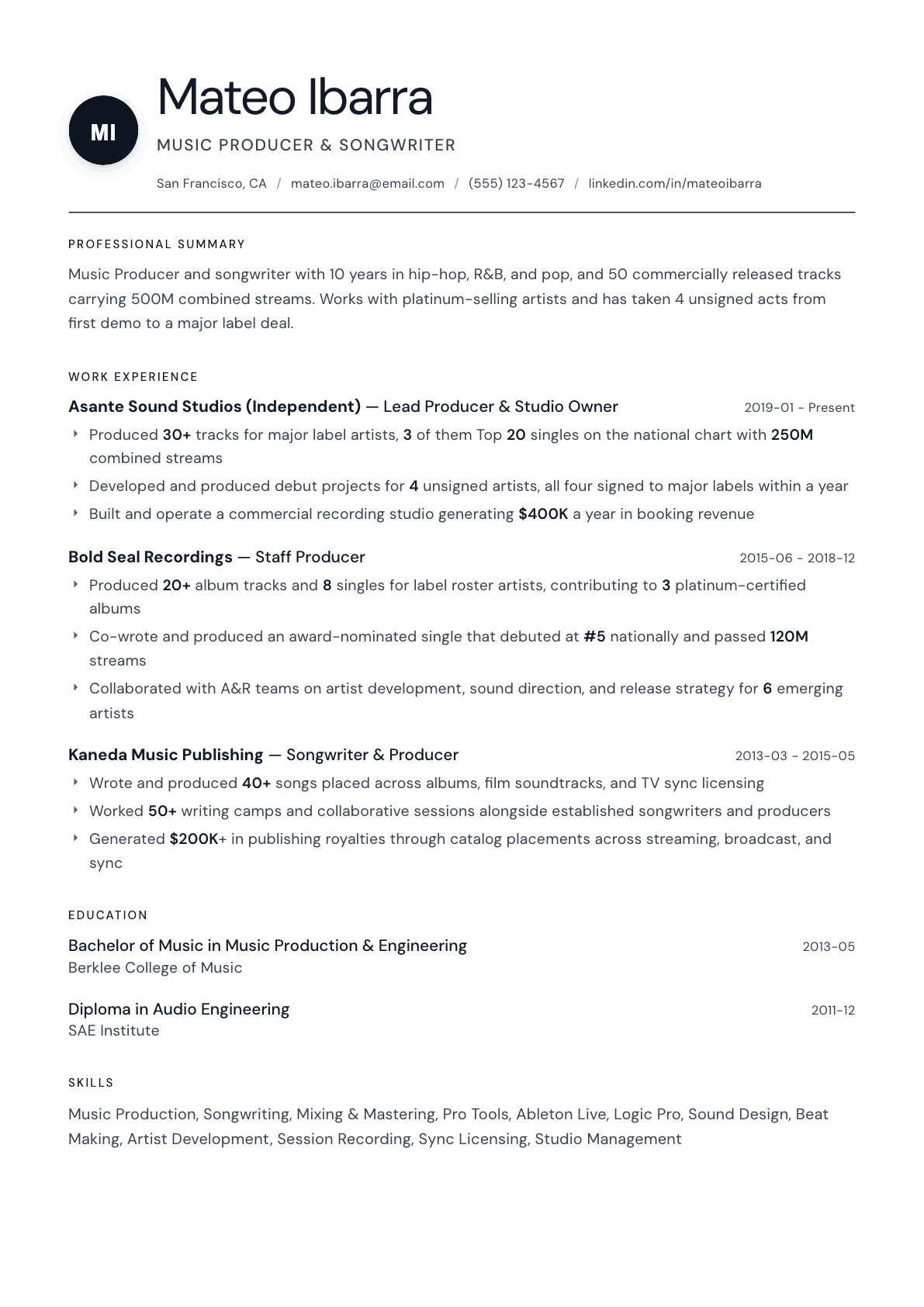
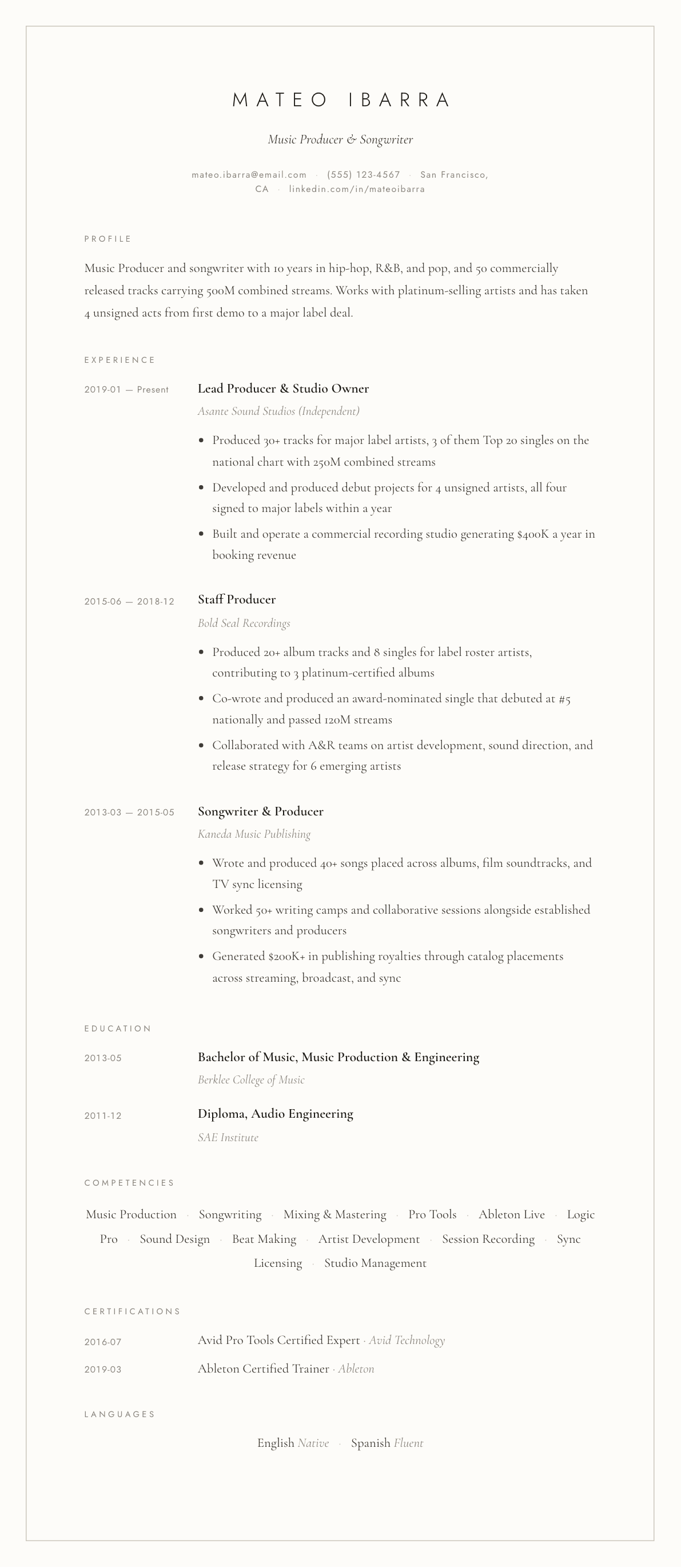
The same music producer content laid out in three CVBooster templates, so you can see what the finished document looks like before you write a word.
Example Music Producer summary
Music Producer, 10 years and 50 commercially released tracks across hip-hop, R&B, and pop, with 500M combined streams, 3 Top 20 singles, and 3 platinum album credits. Owns a studio doing $400K a year and develops artists as well as records.
Skills to list on a Music Producer resume
- Music Production
- Songwriting
- Mixing
- Mastering
- Pro Tools
- Ableton Live
- Logic Pro
- Sound Design
- Beat Production
- Artist Development
- Sync Licensing
- Studio Management
What actually gets this resume read
- Lead with your most recognizable credits, chart positions, and streaming numbers.
- List your primary DAW proficiencies and studio equipment expertise.
- Quantify your output: tracks produced, albums contributed to, and sync placements secured.
- Highlight artist development. Labels value producers who can shape careers, not just beats.
- Include a link to your portfolio, SoundCloud, or streaming credits for immediate reference.
How to write a music producer resume
Producer is one job title covering several trades. One producer writes and builds tracks from scratch and hands an artist a finished record. Another runs a room full of session musicians and gets a performance out of them. Another is effectively an engineer with taste who captures, edits and mixes. Another produces for picture, games or advertising against a brief and a delivery deadline. The person reading your resume needs to know which of these you are within the first two lines.
After that, everyone reads credits. Music is a credit-driven business, and a verifiable release with a named artist and label is worth more than any description of your sound. The other thing being assessed is reliability: whether sessions run on time, whether stems arrive labeled and on schedule, whether you can work to a brief instead of only to your own instincts, and whether artists want to come back.
This guide covers the credit-first format the industry expects, how to describe production work without inflating it, three summaries from a first paid credit through to an established producer, before and after bullets, and the questions producers ask about listing streaming numbers, splits and moving between artist records and media work.
Format: credits first, then rooms and skills
Lead with a selected credits section directly under a short summary. List release title, artist, your role, the label if there was one, and the year. Distinguish producer, co-producer, engineer, mixer, programmer and writer, because those are contractual roles and confusing them is a serious error in this business.
Put links in the header: a portfolio or streaming profile that shows your credited work, and a page or drive with a small set of production examples if you are pitching for work rather than a staff job. Keep the whole document to one or two pages and let the music carry the rest.
- Header: name, role line such as "Producer and Mix Engineer", city, email, credits or streaming link.
- Order: summary, selected credits, experience or studio history, technical skills, equipment, education.
- Separate artist releases from media work such as film, game, advertising and library music.
- Keep publishing and society membership on a short line rather than in the body.
Summary: genre, role, and what you actually do in a session
Name the genres you produce in, your primary role, and the part of the process you own. A producer who writes with the artist, plays several instruments and finishes a mix is offering a different service from one who arranges, directs performance and hands the mix to a specialist, and both are hirable when they are honest.
If you produce for picture or brands, say so separately. That work is judged on brief interpretation, revision handling and delivery to specification rather than on artist relationships, and mixing the two into one paragraph blurs both.
Credits: name the release, the role and the label
Write credits the way they appear on a release. Artist name, track or album title, your credited role, label or independent release, and the year. If you produced three tracks on an album, say three tracks rather than implying the album. Anyone in this industry can check, and inflated credits end conversations permanently.
Group credits so the reader can navigate: singles and albums, sync placements, remixes, and media work. If a release has a chart position, an official certification or a placement in a film, series or game, name it plainly with the source. Streaming figures are worth including only when the number is genuinely notable and attached to a named release.
For unreleased or in-progress work, use a separate line and be clear about its status. Producers often have a year of work in the pipeline, and an editor of your resume would rather see that stated than discover it in conversation.
Technical skills: the session chain from tracking to delivery
Name the digital audio workstations you work in and be specific about which one you actually run sessions in. Pro Tools remains the standard for tracking and larger sessions, Ableton Live for electronic production and live rigs, and Logic Pro for writing and songwriting rooms. Say which one you deliver from, because collaborators need compatible session files.
Then the chain: microphone selection and placement, preamps and converters, tracking bands and vocalists, comping and editing, tuning and timing correction, programming and sound design, mixing, and stem preparation. Mastering deserves a separate line, since many producers hand it off and claiming it without the skill is easy to spot.
Add the delivery discipline that professionals notice: consistently labeled and aligned stems, documented tempo maps and session notes, backup and file management across long projects, and metadata and split sheets completed at the session rather than months later.
- Workstations: Pro Tools, Ableton Live, Logic Pro, session file compatibility.
- Tracking: microphone technique, preamps and converters, vocal and band recording, headphone mixes.
- Production: arrangement, programming, sound design, sampling, comping, tuning and timing.
- Delivery: mixing, stem preparation, session documentation, split sheets and metadata.
Studio, gear and business: what you bring to the room
If you run your own room, describe it briefly and usefully: the space, the monitoring, the key outboard and instruments, and what it is suited to. A studio line matters because it tells a label or an artist whether you can host a session or need to book one, which affects budget directly.
Include the business side that keeps a producer working: performing rights society membership, publishing administration, split sheet practice, session musician booking, budget management, and any label or artist development work. Producers who understand splits and paperwork get repeat business from managers who have been burned before.
Music Producer resume summary examples
First paid credits
Producer and engineer working in indie and alternative rock, with production credits on four independently released singles and engineering credits on a local album. Runs tracking sessions in Pro Tools, produces and programs in Logic Pro, and owns a project room set up for vocals and guitars.
Seven years producing
Producer and mix engineer with seven years in pop and electronic music, credited on two full albums and around 30 singles for independent labels. Writes and programs in Ableton Live, tracks vocals in Pro Tools, mixes in the box, and has placed six tracks in television and advertising.
Established producer
Producer with sixteen years across soul, hip hop and pop, credited on major and independent label releases including two certified singles. Runs a full commercial room, directs session musicians and vocalists, develops artists from demo to delivery, and manages recording budgets and split documentation.
Work experience bullets: before and after
Before: Produced tracks for various artists.
After: Produced 12 singles and two extended plays for independent pop and electronic artists, taking each from writing session through arrangement, tracking, mixing and delivery to the label.
Release counts, genres and full process ownership tell a manager exactly what you deliver.
Before: Recorded and mixed songs in the studio.
After: Tracked live drums, bass and guitars in an eight-piece session, comped and tuned lead vocals, and delivered a mix plus labeled stems within four days of the last tracking day.
The session size and the turnaround from tracking to delivered stems prove reliability, not just ability.
Before: Worked with artists to develop their sound.
After: Developed two independent artists across an album cycle each, running weekly writing sessions, choosing session players, and shaping the arrangement direction that carried across both records.
Artist development is a distinct service, and describing the cadence makes the claim concrete.
Before: Got some music placed in TV and film.
After: Secured six sync placements across two television series and a national advertising campaign, producing alternate instrumental and stem versions to the music supervisor specification.
Naming the placement types and the deliverables shows you understand what supervisors need.
Before: Good at working with people in the studio.
After: Runs sessions to a written plan with a call sheet, keeps takes logged and labeled, and completes split sheets and metadata before anyone leaves the room.
Session process and paperwork discipline are what managers and labels actually pay a premium for.
Hard skills
- Music production and arrangement
- Pro Tools
- Ableton Live
- Logic Pro
- Vocal recording and comping
- Live band tracking
- Microphone selection and placement
- Programming and sound design
- Sampling and beat making
- Mixing and stem preparation
- Tuning and timing editing
- Session documentation and file management
- Sync and media music delivery
Soft skills
- Getting a performance out of a nervous vocalist
- Reading the room in a session
- Working to a brief and a revision round
- Budget and schedule management
- Artist relationship building
- Clear communication about splits and credit
Certifications worth listing
- Avid Certified User, Pro Tools (Avid Technology)
- Avid Certified Professional, Pro Tools (Avid Technology)
- Ableton Certified Trainer (Ableton)
- Apple Certified Pro, Logic Pro (Apple)
Mistakes that cost music producer candidates the interview
- Blurring producer, engineer, mixer and writer credits, which reads as inflation to anyone who works in the business.
- Claiming an album when you produced two tracks on it, a discrepancy that is checkable in seconds.
- Leading with streaming numbers instead of named releases, which suggests the credits themselves are thin.
- Leaving out which workstation you deliver sessions from, when collaborators need compatible files.
- Listing an equipment inventory in place of credits, which reads as gear enthusiasm rather than a working career.
- Ignoring delivery discipline: unlabeled stems and missing split sheets lose more repeat work than a mediocre mix.
- Mixing artist releases and media or library work into one list, so neither career reads clearly.
Music Producer resume questions
How do I list music production credits on a resume?
Give the artist, the release title, your exact credited role, the label if there was one, and the year. Say how many tracks you produced when it was not the whole record, and keep singles, albums, remixes and sync work in separate groups.
Should a music producer include streaming numbers?
Only when a figure is genuinely notable and tied to a named release you can point to. A modest number invites an unflattering comparison, and a list of credits with recognizable artists or labels carries far more weight than any play count.
What is the difference between a producer and an engineer credit?
A producer shapes the creative direction, the arrangement and the performance and is responsible for the record as a whole. An engineer captures and manipulates the sound. Many people do both, but they are separate credits and separate contracts, so list them separately.
How do I get producer work without major label credits?
Build a body of independent releases you can point to, work consistently with two or three artists so there is a visible run of records, and take sync and library work, which is credit-generating and judged more on delivery than on name recognition.
Do producers need a music degree?
No. Credits, a working room and repeat clients matter far more than formal education. A degree helps mainly for teaching posts, staff roles at larger institutions and media composition work, where theory and score reading are part of the daily job.