Audio Engineer Resume Examples: the lines they read
Audio, Sound and Recording Engineer Resume Examples
By Mustafa Tarabya, founder of CVBooster · Published · Updated
Audio, sound and recording engineer resume samples, a studio engineer example written out, live sound bullets, gear fluency, credits and freelance work.
Sample resumes for a audio engineer
The same audio engineer content laid out in three CVBooster templates, so you can see what the finished document looks like before you write a word.
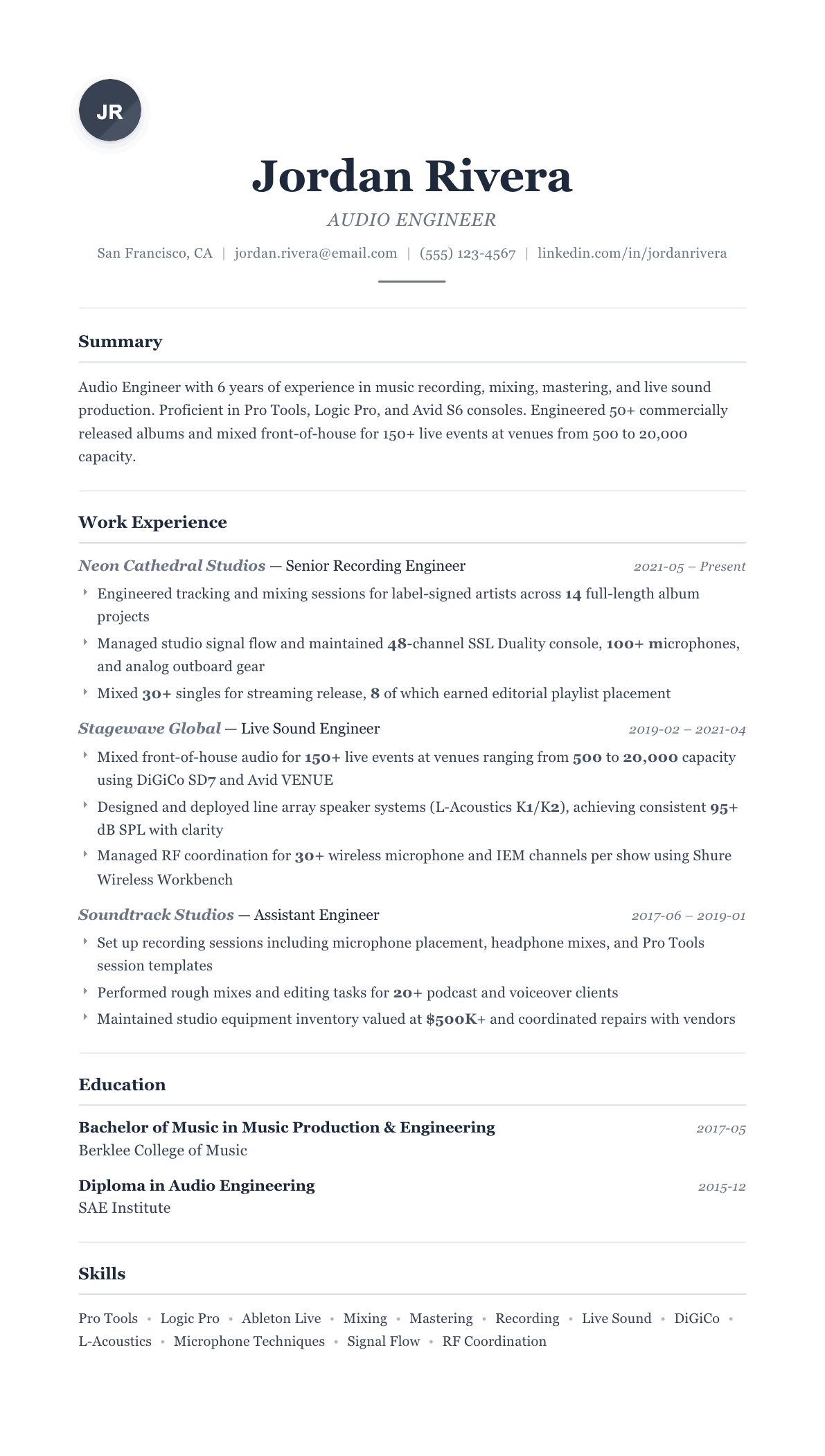
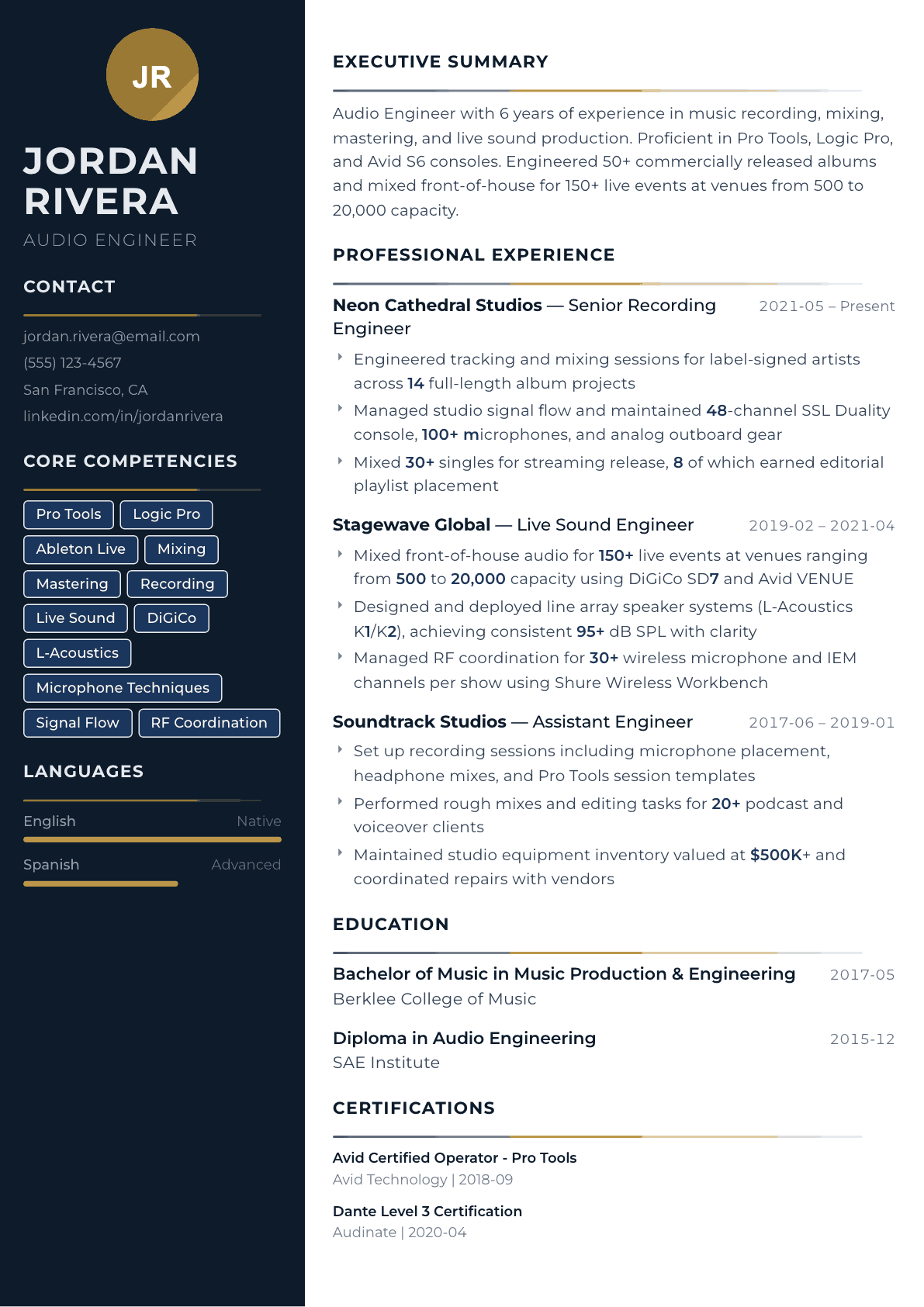
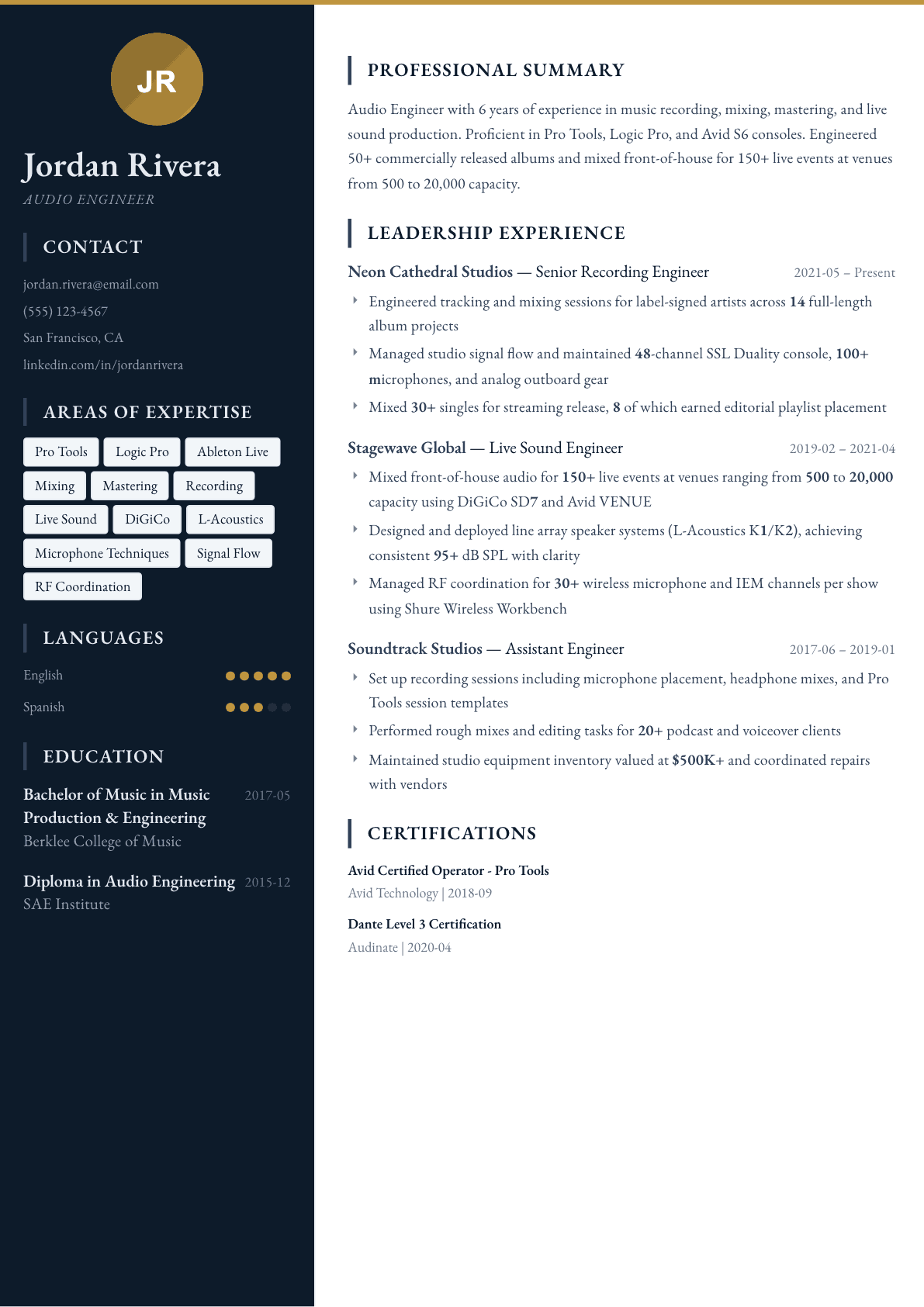
Example Audio Engineer summary
Audio Engineer with 6 years of experience across studio recording, mixing, and live sound production. Proficient in Pro Tools, Logic Pro, and SSL/DiGiCo consoles. Engineered 50+ commercially released albums and ran front-of-house for 150+ live events from club rooms to 20,000-seat arenas.
Skills to list on a Audio Engineer resume
- Pro Tools
- Logic Pro
- Ableton Live
- Mixing & Mastering
- Recording Engineering
- Live Sound Reinforcement
- SSL / Neve Consoles
- DiGiCo / Avid VENUE
- L-Acoustics / d&b
- Microphone Techniques
- Signal Flow Design
- RF Coordination
- Acoustics
- Podcast Production
- Dante / AES67 Networking
What actually gets this resume read
- List DAWs and hardware: Pro Tools, Logic Pro, Ableton, SSL, Neve, DiGiCo, Avid consoles.
- Name the credits a studio will recognize: album and single titles, label, artist tier, and whether you tracked, mixed or mastered each one.
- Specify disciplines: recording, mixing, mastering, live sound, post-production, podcast.
- Quantify achievements: number of releases, streaming numbers, event sizes, equipment managed.
- Mention technical skills: signal flow, microphone techniques, RF coordination, acoustics.
- Reference live sound gear: line arrays (L-Acoustics, d&b), digital consoles, wireless systems.
How to write a audio engineer resume
Audio engineer is one title covering four trades that rarely hire each other. Studio recording and mixing, live sound reinforcement, post-production for film and television, and game or interactive audio each have their own tools, their own vocabulary and their own idea of what a good day looks like. A studio manager and a touring production manager reading the same resume are looking for almost nothing in common.
The second thing to understand is that this field hires on credits and on gear fluency, and both need to be verifiable. A studio owner scanning your page is checking which consoles you can drive without supervision, which rooms you have worked in and whose records you have touched. A production company is checking which desks you have mixed on, how big the rooms were and whether you can do your own system tuning and radio frequency coordination.
This guide covers how to split the resume by track, two samples written out (a live and studio sound engineer, and a recording engineer for a studio), how to present a credit list without turning it into a discography nobody reads, how to write about gear so it reads as competence rather than a shopping list, and what freelancers should do about the gaps between contracts.
Format: pick the track, then build the page around it
One page, always, with a separate credits page allowed when the credits are the point. This industry hires fast and reads on a phone in a loading dock as often as at a desk. Reverse chronological positions, then a compact gear and systems block, then selected credits.
Say the track in your title line rather than leaving it to inference. Recording and mix engineer, front of house engineer, monitor engineer, systems technician, dialogue editor, re-recording mixer and sound designer are all distinct job titles, and using the right one gets you into the correct pile immediately.
- Header: name, target title, city, phone, email, and a link-free mention that a portfolio or reel is available.
- Sections in order: summary, technical proficiencies, experience, selected credits, education and training.
- Freelancers replace employer-by-employer history with a client and production list grouped by year band.
Summary: what you drive alone, and at what scale
The single most useful sentence tells a reader what you can be handed with nobody watching. Tracking sessions on a large-format analog console, a front of house position at a four thousand capacity venue, a dialogue premix for episodic television, or a mastering chain for streaming delivery are all statements of independent competence.
Follow it with scale and volume. Number of sessions, number of shows a year, venue capacity range, episodes delivered or titles released. Scale is what tells a hiring manager whether you have been in the deep end or watching from the edge, and it is the number most audio resumes leave out.
Experience: signal path, decisions and problems solved
Write bullets about decisions rather than duties. Which microphones on which sources and why, how you set up a headphone world that kept a band playing together, how you dealt with a room with a bad low mid buildup, how you gain staged an analog front end into a hybrid mix. Anyone can say they recorded a band. Explaining the choices shows the ear behind them.
In live work the differentiators are the ones that keep a show running: line array prediction and deployment, system tuning by measurement, radio frequency coordination for a large channel count, redundancy plans, and being able to fix a problem while a room full of people watches. Say how many wireless channels you have coordinated and in what environment, because that number sorts candidates faster than almost anything else.
In post-production, the currency is delivery. Episodes or features completed, turnaround per reel, the loudness specification you delivered to, conform and reconform work, and whether you can build and hold a track layout that another mixer can open. In game audio, add the middleware you implemented in and how the audio behaved at runtime.
Gear and systems: fluency, not inventory
Group your gear so a reader can see fluency at a glance: digital audio workstations, consoles, monitoring and measurement, networking, and outboard or plugin chains you actually reach for. Say which ones you can patch, configure and troubleshoot rather than which ones you have stood near. A candidate who lists ten consoles and can only drive two is exposed in the first interview question.
Audio over internet protocol networking is now a hiring filter of its own in live and installation work. If you can configure a Dante or AVB network, set clocking, manage subscriptions and troubleshoot a switch configuration, say so plainly, because a large share of applicants cannot. The same goes for measurement: knowing how to take a transfer function and act on it is a different skill from owning the software.
- Workstations and the editing work you do in each, not just the names.
- Consoles you can patch and configure from a cold desk.
- Measurement and prediction tools, with the tuning work you did using them.
- Networking and clocking, wireless coordination, and intercom systems.
Credits, and the freelance timeline problem
Keep credits selected and labeled with your exact role. Engineer, assistant, mixer, mastering engineer, additional editing and system tech are not interchangeable, and inflating a role is the fastest way to lose a reference in a small industry. Ten well-chosen credits with artist or production, role and year read far better than a hundred lines of everything you have ever touched.
Freelancers should stop trying to force contract work into a normal employment history. Group by year band with a summary of volume, then list notable productions or clients under each. A page that shows a hundred shows across a year and names the venues and desks is a stronger document than one that pretends three tours were three jobs with start and end dates.
Sound, recording and studio engineer resume samples
Sound engineer and audio engineer name the same job, and postings use both, so put the posting's exact title in your header and keep the rest of the page the same. A resume for a sound engineer who works both live and in the studio leads with whichever track the posting wants, then keeps the other as a single block.
First, a recording engineer resume for a studio staff job, written as plain text; the person and studio are invented. Header: Lena Ortiz, Recording Engineer, city, phone, email, portfolio link with three mixes. Summary: Studio engineer with five years in a two room commercial facility, tracking bands and voiceover, editing and comping, and delivering rough mixes and stems on deadline. Runs sessions alone on the large format console and Pro Tools.
Experience under the studio name: engineered tracking and overdub sessions for independent artists, most weeks four to six bookings; maintained the patchbay, microphone locker and session templates; trained two assistants on signal flow and file management. Earlier: Assistant Engineer at the same studio, two years. Selected credits: eight entries with artist, project, role and year. A studio engineer resume reads best when the console, the DAW and the rooms appear in the first three lines.
The bulleted sample below is the top of a resume for a sound engineer applying to a venue that also runs a recording room. The person, venues and studio are invented; keep the order and put your own desks, capacities and counts in place of these.
- Header and summary: Marcus Ellery, Sound Engineer. Seven years in live sound and recording, the last four as house front of house engineer at a 1,200 capacity music venue, about 180 shows a year. Tunes the room by measurement and records the venue's live sessions.
- House Sound Engineer, The Foundry Hall, four years. Mixes visiting and support acts on a digital console, coordinates up to 24 wireless channels for festival weekends and runs the multitrack recording of every headline show.
- Rebuilt the venue's monitor world with in-ear packs for touring acts that carry no engineer, so changeovers run on the posted schedule.
- Freelance Recording Engineer, six years alongside the venue job: tracking and editing sessions for local bands at Glasshouse Studio, from setup and microphone choice to rough mixes delivered the same week.
- Systems and training: Pro Tools, Logic Pro, Dante network configuration and Smaart measurement. Associate degree in audio production.
Audio Engineer resume summary examples
Assistant engineer
Assistant engineer with 2 years in a commercial tracking room, setting up sessions, placing microphones and running Pro Tools for visiting engineers. Comfortable patching a 48-channel analog front end, maintaining session templates and delivering stems and rough mixes on the same day.
Six years in
Recording and mix engineer with 6 years across a commercial studio and freelance work, engineering roughly 40 tracking sessions a year and mixing singles and albums for independent release. Works on a large-format analog console into a hybrid Pro Tools chain and delivers to streaming loudness targets.
Front of house engineer
Front of house engineer with 11 years mixing touring acts in venues from 500-capacity clubs to arenas, averaging 120 shows a year. Handles system design and measurement-based tuning, coordinates 40 wireless channels per show, and travels as the artist mix engineer with local system crews.
Work experience bullets: before and after
Before: Recorded and mixed music for artists.
After: Engineered roughly 40 tracking sessions a year on a 48-channel analog console, then mixed 25 singles in a hybrid setup and delivered masters to streaming loudness specifications.
Session volume, console format and the delivery target turn a job description into a working record.
Before: Mixed live shows at various venues.
After: Mixed front of house for 150 shows in rooms from 500-capacity clubs to arenas on DiGiCo and Avid desks, building show files that traveled between houses without a rebuild.
Show count, capacity range and portable show files show a working touring engineer rather than an occasional fill-in.
Before: Set up wireless microphones for events.
After: Coordinated 40 channels of wireless microphones and in-ear monitors per show in congested urban spectrum, scanning and rebuilding frequency plans at each venue with no dropouts across a 30-date run.
Channel count, the spectrum environment and a clean run demonstrate the specific skill that live audio hiring turns on.
Before: Maintained studio equipment.
After: Maintained the console, patchbay and outboard rack for a room in daily use, keeping a documented signal path and turning around 3 recalls a week without lost session time.
Maintenance framed by uptime and recalls shows the reader what you protect, not what you own.
Before: Worked on podcast and voiceover projects.
After: Edited and mixed 20 weekly podcast episodes and voiceover deliveries, building a noise reduction and loudness chain that cut per-episode turnaround to under 2 hours.
Volume plus turnaround is the metric a content client actually buys.
Hard skills
- Pro Tools editing and mixing
- Logic Pro and Ableton Live
- Analog console operation and patching
- Digital live console programming
- Microphone selection and placement
- Gain staging and signal flow
- Mixing and mastering for streaming delivery
- Line array design and deployment
- System tuning with transfer function measurement
- Radio frequency coordination
- Dante and audio over internet protocol networking
- Dialogue editing and premixing
- Studio maintenance and patchbay wiring
Soft skills
- Session etiquette with artists
- Staying calm during a live fault
- Taking direction from a producer
- Clear communication with stage crew
- Time discipline under a booked clock
- Client confidentiality
Certifications worth listing
- Avid Certified Operator, Pro Tools (Avid Technology)
- Dante Certification Program Levels 1 to 3 (Audinate)
- Certified Technology Specialist (CTS) (AVIXA)
- Smaart Operator Training (Rational Acoustics)
Mistakes that cost audio engineer candidates the interview
- Writing one resume for studio, live and post work when the three trades hire on different evidence.
- Listing every console and plugin ever touched instead of the short list you can drive from cold.
- Inflating a credit from assistant to engineer, which travels fast in a small industry and ends references.
- Leaving out volume: sessions a year, shows a year, episodes delivered or wireless channels coordinated.
- Presenting freelance work as if it were staff employment, which creates gaps that never needed explaining.
- Ignoring networking and measurement skills, which are now the practical filter for live and installation hiring.
Audio Engineer resume questions
Should an audio engineer resume include a credits list?
Yes, but keep it selected and honest. Ten to fifteen entries with the production or artist, your exact role and the year read better than an exhaustive discography, and a studio manager will check a few of them with people she knows.
How do I handle a freelance career with no steady employer?
Group work into year bands with the volume you handled in each, then list notable clients, venues or productions underneath. This shows continuous work instead of manufacturing gaps between contracts that never existed in practice.
Is a recording or studio engineer resume different from an audio engineer resume?
Only in emphasis. Recording engineer, studio engineer, sound engineer and audio engineer overlap heavily, so copy the posting's title into your header and keep the content: the track you work in, the desks you drive alone, scale and credits. A degree is optional; assistant time, shows and delivered projects carry more weight.
How do I move from live sound into studio work?
Lead with the transferable craft: microphone technique, signal flow, gain staging, fast troubleshooting and working under pressure. Then show studio-specific evidence, whether that is your own sessions, an assistant stint or mixes you can play, because studio hiring wants to hear the result.
What technical details matter most on a live audio resume?
Console platforms you can program, venue capacities, show counts, wireless channel counts, whether you tune systems by measurement and whether you can configure the audio network. Those five answers decide most touring and production hires.