Songwriter Resume Examples: free ATS score and gap list
Write a Songwriter Resume That Opens Publishing Doors
By Mustafa Tarabya, founder of CVBooster · Published · Updated
Songwriter resume examples, catalog and credit formatting, co-writing keywords, and a full writing guide for publishing and sync pitches.
Sample resumes for a songwriter
The same songwriter content laid out in three CVBooster templates, so you can see what the finished document looks like before you write a word.
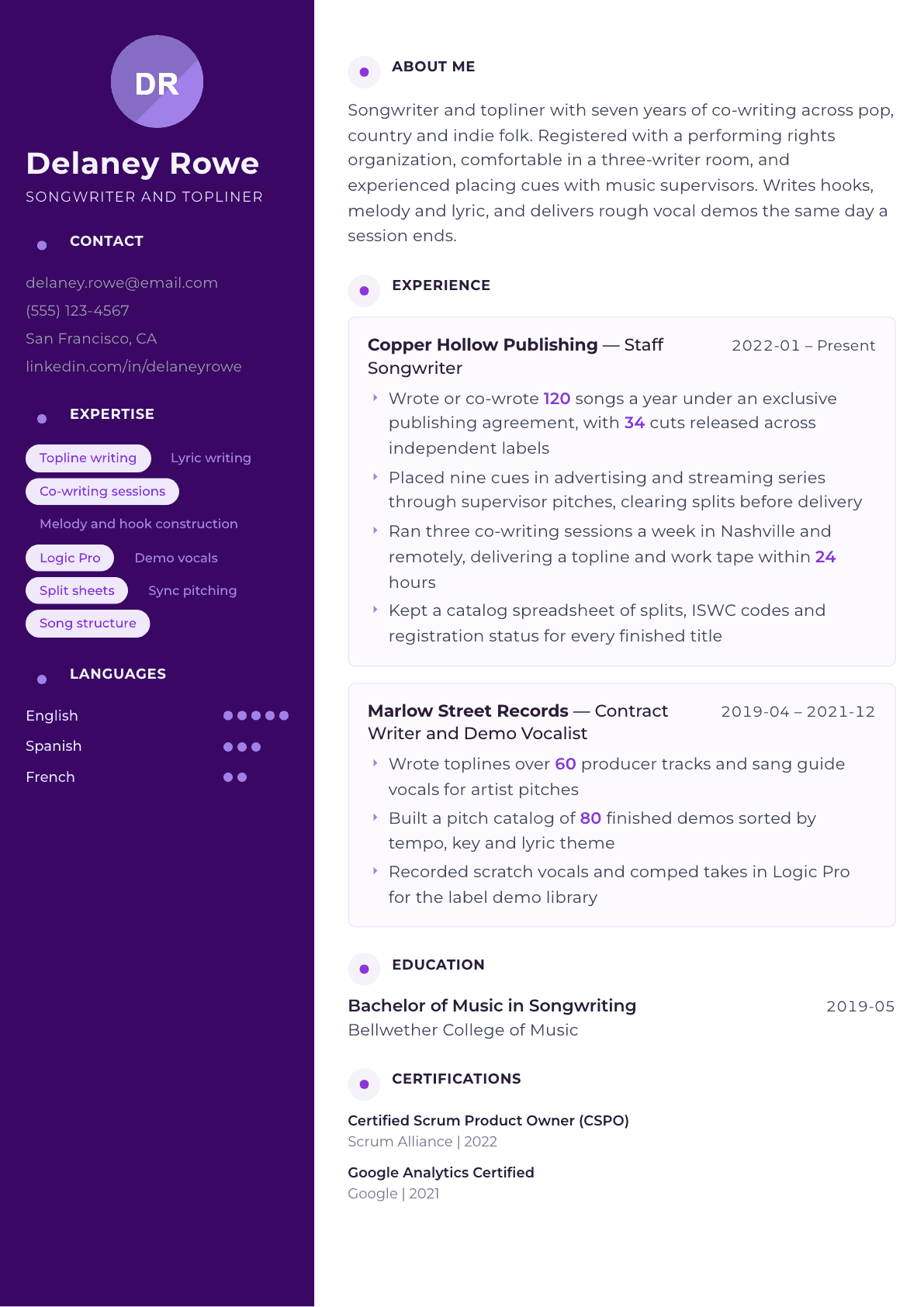
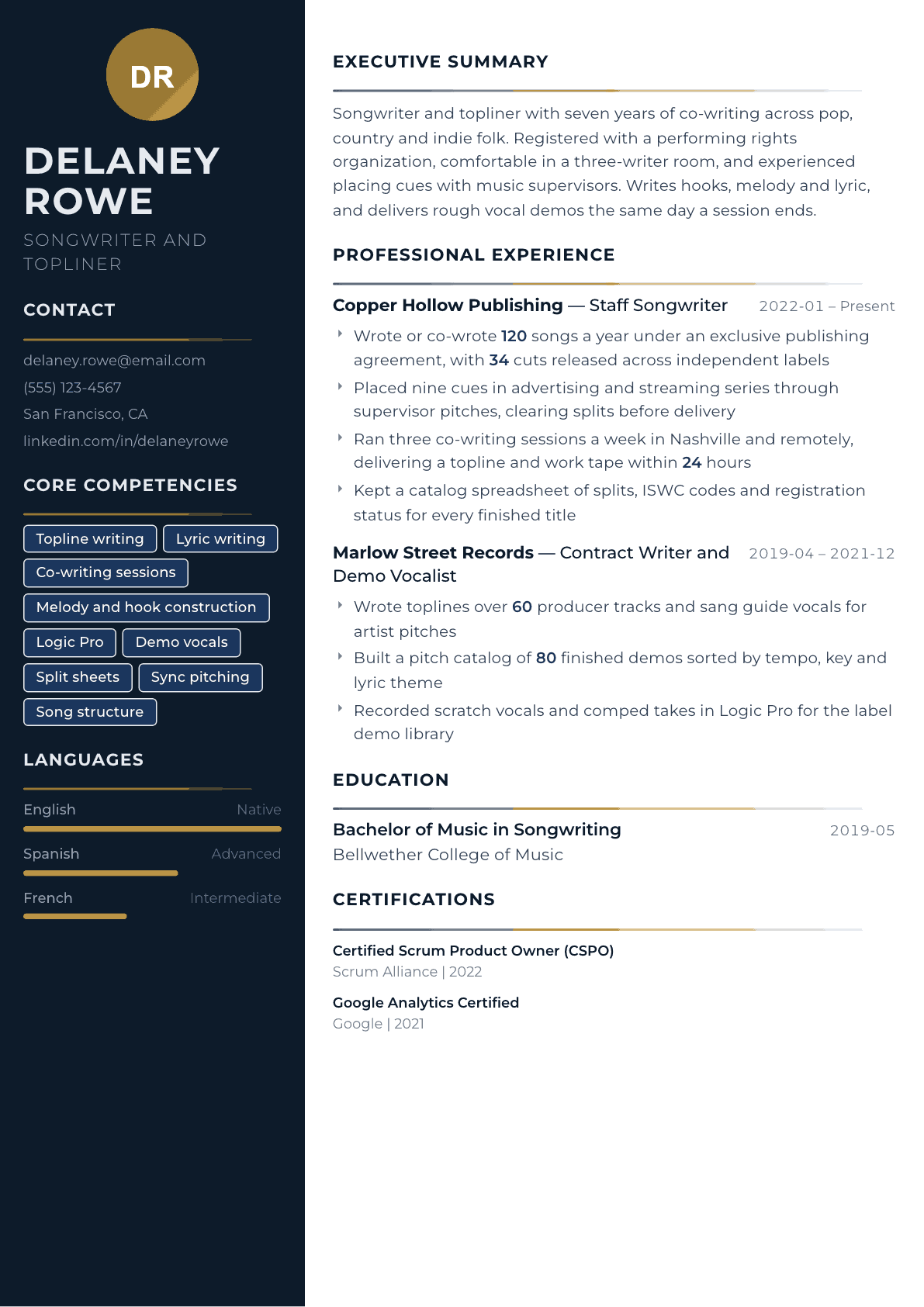
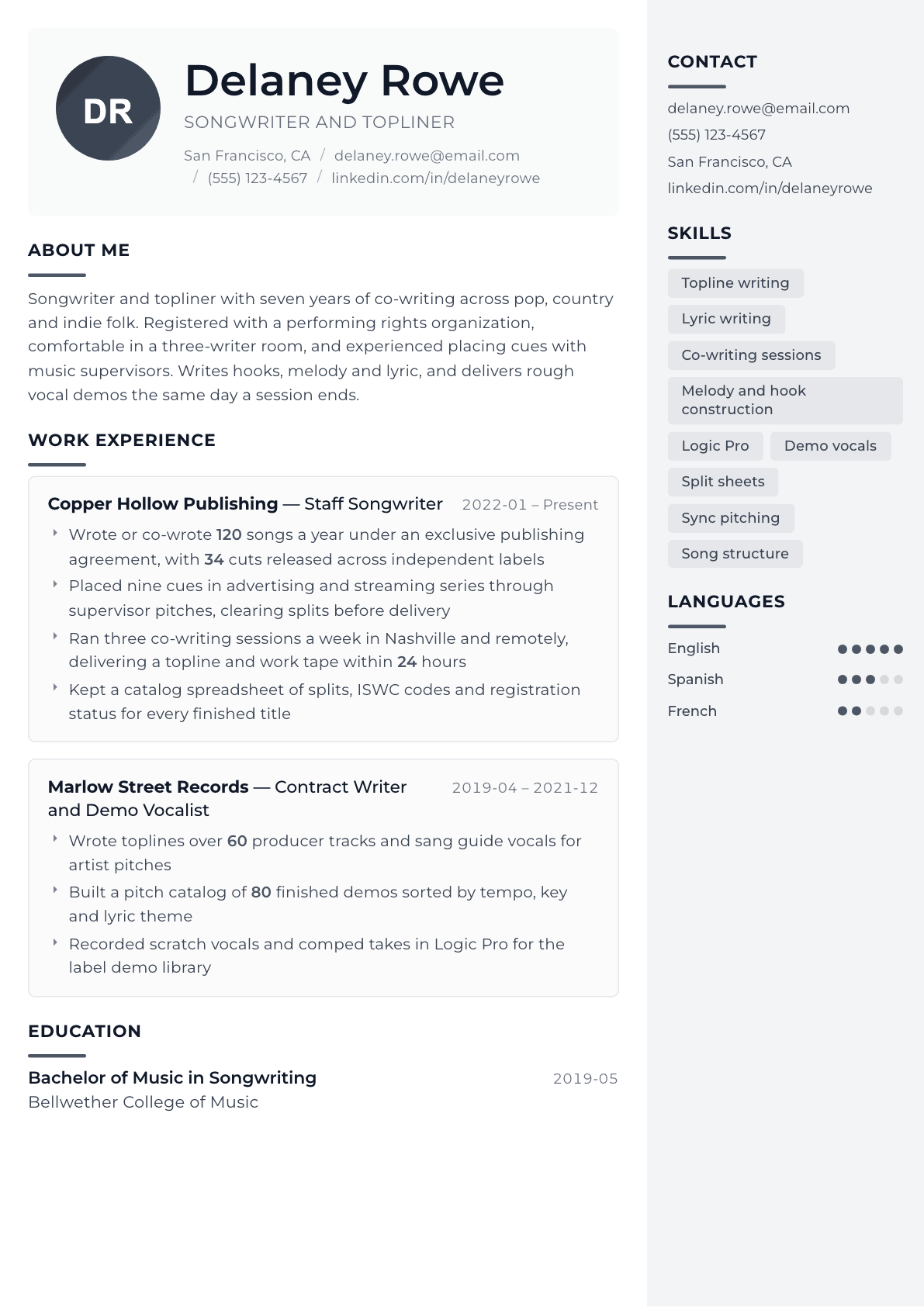
Example Songwriter summary
Songwriter and topliner with seven years of co-writing in pop and country, 34 released cuts and nine sync placements. Runs three writing sessions a week, delivers a finished topline and work tape within a day, and manages split sheets and catalog registration without a manager. Looking for a staff writing seat at a publisher with an active pitch desk.
Skills to list on a Songwriter resume
- Topline writing
- Lyric writing
- Melody construction
- Song structure
- Co-writing
- Split sheets
- Sync licensing
- Demo production
- Logic Pro
- Pro Tools
- Guitar
- Piano
- Vocal arranging
- Catalog registration
- Pitch writing
What actually gets this resume read
- Open with a credits section listing released cuts, the artist, the label and your writer share.
- Name your performing rights organization and your publisher, because that is the first thing a publisher checks.
- Say how many co-writes you run a week and in which cities or over which remote setups.
- List sync placements separately from artist cuts, since supervisors and publishers read for different signals.
- Give the genres you actually write in and the tempo range, not a claim that you can write anything.
- Link one streaming catalog and one private pitch folder, and keep both current with the same titles.
How to write a songwriter resume
A songwriter resume is an unusual document because the person reading it already assumes you can write a song. What a publisher, a label A and R or a music supervisor is trying to work out is narrower: what have you finished, who released it, who else was in the room, and can you do it again next Tuesday with a stranger.
That means the credits section carries more weight than anything you write about yourself. Released cuts, sync placements, artist projects and co-writer names are the evidence. Everything else on the page exists to explain the shape of your practice: the genres you actually live in, the speed you deliver a topline and work tape, and whether your paperwork is clean enough that a publisher will not spend six months chasing a split sheet.
This guide covers how to order the sections, how to list a credit so it reads the same way an internal database does, how to write summaries for a writer with no cuts, a working co-writer and a staff writer, and the mistakes that make a strong catalog look amateur.
Format: credits first, prose second, one page unless the catalog demands two
Put a short header block at the top with your name, the city you write in, your performing rights organization, your publisher if you have one, and a link to a public catalog. Then go straight into credits. A publisher scanning ten writers will read the credit list and stop; they will only come back up to the summary if a title catches them.
Keep credits in reverse chronological order and format them consistently: song title, recording artist, release or project, and your role. Role matters, because "written by" and "co-written with two others" are different offers. If your writer share is relevant to the conversation, keep it for the split sheet rather than the resume.
- Header: name, city, performing rights organization, publisher, catalog link, contact.
- Sections in this order: summary, released cuts, sync placements, artist and project work, skills, education.
- A writer with fewer than ten releases folds sync and cuts into one credits section.
- Two pages is acceptable only when page two is credits, never when it is more description of your style.
Summary: genres, room count, and what you are hired to do
Three lines. Name the genres you write in, whether you write topline, lyric, track or all three, how often you are in a co-writing room, and the single strongest credit or relationship you have. A summary that says you write from the heart is true of everyone who has ever picked up a guitar, so it says nothing to a publisher deciding whether to fund a season of sessions.
If you are known for one thing, lead with it. A writer who consistently lands sync should say so, because supervisors and publishers hire for that specifically. A topliner who works fast over producer tracks should put the turnaround in the first line, since the value being sold is speed and reliability inside someone else's session.
Credits: title, artist, project, role, and nothing decorative
A released cut needs the song title, the artist who recorded it, the album or single, and your role. A sync placement needs the song, the production it appeared in, and the type of use, because a main title theme and a background bed are not the same credit. An artist project you wrote and released yourself is honest to list, but label it clearly as self released so nobody feels misled later.
Do not pad the list with unreleased demos or holds. A hold is not a cut, and a publisher who has been in the business for a year will know the difference immediately. If a song is on hold with a major artist, that belongs in an email or a conversation, not in a permanent credits column.
When most of your work is co-written, name the co-writers on your strongest three or four entries. Publishers read those names as a map of the rooms you can already get into, which is often the deciding factor in a staff writing offer.
Process and paperwork: the part most writers leave out
Add a short section on how you work. Say how many sessions a week you can hold, whether you write remotely with stems over a shared drive, how quickly a work tape follows a session, and how you handle splits. Publishers lose real money on unregistered songs and unsigned split sheets, so a writer who says splits are agreed and signed on the day is describing a business risk they no longer have to carry.
Name your recording setup only in enough detail to prove you can deliver a listenable demo alone: the digital audio workstation, whether you sing your own guide vocals, and whether you produce the track or need a producer. This is not a gear list. It is a statement about what arrives in the inbox after a session ends.
- Sessions per week, in person and remote.
- Turnaround from end of session to work tape.
- Split sheet and registration practice.
- Digital audio workstation and whether you cut your own guide vocals.
- Instruments you write on and can play on a demo.
Keywords a publisher or supervisor searches
Music companies keep writer databases and search them by genre, role and territory. Use the plain terms those systems store: topline, lyricist, composer, co-writer, staff writer, sync, production music, artist development, and the genre names as the industry writes them rather than as a fan would. Mirror the wording of the opportunity you are answering once in the summary and once in a credit or process line, and leave it there.
Songwriter resume summary examples
First year, no cuts yet
Pop and R and B topliner two years into writing, with 40 finished demos, 15 co-writes with producers met through local sessions, and one independent artist EP released in 2024. Sings own guide vocals, writes in Logic Pro, and turns a work tape around within a day.
Working co-writer
Country and Americana songwriter with 12 released cuts since 2021, three sync placements in scripted series, and roughly 90 co-writes a year across Nashville rooms and remote sessions. Signed to a single song publishing deal, registered with a performing rights organization, and known for finishing a lyric in the room.
Staff writer
Staff songwriter with 34 released cuts, nine sync placements and a catalog of over 600 registered titles. Writes topline and lyric across pop, country and indie folk, runs three co-writing sessions a week, and has developed two artist projects from first session through album release.
Work experience bullets: before and after
Before: Wrote songs for various artists.
After: Co-wrote 12 released cuts for independent country and Americana artists since 2021, including two singles that led their album campaigns.
Named genre, a count, a date range and the role the songs played turn an unverifiable claim into a checkable credit.
Before: Worked on sync stuff.
After: Placed nine cues in scripted series and national advertising through direct supervisor pitches, with splits agreed and cleared before delivery.
The type of use and the clearance detail tell a supervisor you are safe to license from, which is the real question.
Before: Do a lot of co-writing sessions.
After: Ran three co-writing sessions a week for two years, in person and remote, delivering a finished topline and rough vocal work tape within 24 hours of each session.
Frequency plus turnaround describes a working rhythm a publisher can schedule around.
Before: Organized my catalog.
After: Kept a catalog register of 600 titles with co-writer splits, registration status and ISWC codes, so no released song sat unregistered past its release week.
It converts admin into the outcome publishers care about, which is royalties that actually arrive.
Before: Helped develop new artists.
After: Developed two artist projects from a first writing session through a finished album, writing 30 songs per project and cutting the final track list with the artist and producer.
Scope, volume and the decision you were trusted with show depth rather than a one-off session.
Hard skills
- Topline writing
- Lyric writing
- Melody and hook construction
- Song structure
- Co-writing facilitation
- Split sheets and registration
- Sync pitching
- Demo production
- Guide vocals
- Logic Pro
- Pro Tools
- Guitar and piano
- Vocal arranging
Soft skills
- Reading a room
- Taking direction from an artist
- Finishing under time pressure
- Diplomacy over splits
- Giving usable feedback
- Follow through after a session
Mistakes that cost songwriter candidates the interview
- Listing holds, pitches and unreleased demos as credits, which a publisher will spot within one phone call.
- Writing three paragraphs about your artistic voice and burying the credits below the fold.
- Leaving off the performing rights organization and publisher, so the reader cannot tell whether you are free to sign.
- Claiming every genre. A writer who says they do pop, metal, jazz and film scoring reads as a writer with no room.
- Naming a famous artist you demoed for without saying the song was never released.
- Sending a catalog link that opens on a five year old track instead of your current best three songs.
- Hiding the fact that you produce your own demos, when that is often the reason a publisher can afford you.
Songwriter resume questions
Do I need a resume as a songwriter at all?
For a publishing meeting you mostly need songs and a credits list, but a resume matters for staff writer applications, music company jobs, teaching posts, grant applications and sync libraries that ask for a background document before they open a catalog.
How do I list a song that was cut but never released?
Keep it out of the credits column. Mention it in a cover note or in conversation if the artist is meaningful, and describe it accurately as recorded but unreleased, since a publisher checking the release will find nothing and lose trust in the whole list.
Should I put my splits on the resume?
No. Writer share belongs on split sheets and in registration, not on a public document. What helps instead is stating that splits are agreed and signed on the day of the session, which tells a publisher your catalog will not need untangling later.
What goes on a songwriter resume with no released cuts?
Lead with volume and finishing: how many completed songs, how many co-writes, any independent release you were part of, live performance and any production or vocal work you supply yourself. Publishers sign potential, but they only sign potential that finishes things.
How should I present sync placements?
Give the song, the production or campaign, and the type of use such as main title, needle drop or background. Note whether you controlled the master as well as the publishing, because a one stop clearance is worth more to a supervisor than a song with four unreachable co-writers.