DJ Resume Examples: what a hiring manager reads first
Build a DJ Resume That Books Residencies and Festivals
By Mustafa Tarabya, founder of CVBooster · Published · Updated
DJ resume examples with residency credits, gear lists, genre range and promoter keywords, plus a guide to writing each section.
Sample resumes for a dj
The same dj content laid out in three CVBooster templates, so you can see what the finished document looks like before you write a word.
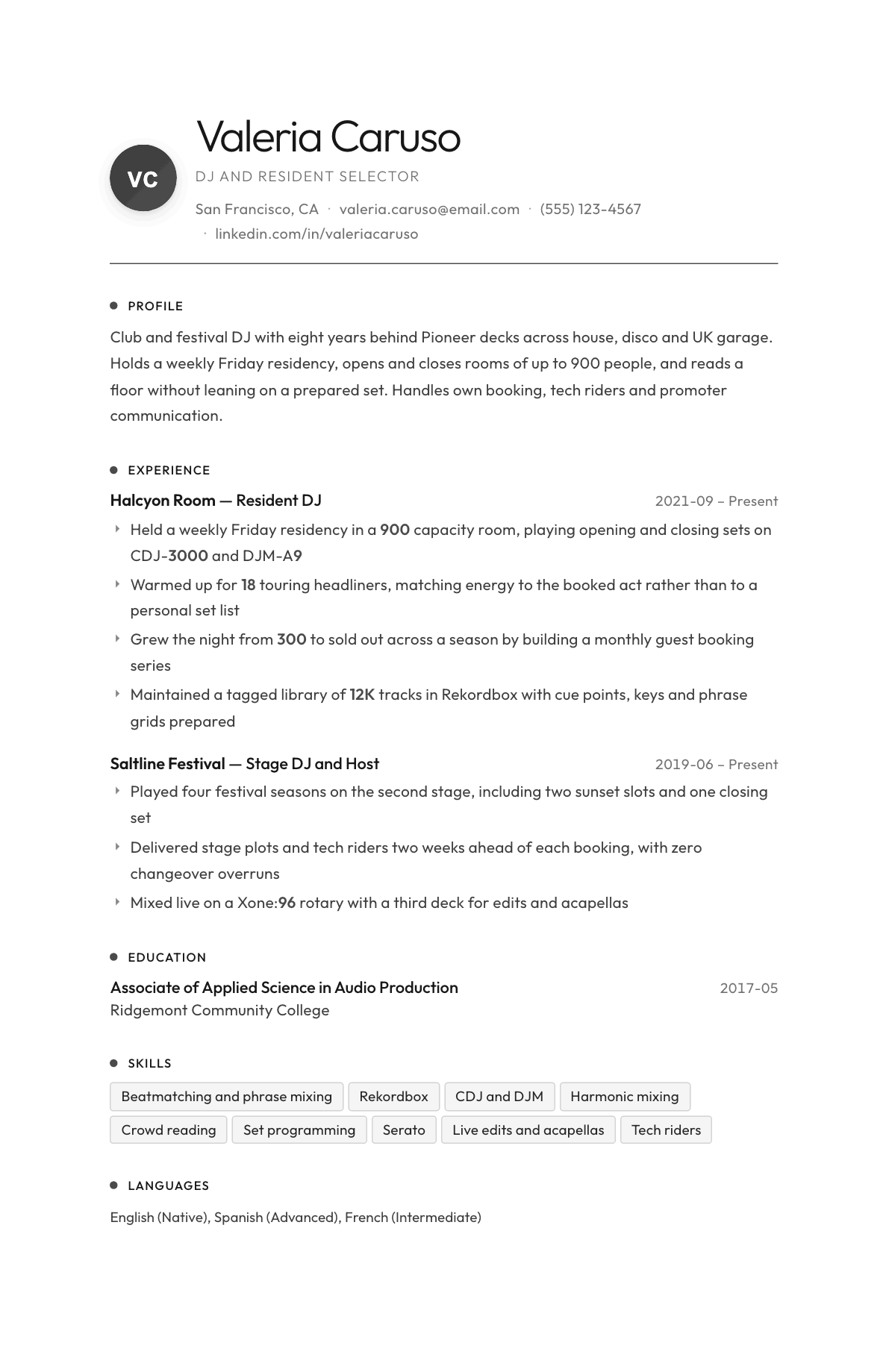
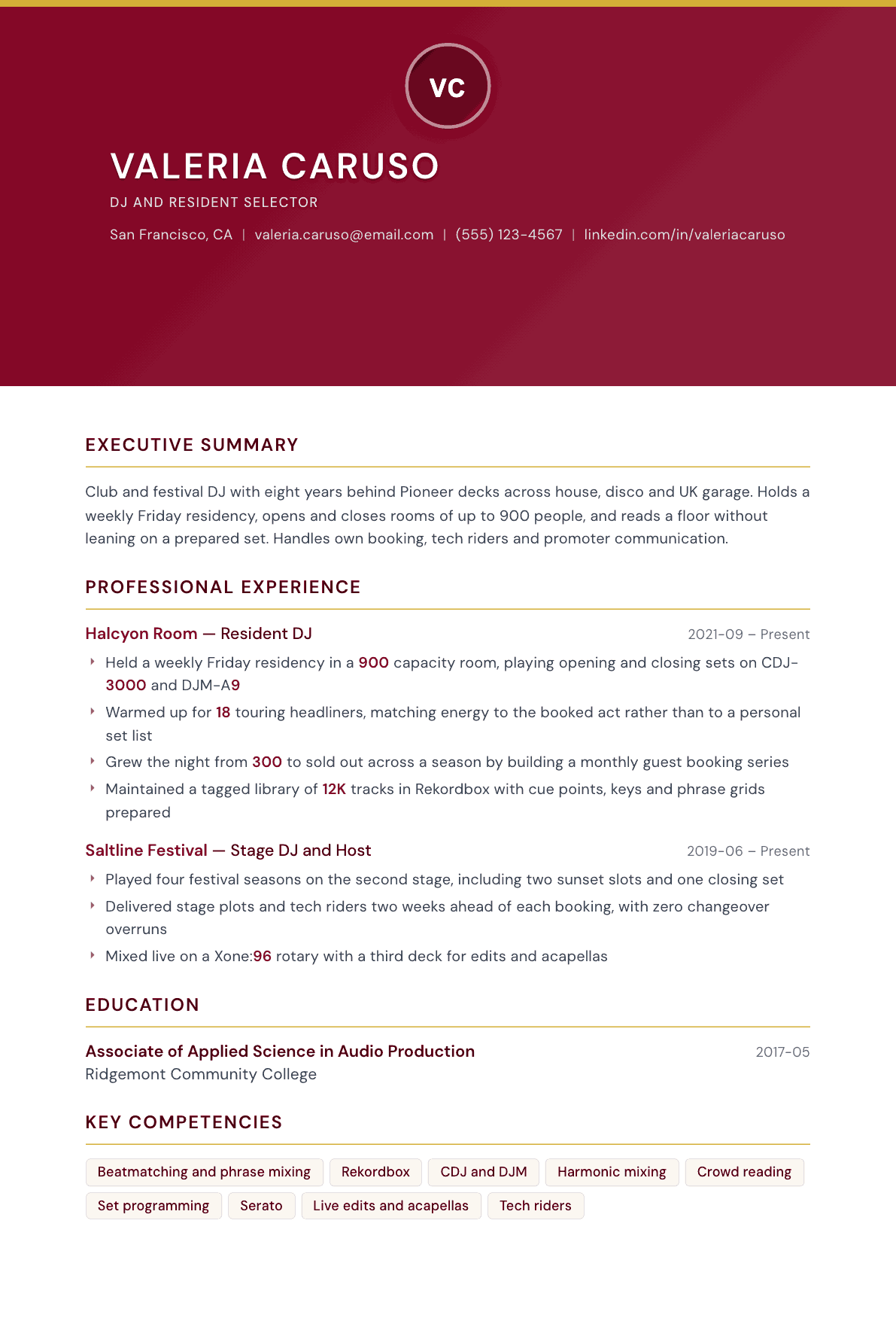
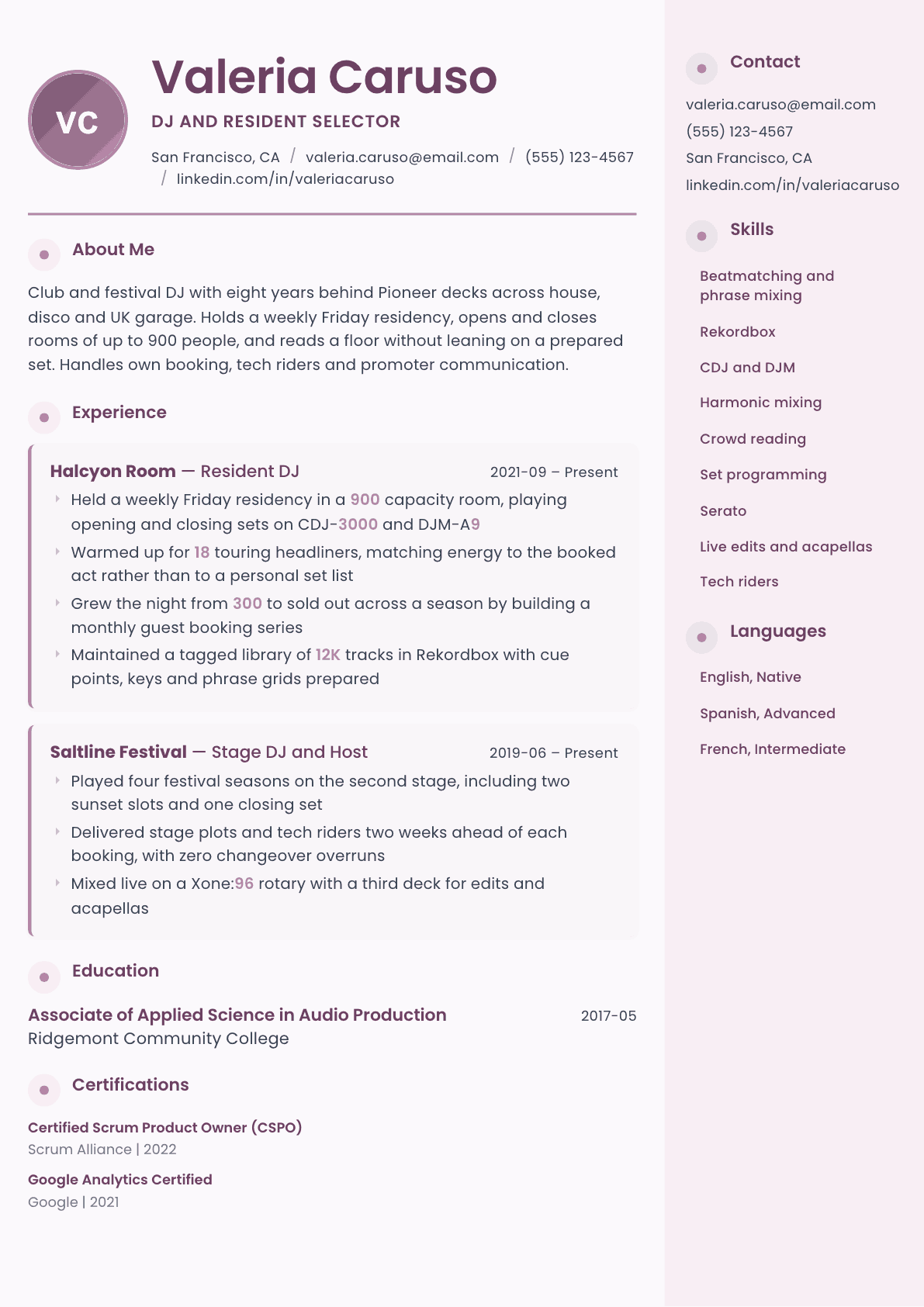
Example DJ summary
Club and festival DJ with eight years across house, disco and garage, holding a weekly residency in a 900 capacity room and four seasons on a festival second stage. Warms up for touring headliners without stepping on their sets, prepares a tagged Rekordbox library, and files riders early. Seeking a monthly residency and regional festival bookings.
Skills to list on a DJ resume
- Beatmatching
- Harmonic mixing
- Set programming
- Crowd reading
- Rekordbox
- Serato
- Traktor
- CDJ and DJM
- Rotary mixers
- Live editing
- Tech riders
- Promoter relations
- Music curation
- Ableton Live
What actually gets this resume read
- Put residencies first with the venue, the room capacity, the night and how long you held it.
- Name the gear you play on, because promoters match a booking to the booth they already own.
- Separate warm-up and headline slots, since a promoter hires for one job or the other.
- List festivals with the stage and the slot time rather than only the festival name.
- Give your genre range in three or four styles you can actually hold for two hours.
- Include your mix links, track ID policy and whether you supply your own controller or USB drives.
How to write a dj resume
A DJ resume is read by a promoter deciding whether you can hold a specific slot in a specific room, on the gear already bolted into that booth. Nobody is reading it for prose. They want the venue names, the capacities, the nights you held, the slots you played, and whether you turn up with a USB drive or a full backline request.
The second reader is the booking agent or festival programmer, who is sorting applications by genre and by draw. That reader wants your styles named honestly, your mix links live, and a clear signal about whether you open, warm up, headline, or close.
This guide covers the sections a booking inbox expects, how to write a residency credit that means something, gear and rider detail, and the questions selectors ask when they finally sit down to write the thing.
Format: one page, credits above everything else
Keep it to a single page and lead with the bookings. A promoter does not scroll. Put a two line header with your name, your base city, your booking email and your mix links, then go straight into residencies and notable bookings. Education, if you have any, sits at the bottom and often gets cut.
Avoid heavy graphic layouts and full bleed photographs inside the document. Send the artwork separately in a press kit. The resume itself needs to survive being forwarded as a plain attachment to a venue manager who opens it on a phone in a loading bay.
- Header: name and DJ name, city, booking email, mix links, genre line in four words or fewer.
- Sections in this order: residencies, festivals and notable bookings, radio and mixes, gear and rider, skills.
- Producers who also DJ add a releases section, kept short and separate from the booking credits.
Residencies: the venue, the capacity, the night, the run
A residency is the strongest credit you have, because it proves a room trusted you repeatedly. Write it with the venue, the room capacity, which night of the week it ran, and how long you held it. A weekly Friday residency in a 900 capacity room for three seasons tells a promoter more than a list of thirty one off guest slots.
Then say what the job actually was. Opening a room, warming up for a booked headliner and closing after everyone has left are three different skills, and promoters hire for one of them at a time. If you grew a night, give the door numbers at the start and at the end rather than calling it successful.
Festivals and guest slots: stage, slot time, and the act around you
List festivals with the stage and the slot, not just the festival name. A second stage sunset set and a 2am tent closer are read completely differently. Name the touring acts you have warmed up for, because that is how a promoter calibrates the level you can hold without embarrassment.
Keep the list tight. Ten specific bookings with detail beat forty venue names in a wall of text. If you play multiple cities or countries, group by region so a booker can see your travel range at a glance.
Gear, library and rider: what the booth needs to have
Name the players and mixers you are fluent on: CDJ and DJM setups, Xone rotary mixers, Serato or Rekordbox, Traktor, and whether you bring a controller or play off USB. A venue with an older booth needs to know before it books you, and a promoter who has to hire a rotary mixer wants that on paper rather than in an argument on the night.
Say how your library is prepared. A tagged Rekordbox collection with cue points, keys and phrase grids set is the difference between a smooth handover and a scramble at the changeover. If you carry backups on two drives, say so, because that is a professionalism signal every technical manager notices.
- Players and mixers you have played on, listed by model family rather than every unit ever made.
- Library software, track count and preparation method: cue points, keys, phrase grids, playlists by tempo.
- What you supply: USB drives, headphones, a controller, or a full rider needing a rotary mixer and monitors.
Genre and skills: three or four styles you can hold for two hours
Do not list twelve genres. A promoter reads a long genre list as a signal that you have no room of your own. Name three or four styles you can genuinely carry across a long set, and add open format separately if you also take weddings and corporate work, since that is a different market with a different rate.
The skills section is where the searchable terms live: beatmatching, harmonic mixing, set programming, crowd reading, live editing, tech riders, promoter relations. Keep it factual. A claim that you read a floor is only credible next to a credit that shows you doing it under pressure.
DJ resume summary examples
First bookings
House and disco selector two years into playing out, with a monthly warm up slot in a 200 capacity basement and eight guest bookings across the city. Mixes on CDJs and a Xone rotary, prepares a tagged Rekordbox library, and posts a monthly recorded set.
Weekly resident
Resident DJ holding a weekly Friday night in a 900 capacity room for three seasons, opening and closing depending on the booking. Has warmed up for 18 touring headliners without stepping on a set, plays house, disco and UK garage, and handles own riders and promoter contact.
Touring selector
Touring DJ with eight years of club and festival work, four festival seasons on second stages including sunset and closing slots. Programs long form sets from a 12K track library, mixes on a Xone rotary with a third deck for edits, and books and routes own regional tours.
Work experience bullets: before and after
Before: DJ at a local club every week.
After: Held a weekly Friday residency in a 900 capacity room for three seasons, playing both the opening two hours and the closing set.
The capacity, the night, the length of the run and the slot tell a promoter exactly what you have carried.
Before: Played at a big festival.
After: Played four festival seasons on a second stage, including two sunset slots and one closing set of the night.
The stage and the slot are how programmers rank a festival credit; the festival name alone says almost nothing.
Before: Have a large music collection.
After: Maintain a 12K track Rekordbox library with cue points, keys and phrase grids set, mirrored across two USB drives.
Preparation method turns a hobbyist claim into evidence that a changeover with you will be clean.
Before: Good at getting the crowd going.
After: Grew a monthly night from 300 through the door to a sold out room across one season by adding a guest booking series.
Door numbers and the tactic behind them replace a claim every applicant makes with something a promoter can check.
Before: Opened for touring artists.
After: Warmed up for 18 touring headliners, building energy toward the booked act rather than playing a prepared personal set.
It names the count and shows you understand what a warm up slot is actually for.
Hard skills
- Beatmatching and phrase mixing
- Harmonic mixing
- Set programming
- Rekordbox library preparation
- Serato
- Traktor
- CDJ and DJM setups
- Rotary mixers
- Live edits and acapella layering
- Tech riders and stage plots
- Ableton Live
- Vinyl mixing
Soft skills
- Crowd reading
- Slot discipline
- Promoter communication
- Composure at changeovers
- Self booking
- Reliability on travel days
Mistakes that cost dj candidates the interview
- Listing every venue you have ever played instead of ten bookings with the room, the night and the slot.
- Hiding whether you warmed up or headlined, which forces a promoter to guess and usually guess low.
- Naming eight genres, which reads as having no sound of your own rather than as range.
- Leaving out the gear you play on, so a venue with an older booth cannot tell whether you will fit it.
- Sending a heavy image based document that a venue manager cannot open or forward from a phone.
- Posting dead mix links, which ends the review before anyone reaches your credits.
DJ resume questions
How long should a DJ resume be?
One page. A promoter is scanning for the room, the night and the slot. If you have more credits than fit, cut the weakest bookings rather than shrinking the type, and keep the full list in your press kit instead.
Should I include mix links on a DJ resume?
Yes, in the header, and check every link the day you send it. Two links is enough: one recorded club set that shows how you build over an hour, and one shorter mix that shows your sound quickly.
How do I list residencies and one off bookings together?
Keep them apart. Residencies come first with the venue, capacity, night and how long the run lasted. Guest bookings go in a second list grouped by city or region so a booker can read your travel range in one pass.
Do I need to list my gear and rider?
Yes if you play clubs and festivals. Name the players and mixers you are fluent on, whether you bring USB drives or a controller, and any rotary mixer or monitor request. Venues book faster when the technical answer is already on the page.
What if I mostly play weddings and corporate events?
Treat open format work as its own section with the event type, guest count and whether you supplied sound and lighting. That market hires on reliability and equipment, so list your PA, microphones and backup gear rather than your genre range.