Content Creator Resume Examples: the lines they read
Create a Content Creator Resume That Showcases Your Digital Influence
By Mustafa Tarabya, founder of CVBooster · Published · Updated
Build a compelling content creator resume highlighting audience growth, brand partnerships, and multi-platform content production for media companies and agencies.
Sample resumes for a content creator
The same content creator content laid out in three CVBooster templates, so you can see what the finished document looks like before you write a word.
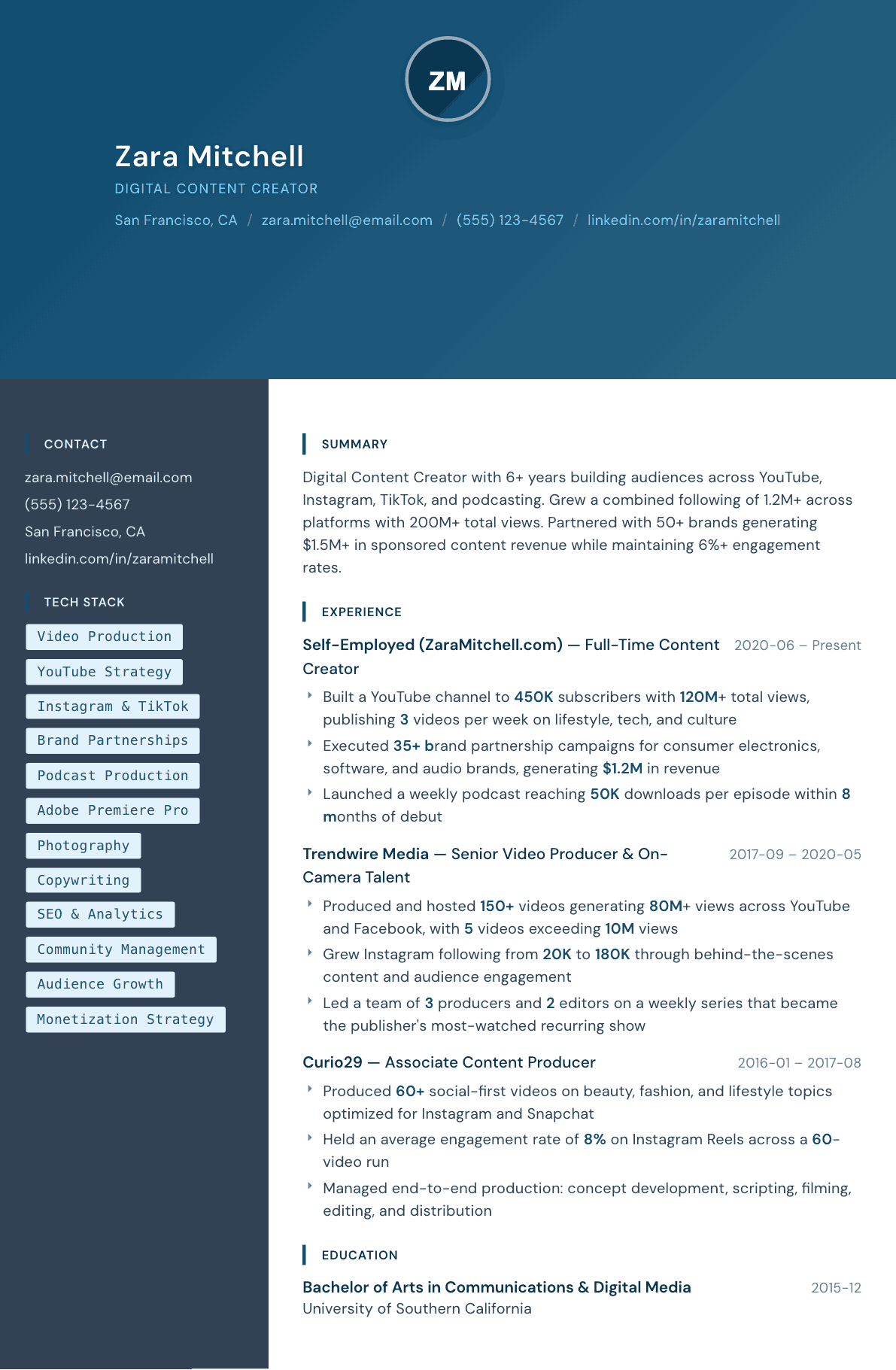
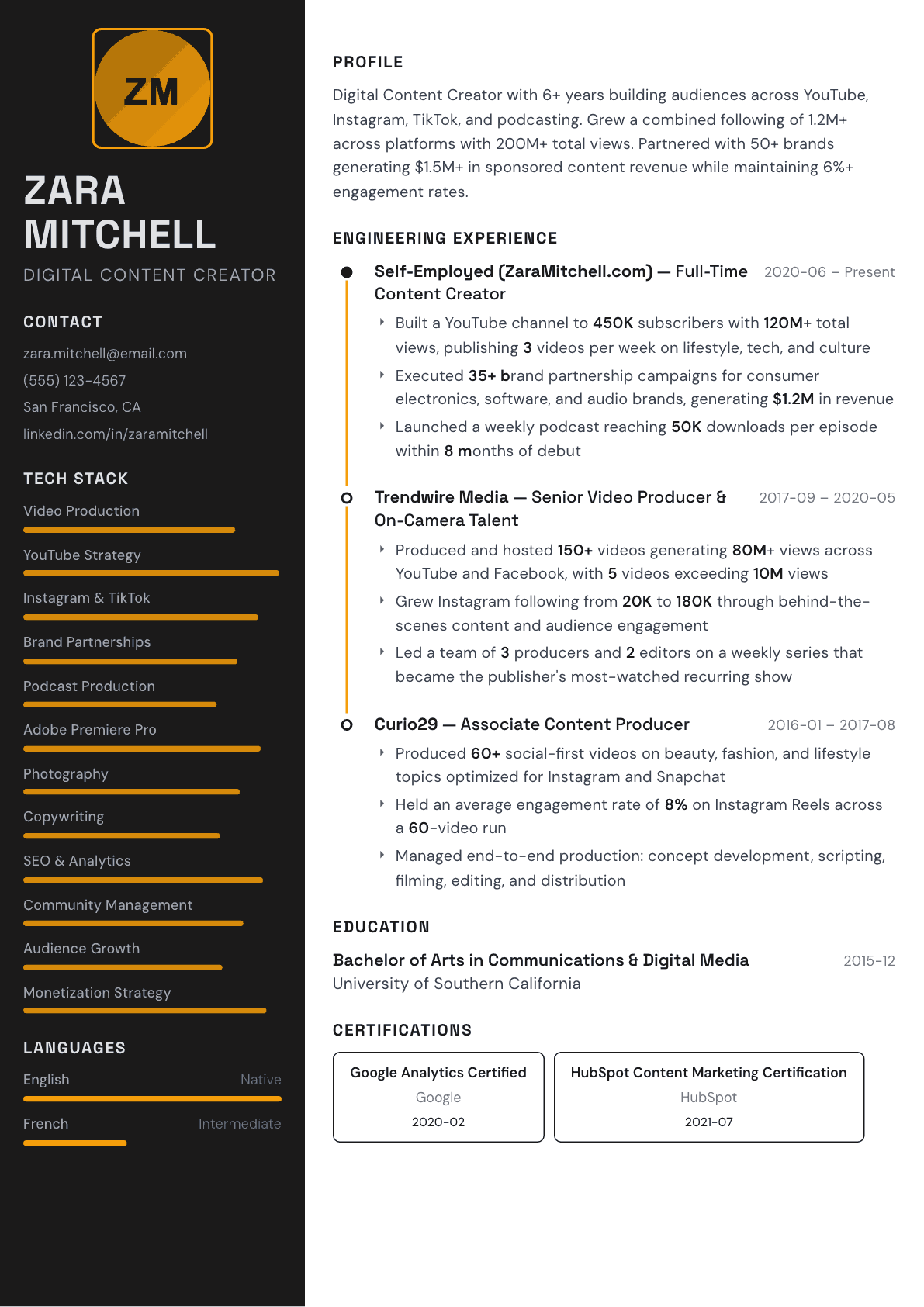
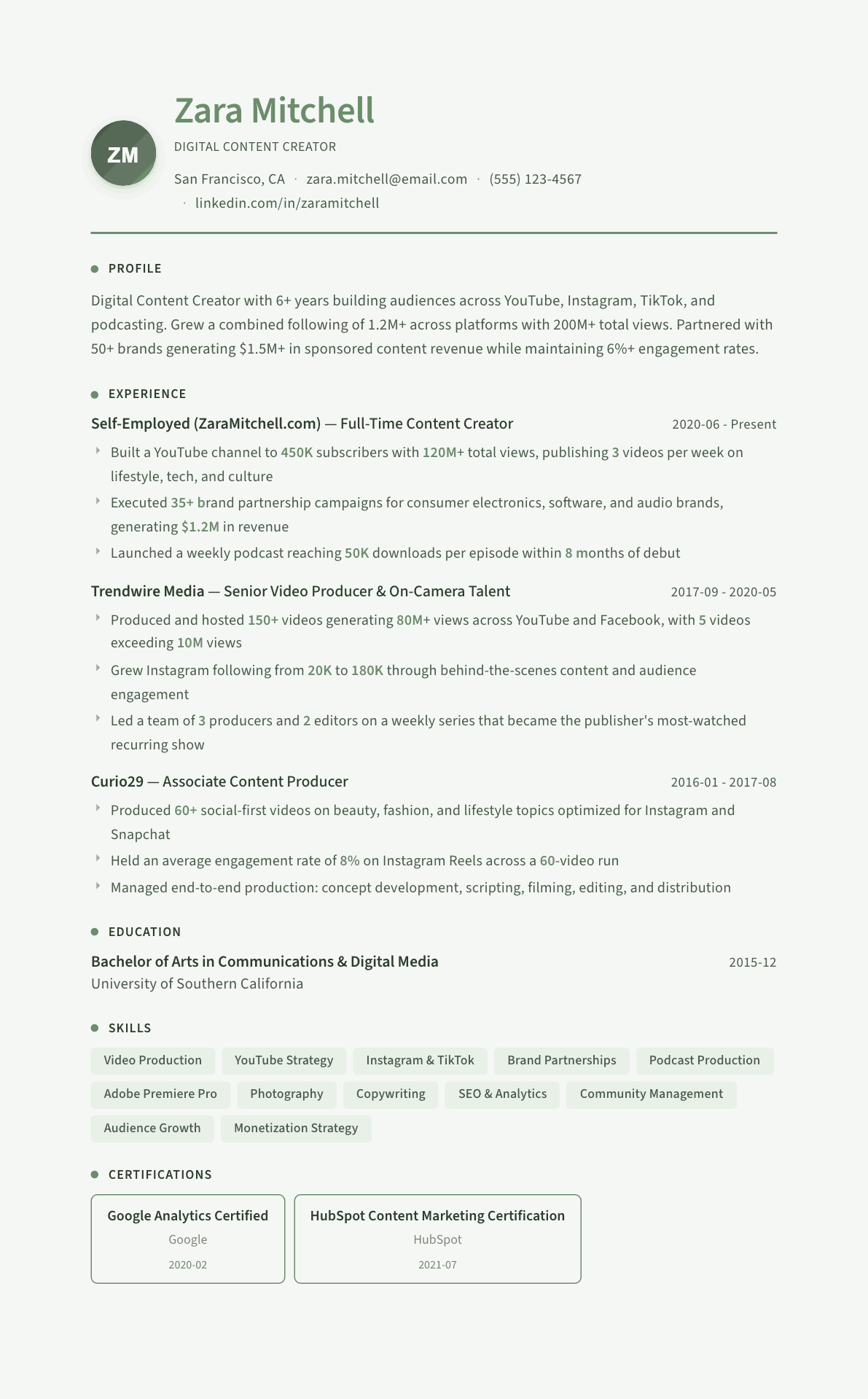
Example Content Creator summary
Digital Content Creator with 6 years of experience building audiences across YouTube, Instagram, TikTok, and podcasting. 1.2M+ combined followers, 200M+ views, and $1.5M+ in brand partnership revenue. Expert in video production, audience growth, and multi-platform content strategy.
Skills to list on a Content Creator resume
- Video Production
- YouTube Strategy
- Instagram Marketing
- TikTok Content
- Brand Partnerships
- Podcast Production
- Adobe Creative Suite
- Photography
- Copywriting
- SEO
- Analytics
- Community Building
What actually gets this resume read
- Lead with audience metrics: followers, views, engagement rates, and growth percentages.
- Highlight brand partnership experience with deal values and notable brands.
- Show platform versatility: YouTube, Instagram, TikTok, podcasts, and newsletters.
- Include production skills: filming, editing, photography, and graphic design capabilities.
- Demonstrate business acumen: monetization strategies, sponsorship revenue, and media kit creation.
How to write a content creator resume
Content creator resumes get read by two very different people. One is a brand or agency hiring for an in house creator or social role, and they want proof you can produce on a calendar for someone else audience. The other is a partnerships manager evaluating you as a channel, and they want audience size, retention and past brand work. Those readers want different pages, and sending one page to both is why so many creator resumes go nowhere.
The common failure is a resume made entirely of follower counts. Audience is an outcome, and a hiring manager needs the inputs: what you make, how often, on which platforms, with what production setup, and how you decide what to make next. A creator who can explain why a format worked is far more employable than one who happened to have a video take off.
This guide covers how to structure the page for a job application rather than a media kit, which metrics carry weight and which do not, how to write about brand partnerships without breaking a contract, three summaries from early creator through content lead, before and after bullets, and the questions creators ask when they apply for a salaried role.
Decide first: resume or media kit
A media kit sells your audience to a sponsor. It leads with reach, demographics, engagement and past campaign results, and it is designed. A resume gets you a job. It leads with what you can produce for an employer, on what cadence, with which skills, and it is a document a hiring manager can scan in twenty seconds.
Build the resume first and keep the media kit as a separate link. Mixing them produces a page that reads as self promotion to a hiring manager and as an incomplete pitch to a brand. The header can carry links to both your best channel and your portfolio of client work, which covers both readers without confusing either.
- Header: name, the role you want, city, email, and one link each for your main channel and your work portfolio.
- Sections: summary, experience including self employed creator work, platforms and audience, production and editing skills, brand partnerships, education.
- Treat your own channel as a job with a start date, an output cadence and responsibilities, because that is what it is.
Your own channel is experience: write it that way
List yourself as an entry with a title, a date range and a location, exactly as you would a job. Under it, describe the operation: the format and length of what you make, the publishing cadence, how you research and plan, how you script, the shoot and edit pipeline, thumbnail and title work, and how you read performance data and adjust.
Cadence is the single most persuasive detail for a hiring manager, because their fear is that a creator cannot produce reliably on someone else schedule. A person who has published weekly for two years without a gap is demonstrating exactly the discipline the job requires, and most creator resumes never mention it.
Describe the decision loop. Which retention or watch time signals you look at, what you changed after a video underperformed, how you test a title or a hook, how you decide to kill a format. That reasoning is the difference between a creator and a person who posts.
Metrics: the ones that mean something
Follower count is the weakest number on the page and the one everyone leads with. Stronger figures are the ones that describe the work: average views per piece over the last stretch rather than a single peak, retention or average watch time, subscriber or follower growth over a defined period, publishing volume, and repeat performance across a format rather than one outlier.
For a job application, output metrics beat vanity metrics. Pieces produced per month, videos edited, shoots run, posts scheduled across platforms, community messages handled, and turnaround time from brief to publish. A social manager hiring you cares whether you can hit a Tuesday deadline more than whether one clip once reached a large audience.
Be honest about scale rather than comparative. If your audience is modest but engaged, say so with the engagement evidence. Small, specific and true reads better to a hiring manager than a rounded number that will be checked in the first thirty seconds of the call.
Brand work: name what you can, describe what you cannot
Treat brand partnerships as client work. Name the brand where the campaign was public, the deliverables you produced, the platform, and what the campaign was trying to do. Never publish deal values, since those are almost always covered by the agreement and a partnerships manager will notice immediately.
Include the professional parts most creators leave out: working to a brief, delivering to a usage window, handling revisions and legal review, complying with advertising disclosure rules, delivering assets in the formats the brand needed, and reporting afterward. Brands hire creators who make campaign management easy, and that reliability is invisible from the content itself.
If you have worked with an agency, a talent manager or a network, say so. It signals that you have operated inside a contracted process rather than only informal arrangements.
Production skills and search terms
List the practical craft: camera and lighting you own and operate, audio capture, editing software for both long and short form, motion and graphics work, thumbnail and cover design, photography, and any writing such as scripts, newsletters or show notes. Employers hiring a creator are usually hiring one person to do four jobs, so range is the selling point.
Add the operational tools: scheduling and publishing platforms, analytics dashboards, project management, and community moderation. Recruiters search for social media, video production, short form video, editing, content strategy, community management, brand partnerships and the platform names, so use the terms that match the work you actually want to be hired for.
Content Creator resume summary examples
Early creator seeking a first role
Content creator publishing 3 short form videos a week for 18 months across two platforms, growing an audience of 24 thousand from zero. Films, edits and captions everything solo, and has completed 5 paid brand deliverables to brief with disclosure and revision rounds.
Creator moving in house
Content creator with 5 years producing long and short form video, averaging 60 thousand views per upload with a 42% average view duration on the main format. Runs the full pipeline from research to publish, and has delivered 30 sponsored campaigns for consumer brands.
Content lead
Content lead with 9 years, moving from a personal channel to running content for a consumer brand. Directs a team of 4 across video, design and community, owns a weekly publishing calendar across four platforms, and has rebuilt the short form format after a full quarter of testing.
Work experience bullets: before and after
Before: Grew my social media following.
After: Grew a short form channel from zero to 24 thousand followers in 18 months by publishing three times a week and rebuilding the opening hook after tracking where viewers dropped off.
The cadence and the specific change behind the growth show a method a hiring manager can expect you to repeat.
Before: Created videos for my YouTube channel.
After: Researched, scripted, filmed and edited a weekly long form video, handling thumbnail design and title testing, and holding the publish date for 96 consecutive weeks.
The full pipeline plus an unbroken publishing record answers the reliability question every employer has about creators.
Before: Worked with brands on sponsored content.
After: Delivered sponsored integrations for consumer brands to written briefs, managing two revision rounds, advertising disclosure and asset delivery in the formats each brand needed for their own channels.
The brief, revisions, disclosure and asset delivery describe a professional who is easy to run a campaign with.
Before: Used analytics to improve my content.
After: Reviewed retention curves weekly, cut the intro to under eight seconds after finding a consistent early drop, and lifted average view duration across the following ten uploads.
A specific signal, a specific change and a measured result show a real feedback loop instead of a claim to be data driven.
Before: Managed the community around my content.
After: Answered comments and messages daily, ran a monthly live session to test topics before producing them, and built the next quarter of content from the questions that came up most.
Turning community interaction into a content input is a strategy, while managing a community is only a task.
Hard skills
- Short form video production
- Long form video production
- Video editing
- Scriptwriting and story structure
- Camera operation and lighting
- Audio recording and cleanup
- Thumbnail and cover design
- Title and hook testing
- Platform analytics and retention analysis
- Content calendar planning
- Publishing and scheduling tools
- Advertising disclosure compliance
Soft skills
- Publishing on schedule without supervision
- Taking brand feedback without friction
- On camera presence
- Killing a format that is not working
- Community tone under criticism
Mistakes that cost content creator candidates the interview
- Leading with a follower count and nothing else, which tells a hiring manager nothing about what you can produce for them.
- Sending a designed media kit to a job application, where a hiring manager wants a scannable resume instead.
- Publishing deal values from brand partnerships, which are usually covered by the agreement.
- Quoting the reach of a single outlier post as if it were typical performance.
- Leaving out publishing cadence, the detail that answers an employer main worry about hiring a creator.
- Listing platforms with no description of the format, length or workflow behind the content on them.
Content Creator resume questions
How do I put my own channel on a resume?
As a job entry with a title, date range and responsibilities. Describe the format, the publishing cadence, the production pipeline and how you use performance data. Employers treat self directed output as real experience when it is written like a job rather than a hobby.
Which metrics should a content creator resume include?
Average performance rather than peaks, growth over a stated period, retention or watch time, and production volume such as pieces published per month. Output and consistency numbers matter more than audience size when you are applying for a salaried role.
Can I mention brands I worked with under a nondisclosure agreement?
Describe the category and the deliverables without naming the brand, and say the client is confidential. Never include deal values. If the campaign ran publicly with your face on it, the brand name is usually fine, but check the agreement first.
What if my audience is small?
Lead with craft and consistency instead. Production skills, publishing cadence, editing speed, and evidence that you can work to a brief are what an employer is buying. A small engaged audience described honestly is more persuasive than a rounded number that does not survive a check.
Should a content creator resume be visually designed?
Keep it clean and readable with one accent of personality, such as a well set header. Heavy design slows a hiring manager down and competes with your portfolio. Put the visual argument in the linked work, and let the resume prove you can be organized and clear.