Podcast Host Resume Examples: free ATS score and gap list
Create a Podcast Host Resume That Amplifies Your Voice
By Mustafa Tarabya, founder of CVBooster · Published · Updated
Build a professional podcast host resume showcasing audience growth, interviewing skills, and audio production expertise for media companies and independent ventures.
Sample resumes for a podcast host
The same podcast host content laid out in three CVBooster templates, so you can see what the finished document looks like before you write a word.
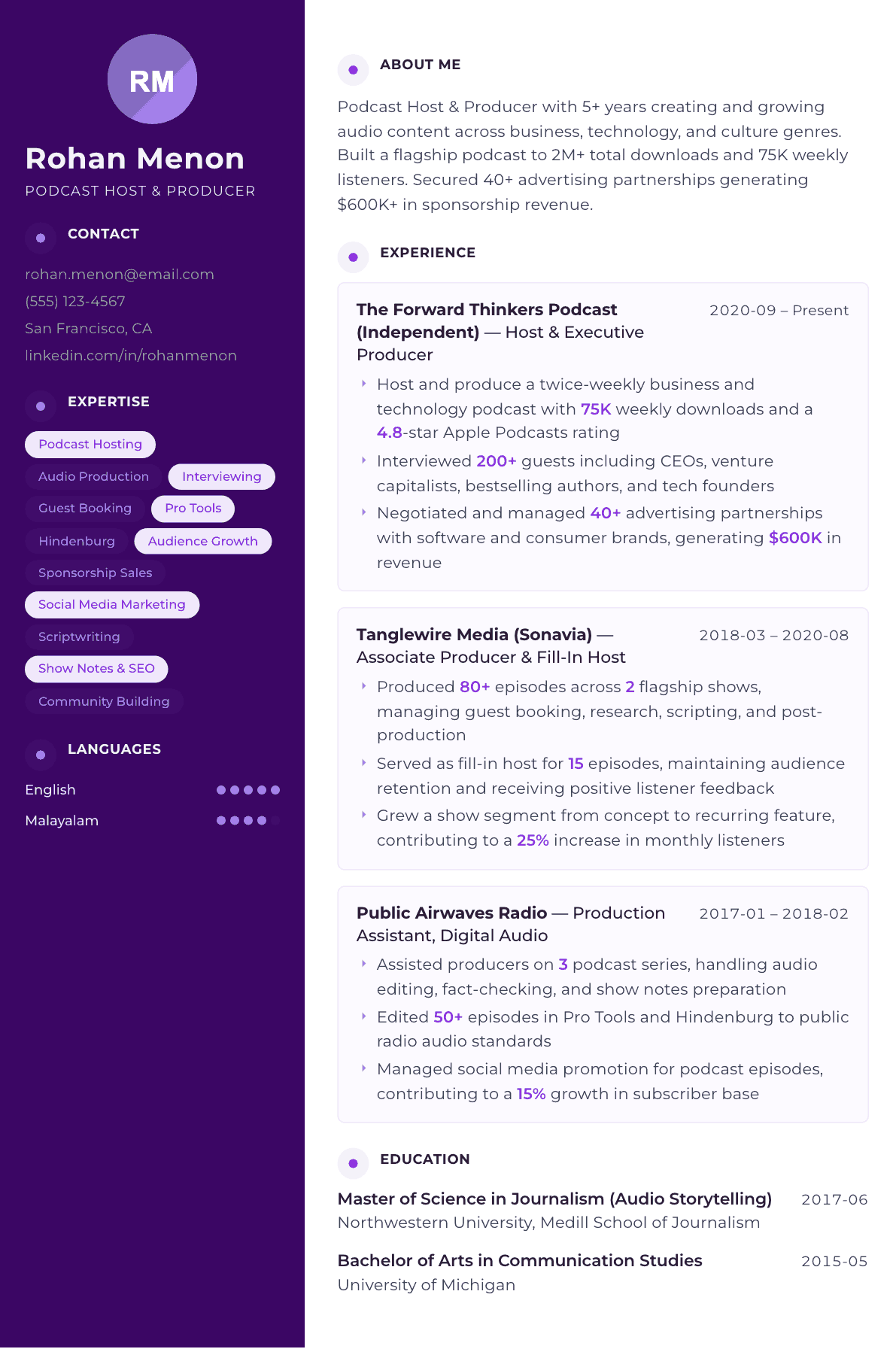
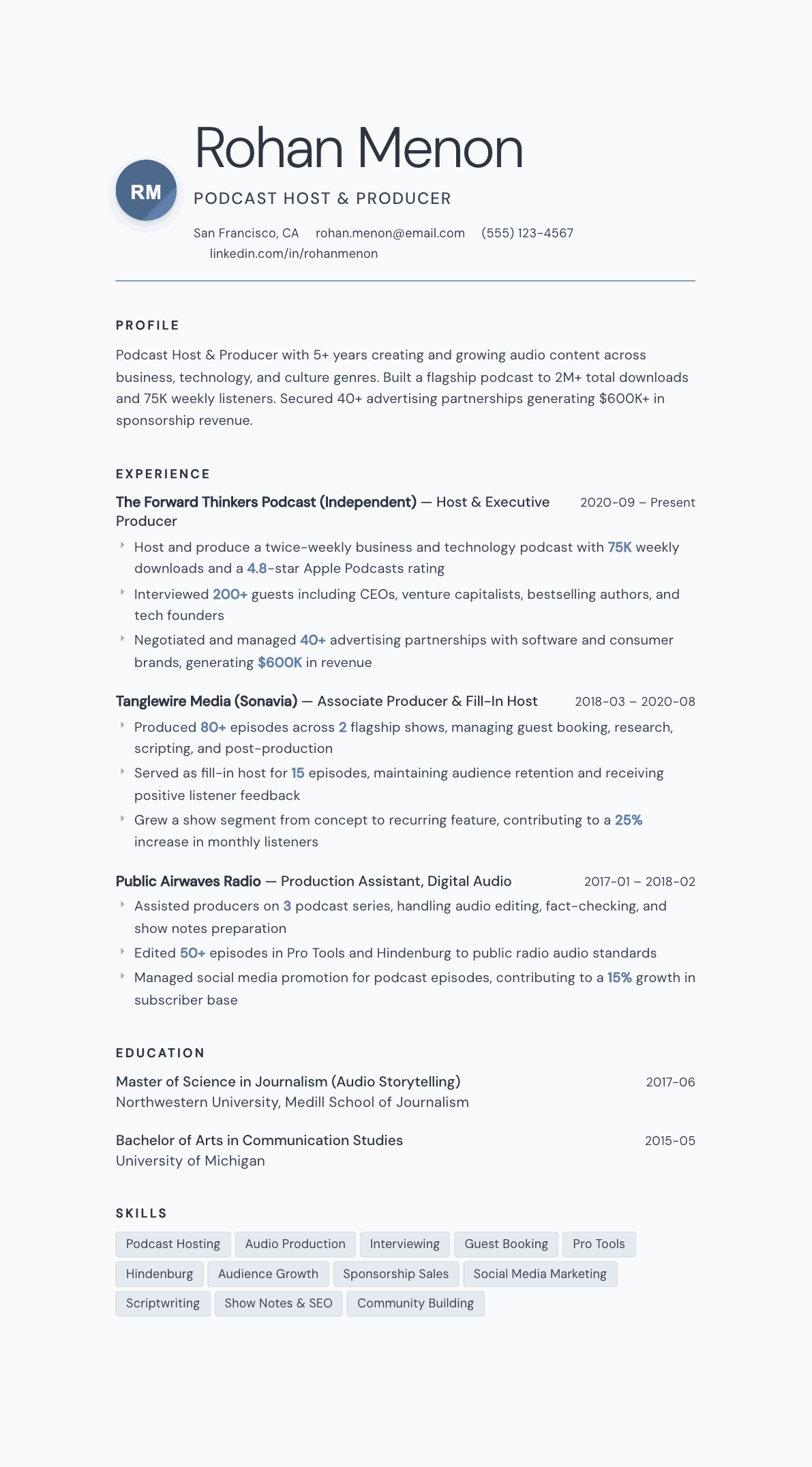
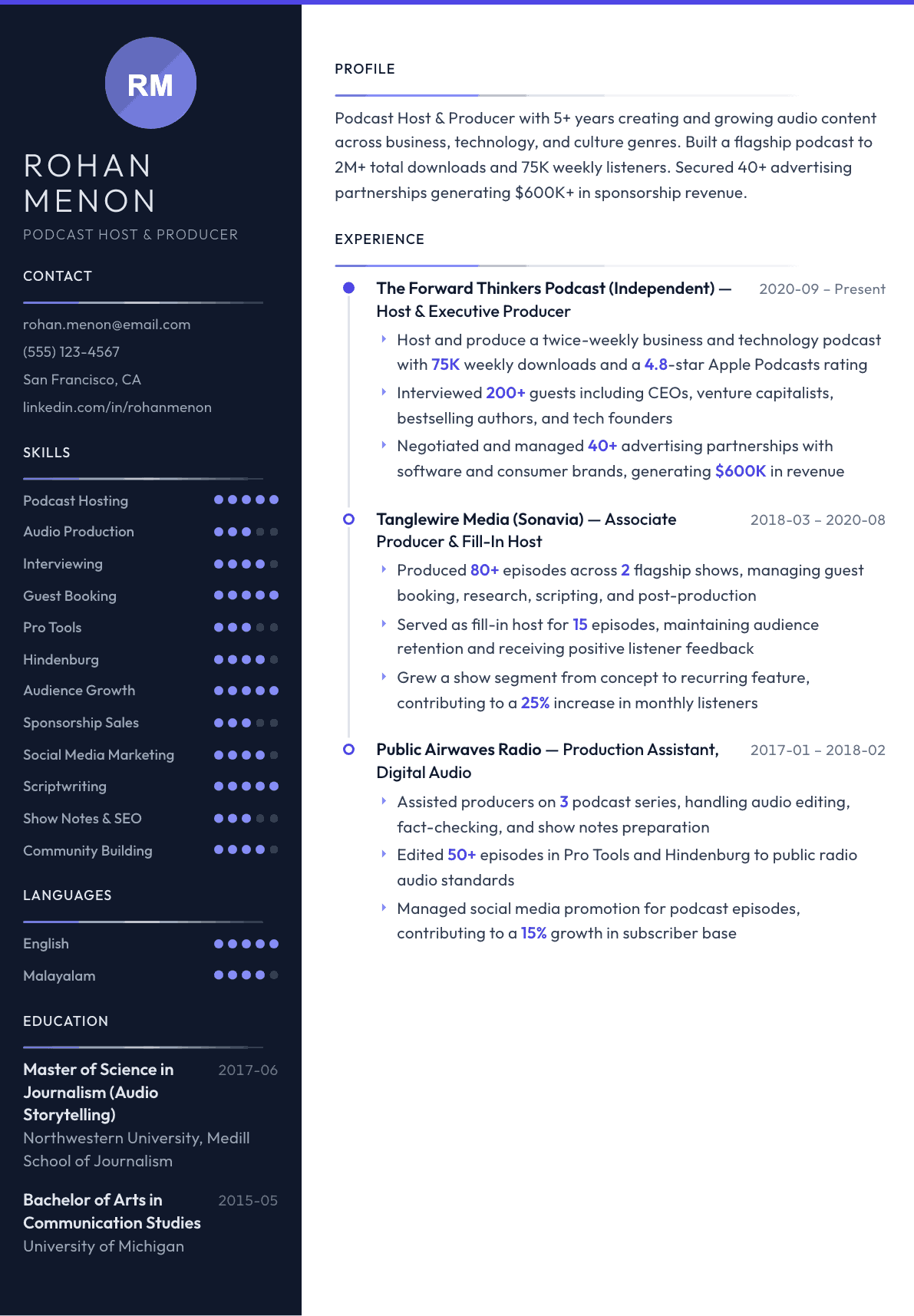
Example Podcast Host summary
Podcast Host & Producer with 5 years of experience building and growing audio content across business and technology genres. 2M+ total downloads, 75K weekly listeners, and $600K+ in sponsorship revenue. Expert interviewer with 200+ high-profile guest conversations.
Skills to list on a Podcast Host resume
- Podcast Hosting
- Audio Production
- Interviewing
- Guest Booking
- Pro Tools
- Hindenburg
- Audience Development
- Sponsorship & Monetization
- Social Media
- Scriptwriting
- SEO for Podcasts
- Community Management
What actually gets this resume read
- Lead with download numbers, subscriber counts, and listener growth metrics.
- Highlight notable guests and the depth of your interviewing ability.
- Showcase monetization skills: sponsorship revenue, ad partnerships, and premium content.
- Include technical proficiency: recording software, editing tools, and distribution platforms.
- Demonstrate audience engagement: ratings, reviews, community size, and listener retention rates.
How to write a podcast host resume
Nobody hires a podcast host on charisma alone. The person reading your resume runs a network, a brand studio or a media team, and they are trying to answer one question: will this voice bring an audience, hold it, and stay bookable for a hundred episodes without falling apart. That means the document has to carry download numbers, retention, cadence, guest tier and revenue in a form the reader can check.
The role also splits. A network show host is measured on downloads, completion rate and chart position. A brand podcast host is measured on pipeline and brand lift, and the sponsor is the employer. An independent host is a small business: booking, production, editing, distribution and ad sales all sit on one desk. Say which lane you are in, because the metrics that impress one lane mean nothing in another.
Below is the section order that works for audio, three summaries at different career stages, before and after bullets that put the audience numbers where they belong, and answers to what hosts most often get stuck on.
Format: one page, show links up top, numbers in the bullets
One page for most hosts, two only when you have a decade of shows and a long guest list worth naming. Put a link to the show and to one representative episode in the header, next to your name and city. A hiring producer will listen to ninety seconds before deciding, so choose the episode that shows you doing the hard version of the job: a difficult interview, a live read, a solo monologue with real structure.
Use these sections: summary, shows hosted, experience, notable guests, audience and revenue metrics, technical proficiency, education. If you also produce, keep production credits inside each show entry rather than in a separate block, because a host who produces is one story, not two.
- Header: name, city, phone, email, show URL, and a direct link to one sample episode.
- Give every show its format, cadence and run length: weekly interview, 45 minutes, ongoing since launch.
- Say whether the show is yours, a network property, or work for hire, because ownership changes what you can claim.
- A short notable guests list of eight to ten names is faster to read than a paragraph about your interviewing style.
Summary: format, subject, audience size, and what you actually do on the show
Say the genre and format first (narrative documentary, weekly interview, daily news roundup, panel), then the subject area, then the audience figure you can defend. Use a consistent unit: weekly downloads or downloads in the first thirty days, not a cumulative total stretching back to launch that flatters an old show. Producers know the difference and they will ask.
Then name your actual function. Some hosts write the show. Some read a script written by a producer. Some book their own guests, run the board and cut the tape. These are different jobs at different pay grades and a summary that hides which one you did will fall apart in the first call.
Experience: cadence, retention, growth, and the ad read
Lead each show entry with the shape of the commitment: how many episodes, over what period, at what length. A host who has published two hundred episodes without missing a week is telling a producer something about reliability that no adjective conveys.
Then the audience story. Growth is more persuasive than size for a mid-size show, so give a starting point and an end point over a stated period. Retention and completion rate matter more than raw downloads to anyone selling advertising, so include them if your hosting platform reports them. Chart positions are fine when you name the category and the market.
Sponsorship deserves its own bullets if you touched it. Reading host-read ads is a craft, and advertisers renew on read quality. If you sold, negotiated or renewed sponsorships, or if you can point at a sponsor who stayed for multiple seasons, that is the line that separates a host from a talent for hire.
- One bullet on cadence and reliability, one on audience trend, one on guests, one on money or partnerships.
- Name the hosting platform whose analytics you are quoting, so the number has a source.
- If a show ended, say why in neutral terms: season completed, network restructure, format concluded.
- Live events, tours and recorded stage shows count and should be listed with the venue and audience size.
Guests and interviewing: prove the booking muscle
A notable guests block does two things. It proves you can get people to say yes, and it shows the level of room you are comfortable in. Group the names if that helps the reader: founders and operators, elected officials, authors, musicians, researchers. Ten names in a tight line beats forty in a wall.
Interviewing itself is worth one or two bullets that show method rather than adjectives. Prepping from primary sources rather than a press kit, writing a question spine and then abandoning it when the guest goes somewhere better, holding a follow up when a guest dodges: these are the things an executive producer listens for in your sample episode, so name them.
Technical and production: what you can do without a producer
List the recording chain you are fluent with, not everything you have touched. That means the microphone and interface class you record on, the remote recording tool you use for guests, and the editing environment: Pro Tools, Adobe Audition, Reaper, Hindenburg or Descript. Mention loudness targets if you master your own episodes, because a host who delivers to a consistent loudness standard saves a network real time.
Distribution counts too. RSS and hosting platform administration, show notes with timestamps and transcripts, chapter markers, clip cutting for social, and the newsletter or community that surrounds the show. Many podcast host postings are really host and producer postings, and the technical block is where you show you can carry both.
Podcast Host resume summary examples
First show, building an audience
Podcast host and producer with two years running a weekly 30 minute interview show on independent music, self booked and self edited. Grew from launch to 4,000 downloads per episode across 90 consecutive weeks. Records and masters every episode in Reaper to a consistent loudness target.
Five years, sponsored show
Host of a twice weekly business interview podcast, 400 episodes published without a missed week, averaging 60K downloads in the first 30 days. Books and researches every guest, writes and reads all host-read sponsorships, and holds an episode completion rate above 70%.
Network host and showrunner
Network podcast host and showrunner with ten years in narrative and interview audio. Launched three original series, two of which reached the top 20 in their category, and leads a team of four producers. Owns editorial direction, guest strategy and sponsor relationships across a slate of shows.
Work experience bullets: before and after
Before: Hosted a popular podcast about technology.
After: Hosted a weekly technology interview podcast for four years, publishing 210 episodes and growing the show from 900 to 55K downloads per episode.
Cadence, episode count and a growth range replace the word popular, which a producer cannot verify or price.
Before: Interviewed many well known guests.
After: Booked and interviewed 180 guests including three sitting mayors, a Nobel laureate in economics and the founders of two publicly traded companies, sourcing every booking without a booking producer.
Naming the guest tier and admitting you did the booking yourself proves both access and effort.
Before: Worked with sponsors on the show.
After: Wrote and voiced host-read sponsorships for nine advertisers, five of whom renewed for a second season, and handled campaign scheduling and reporting directly with their media buyers.
Renewals and direct buyer contact show the ads worked, which is what the revenue side of a network cares about.
Before: Handled the editing and production of episodes.
After: Produced each episode end to end: remote multitrack capture, dialogue edit and noise repair in Adobe Audition, music beds, chapter markers, timestamped show notes and a transcript published with every release.
The specific pipeline shows a network they can hire one person instead of a host plus a producer.
Before: Grew the podcast audience through social media.
After: Cut 3 vertical clips per episode and ran a weekly newsletter to 12K subscribers, lifting new listener starts by 30% over two quarters as measured in the hosting dashboard.
It names the channel, the volume, the result and where the number came from rather than gesturing at social media.
Hard skills
- Live and remote interviewing
- Guest booking and research
- Episode scripting and outlining
- Multitrack remote recording
- Adobe Audition
- Pro Tools
- Descript
- Dialogue editing and noise repair
- Loudness mastering for audio
- RSS and hosting platform administration
- Show notes, timestamps and transcripts
- Host-read sponsorship writing
- Audience analytics and retention reporting
- Clip editing for social distribution
Soft skills
- Active listening
- Follow up questioning
- Composure with difficult guests
- Editorial judgment
- Publishing discipline
- Sponsor relationship management
Mistakes that cost podcast host candidates the interview
- Quoting a cumulative download total across every episode ever published instead of a per episode or 30 day figure a producer can compare.
- Leaving out the sample episode link, which forces a hiring producer to go hunting through a feed to hear your voice.
- Describing yourself as a storyteller and a conversationalist without naming a single format, cadence or guest.
- Hiding the fact that a producer wrote the show and booked the guests, which surfaces immediately in the interview.
- Listing every microphone and plugin you own while never mentioning editing, mastering or distribution.
- Omitting the gap when a show stopped, instead of stating plainly that the season concluded or the network restructured.
Podcast Host resume questions
What audience number should a podcast host put on a resume?
Use downloads per episode in the first 30 days, taken from your hosting dashboard, and say which platform reported it. Add average completion rate if you have it. Those two figures are how advertisers and networks value a show, so they travel further than a cumulative total.
How do I write a resume for a podcast host job when my show is small?
Lead with consistency and craft instead of size. A hundred episodes published on schedule, a guest list above your download count, clean self produced audio and a growth trend all tell a producer you will not miss a deadline once the audience arrives.
Should a podcast host resume include production and editing skills?
Almost always yes. Most podcast host openings outside large networks are host and producer roles in practice, so the recording chain, editing environment, mastering standard and publishing workflow are part of what is being bought.
How do I list a branded or corporate podcast I hosted?
Give the sponsoring company, the audience it was made for, and the business result it existed to create, such as pipeline, recruiting or customer retention. Internal shows are judged on business outcome rather than chart position, so use the metric the company used.
Do I need a demo reel as well as a resume?
A short reel helps, but a full sample episode helps more, because hosting is judged over an hour rather than over a highlight. Link one strong complete episode in the header and mention in the bullets what makes it a fair test of your hosting.