Film Editor Resume Examples: free ATS score and gap list
Build a Film Editor Resume That Showcases Your Craft
By Mustafa Tarabya, founder of CVBooster · Published · Updated
Create a standout film editor resume highlighting post-production expertise, storytelling through cuts, and experience with major editing suites for film and television.
Sample resumes for a film editor
The same film editor content laid out in three CVBooster templates, so you can see what the finished document looks like before you write a word.
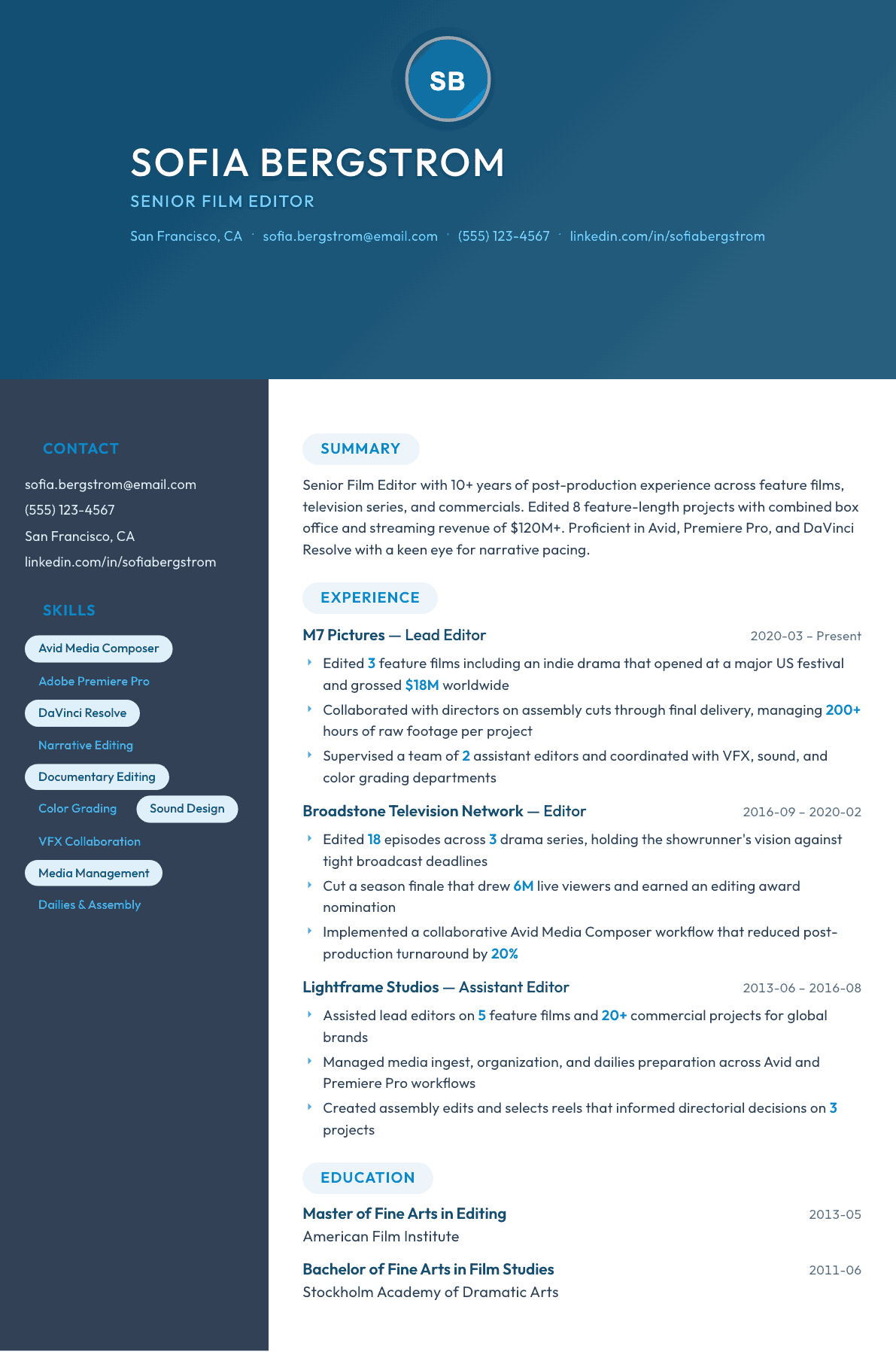
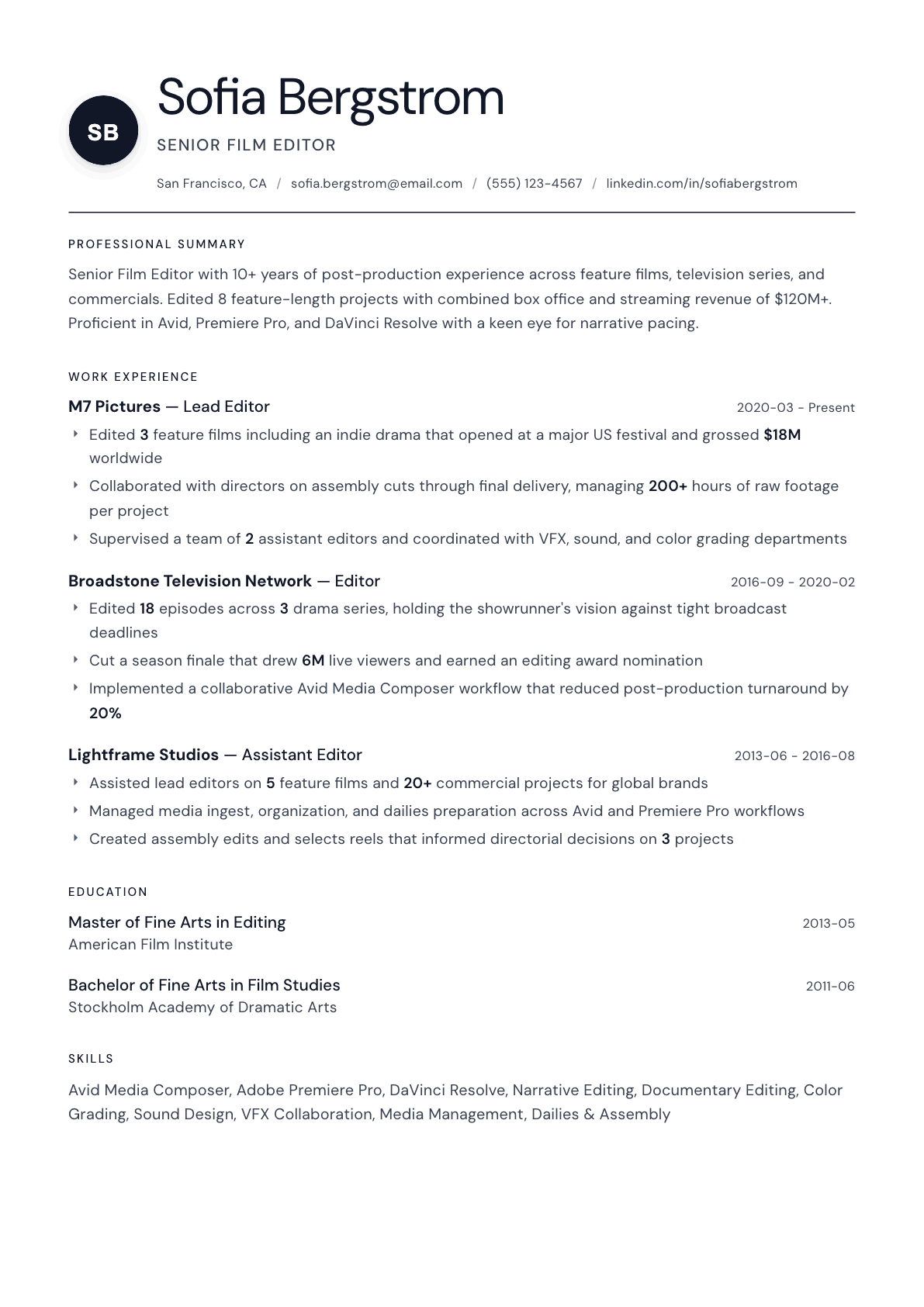
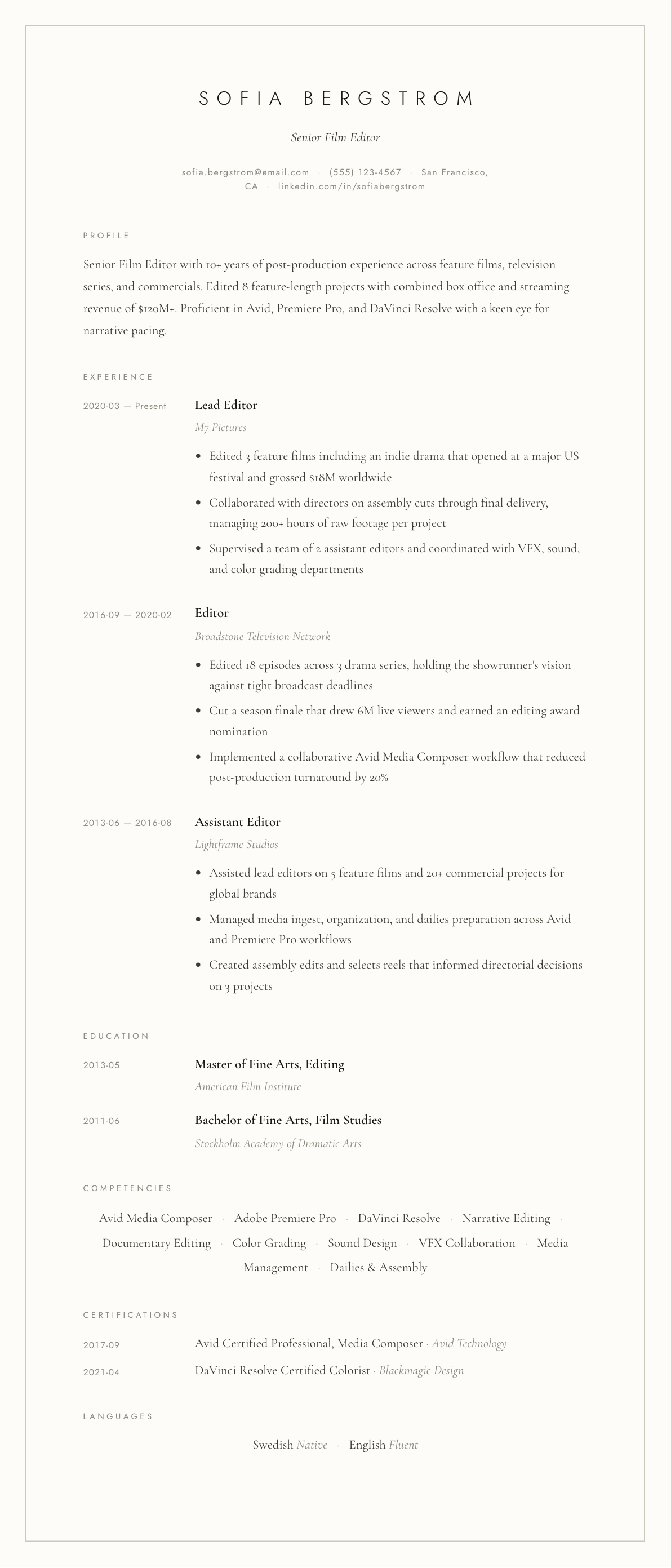
Example Film Editor summary
Film Editor, 10 years across features, episodic television, and commercials. Has cut 8 features with $120M in combined box office and streaming revenue, including a festival opener and an award-nominated season finale. Works in Avid, Premiere Pro, and DaVinci Resolve.
Skills to list on a Film Editor resume
- Avid Media Composer
- Adobe Premiere Pro
- DaVinci Resolve
- Final Cut Pro
- Narrative Editing
- Documentary Editing
- Commercial Editing
- Color Grading
- Sound Editing
- VFX Workflow
- Media Management
- Storytelling
What actually gets this resume read
- List your most notable projects with festival selections, awards, and audience reach.
- Specify which editing platforms you are proficient in: Avid, Premiere, DaVinci, and Final Cut.
- Include an IMDb or portfolio link so employers can view your work directly.
- Highlight collaboration with directors, producers, VFX, and sound departments.
- Showcase your ability to handle different formats: features, episodic, commercials, and documentaries.
How to write a film editor resume
Editors are hired by word of mouth and by reel, but the resume is what a post-production supervisor reads when the recommendation runs out. What that person needs to know is narrow and specific: what formats you cut, on which system, at what stage of the pipeline, and whether you have worked at the scale of the show they are staffing. A feature cut alone in a spare room and a network episodic seat with two assistants and a nightly turnover are different jobs, and the resume has to say which one you have done.
The other thing a supervisor is checking for is workflow literacy. Camera formats, proxy generation, conform, EDL and AAF handoff, turnovers to sound and visual effects, and how you keep a project tidy across a long schedule. An editor who slows down the finish costs more than a fast cutter saves.
This guide sets out the credit-driven format the industry expects, how to list projects so a reader can place them, three summaries from assistant editor through to a seasoned feature cutter, before and after bullets, and the questions editors ask when moving between documentary, scripted and commercial work.
Format: a credits list, not a corporate work history
Film and television resumes are organized around credits, not employers, because the employer changes every job. Group by format, then list projects in reverse order: title, your role, format and length, the production company or network, and the director or showrunner. A reader recognizes names and uses them to place you.
Put the reel link and any professional profile link in the header where they cannot be missed. Keep the whole thing to one page for under about five years of credits, and two once you have a body of work. A dense, readable list beats a designed layout every time in a post house.
- Header: name, city, phone, email, reel link, union membership if you hold one.
- Sections: reel, credits grouped by format, technical skills, education or training.
- Each credit: title, role, format and runtime, company or network, director.
- Note the system used per credit when it varies, since some shows staff on system.
Summary: format, system, stage of pipeline
Three lines that name the formats you cut, the system you cut on, and one thing that distinguishes your work: verite documentary out of enormous ratios, comedy timing, action coverage, archival heavy work, or fast commercial turnarounds. Generic praise for storytelling belongs to everyone applying.
If you are an assistant editor targeting an editor seat, say so and point to what you have already cut: scenes, lifts, sizzles, a second unit, a full episode of an unscripted show. Supervisors promote assistants who already have footage on the timeline.
Credits: scale, ratio and what you actually cut
Give each credit enough context that a reader can size it. Runtime, episode count, number of shooting days, and shot ratio all do that work. Cutting a feature documentary from six hundred hours of verite material is a different craft from cutting a scripted half hour with a tight script, and only the numbers make that visible.
Then describe your contribution in the vocabulary of the room: assembling dailies, building a first assembly, working through the director cut, taking notes from the studio or network, running temp visual effects and temp sound, and preparing turnovers. Naming the cut stages you handled tells a supervisor exactly where you fit.
For assistant editor credits, say what you owned: media ingest and organization, sync, proxies, project structure across editors, visual effects pulls, turnover lists, and the conform relationship with the finishing house. That work is highly specific and is what an assistant is hired on.
Technical section: systems, formats and finishing handoff
List the editing systems separately from the finishing and support tools, and be honest about depth. Avid Media Composer, Adobe Premiere Pro, DaVinci Resolve and Final Cut Pro are not interchangeable in a staffing decision, and a show cutting on Avid with shared storage will not hire someone who has only cut on a laptop.
Then the pipeline knowledge: camera codecs and raw formats, proxy workflows, shared storage and project sharing, media management across long schedules, EDL, XML and AAF export, temp mixing, and color handoff. If you have supervised a conform or delivered to a broadcaster specification, that is a credit line, because it is a common failure point.
- Systems: Avid Media Composer, Premiere Pro, DaVinci Resolve, Final Cut Pro.
- Support: After Effects for temp effects, Pro Tools handoff, sound and music prep.
- Pipeline: proxy and raw workflows, shared storage, project sharing, media management.
- Delivery: EDL, XML and AAF turnovers, conform support, broadcast delivery specs.
Festivals, awards and reach: keep it verifiable
A short list of festival selections, broadcast slots, awards or nominations, and notable release platforms. Name the festival and the year within the credit rather than describing a film as acclaimed. A reader who knows the circuit reads a selection instantly, and a reader who does not can look it up.
Resist the urge to pad with view counts unless the number is genuinely large for the format and you can point to the platform. An unverifiable audience figure buys nothing and invites a question you cannot answer.
Film Editor resume summary examples
Assistant editor
Assistant editor with three years on scripted television and two independent features, running dailies, sync, project organization and visual effects pulls on Avid Media Composer with shared storage. Has cut lifts, scenes and a full unscripted episode, and is looking for a first editor credit on longform.
Six years cutting
Editor with six years across documentary features and branded longform, cutting on Avid and Premiere Pro. Comfortable building structure out of large verite ratios, working with archive and clearance lists, and delivering broadcast turnovers with clean AAF handoff to sound.
Feature and series editor
Feature and series editor with fourteen years and credits on four scripted features and five seasons of episodic television. Runs the cutting room from assembly through director, studio and network cuts, supervises assistants, and has delivered final conforms and mixes on international broadcast schedules.
Work experience bullets: before and after
Before: Edited a documentary feature.
After: Cut a 94-minute documentary feature from roughly 400 hours of verite and archival material, building three structural passes with the director before locking picture.
Runtime, source ratio and the number of structural passes show the actual scale of the craft problem.
Before: Worked as an assistant editor on a TV series.
After: Assistant edited ten episodes of a scripted drama on Avid with shared storage, handling dailies ingest, sync, project structure for two editors, visual effects pulls and sound turnovers.
The episode count and the named assistant duties describe a job a supervisor can staff from.
Before: Familiar with Avid, Premiere and Resolve.
After: Cuts primarily on Avid Media Composer with project sharing, works in Premiere Pro for short-form and branded jobs, and conforms and grades short pieces in DaVinci Resolve.
Separating primary from secondary systems is honest and tells a staffing decision what it needs.
Before: Collaborated with the director and other departments.
After: Ran weekly cut reviews with the director and producers, tracked notes across four cut versions, and prepared temp visual effects and temp music for each screening.
It shows a working process and note discipline rather than a general claim about teamwork.
Before: Delivered the final version of the film.
After: Delivered picture lock with a clean EDL and AAF turnover, supervised the conform at the finishing house, and passed the broadcaster quality control review on the first submission.
Finishing cleanly on the first pass is the outcome a post supervisor cares about most.
Hard skills
- Avid Media Composer
- Adobe Premiere Pro
- DaVinci Resolve
- Final Cut Pro
- Dailies and assembly
- Narrative structure and scene work
- Documentary and archival editing
- Media management and project organization
- Proxy and raw camera workflows
- EDL, XML and AAF turnovers
- Temp visual effects and temp sound
- Broadcast delivery specifications
- Shared storage and project sharing
Soft skills
- Taking and tracking notes
- Director collaboration
- Pacing judgment
- Calm under a locked delivery date
- Assistant supervision
- Discretion with unreleased material
Certifications worth listing
- Avid Certified User, Media Composer (Avid Technology)
- Avid Certified Professional, Media Composer (Avid Technology)
- DaVinci Resolve Certified Editor (Blackmagic Design)
- Adobe Certified Professional, Premiere Pro (Adobe)
Mistakes that cost film editor candidates the interview
- Writing the resume as a list of employers instead of a list of credits, which hides the projects a reader would recognize.
- Leaving off runtime, episode count and source ratio, so nobody can tell whether a credit was a short piece or a year of work.
- Listing every editing system as if they were equal, when staffing often turns on which one you cut in daily.
- Omitting assistant editor duties on assistant credits, since ingest, sync, organization and turnovers are exactly what is being hired.
- Burying the reel link at the bottom, or linking to a site that opens slowly on a phone.
- Describing a film as award winning without naming the award and the body that gave it.
- Ignoring finishing entirely, when a messy turnover is the thing post supervisors fear most.
Film Editor resume questions
What goes on a film editor reel?
Two to four minutes of your strongest cutting, opening with the best thirty seconds. Show scenes rather than trailers where you can, since a trailer hides your structural work. Keep a separate longer page of full projects for anyone who wants more.
Should an editor resume list every project?
No. List the credits that show the format you are being hired for, then group the rest under a short additional credits line. A supervisor staffing a documentary series does not need your full commercial history in detail.
How do I move from assistant editor to editor?
Collect real cutting credits inside your assistant work: scenes, lifts, promo pieces, second unit, or a full episode on an unscripted show. Put those under a separate editing credits heading so they are not buried inside your assistant duties.
Do I need to list camera formats and codecs?
Yes if you have handled them. Naming the camera formats and the proxy workflow you built shows you can set up a cutting room rather than only work inside one someone else prepared, which matters on smaller productions.
How should a film editor handle gaps between projects?
Freelance work is project based, so gaps are normal and rarely questioned. Group credits by year rather than by month, and if a long gap needs explaining, a short line about training, a personal project or unrelated work is enough.