Screenwriter Resume Examples: free ATS score and gap list
Build a Screenwriter Resume That Gets Your Scripts Read
By Mustafa Tarabya, founder of CVBooster · Published · Updated
Create a polished screenwriter resume highlighting produced credits, awards, and storytelling range for film, television, and streaming platforms.
Sample resumes for a screenwriter
The same screenwriter content laid out in three CVBooster templates, so you can see what the finished document looks like before you write a word.
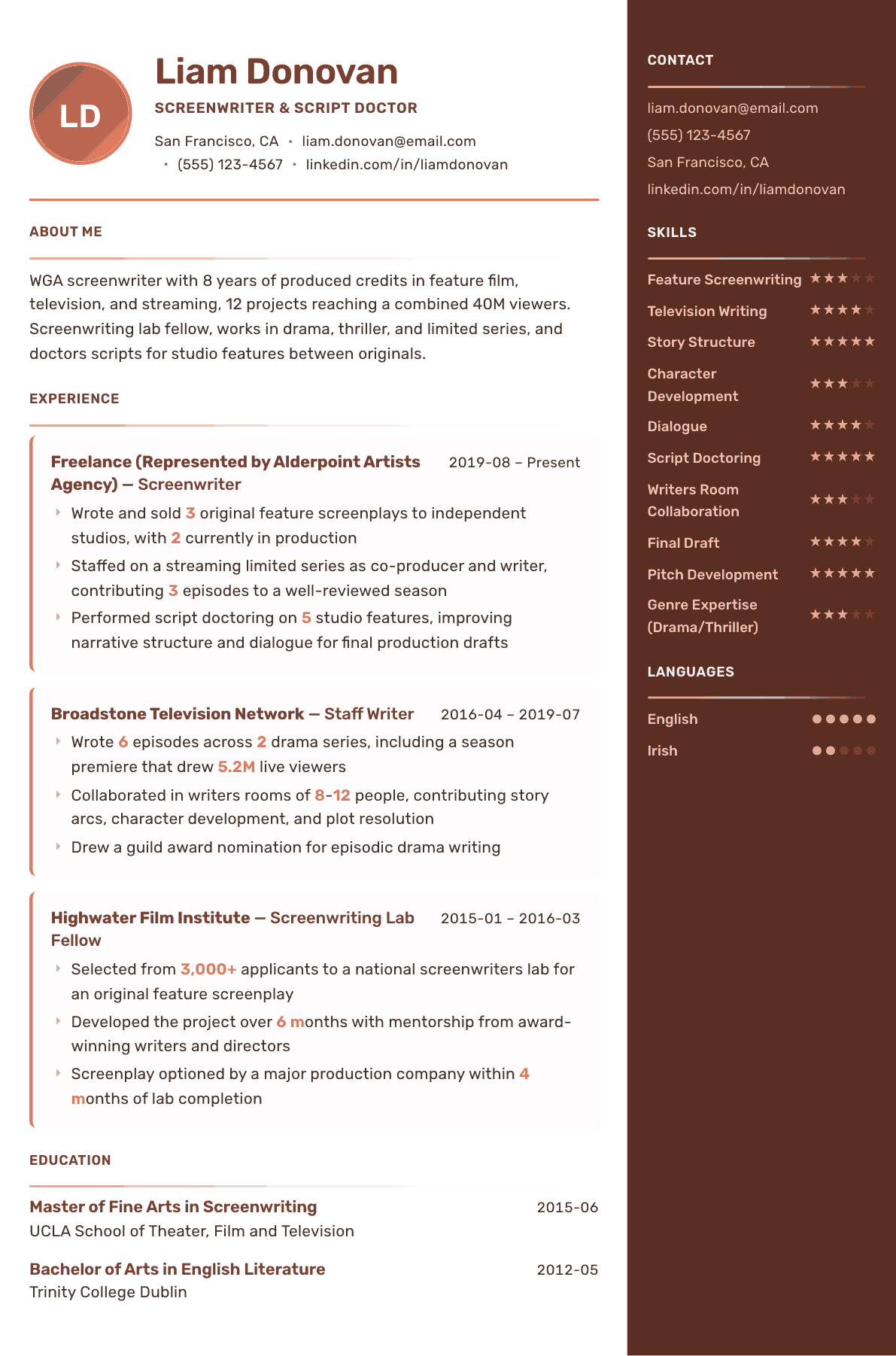
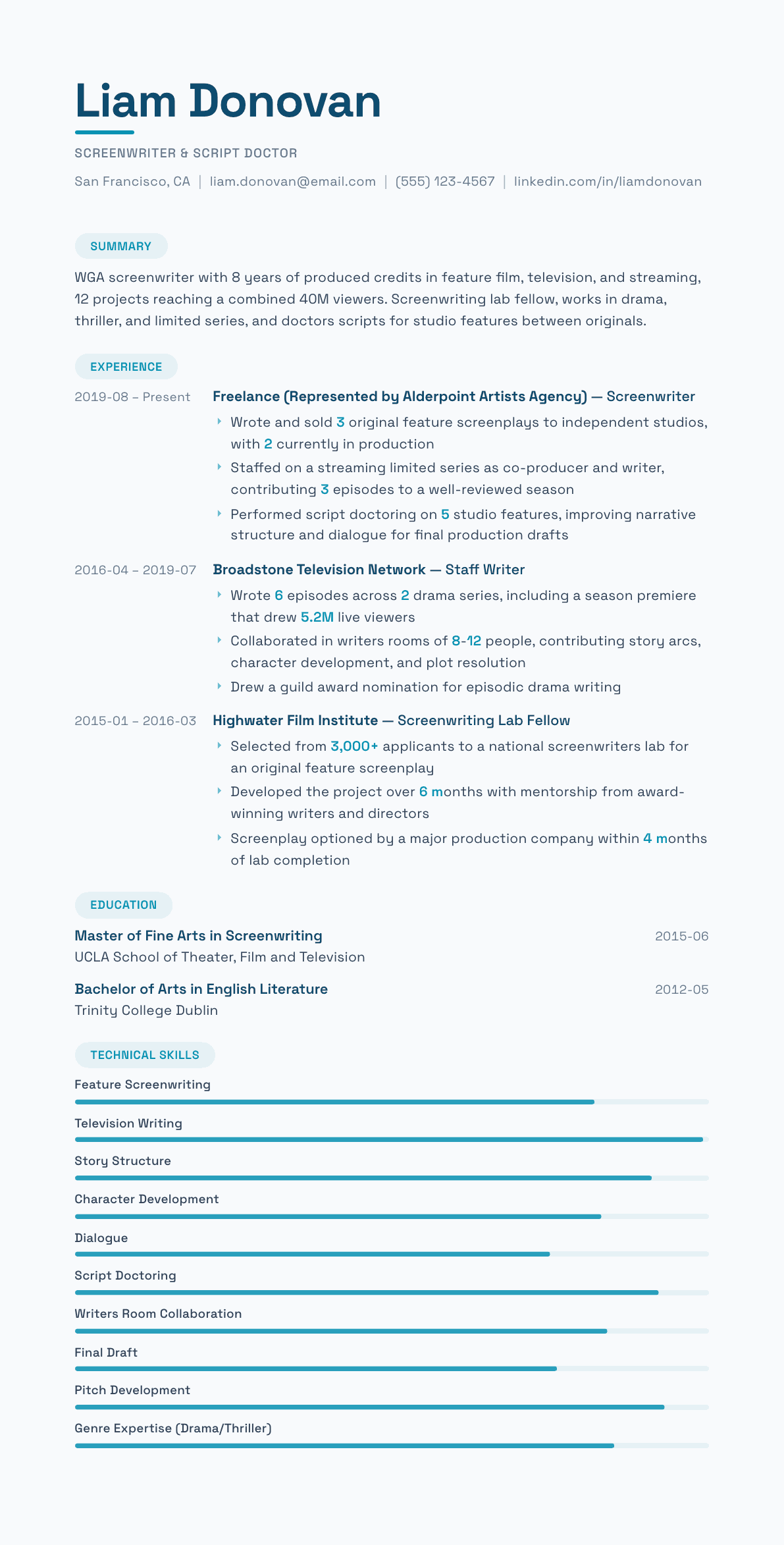
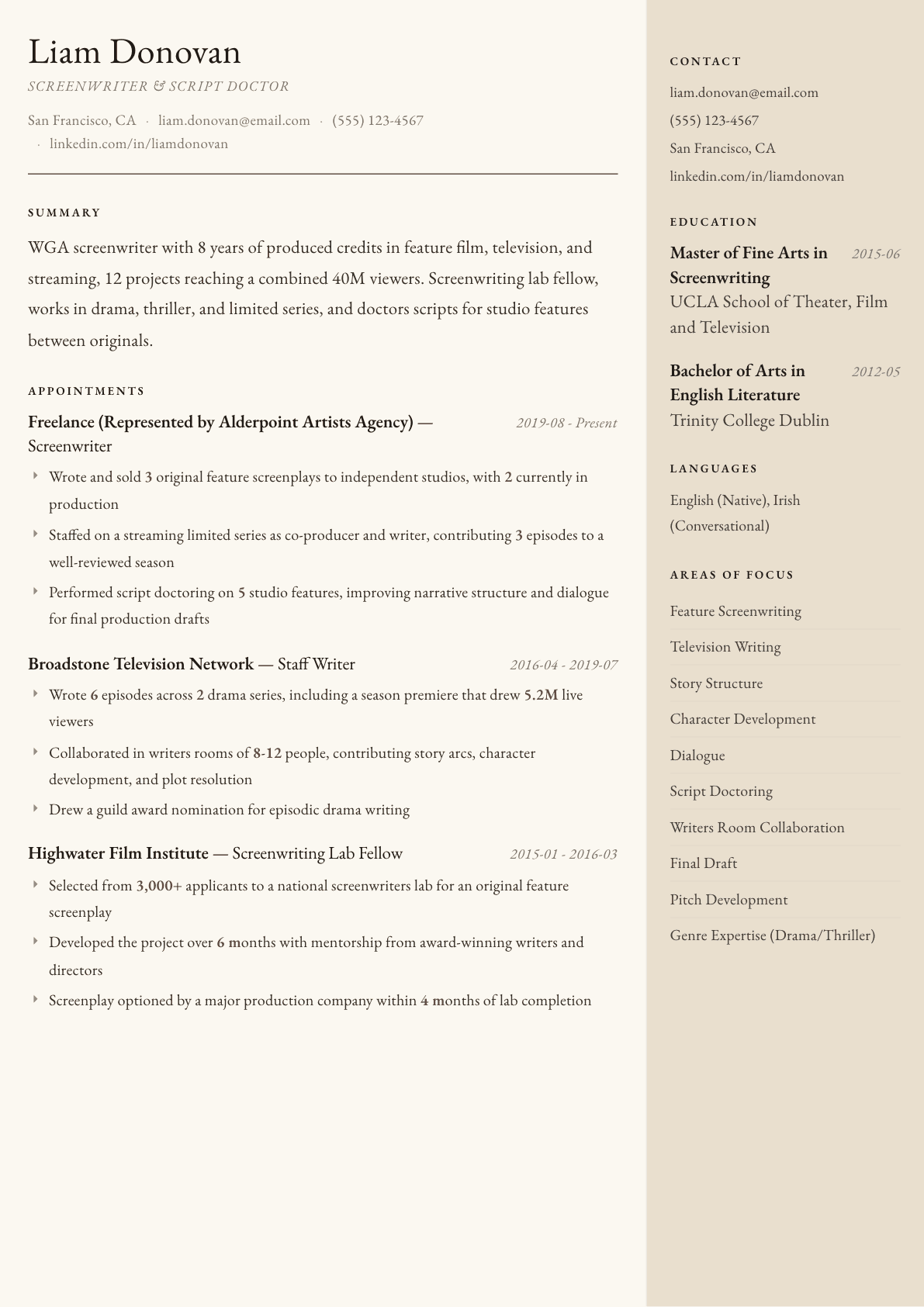
Example Screenwriter summary
WGA screenwriter, 8 years and 12 produced credits across feature film, television, and streaming, reaching 40M viewers. Screenwriting lab fellow with a guild award nomination for episodic drama. Sells original specs and doctors studio scripts.
Skills to list on a Screenwriter resume
- Feature Screenwriting
- Television Writing
- Story Structure
- Character Development
- Dialogue Writing
- Script Doctoring
- Writers Room
- Final Draft
- Pitch Development
- Adaptation
- Genre Writing
- Script Coverage
What actually gets this resume read
- List produced credits with networks, studios, and viewership numbers prominently.
- Include awards, nominations, and prestigious lab or fellowship selections.
- Highlight genre versatility and the ability to work across features, episodic, and limited series.
- Show collaborative skills across writers rooms, studio notes, and script revision processes.
- Include your representation (agent/manager) if applicable, and link to your portfolio or scripts.
How to write a screenwriter resume
Screenwriting is one of the few crafts where the resume is not the primary document. A script gets you the job. But a resume still travels: to studio and network human resources when you staff on a series, to fellowship and lab committees, to producers who want to see your track record before they read, and to the university that might hire you to teach. It has to say, in one page, what you have written, who paid for it, and what got made.
The rule that governs everything here is that credits outrank everything else. A produced credit with a network or distributor attached is worth more than any amount of description of your voice. Options, assignments and staff weeks come next. Contests and labs come after that, and only the ones a working producer recognizes. Everything you cannot verify should come off the page.
This guide walks through the section order the industry expects, three summaries for writers at different stages, before and after bullets that make credits legible, and the questions writers ask when they realize a script sample is not the same thing as a resume.
Format: one page, credits first, everything verifiable
One page. Two only if you have a long produced filmography, in which case the second page is a credit list and nothing else. Header carries name, city, phone, email, representation if you have it, and guild membership if you are a member. A manager or agent listed in the header changes how the document is read, because it means someone has already vetted you.
Section order: selected credits, development and assignments, staff writing history, fellowships and labs, awards, other writing, education. Notice that experience in the ordinary sense comes late. A screenwriter resume is a credit document, not a job history, and organizing it like a corporate resume signals that you are new.
- Each credit gets the title, format, the studio, network or distributor, your credit position and the year.
- Say the status honestly: produced, in production, in development, optioned, or on spec.
- Sole credit, co-written and rewrite are different things. Name which one you had.
- Keep loglines to one line if you include them at all, and only for scripts a reader could not look up.
Credits: format, buyer, position and status
A credit line has to answer four questions instantly. What was it: a feature, a limited series, an episode of an ongoing series, a short, a pilot. Who bought or made it: the studio, the network, the streamer, the production company. What were you: writer, co-writer, staff writer, story editor, executive story editor, co-producer, or higher. And what happened to it: released, in post, in production, in development.
Television credits carry a level in the title itself, so use the correct one. Staff writer, story editor, executive story editor, co-producer, producer, supervising producer and co-executive producer describe a ladder that everyone in the business reads instantly. Inflating a rung is the fastest way to lose a room, because the people reading know each other.
For episodic work, list the series, the seasons you were on, the number of episodes you were credited on, and the credit type: written by, teleplay by, story by. A writer with two written-by credits in a room of ten is telling a very different story from a writer with none.
Unproduced work: options, assignments and the spec pile
Sold and optioned material belongs on the page even when nothing shot, because it proves a buyer paid. Give the title, the format, the company that optioned or commissioned it, and whether it was an original or an assignment. Assignments are strong evidence for staffing, because they show you can write to somebody else's intention on a schedule.
Spec scripts are a different matter. A list of unsold specs looks like a list of things nobody wanted. Instead name at most two available samples by title and genre, because that is what a producer will ask for anyway, and let the rest live in your submissions rather than on the page.
Script doctoring, punch-up, uncredited rewrites and polish work can be mentioned in general terms when confidentiality prevents naming the project. Say the format and the scope, such as a structural pass on a studio feature, without naming what you are not free to name.
Rooms, labs and fellowships: what they actually signal
Time in a writers room is its own credential, separate from the credits it produced. Say the room size, the format, whether it was a mini room or a full season, and what you contributed beyond your assigned scripts: breaking story, arc tracking, punch-up, set visits, production drafts, cuts and notes. Showrunners staff on room behavior at least as much as on pages.
Labs and fellowships carry weight when the reader knows them. Long running studio and network writing programs, the major festival labs and established screenwriting fellowships are all recognizable. Anything with an entry fee and no track record is not, and listing it drags down the credits above it. Selection numbers are worth including only when the program publishes them.
- Name the showrunner or the series when you list room experience, since staffing is a referral business.
- Include production experience such as on-set writer, because it is scarce and valuable.
- List guild membership plainly, and do not imply eligibility you do not have.
- Teaching, mentoring and script coverage work belong under other writing, not among credits.
Voice, genre and the samples question
A short line about the material you write is useful because staffing is genre driven: an hour drama room hires hour drama writers, and a half hour comedy room hires comedy. Name the formats and two or three genres you have actual pages in. Claiming everything reads as having nothing.
Do not try to describe your voice in adjectives. It cannot be evaluated on a resume and it wastes the space a credit could occupy. If you want the reader to understand your voice, make the sample easy to request: one line saying which scripts are available and in what genre, and a working email.
Screenwriter resume summary examples
Pre-first credit
Screenwriter working in hour drama and limited series, with an original pilot selected for a network writing program and a feature optioned by an independent production company. Two years as a writers assistant on a cable drama, tracking arcs and cutting production drafts for a room of eight.
Staffed, first credits
Television writer with three seasons of staff experience across two hour dramas, credited on 6 episodes as writer or co-writer, most recently at story editor level. Also wrote an assignment feature for a studio and has one original limited series in development with a production company.
Co-executive producer
Guild member and co-executive producer with twelve years in television drama, credited on 24 episodes across five series, including two season finales. Has run a mini room, supervised production drafts and cuts, and mentored three staff writers into story editor positions.
Work experience bullets: before and after
Before: Wrote several screenplays, some of which were optioned.
After: Wrote three original feature screenplays, two optioned by independent production companies and one produced and released theatrically as a sole written-by credit.
Naming the count, the status of each and the credit type turns a vague claim into three checkable facts.
Before: Was part of the writing team on a TV show.
After: Staffed at story editor level on a two season cable drama, credited as writer on 4 episodes including the season two premiere, in a room of nine over 22 weeks.
The level, the episode count, the room size and the run length tell a showrunner exactly what you have done.
Before: Did rewrites and script consulting for producers.
After: Completed six paid rewrite assignments for producers, including a structural pass and dialogue polish on a studio feature that entered production the following year.
Paid assignments prove someone bought your judgment, which specs never do on their own.
Before: Selected for a prestigious screenwriting lab.
After: Selected for a screenwriting lab from an open applicant pool, developing an original feature over six months with mentorship from produced writers and directors.
Describing what the program actually involved is more persuasive than the word prestigious, which no reader accepts on trust.
Before: Helped out in the writers room as an assistant.
After: Worked as writers assistant on a network drama for two seasons, keeping the room notes and arc board, preparing outlines and production drafts, and writing a freelance episode in season two.
The concrete duties plus the freelance script show the promotion path a room actually recognizes.
Hard skills
- Feature screenwriting
- Television pilot writing
- Episodic teleplay writing
- Story breaking and outlining
- Three act and five act structure
- Character arc construction
- Dialogue
- Rewriting and polish work
- Script coverage and notes
- Final Draft
- Writers room collaboration
- Pitching and pitch documents
- Adaptation from source material
- Production drafts and revision colors
Soft skills
- Taking notes without defensiveness
- Working to a deadline under supervision
- Room etiquette
- Pitching in a room
- Collaboration with directors and producers
- Discretion about unreleased material
Mistakes that cost screenwriter candidates the interview
- Listing every spec script ever written, which reads as a catalog of work no buyer wanted.
- Inflating a television credit level, when everyone reading the page knows the ladder and knows each other.
- Padding the fellowships block with fee-charging contests that no working producer has heard of.
- Organizing the page as a job history so that credits sit below unrelated employment.
- Describing your voice in adjectives instead of naming formats, genres and the samples you have available.
- Leaving off the status of each project, so a producer cannot tell a produced feature from a script in a drawer.
- Claiming sole authorship of a co-written project, which is trivially checked and ends the conversation.
Screenwriter resume questions
What goes on a screenwriter resume if nothing has been produced yet?
Lead with anything a buyer or institution paid for or selected: options, assignments, lab and fellowship placements, writers assistant or script coordinator work. Then name one or two available samples by format and genre so a producer can request pages without a second email.
How do I list television credits correctly?
Give the series, network or streamer, your staff level, the seasons you worked, and the episodes you were credited on with the credit type. Use the real ladder title, because story editor and co-producer describe specific rungs that every showrunner reads instantly.
Should a screenwriter include loglines on the resume?
Only for unproduced work that a reader cannot look up, and only one line each for at most two projects. Produced credits do not need a logline, and a page of them turns a credit document into a pitch deck nobody asked for.
Do screenwriting contests belong on a resume?
A small number do, the ones that reliably lead to representation or staffing and that industry readers recognize. Placements in contests that charge entry fees and produce no working writers pull attention away from stronger material on the page.
How should a feature writer present themselves for a television staffing job?
Reframe the page around collaboration and speed rather than authorship: assignments delivered to another party's notes, rewrites on deadline, any room or assistant experience, and a pilot sample in the same genre and format as the show you are being considered for.