Occupational Health Nurse Resume Examples: free score
Create an Occupational Health Nurse Resume for Employer Clinics
By Mustafa Tarabya, founder of CVBooster · Published · Updated
Occupational health nurse resume examples with OSHA recordkeeping and workers compensation keywords, sample bullets, and a practical writing guide.
Sample resumes for a occupational health nurse
The same occupational health nurse content laid out in three CVBooster templates, so you can see what the finished document looks like before you write a word.
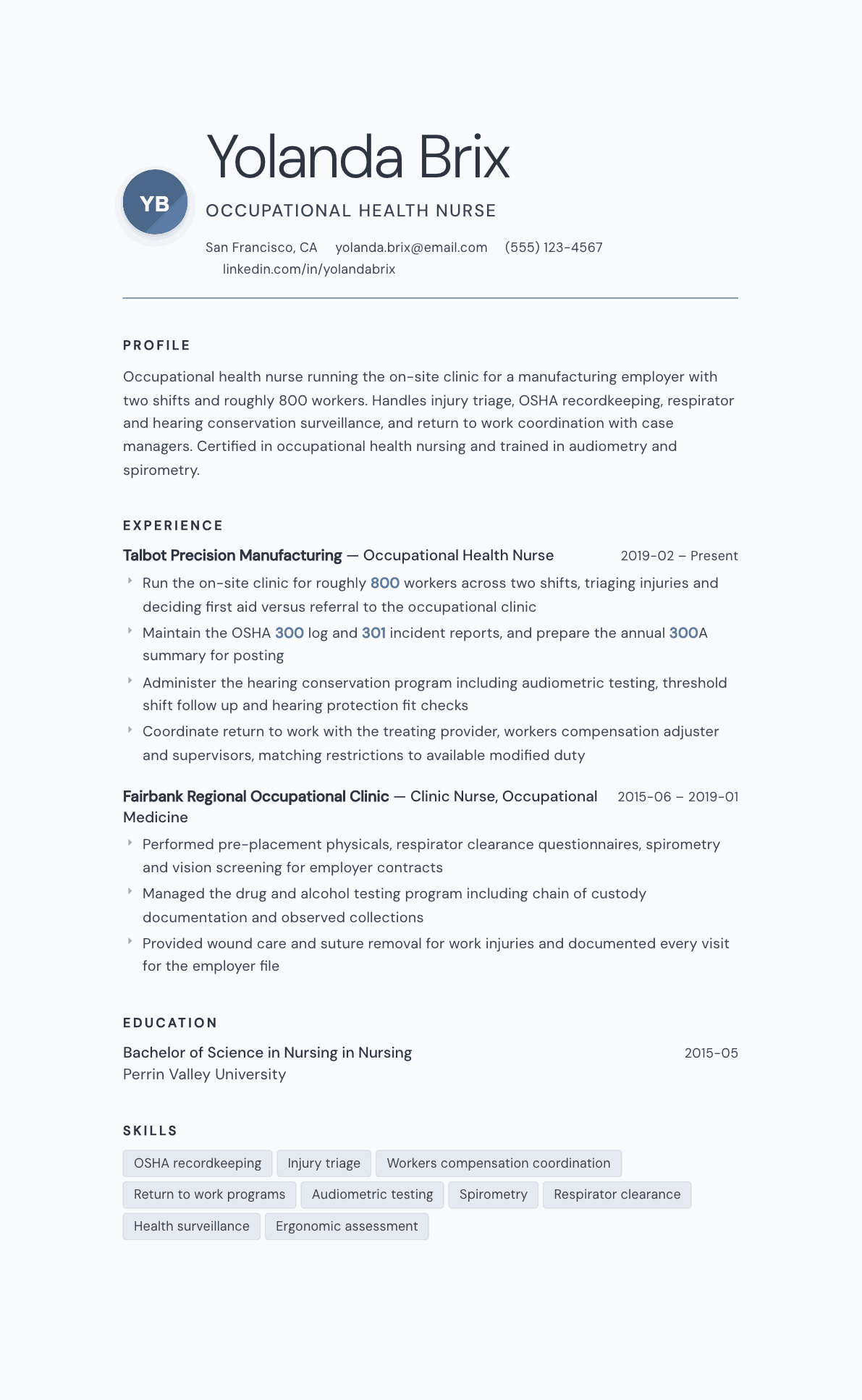
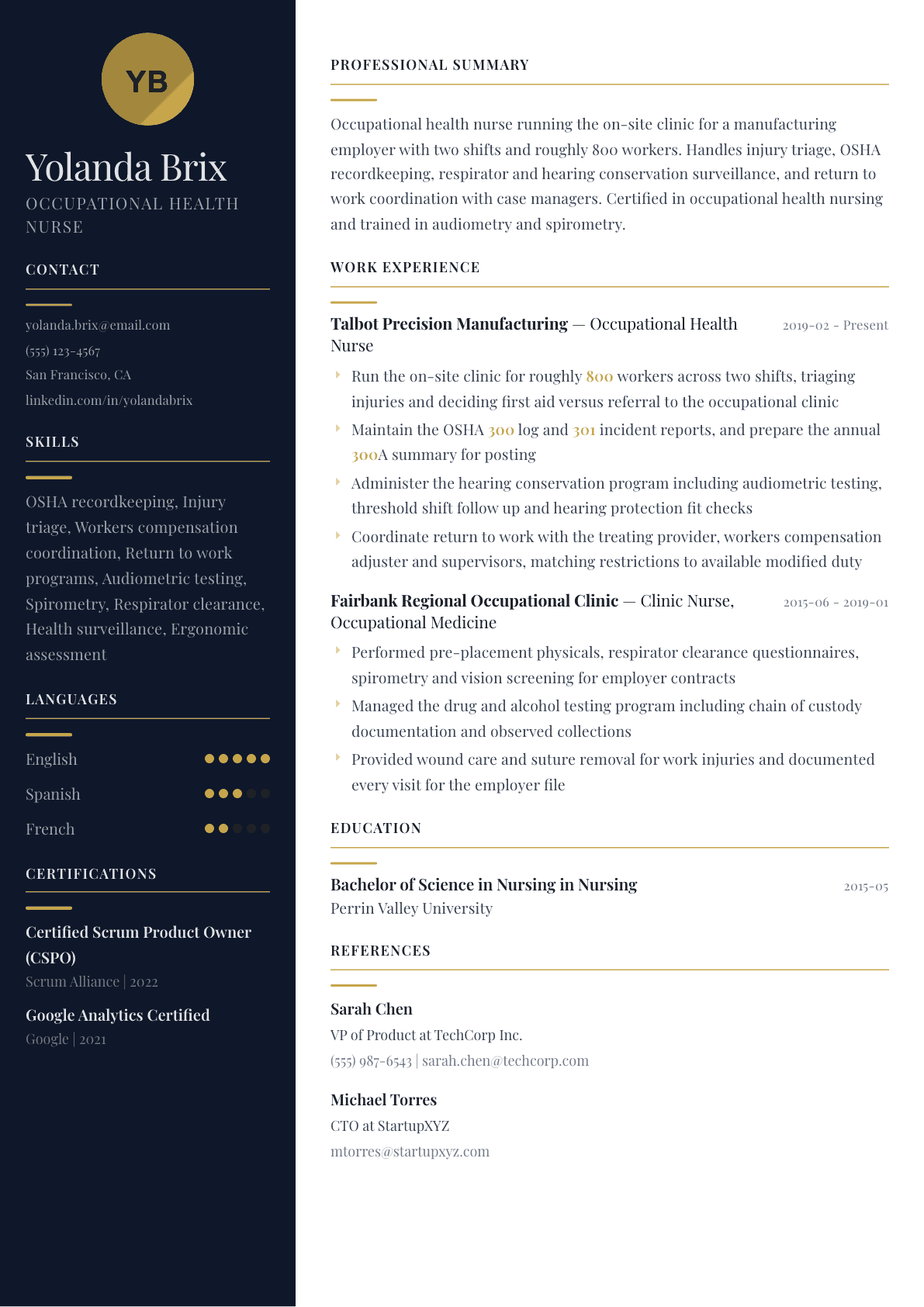
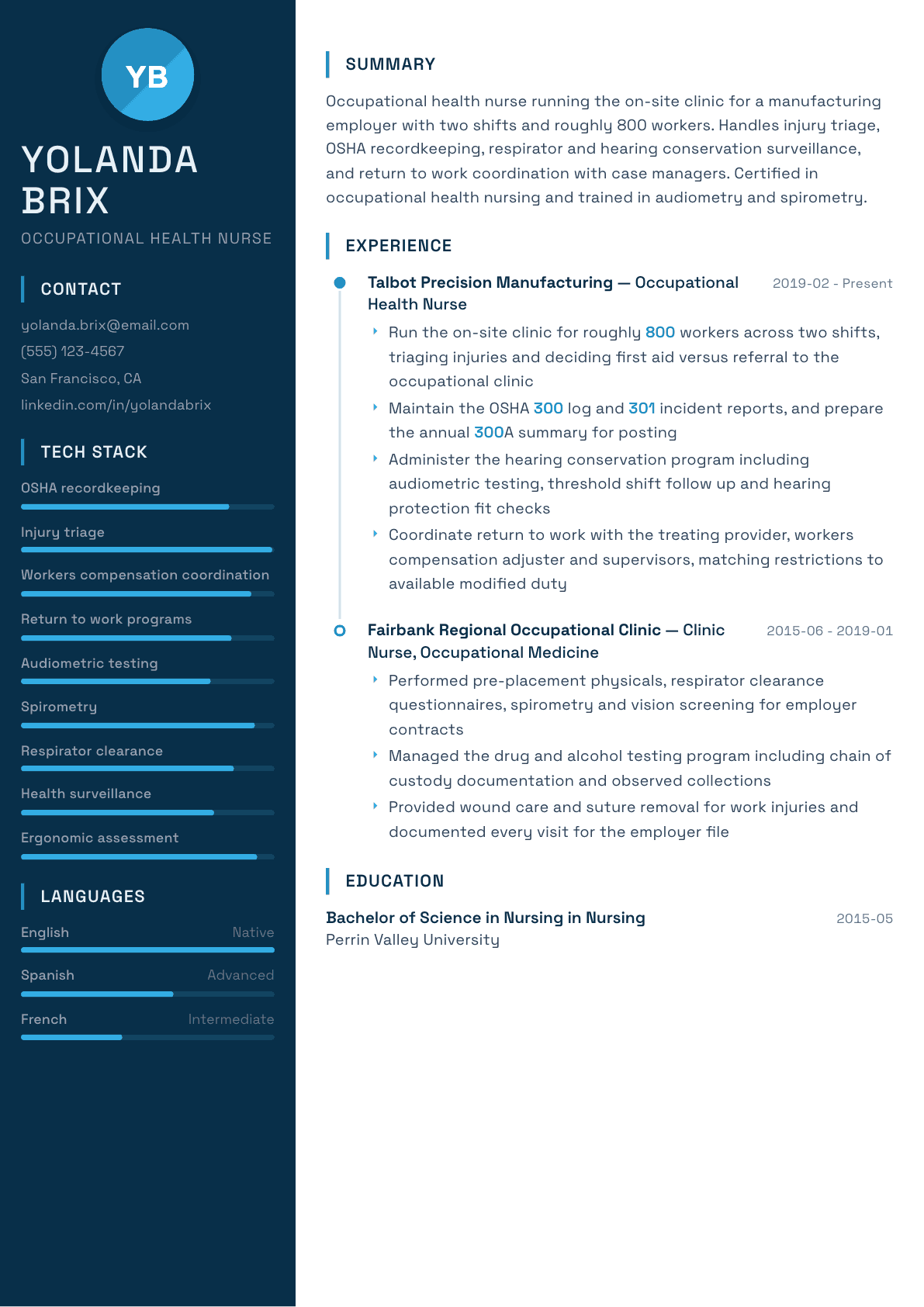
Example Occupational Health Nurse summary
Occupational health nurse with ten years across employer clinics and occupational medicine, currently running an on-site clinic for a manufacturing workforce of roughly 800 across two shifts. Owns OSHA recordkeeping, hearing and respiratory surveillance, injury triage and return to work coordination with adjusters and supervisors. COHN certified. Seeking a regional occupational health role covering several sites.
Skills to list on a Occupational Health Nurse resume
- OSHA recordkeeping
- Injury triage and first aid
- Workers compensation case coordination
- Return to work and modified duty
- Hearing conservation program
- Audiometric testing
- Spirometry
- Respirator medical clearance
- Pre-placement physicals
- Drug and alcohol testing programs
- Bloodborne pathogen exposure response
- Ergonomic assessment
- Health education and wellness programs
- Immunization programs
- Emergency response planning
What actually gets this resume read
- Say what kind of worksite you cover and how many workers, because a refinery clinic and an office clinic are different jobs.
- Put OSHA recordkeeping in its own bullet and name the forms you maintain, since compliance is the first thing an employer checks.
- Describe the surveillance programs you run by hazard: hearing, respiratory, bloodborne pathogen, heat or lead.
- Show the return to work side clearly, including how you match medical restrictions to modified duty with supervisors.
- Include the testing you personally perform, such as audiometry, spirometry, vision screening and drug collections.
- Add COHN or COHN-S certification and any case management credential near the top of the resume.
How to write a occupational health nurse resume
The person hiring an occupational health nurse is usually not a nurse. It is an environmental health and safety director, a plant manager or a human resources leader, and their first question is whether you will keep the site compliant and the injury log defensible. Clinical skill is assumed. Regulatory competence and independent judgment are what get screened.
That changes what belongs on the resume. The hazard profile of the worksite, the surveillance programs you run, the recordkeeping you own, and how you move an injured worker from first report through treatment and back to modified duty all matter more than a list of clinical tasks. A single nurse often covers a whole site with no colleague down the hall, so evidence of working alone carries real weight.
This guide walks through how to structure an occupational health nurse resume, three summaries covering a first move out of the hospital through to a regional role, before and after bullets from worksite clinic work, and the questions nurses ask when they leave acute care for industry.
Format: the worksite defines the job
Reverse-chronological, one to two pages, and every position opens with the employer type, the workforce size and the shift pattern you covered. A clinic supporting a foundry across three shifts and a clinic supporting an office campus are different jobs with different hazards, and the reader cannot infer which one you did.
Under the summary, add a compliance and programs block: the recordkeeping you maintain, the surveillance programs you run, the testing you perform yourself, and your certifications. Safety directors shortlist from that block.
- Header: name, credentials, certification, city and state, license states for multi-site roles.
- Order: summary, compliance and program block, occupational health experience, other clinical experience, education, certifications.
- Nurses coming from acute care keep an emergency or critical care block to show triage credibility.
Summary: workforce, hazards, programs, autonomy
Say who you cover, how many, and against which hazards. Naming the workforce size and the industry gives scale, and naming the hazard set gives relevance: noise, respirable dust, solvents, heat, lead, bloodborne pathogens or ergonomic strain.
Say plainly that you run the clinic alone if you do. Employers hiring a solo site nurse are buying judgment about when a laceration goes to the occupational clinic and when it stays on site, and that decision authority should be visible in the first four lines.
Compliance and recordkeeping is the spine of the resume
Recordkeeping deserves its own bullet in every relevant job. Name the forms you maintain and the annual summary you prepare for posting, and say who you work with on classification decisions when a case sits on the line between first aid and recordable.
Add the audits and inspections you have supported, the regulatory training you deliver, and any written program you authored or revised. Safety leaders read written program ownership as the difference between a nurse who treats injuries and a nurse who runs a health function.
Surveillance, testing and return to work
Organize medical surveillance by hazard, not as a single blur. Hearing conservation with audiometric testing and threshold shift follow-up, respiratory protection with clearance questionnaires and spirometry, bloodborne pathogen exposure response with post-exposure follow-up, and heat or lead monitoring where the hazard exists.
Return to work is the process employers care most about after compliance, because it drives claim duration and staffing. Show how you translate a treating provider restriction into a real task list with the supervisor, how you track the worker through the restriction period, and how you coordinate with the workers compensation adjuster and the case manager without stepping outside your scope.
Name the testing you personally perform: audiometry, spirometry, vision screening, drug and alcohol collections with chain of custody, immunization administration and tuberculosis screening. Employers with a certified collector requirement search for those exact terms.
Certifications and the vocabulary employers search
Give occupational health certification its own line with the issuing body, and add case management, audiometry technician or spirometry training with the awarding organization. Employers filter on these because several of the programs you run require a certified technician on file.
Postings repeat a small set of terms: injury triage, recordkeeping, medical surveillance, hearing conservation, respiratory protection, return to work, modified duty, workers compensation, pre-placement examination, ergonomics and case management. Use the posting version of each once high on the page and once inside a bullet.
Occupational Health Nurse resume summary examples
First move out of the hospital
Emergency department RN with five years of triage and wound care moving into worksite health. Completed occupational health coursework covering recordkeeping, medical surveillance and return to work coordination. Seeking a site clinic role supporting a manufacturing workforce with structured onboarding to compliance duties.
Four years on site
Occupational health nurse running a single-site clinic for roughly 800 manufacturing workers across two shifts. Owns injury triage, recordkeeping, hearing conservation and respiratory clearance, and coordinates return to work with treating providers, adjusters and supervisors. Certified in occupational health nursing.
Regional occupational health manager
Regional occupational health manager covering six manufacturing and distribution sites with four site nurses reporting in. Standardizes surveillance protocols and written programs across locations, leads case review with the workers compensation carrier, and represents health services in regulatory inspections and internal audits.
Work experience bullets: before and after
Before: Treated injured employees at the plant.
After: Triaged injuries for roughly 800 workers across two shifts, deciding first aid on site versus referral to the occupational clinic, and documented every encounter in the employer health record.
Workforce size, shift coverage and the referral decision show the scope and the judgment the job requires.
Before: Maintained OSHA logs.
After: Maintained the injury and illness log and incident reports, reviewed borderline cases with the safety director against recordability criteria, and prepared the annual summary for posting each February.
Naming the classification review turns routine paperwork into evidence of regulatory judgment.
Before: Ran the hearing testing program.
After: Administered the hearing conservation program including annual audiometric testing, standard threshold shift follow-up, retesting and hearing protection fit checks for workers in high noise areas.
The full program cycle proves ownership rather than performing one step of it.
Before: Helped employees return to work after injuries.
After: Translated treating provider restrictions into written modified duty task lists with supervisors, tracked each worker through the restriction period, and closed the case with the adjuster once released to full duty.
A concrete process shows how you shorten claim duration, which is what the employer is buying.
Before: Did physicals for new hires.
After: Performed pre-placement examinations including respirator clearance questionnaires, spirometry, vision screening and hearing baselines, and released results to hiring managers as fit determinations only.
The confidentiality boundary at the end signals you understand what an employer may and may not receive.
Hard skills
- Injury triage and first aid
- Injury and illness recordkeeping
- Medical surveillance program administration
- Hearing conservation and audiometric testing
- Respiratory protection clearance and spirometry
- Bloodborne pathogen exposure response
- Pre-placement and fitness for duty examinations
- Return to work and modified duty coordination
- Workers compensation case coordination
- Drug and alcohol collection with chain of custody
- Ergonomic assessment
- Immunization and tuberculosis screening programs
Soft skills
- Working alone without clinical backup
- Confidentiality with a non-clinical employer
- Supervisor and union communication
- Persuading workers into follow-up
- Documentation for legal review
- Health education for adult workers
Certifications worth listing
- COHN (Certified Occupational Health Nurse) (American Board for Occupational Health Nurses)
- COHN-S (Certified Occupational Health Nurse Specialist) (American Board for Occupational Health Nurses)
- Certified Case Manager (CCM) (Commission for Case Manager Certification)
- Certified Occupational Hearing Conservationist (Council for Accreditation in Occupational Hearing Conservation)
- NIOSH Approved Spirometry Training (National Institute for Occupational Safety and Health)
Mistakes that cost occupational health nurse candidates the interview
- Describing the clinic without the workforce size, the industry or the shifts, which hides the real scope of the job.
- Leaving recordkeeping in a single vague line when it is the first thing a safety director checks.
- Listing surveillance as a word rather than by hazard, so the reader cannot match you to their exposure profile.
- Skipping return to work entirely, which is the process that drives claim duration for the employer.
- Forgetting the technician certifications that programs legally require on file, such as hearing conservation or spirometry training.
- Writing acute care bullets about patient care instead of translating them into triage, wound care and independent judgment.
Occupational Health Nurse resume questions
Can I move into occupational health nursing from the emergency department?
It is one of the most common paths, because triage and wound care transfer directly. Rewrite those years around independent decisions and referral judgment, then add any coursework or certification progress in recordkeeping, surveillance and return to work so the compliance gap looks small.
What should I include about confidentiality on the resume?
Show that you keep employee health records separate from personnel files and that you release fit determinations rather than diagnoses. Employers with prior compliance trouble screen for this, and one clear line about it distinguishes you from candidates who have never faced the boundary.
How do I write about workers compensation without overstating my role?
Describe coordination rather than claim decisions. You gather the report, communicate with the treating provider, translate restrictions with supervisors and update the adjuster. Claim acceptance and payment sit with the carrier, and a resume that blurs that line invites an awkward interview.
Is a bachelor degree required for occupational health nursing roles?
Many postings ask for one, and certification eligibility often assumes it. If you hold an associate degree with strong site experience, keep the experience section detailed and name any degree in progress with the expected completion so the recruiter can justify moving you forward.
What makes a multi-site or regional application different?
Regional employers hire for standardization and travel. Show written programs you rolled out across locations, protocols you harmonized, site nurses you supported or supervised, and audit participation, then state your license coverage and willingness to travel between sites.