Occupational Therapy Assistant Resume Examples: free
Write an Occupational Therapy Assistant Resume That Shows Setting and Caseload
By Mustafa Tarabya, founder of CVBooster · Published · Updated
An occupational therapy assistant resume example with setting, caseload and productivity detail, the keywords rehab managers scan, and a full guide.
Sample resumes for a occupational therapy assistant
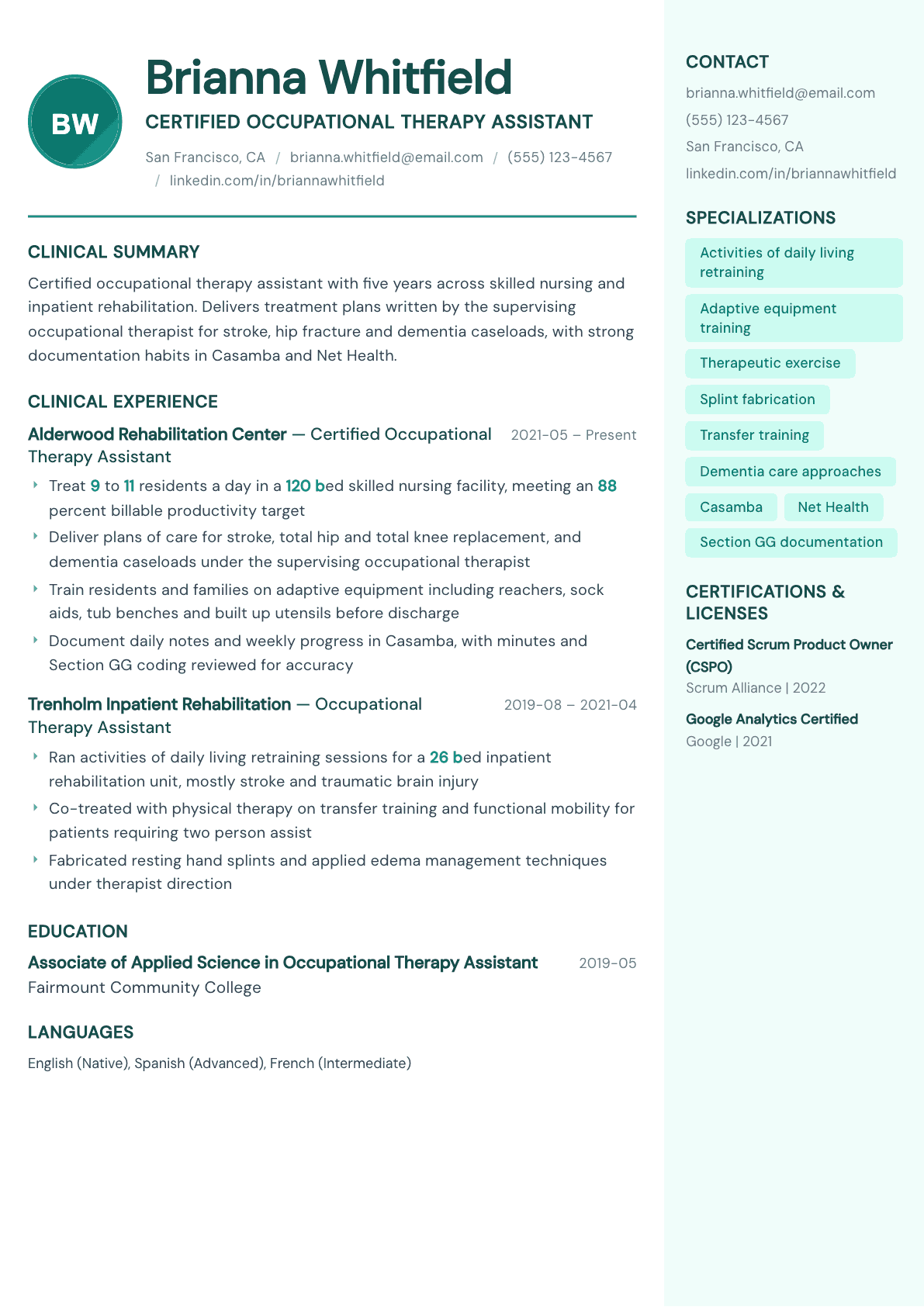
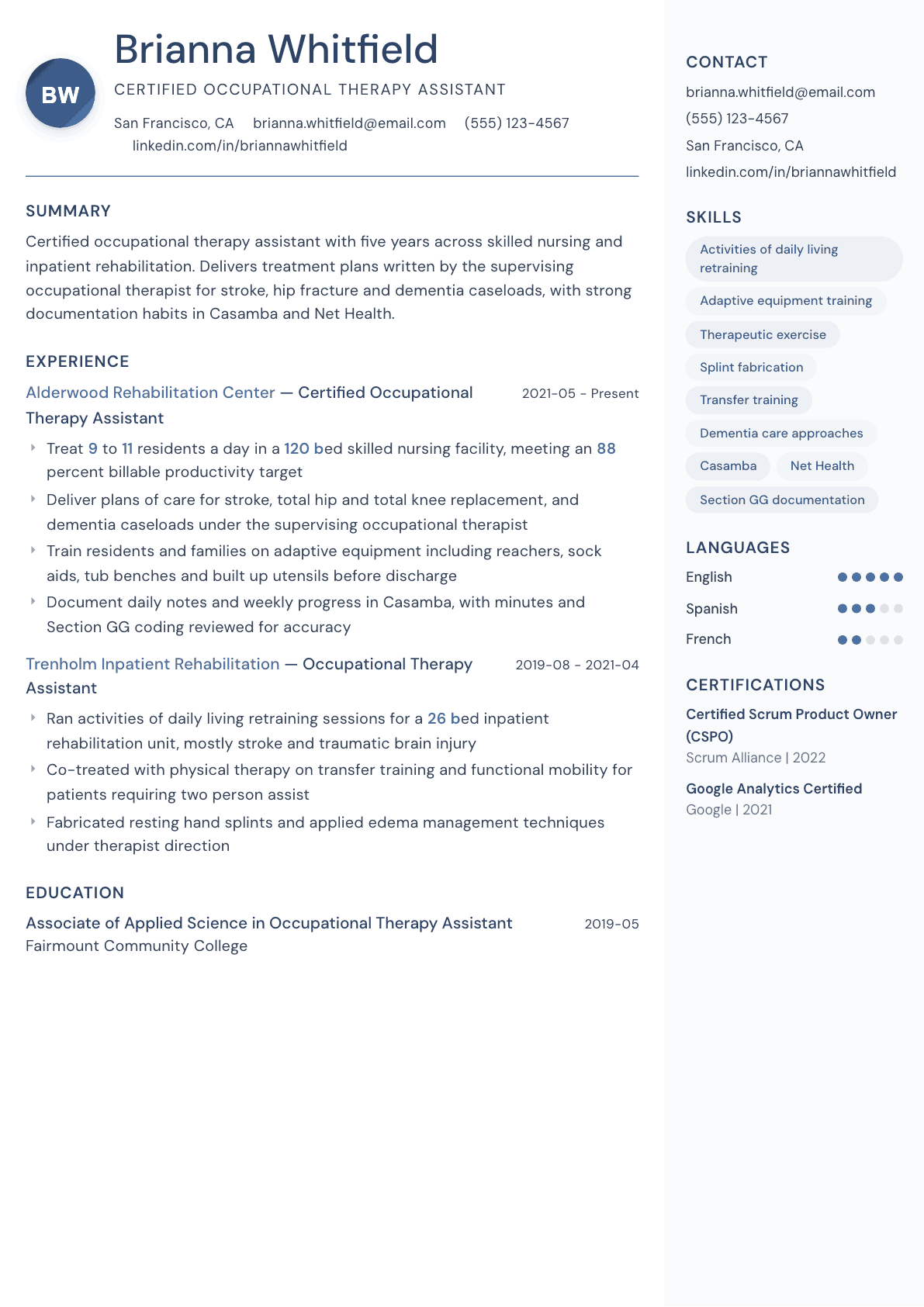
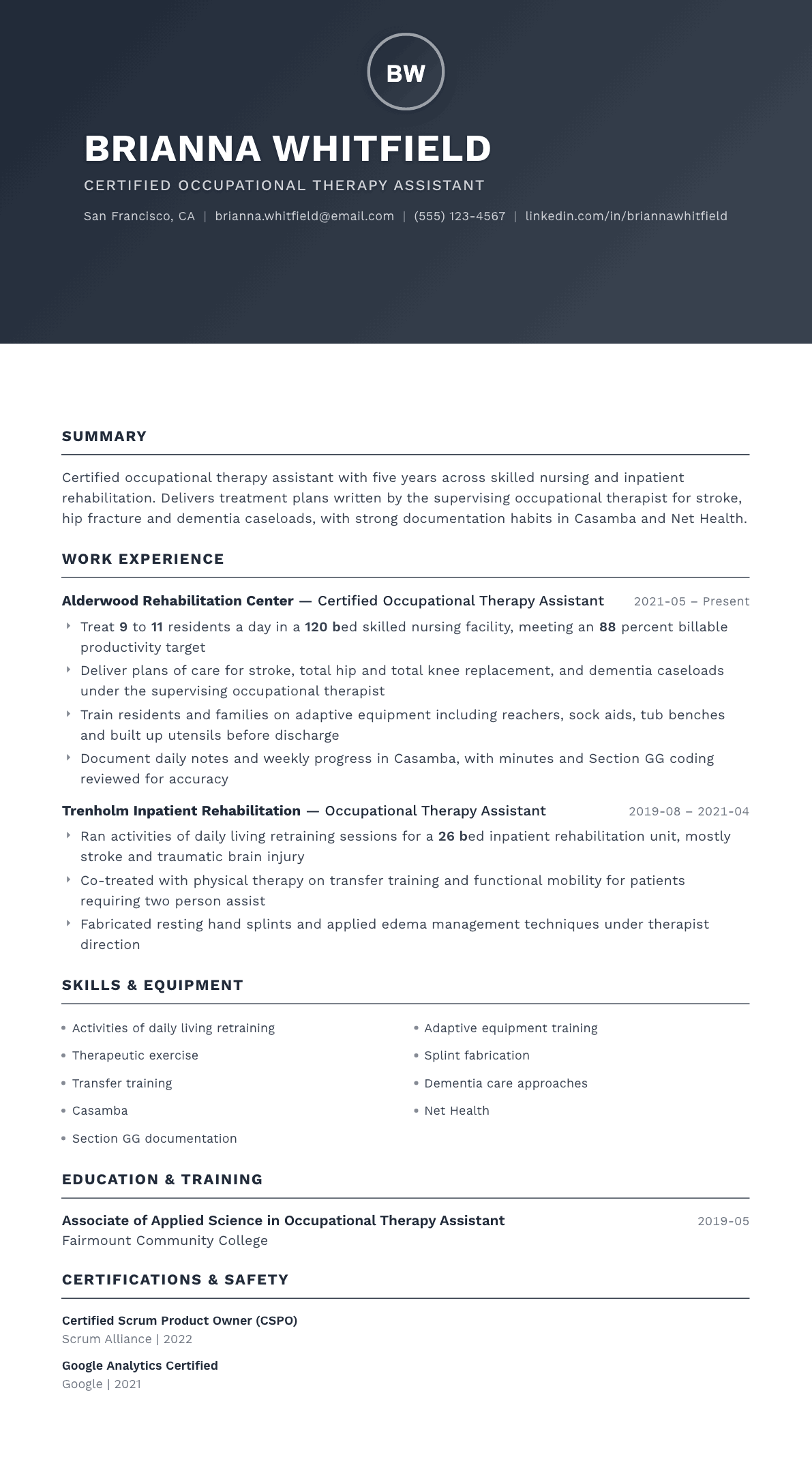
The same occupational therapy assistant content laid out in three CVBooster templates, so you can see what the finished document looks like before you write a word.
Example Occupational Therapy Assistant summary
Certified occupational therapy assistant with five years in skilled nursing and inpatient rehabilitation. Delivers plans of care for stroke, orthopedic and dementia caseloads under a supervising occupational therapist, treating nine to eleven residents daily while holding productivity targets. Trains patients and families on adaptive equipment, documents in Casamba, and co-treats with physical therapy on complex transfer cases.
Skills to list on a Occupational Therapy Assistant resume
- Activities of daily living retraining
- Adaptive equipment training
- Therapeutic exercise
- Therapeutic activity
- Transfer and mobility training
- Splint fabrication
- Edema management
- Cognitive retraining
- Dementia care approaches
- Home safety recommendations
- Section GG functional coding
- Casamba
- Net Health
- Group and concurrent treatment
What actually gets this resume read
- List the setting for every job, because skilled nursing, inpatient rehabilitation, schools and home health hire on setting fit.
- Give daily caseload and productivity expectation, since rehab managers read those two numbers before anything else.
- Say what you treat: stroke, orthopedic post surgical, dementia, hand injuries or pediatric sensory and fine motor work.
- Name your documentation systems, such as Casamba, Net Health, WebPT or the school district reporting platform.
- Show the supervisory relationship clearly, because state practice acts define what an assistant may do independently.
- Include equipment and interventions by name so an applicant tracking system can match them to the posting.
How to write a occupational therapy assistant resume
Rehab managers hire occupational therapy assistants on setting fit and caseload evidence, in that order. A skilled nursing facility director wants to know you can carry nine to eleven residents a day and hold a productivity target. A school district wants to know you can run push in sessions and write into an individualized education program. A hand clinic wants splinting. The same resume cannot answer all three, and a generic one answers none.
The second thing a reader checks is whether you understand the supervisory relationship. State practice acts define what an assistant may do, what requires the supervising occupational therapist, and how often that supervision must occur. A resume that describes evaluating patients and writing plans of care raises a flag rather than impressing anyone.
What follows is the section order rehab managers expect, three summaries covering a new graduate through a senior assistant, before and after bullets built from treatment work, and the questions assistants ask when they change settings.
Format: one page, certification line at the top
Keep it to one page. Occupational therapy assistant hiring is fast and volume driven, and a manager filling an open caseload reads the top third of the page before deciding. Put the certification and state license line directly under your name, with the license state and status, because staffing cannot schedule you without it.
Add a settings line right under the summary listing every setting you have worked in with the setting type spelled out. Skilled nursing, inpatient rehabilitation, outpatient, home health, school based, early intervention and behavioral health are the categories managers sort by.
- Header: name, credential, license state and status, city and state, phone, email.
- Order: summary, certification and licensure, settings, clinical experience, fieldwork, education, skills and systems.
- New graduates put both level two fieldwork placements above employment with the setting, hours and populations named.
Summary: setting, population, and daily caseload
Three lines. Name the setting type and facility size, the diagnoses you treat most, and the daily caseload with the productivity expectation you have held. A manager reading occupational therapy assistant with five years in a hundred and twenty bed skilled nursing facility treating stroke, orthopedic and dementia caseloads at nine to eleven residents a day already knows whether to call you.
If you are changing settings, say so and name the transferable part. An assistant moving from skilled nursing into school based practice should say so and point to the pediatric fieldwork, the fine motor work and any sensory training rather than hoping the reader connects it.
Experience: interventions, equipment, and who supervises
Lead with the facility type and bed count, then write bullets around what you actually deliver. Activities of daily living retraining, therapeutic exercise, therapeutic activity, adaptive equipment training, cognitive retraining, splint fabrication, edema management, transfer training and home safety education are the intervention words that appear in postings, and they should appear in yours where they are true.
Name the equipment. Reachers, sock aids, long handled sponges, tub benches, built up utensils, dycem, resting hand splints and adaptive keyboards make a bullet concrete. So does saying which patients needed a two person assist and how you coordinated a co treatment with physical therapy.
Make the supervisory relationship visible without making it sound limiting. Delivering the plan of care written by the supervising occupational therapist, reporting patient changes the same day, and contributing objective data to reassessments is the correct and expected description of the role.
Documentation, productivity and reimbursement literacy
Name your documentation system, whether that is Casamba, Net Health, WebPT, MatrixCare or a school district platform. Then say something about accuracy. Minutes captured correctly, daily notes closed before leaving, weekly progress notes filed on time, and functional coding entered accurately are all things a director has had to chase from previous staff.
Productivity is not a dirty word on this resume. State the target you met and the caseload it covered. If you handled group or concurrent treatment, say so, because the rules around those modes are exactly the kind of knowledge a facility does not want to teach from scratch.
- Documentation platforms by name, plus any functional coding you completed.
- Productivity target held, with the caseload and setting that produced it.
- Any student supervision, since assistants can supervise level one fieldwork students in many programs.
Keywords and tailoring by setting
The filter looks for activities of daily living, adaptive equipment, therapeutic exercise, plan of care, transfer training, cognitive retraining, splinting, home safety and the setting name. Use each once in the skills block and once in a bullet.
Then tailor by setting. School applications lead with fine motor, sensory regulation, handwriting programs, classroom accommodations and individualized education program participation. Home health leads with home safety assessment contributions, caregiver training, energy conservation and independent scheduling across a territory. Change the summary and the first two bullets, keep the rest.
Occupational Therapy Assistant resume summary examples
New graduate
Certified occupational therapy assistant and recent associate degree graduate with two level two fieldwork placements: 12 weeks in a 90 bed skilled nursing facility and 12 weeks in an elementary school district. Trained in activities of daily living retraining, adaptive equipment and sensory regulation strategies.
Five years in skilled nursing
Occupational therapy assistant with five years in a 120 bed skilled nursing facility, treating 9 to 11 residents daily at an 88% productivity target. Delivers stroke, total joint and dementia plans of care, trains families on adaptive equipment before discharge, and documents daily notes and functional coding in Casamba.
Senior assistant and student mentor
Senior occupational therapy assistant with eleven years across inpatient rehabilitation and outpatient hand therapy. Fabricates resting and static progressive splints, runs edema and scar management protocols under therapist direction, mentors level one fieldwork students, and leads the facility adaptive equipment education program.
Work experience bullets: before and after
Before: Provided occupational therapy treatments to patients.
After: Treated 9 to 11 residents daily in a 120 bed skilled nursing facility, delivering plans of care for stroke, total hip and total knee replacement, and dementia caseloads.
Daily caseload, facility size and diagnosis mix let a director place you against an open schedule immediately.
Before: Taught patients how to use adaptive equipment.
After: Trained residents and family caregivers on reachers, sock aids, tub benches and built up utensils, and confirmed safe use during a simulated morning routine before discharge.
Naming the equipment and the check you performed shows a discharge process rather than a handout.
Before: Documented treatment in the computer system.
After: Completed daily notes and weekly progress documentation in Casamba before end of shift, with treatment minutes and functional coding reviewed for accuracy against the plan of care.
Timeliness and coding accuracy are the two documentation problems every rehab director has had to fix.
Before: Worked with the physical therapy team on some patients.
After: Co-treated with physical therapy on transfer and functional mobility training for residents requiring a two person assist, coordinating session timing to keep both disciplines within their minutes.
Co-treatment logistics show you understand both the clinical need and the billing constraint behind it.
Before: Made splints for patients with hand injuries.
After: Fabricated resting hand and thumb spica splints from low temperature thermoplastic under therapist direction, and adjusted wear schedules based on edema and skin integrity checks.
Materials, splint types and the monitoring you performed turn a task into a demonstrable clinical skill.
Hard skills
- Activities of daily living retraining
- Adaptive equipment training
- Therapeutic exercise
- Therapeutic activity
- Transfer and functional mobility training
- Splint fabrication and adjustment
- Edema and scar management
- Cognitive retraining
- Dementia care approaches
- Home safety education
- Functional outcome coding
- Casamba and Net Health documentation
Soft skills
- Grading activities to patient tolerance
- Family and caregiver teaching
- Same day reporting to the supervising therapist
- Patience with cognitive impairment
- Schedule management under productivity pressure
- Team communication across disciplines
Certifications worth listing
- Certified Occupational Therapy Assistant (COTA) (National Board for Certification in Occupational Therapy)
- LSVT BIG Certification (LSVT Global)
- Basic Life Support (BLS) (American Heart Association)
Mistakes that cost occupational therapy assistant candidates the interview
- Writing bullets that describe evaluation or plan of care authorship, which sit with the supervising therapist rather than the assistant.
- Leaving out the setting type and facility size, so a reader cannot tell outpatient pediatrics from a subacute unit.
- Never mentioning caseload or productivity, when those are the first two numbers a rehab director looks for.
- Listing the license without the state and status, which forces a recruiter to email you before doing anything else.
- Using the same resume for skilled nursing and school based roles when the two want opposite evidence.
- Skipping fieldwork detail as a new graduate, which is the only clinical evidence you have at that stage.
Occupational Therapy Assistant resume questions
What is the difference between an occupational therapist and an occupational therapy assistant on a resume?
The therapist evaluates, writes the plan of care and completes reassessments. The assistant delivers that plan, contributes objective data and reports changes. Write your bullets on the delivery side so the reader sees you know your state practice act.
Should I list my fieldwork placements?
Yes for the first two years after graduation. Give each placement the setting, the facility type, the number of weeks and the populations treated, then drop them once you have a full year of paid caseload behind you.
How do I move from skilled nursing into school based practice?
Rewrite the summary around pediatrics and name every transferable element: fine motor work, sensory strategies, adaptive equipment, family education and any pediatric fieldwork. Add relevant continuing education so the change reads as prepared rather than opportunistic.
Is it a problem to put productivity numbers on the resume?
No, it is expected. Facilities staff around productivity, so stating the target you met alongside your caseload and setting reassures a director that you can carry the schedule they need to fill without a long ramp up.
How long should an occupational therapy assistant resume be?
One page in nearly every case. Two pages is defensible only after a decade with multiple settings, splinting specialization or student supervision, and even then the caseload and setting evidence belongs on page one.