Occupational Therapist Resume Examples: read this first
Craft an Occupational Therapist Resume That Opens Doors
By Mustafa Tarabya, founder of CVBooster · Published · Updated
Design a professional occupational therapist resume with healthcare-specific templates, real clinical examples, and ATS-friendly formatting.
Sample resumes for a occupational therapist
The same occupational therapist content laid out in three CVBooster templates, so you can see what the finished document looks like before you write a word.
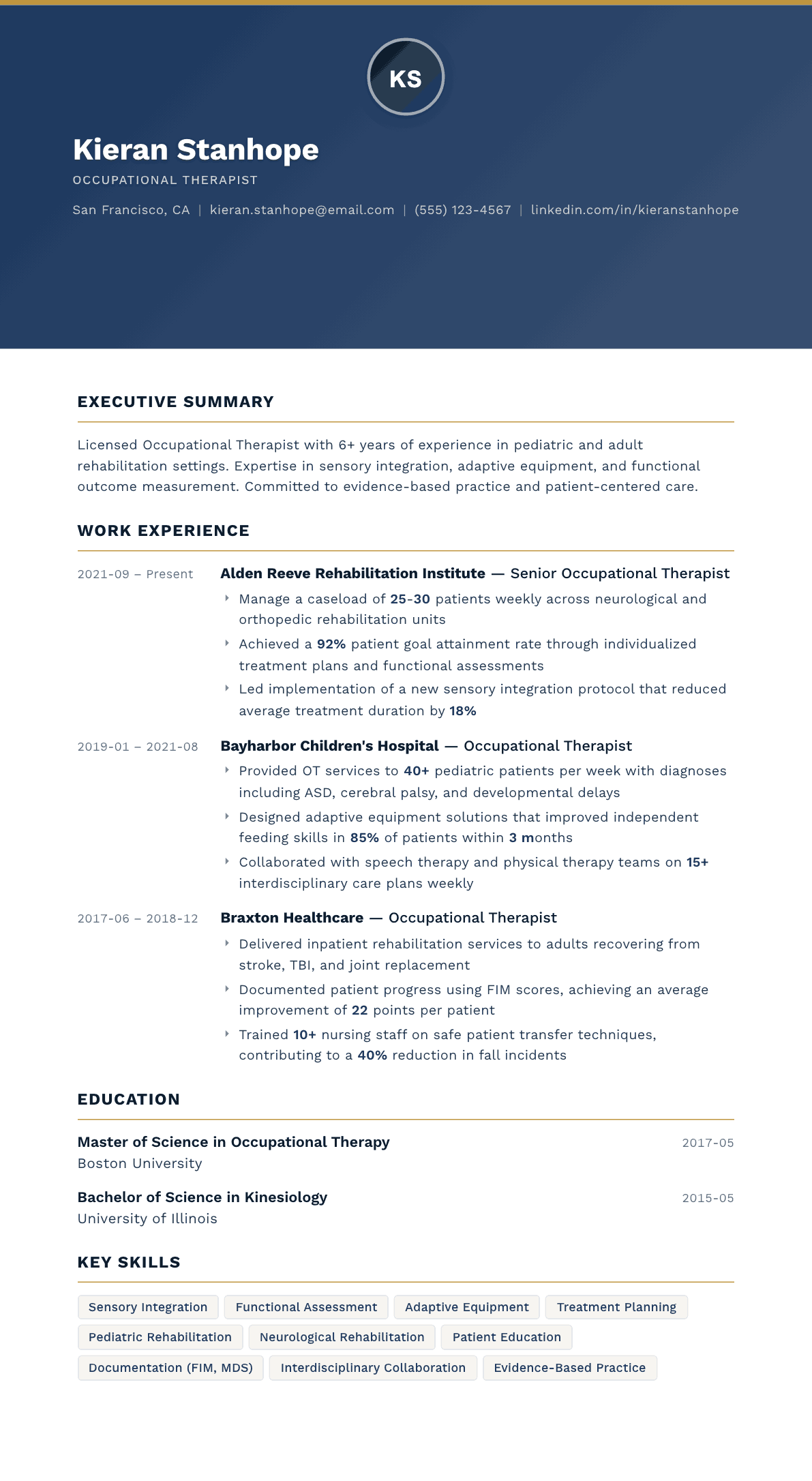
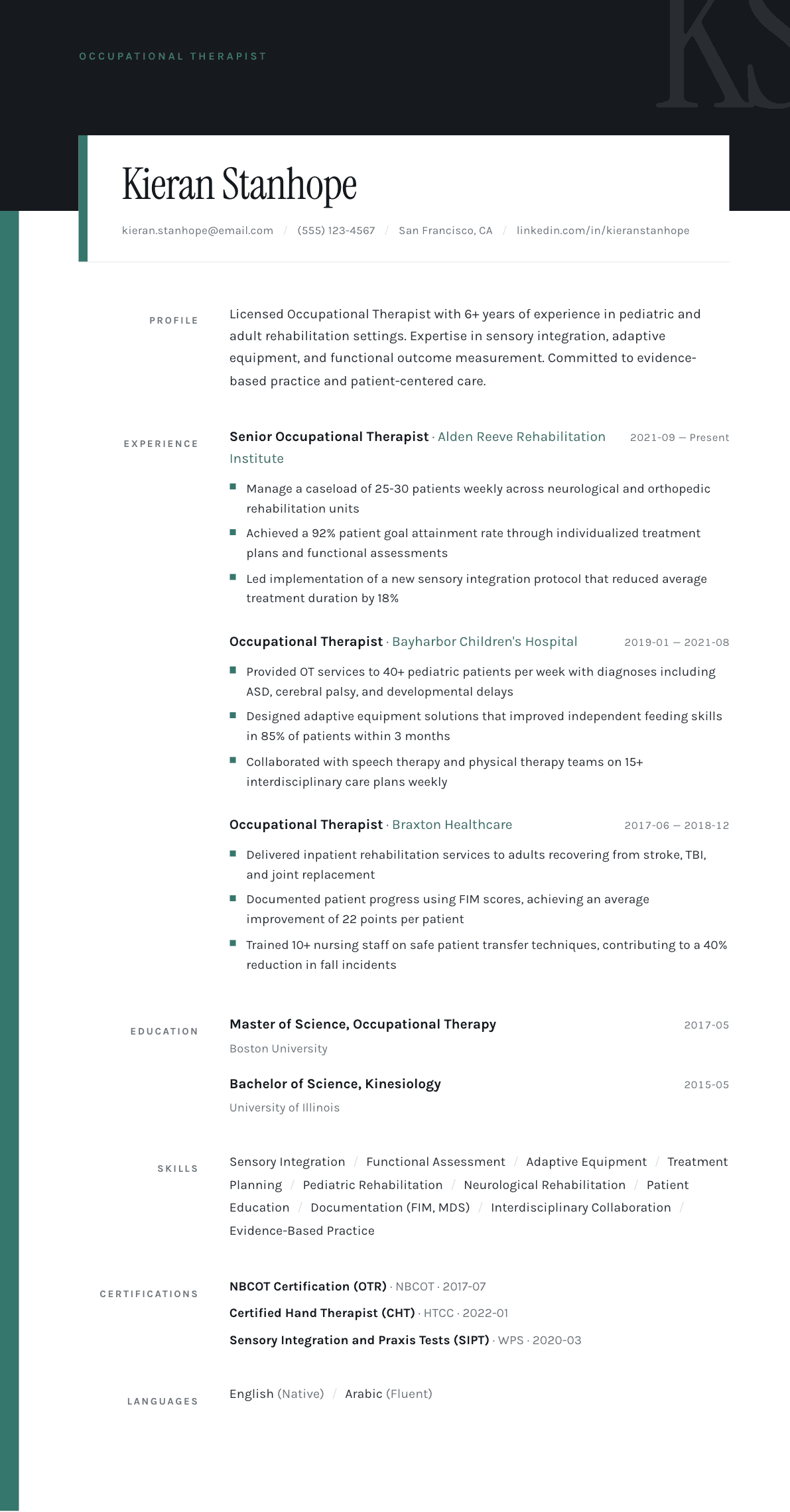
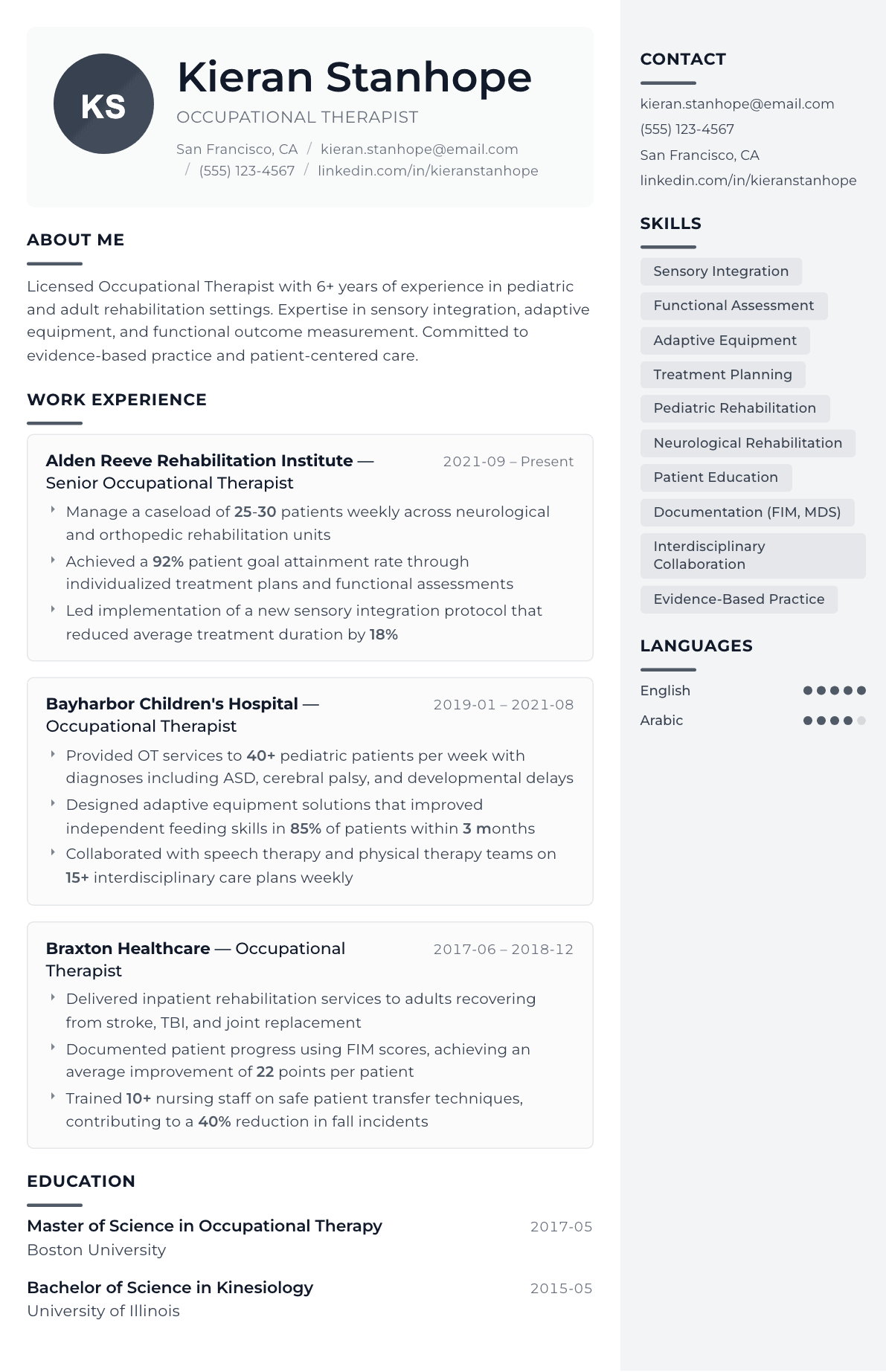
Example Occupational Therapist summary
Occupational Therapist (OTR/L) with 6 years across pediatric and adult rehabilitation, carrying caseloads of 25-30 patients a week. Reached 92% goal attainment using standardized functional assessment and sensory integration protocols. Targeting a senior OT role with clinical program development.
Skills to list on a Occupational Therapist resume
- Functional Assessment
- Treatment Planning
- Sensory Integration
- Adaptive Equipment
- Neurological Rehabilitation
- Pediatric OT
- Geriatric OT
- Hand Therapy
- Cognitive Rehabilitation
- Patient Education
- Documentation
- Interdisciplinary Collaboration
- Evidence-Based Practice
- Home Safety Assessment
What actually gets this resume read
- Include your NBCOT certification and state license number prominently.
- Quantify caseload sizes, patient outcomes, and goal attainment rates.
- Specify the populations you work with: pediatric, adult, geriatric, or specialty areas.
- Highlight evidence-based interventions and standardized assessments you use.
- Mention continuing education and specialty certifications like CHT or SIPT.
- Show interdisciplinary collaboration experience with PT, SLP, and nursing teams.
How to write a occupational therapist resume
An occupational therapist resume is screened by a rehabilitation director or a therapy manager who has to fill a specific caseload in a specific setting. Her first questions are the license and its state, the setting you have worked in, the diagnoses you treat, the assessments you administer, and whether you can carry the productivity standard her department is held to. Everything else is secondary.
The most common weakness in these files is that they describe occupational therapy in general rather than the therapist writing them. Every occupational therapist evaluates, treats and documents. What distinguishes a candidate is the population, the standardized assessments, the interventions and equipment, the outcome measures the setting uses, and the documentation systems that make reimbursement work.
This guide covers the section order rehabilitation managers expect, how to present licensure and the national certification, how to write caseload and outcomes in the language each setting uses, and the questions occupational therapists ask when moving between school based practice, acute care, inpatient rehabilitation, skilled nursing, hand therapy and home health.
Format: one page early, credentials and setting in every heading
Reverse chronological, one page for the first several years and two once you have multiple settings, a specialty certification or supervisory experience. Skip decorative templates: rehabilitation departments in hospitals run applications through parsers that mishandle columns and drop the license line.
Write the credential after your name as the profession writes it, with the degree, the licensure designation and the state. Then repeat the license with its number and expiration in a licensure block, along with the national certification, since employers verify both separately.
- Header: name with credentials, city and state, phone, email, and the states you hold a license in.
- Sections in this order: summary, licensure and certification, clinical experience, assessments and interventions, fieldwork for new graduates, education.
- Name the setting in every job heading: acute care, inpatient rehabilitation, skilled nursing, outpatient, school district, early intervention or home health.
Summary: setting, population, caseload, specialty
Three lines. Give the years, the settings, the populations and one area of depth. "Occupational therapist with six years across pediatric outpatient and inpatient neurological rehabilitation, treating twenty five to thirty patients weekly with a focus on sensory integration and adaptive equipment" tells a manager immediately whether you fit her opening.
If you are changing settings, name the transferable clinical thread instead of hoping the reader finds it. A skilled nursing therapist moving to acute care should lead with early mobility, precautions after joint replacement, cognitive screening and discharge recommendations, not with maintenance therapy volume.
Experience: caseload, diagnoses, and functional outcomes
Start each role with the facility type, the caseload per week or per day, the age range and the diagnoses. Then write bullets around evaluation, treatment planning and functional outcome. Managers read for whether you can evaluate independently and defend a plan of care when a payer questions it.
Name the interventions that are specific to your setting: activities of daily living retraining, upper extremity strengthening and range of motion, splinting and orthotic fabrication, cognitive and perceptual remediation, sensory integration, feeding and oral motor work, wheelchair seating and positioning, home safety evaluation and modification, driver rehabilitation, and return to work conditioning.
Use the outcome language of the setting. Inpatient rehabilitation and skilled nursing settings score functional independence and self-care and mobility performance on a standardized scale; outpatient settings track functional outcome instruments; school practice tracks progress against individualized education program goals. Write results in the measure your department actually reported.
Assessments, equipment and documentation
List the standardized assessments you administer, because that list is a direct proxy for clinical depth. Depending on your setting these may include developmental and sensory processing measures for pediatrics, cognitive screening tools, upper extremity and hand function tests, activities of daily living scales, and fall risk or balance measures. Name only the ones you can score and interpret.
Add the equipment and technology you fabricate, fit or train on: static and dynamic splints, adaptive feeding and dressing equipment, transfer devices and mechanical lifts, wheelchairs and custom seating, augmentative communication supports, and home modification recommendations.
Documentation is a hiring factor. Name the platform you chart in, whether you have written evaluations that held up to a payer audit, and whether you have handled the minimum data set process in a skilled nursing facility or individualized education program paperwork in a school. Managers hire therapists whose notes do not create rework.
The vocabulary the posting will use
Therapy job descriptions recycle a small set of terms: occupational profile, activities of daily living and instrumental activities of daily living, plan of care, functional mobility, fine motor and visual motor skills, adaptive equipment, home exercise program, interdisciplinary team, discharge planning, productivity standard and clinical documentation. Use the posting phrasing once in a skills block and once in a bullet that proves it.
Productivity is the term candidates avoid and managers care about. If you consistently met a departmental standard while keeping documentation current, say so plainly, because that combination is the whole job in a busy rehabilitation department.
Occupational Therapist resume summary examples
New graduate therapist
Entry level occupational therapist licensed and nationally certified, with three level two fieldwork placements in inpatient rehabilitation, pediatric outpatient and skilled nursing. Trained in activities of daily living retraining, cognitive screening and splinting, and seeking a rehabilitation position with structured mentorship.
Six years in practice
Occupational therapist with six years across neurological and orthopedic rehabilitation, carrying twenty five to thirty patients weekly. Evaluates independently, fabricates upper extremity orthoses, and leads adaptive equipment training for stroke and traumatic brain injury patients returning home with family caregivers.
Senior or lead therapist
Senior occupational therapist with eleven years in pediatric and adult rehabilitation, now clinical lead for a six therapist team and fieldwork coordinator for two universities. Built the sensory integration protocol used across the clinic and mentors new graduates through their first year of independent evaluation.
Work experience bullets: before and after
Before: Provided occupational therapy to patients.
After: Carried a weekly caseload of twenty five to thirty patients across neurological and orthopedic rehabilitation units, completing evaluations, plans of care and discharge recommendations independently.
Caseload, unit type and independent evaluation scope are what a rehabilitation manager is sizing.
Before: Helped patients improve daily living skills.
After: Retrained dressing, bathing and kitchen safety for stroke survivors using adaptive equipment and one handed technique, and trained family caregivers before every discharge home.
Naming the tasks, the technique and the caregiver handoff shows real functional practice.
Before: Worked with children with developmental delays.
After: Treated forty pediatric clients weekly with autism spectrum disorder, cerebral palsy and developmental delay, running sensory integration sessions and building home programs with parents each visit.
Volume, diagnoses and the parent-facing home program turn a vague population claim into practice.
Before: Documented patient progress.
After: Documented evaluations, daily notes and progress reports in the electronic record within the same shift, and defended two plans of care successfully through payer review without a downgrade.
Timeliness plus a payer outcome is the documentation evidence a therapy manager actually wants.
Before: Trained staff on transfers.
After: Delivered safe patient handling training to more than ten nursing staff on transfer technique and mechanical lift use, which cut transfer related incidents on the unit over the following two quarters.
The audience, content and downstream effect make the training claim measurable.
Hard skills
- Occupational profile and evaluation
- Activities of daily living retraining
- Standardized assessment administration
- Splinting and orthotic fabrication
- Sensory integration intervention
- Cognitive and perceptual remediation
- Wheelchair seating and positioning
- Home safety evaluation
- Upper extremity rehabilitation
- Adaptive equipment prescription
- Discharge planning
- Clinical documentation and plan of care writing
Soft skills
- Motivating reluctant patients
- Caregiver teaching
- Interdisciplinary collaboration
- Creative problem solving
- Patience across slow progress
- Time management under productivity targets
Certifications worth listing
- Occupational Therapist Registered, OTR (National Board for Certification in Occupational Therapy)
- Certified Hand Therapist (CHT) (Hand Therapy Certification Commission)
- Assistive Technology Professional (ATP) (Rehabilitation Engineering and Assistive Technology Society of North America)
- Board Certification in Pediatrics (BCP) (American Occupational Therapy Association)
- Certified Driver Rehabilitation Specialist (CDRS) (Association for Driver Rehabilitation Specialists)
- Certified Lymphedema Therapist (CLT) (Lymphology Association of North America)
Mistakes that cost occupational therapist candidates the interview
- Describing the profession rather than your own practice, so every bullet could belong to any therapist in the country.
- Leaving the setting out of the job heading, when school practice and acute care share a title and share almost nothing else.
- Listing assessments you have heard of rather than the ones you can administer, score and defend in an evaluation.
- Omitting caseload and productivity, which are the operational numbers a rehabilitation manager plans around.
- Reporting improvement without the measure your department used, which makes an honest result sound invented.
- Skipping fieldwork detail as a new graduate when those placements are the only clinical evidence on the page.
Occupational Therapist resume questions
How do I list my occupational therapy license and certification?
Put the credentials after your name, then give a licensure block with the state license number and expiration plus the national certification. Employers verify the license through the state board and the certification through the certifying body, so both need to appear.
What should a new graduate occupational therapist put in the experience section?
Level two fieldwork, written as clinical experience. Give the site, the setting, the population, the weeks completed, the assessments used and the interventions you delivered. Add level one placements only if you have room and they add a different setting.
How do I move from a school setting into a hospital or rehabilitation job?
Rewrite the summary around adult functional outcomes and lead with anything transferable: evaluation independence, standardized testing, splinting, adaptive equipment and family training. Then address the pace difference directly, because managers assume school therapists have not worked to a productivity standard.
Should I include productivity numbers on my resume?
Yes if you met the standard consistently and can say so alongside timely documentation. Rehabilitation departments are measured on productivity, and a therapist who hits it without falling behind on notes is exactly what the manager is trying to hire.
Does a specialty certification make a difference?
A recognized specialty credential such as hand therapy, assistive technology or lymphedema certification moves a resume up the pile for the jobs that need it. Pursue the one that matches the setting you want rather than collecting several unrelated ones.