Physical Therapist Assistant Resume Examples: free score
PTA Resume Example: a Physical Therapist Assistant Resume Built for Clinics
By Mustafa Tarabya, founder of CVBooster · Published · Updated
A PTA resume example and physical therapy assistant resume guide: caseload, setting and modality detail, plus keywords for outpatient and rehab hiring.
Sample resumes for a physical therapist assistant
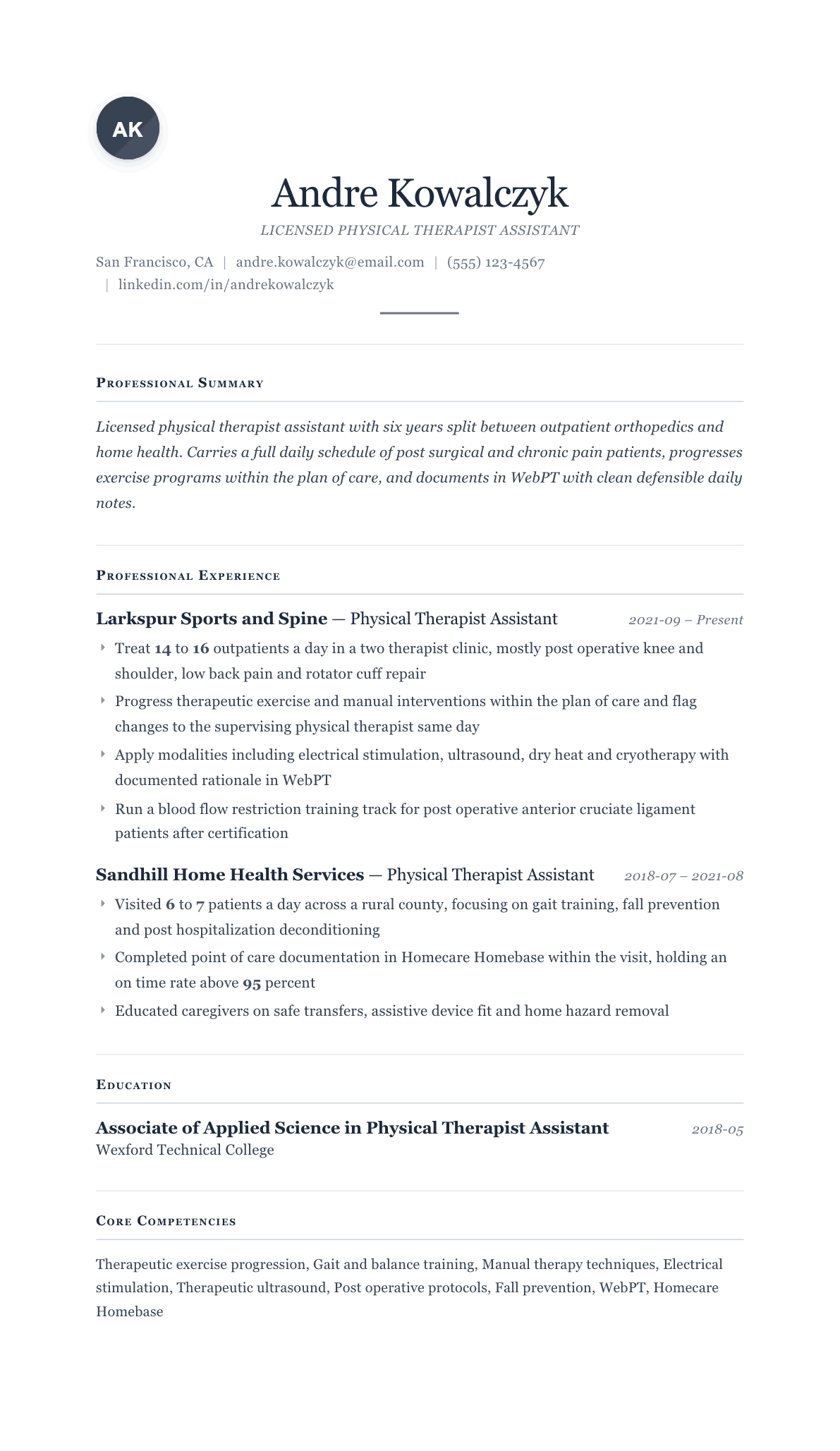
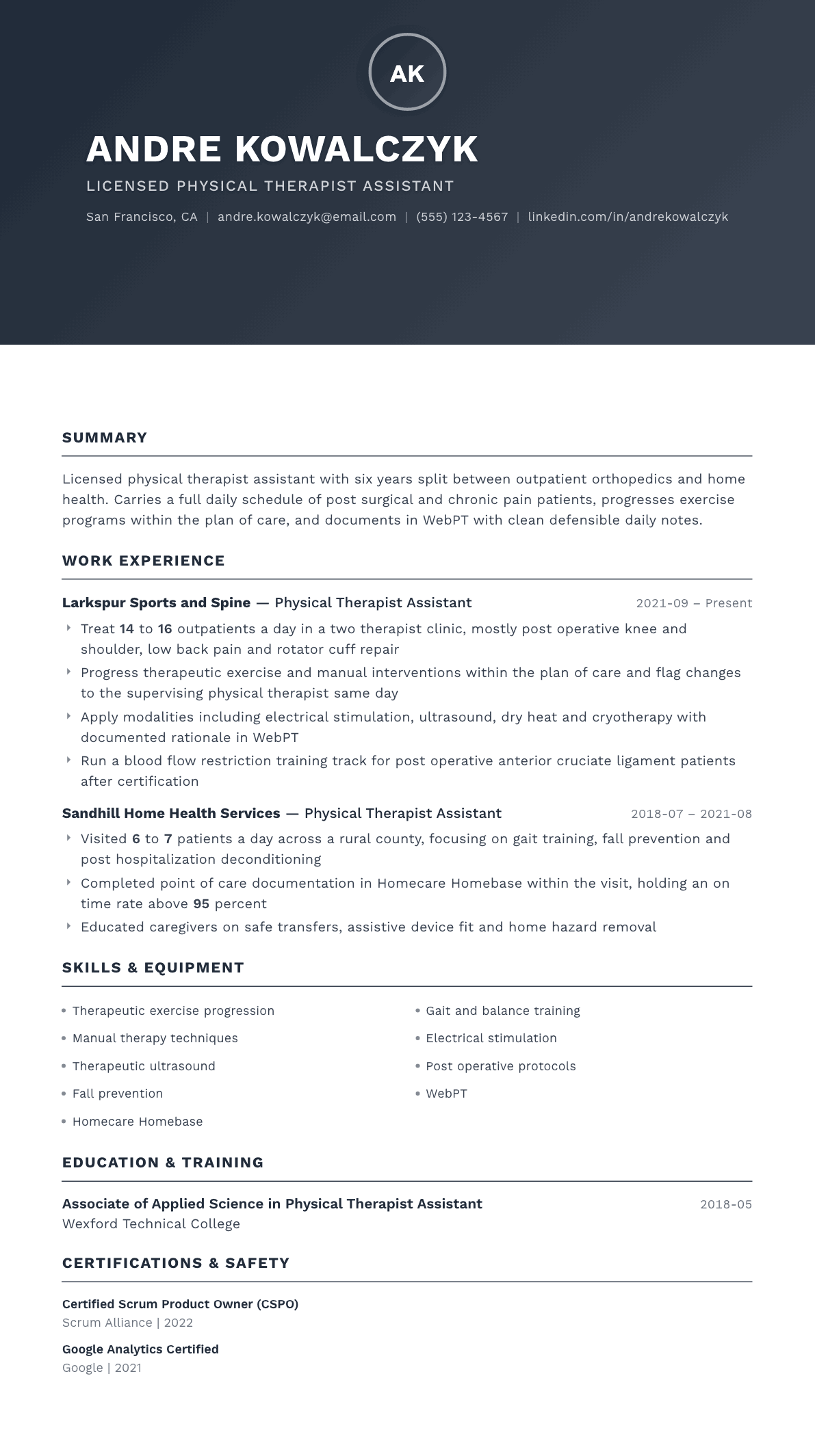
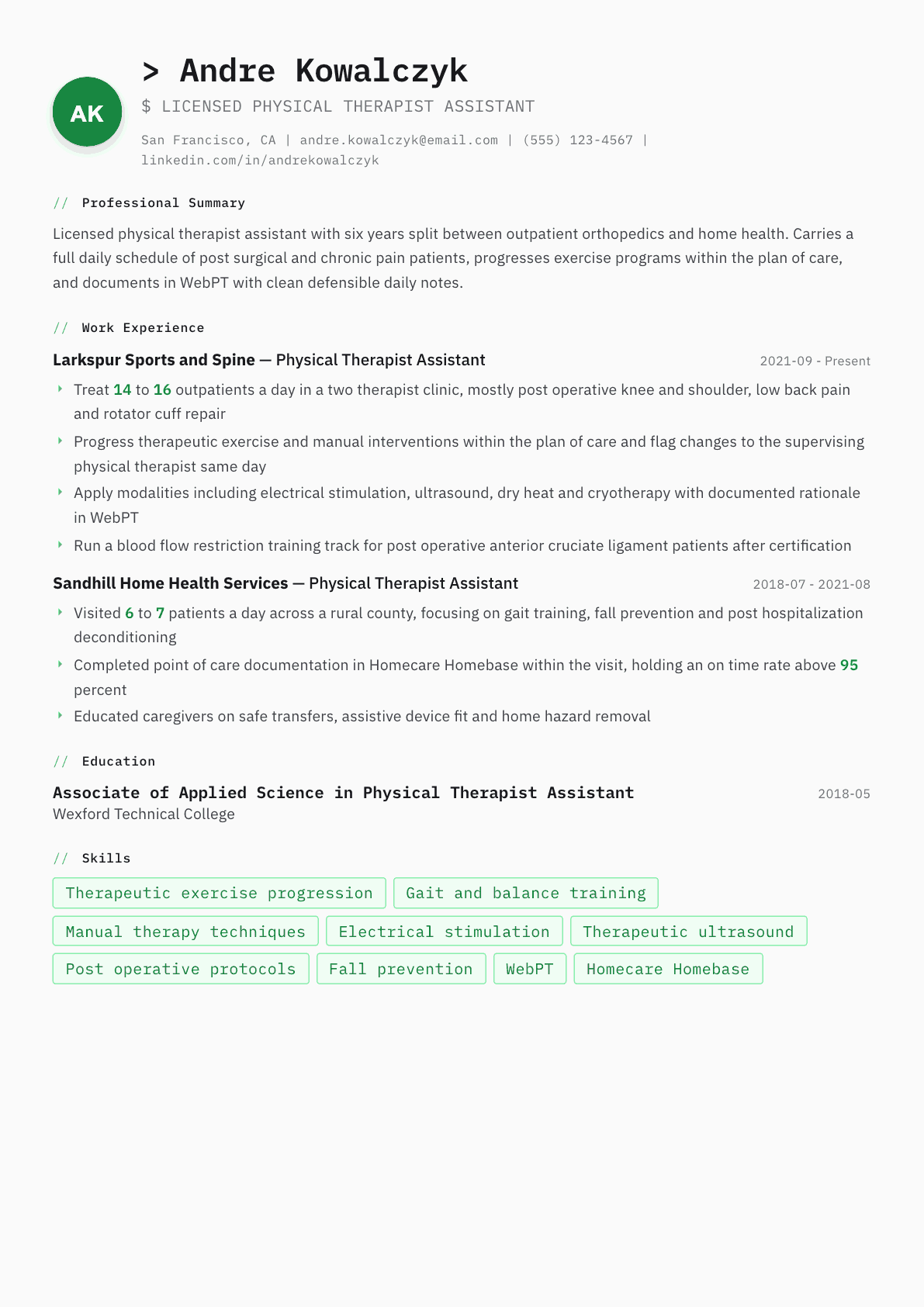
The same physical therapist assistant content laid out in three CVBooster templates, so you can see what the finished document looks like before you write a word.
Example Physical Therapist Assistant summary
Licensed physical therapist assistant with six years across outpatient orthopedics and home health. Treats fourteen to sixteen patients a day through post operative knee, shoulder and spine caseloads, progressing exercise within the plan of care and reporting changes to the supervising therapist. Applies modalities with documented rationale, tracks objective outcome measures, and keeps daily notes complete before leaving the clinic.
Skills to list on a Physical Therapist Assistant resume
- Therapeutic exercise
- Gait training
- Balance and vestibular training
- Manual therapy techniques
- Soft tissue mobilization
- Electrical stimulation
- Therapeutic ultrasound
- Cryotherapy and moist heat
- Post operative orthopedic protocols
- Fall prevention programs
- Assistive device fitting
- Patient and caregiver education
- WebPT
- Homecare Homebase
- Objective outcome measures
What actually gets this resume read
- State your license and the state that issued it near the top, because clinics verify it before scheduling an interview.
- Give patients per day and clinic size, since an outpatient mill and a hospital gym are different jobs entirely.
- Name post surgical protocols you have followed, such as anterior cruciate ligament reconstruction or total joint pathways.
- List modalities and manual techniques explicitly, because those words are pulled straight from the job posting.
- Show how you communicate changes back to the supervising physical therapist, since that is a regulated relationship.
- Add certifications like blood flow restriction or vestibular training, which separate you from an equally licensed applicant.
How to write a physical therapist assistant resume
A physical therapist assistant resume is read by a clinic director doing arithmetic. How many patients an hour can this person take, how long before they can run a schedule unsupervised, and will the notes be finished at the end of the day. Every bullet either helps that arithmetic or it is filler.
The second read is about setting. Outpatient orthopedics, hospital acute care, skilled nursing, home health and pediatrics are five different jobs sharing one license. A clinic hiring for a busy orthopedic schedule wants patients per day and post surgical protocol familiarity. A home health agency wants visit productivity, independent territory work and point of care documentation. Say which one you have done.
This guide walks through the order those readers expect, three summaries from new graduate through a senior assistant, a complete PTA resume written out section by section, before and after bullets pulled from treatment sessions, and the questions assistants ask when they change settings or come back after a gap.
Format: license line first, one page for most applicants
Put your license type, the issuing state and the status directly under your name. Clinics verify licensure before scheduling an interview, and a missing state slows the file down for no reason. Add a second line for certifications that change what you can treat, such as blood flow restriction training or a vestibular course.
Keep the resume to one page unless you have run a clinic schedule, precepted students or worked across several settings. Under the summary, add a settings and volume line so a director can see your pace at a glance.
- Header: name, license type, state and status, city and state, phone, email.
- Order: summary, license and certifications, settings and volume, clinical experience, clinical education, degree, skills.
- New graduates put both full time clinical education rotations above employment, with weeks, setting and caseload named.
Summary: setting, daily volume, and the caseload you are fluent in
Three lines that answer where, how many and what kind. A physical therapist assistant treating fourteen to sixteen outpatients a day in a two therapist clinic, mostly post operative knee and shoulder plus low back pain, has told the reader everything the first screen needs.
If you are switching settings, name the move and the bridge. An assistant leaving home health for outpatient should point to the orthopedic caseload inside those visits, the exercise progression work and any manual technique training, rather than leaving the reader to guess.
Experience: progression within the plan of care
The core of this job is progressing a program the physical therapist wrote, recognizing when a patient is not responding, and telling the therapist the same day. Write bullets that show that loop. Progressed therapeutic exercise within the plan of care and flagged a change in pain behavior to the supervising therapist before the next visit is a bullet that gets read twice.
Name interventions precisely. Therapeutic exercise, neuromuscular reeducation, gait training, balance and vestibular work, soft tissue mobilization, joint mobilization within your state scope, manual stretching, and modalities including electrical stimulation, therapeutic ultrasound, cryotherapy and moist heat. Add the rationale you documented, since modality use without a documented reason is a denial waiting to happen.
Post surgical protocols are a keyword goldmine and a genuine skill. Anterior cruciate ligament reconstruction, rotator cuff repair, total knee and total hip arthroplasty, lumbar fusion and Achilles repair each carry timelines and precautions. Naming the ones you have followed tells a clinic you will not need protocol coaching.
Documentation, outcome measures and the productivity question
Name your documentation platform, whether that is WebPT, Raintree, Homecare Homebase, Epic or a hospital rehab module. Then say when the notes get finished. Daily notes closed before leaving the clinic is a genuine differentiator, because incomplete documentation is the single most common problem clinic directors describe.
List the objective outcome measures you collect: the numeric pain rating, goniometric range of motion, manual muscle testing grades, the Timed Up and Go, the Berg Balance Scale, the six minute walk test, and the patient reported outcome tools your clinic used. Measurement is what makes a progress note defensible.
- State patients per day or visits per day, with the setting that produced that number.
- Include any schedule ownership, such as running a second treatment area or covering a therapist absence.
- Mention student or aide supervision, plus any clinic workflow you helped build.
Keywords and tailoring by setting
Postings use PTA, physical therapist assistant and physical therapy assistant for the same licensed job, and applicant tracking systems do not always treat them as one term. Write the full title once in your header and once in the summary, and put PTA in brackets after it, so a resume for a physical therapy assistant opening and one for a PTA opening both match. The words a filter searches for are consistent after that: therapeutic exercise, gait training, manual therapy, modalities, plan of care, supervising physical therapist, home exercise program, fall prevention, and the setting name. Place each once in the skills block and once inside a bullet.
Then rewrite the top for the setting. Acute care wants early mobility, line and drain awareness, bed mobility and safe transfer with monitoring equipment attached. Pediatrics wants developmental milestones, play based intervention and family coaching. Skilled nursing wants restorative programs, group treatment rules and functional coding. The bottom half of the resume can stay the same.
A complete PTA resume, written out
Here is a full resume for an invented outpatient physical therapist assistant with four years of experience, in the order a clinic director reads it. Copy the structure and replace every detail with your own license, caseload and clinics.
- Header: Jenna Morales, PTA, Licensed Physical Therapist Assistant, Texas license active, Austin, TX, phone, email.
- Summary: Physical therapist assistant (PTA) with four years in outpatient orthopedics, treating 14 to 16 patients a day under two supervising therapists. Progresses post operative knee and shoulder programs within the plan of care and closes every daily note in WebPT before leaving the clinic.
- Settings and volume: outpatient orthopedics, four years, 14 to 16 patients a day; skilled nursing clinical rotation, 7 weeks.
- Physical Therapist Assistant, Eastside Sports and Spine, current role: progresses therapeutic exercise for total knee arthroplasty, rotator cuff repair and lumbar programs; applies electrical stimulation and ultrasound with documented rationale; collects range of motion and Timed Up and Go measures for progress notes; trains new rehab aides on clinic flow.
- Clinical education: outpatient orthopedics, 8 weeks, 10 patients a day; skilled nursing, 7 weeks, group and individual treatment.
- Education and certifications: Associate of Applied Science, Physical Therapist Assistant program; Basic Life Support; blood flow restriction training course.
- Skills: therapeutic exercise, gait training, neuromuscular reeducation, modalities, home exercise programs, fall prevention, WebPT.
Physical Therapist Assistant resume summary examples
New graduate
Licensed physical therapist assistant and recent associate degree graduate with two full time clinical rotations: 8 weeks in outpatient orthopedics carrying 10 patients a day and 7 weeks in a 140 bed skilled nursing facility. Trained in therapeutic exercise, gait training and modality application.
Five years in outpatient
Physical therapist assistant treating 14 to 16 outpatients a day in a two therapist orthopedic clinic. Progresses post operative knee, shoulder and spine programs within the plan of care, applies modalities with documented rationale, collects objective outcome measures, and closes every daily note in WebPT before leaving.
Senior assistant across settings
Physical therapist assistant with ten years across outpatient orthopedics, home health and acute care. Certified in blood flow restriction training, runs a post operative anterior cruciate ligament track, precepts assistant students, and built the clinic home exercise program library used by four clinicians.
Work experience bullets: before and after
Before: Treated patients in an outpatient physical therapy clinic.
After: Treated 14 to 16 outpatients a day in a two therapist clinic, mostly post operative knee and shoulder, rotator cuff repair and low back pain.
Daily volume, staffing context and caseload type let a clinic director judge pace and fit in one line.
Before: Followed the plan of care set by the physical therapist.
After: Progressed therapeutic exercise and manual interventions within the plan of care and reported changes in pain behavior or range of motion to the supervising physical therapist the same day.
The strong version shows the communication loop that state practice acts require and that directors worry about.
Before: Applied modalities such as ultrasound and electrical stimulation.
After: Applied electrical stimulation, therapeutic ultrasound, cryotherapy and moist heat with parameters and clinical rationale documented in every note.
Documented rationale is what keeps modality billing defensible, so it matters more than the modality list itself.
Before: Did home visits for patients after hospital discharge.
After: Completed 6 to 7 home visits a day across a rural county for gait training, fall prevention and post hospitalization deconditioning, documenting at the point of care within each visit.
Visit volume, geography and point of care documentation describe the parts of home health that actually challenge people.
Before: Educated patients on their exercises.
After: Built and reviewed home exercise programs with photo handouts, confirmed technique through return demonstration, and adjusted dosage at each visit based on reported soreness.
Return demonstration and dosage adjustment prove adherence work rather than handing over a printout.
Hard skills
- Therapeutic exercise progression
- Gait and stair training
- Balance and vestibular training
- Neuromuscular reeducation
- Soft tissue mobilization
- Electrical stimulation
- Therapeutic ultrasound
- Cryotherapy and moist heat
- Post operative orthopedic protocols
- Fall prevention programs
- Assistive device fitting and training
- Objective outcome measurement
- Home exercise program design
- Point of care documentation
Soft skills
- Cueing and hands on correction
- Motivating patients through slow progress
- Same day reporting to the supervising therapist
- Schedule flexibility when the clinic runs behind
- Caregiver education
- Documentation discipline
Certifications worth listing
- Licensed Physical Therapist Assistant (State physical therapy licensing board)
- Credentialed Clinical Instructor Program (American Physical Therapy Association)
- LSVT BIG Certification (LSVT Global)
- Basic Life Support (BLS) (American Heart Association)
Mistakes that cost physical therapist assistant candidates the interview
- Writing bullets that claim evaluation, plan of care authorship or discharge decisions, which belong to the physical therapist.
- Leaving off patients per day, which is the first number an outpatient clinic director looks for.
- Listing modalities without any documented rationale, since modality use alone reads as low value treatment time.
- Naming no post surgical protocols, so a clinic assumes it will have to teach every timeline from scratch.
- Omitting the license state and status, which forces a recruiter to chase you before the file can move.
- Reusing a home health resume for an outpatient application, where the pace and the caseload evidence are completely different.
Physical Therapist Assistant resume questions
How many patients per day should I put on my resume?
Give the honest range you carried and the setting that produced it. An outpatient clinic reads fourteen to sixteen a day very differently from six home health visits, and both are respectable when the setting is stated alongside the number.
Can a physical therapist assistant list manual therapy on a resume?
List the manual techniques your state practice act permits and your supervising therapist delegated. Soft tissue mobilization and manual stretching are widely permitted; joint mobilization rules vary, so match your wording to the state you are applying in.
Should I include my clinical rotations as a new graduate?
Yes, and treat them as jobs. Give each rotation the setting, the number of weeks, the caseload you carried by the end and the interventions you performed, because that is the only clinical evidence a new graduate has to offer.
How do I explain a gap in clinical work?
Name the reason briefly and then show currency. List continuing education completed, your license renewal status, any per diem or volunteer clinical hours, and refresher courses. Directors worry about rust, not about the gap itself.
What certifications actually help a physical therapist assistant get hired?
Ones that expand what you can treat or teach. Blood flow restriction training, vestibular rehabilitation coursework, an LSVT credential for Parkinson caseloads and clinical instructor credentialing all separate you from an equally licensed applicant.