ESL Teacher Resume Examples: free ATS score and gap list
ESL Teacher Resume and ESL Instructor Resume Examples
By Mustafa Tarabya, founder of CVBooster · Published · Updated
ESL teacher and ESL instructor resume examples for schools, adult programs and teaching abroad: license, CELTA or TESOL, caseload and language growth.
Sample resumes for a esl teacher
The same esl teacher content laid out in three CVBooster templates, so you can see what the finished document looks like before you write a word.
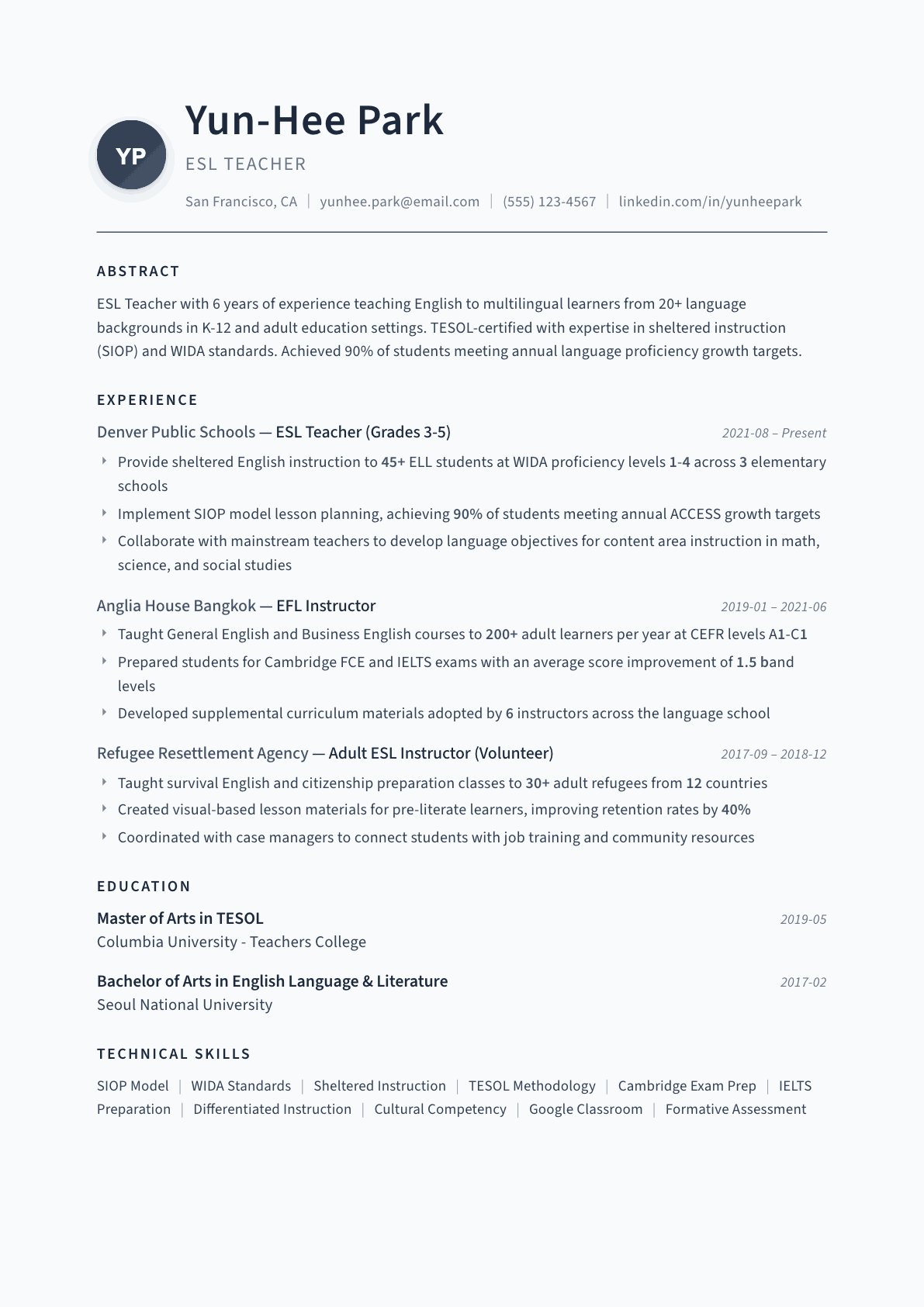
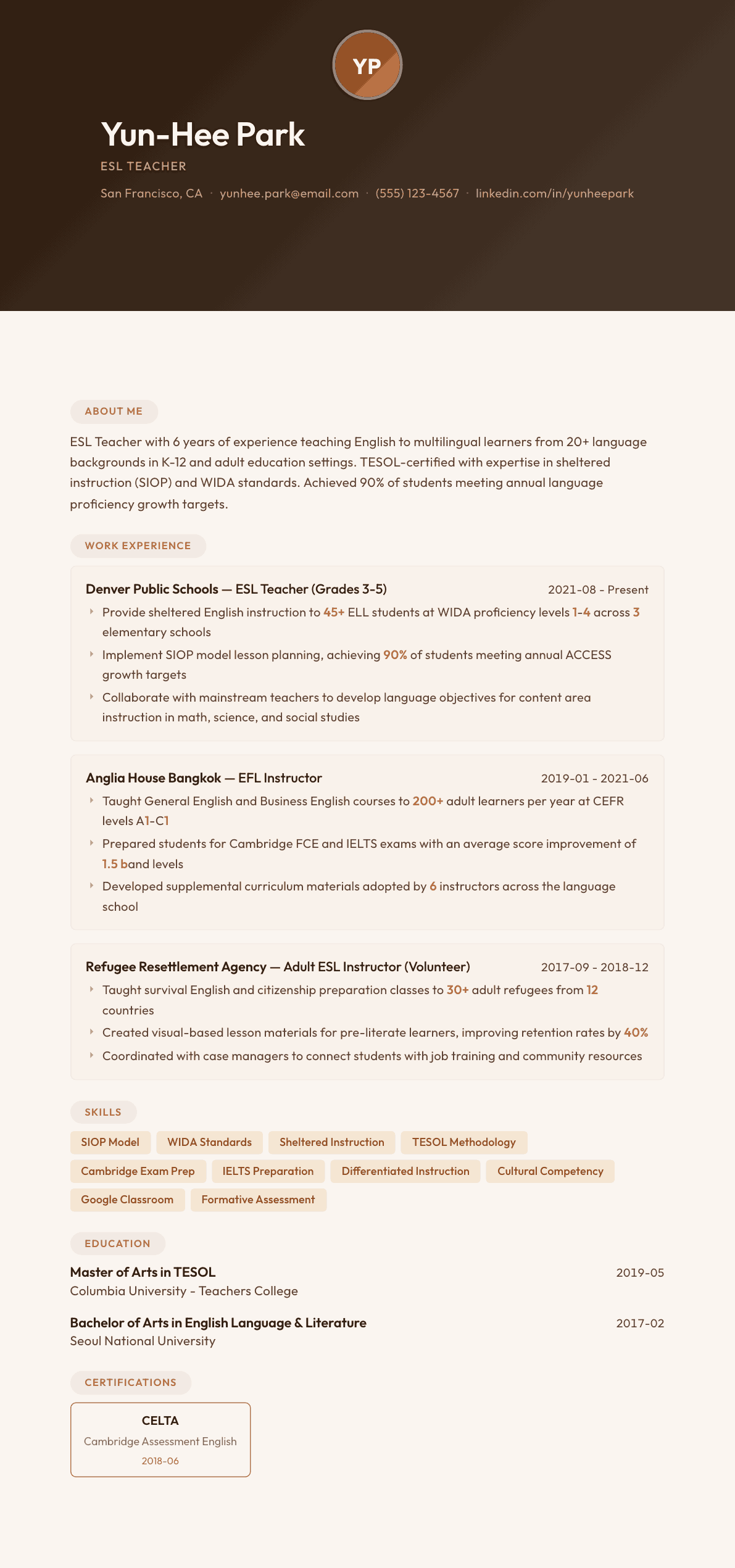
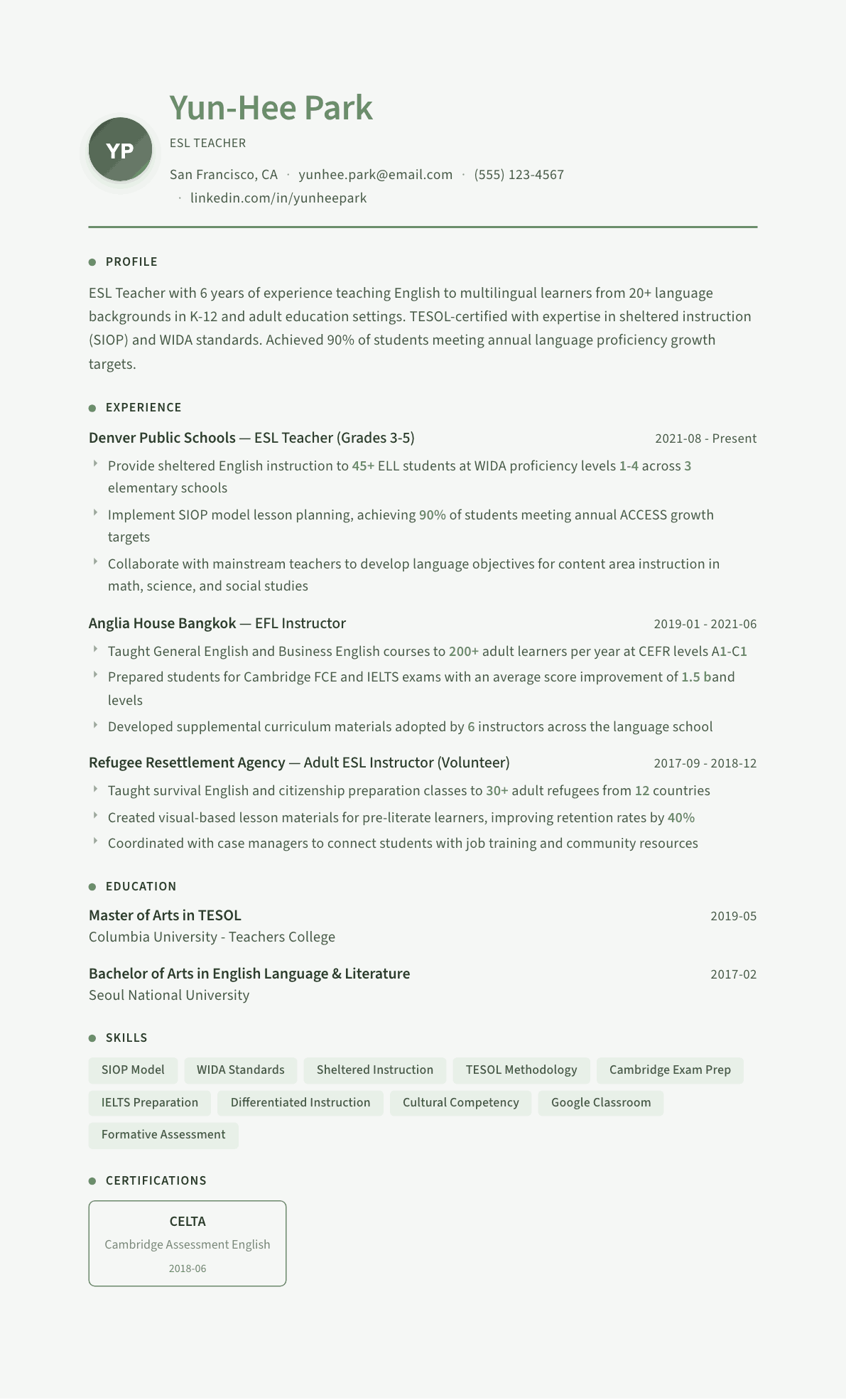
Example ESL Teacher summary
TESOL-certified ESL Teacher with 6 years of experience teaching multilingual learners from 20+ language backgrounds. Expert in SIOP model instruction and WIDA standards with CELTA qualification. Achieved 90% student growth on ACCESS assessments through culturally responsive, data-informed instruction.
Skills to list on a ESL Teacher resume
- SIOP Model
- WIDA Standards
- Sheltered Instruction
- TESOL / TEFL
- CELTA Methodology
- Cambridge Exam Preparation
- IELTS / TOEFL Prep
- Differentiated Instruction
- Cultural Competency
- Formative Assessment
- Language Proficiency Assessment
- Content-Based Instruction
- Newcomer Education
- Bilingual Education
What actually gets this resume read
- Highlight TESOL/TEFL certifications and ESL endorsements prominently.
- Reference instructional frameworks: SIOP, WIDA, CEFR, BICS/CALP.
- Quantify student language growth: ACCESS scores, IELTS/TOEFL improvements, proficiency level gains.
- Mention languages you speak to demonstrate cultural competency and bilingual advantages.
- Describe student populations: grade levels, proficiency levels, language backgrounds, newcomers.
- Include assessment tools: ACCESS for ELLs, WIDA MODEL, LAS Links, running records.
How to write a esl teacher resume
An English as a second language (ESL) teacher resume has to answer a question that other teaching resumes do not: which system are you trained for. Teaching English learners inside a public school district, teaching adults at a community college, teaching abroad in a private language school, and preparing candidates for an international examination are four different professions that share a name. The credentials, the vocabulary and the evidence are different in each, and a resume built for one is usually invisible to the others.
Inside a school district, the screening is credential-driven: a state teaching license with an English learner or bilingual endorsement, familiarity with the state proficiency standards, and knowledge of the identification, service and reclassification process required by federal law. Outside a district, the screening turns on a recognized preparation certificate, teaching hours, and examination results.
This guide covers how to signal which system you belong to, including the ESL instructor resume that adult programs expect, how to write language growth as evidence, the frameworks and assessments each setting expects, and the questions ESL teachers ask when they move between school, adult, and overseas teaching. Postings that say English language teacher, ELL teacher or English teacher for international students want the same evidence, so an English language teacher resume follows the structure below.
Decide the setting first, then build the page for it
Write a separate version of the resume for each setting you are targeting, because the first three lines decide whether the reader keeps going. A district version leads with the state license and endorsement, the grade band, and the number of English learners served. An adult education version leads with the program type, the levels taught and the certificate. An overseas version leads with the preparation certificate, the degree, teaching hours and nationality or work eligibility if the visa route requires it.
Whatever the setting, name the languages your students speak and the languages you speak. A teacher who has worked with newcomers across many first languages and a teacher who works in a single-language community are different hires, and both are valuable to the right program.
- Header: name, city and state or country, phone, email, license and endorsement or preparation certificate, and languages spoken with an honest proficiency level.
- Section order for schools: license, summary, teaching experience, assessment and compliance, education, professional development.
- Section order for adult or overseas roles: certificate, summary, teaching experience with levels and hours, examination preparation, education.
English language teacher resume summary: levels, program model and growth
Name the proficiency levels you teach, the program model you work in, and the population. Newcomer program, sheltered content instruction, a pull-out or push-in model, dual language, a self-contained newcomer classroom, or a co-teaching arrangement with a content teacher are all distinct, and a program director hires for the model she runs.
Then give a language growth result. Movement on the state English proficiency assessment, reclassification numbers, examination pass rates, or level advancement in an adult program. Language growth is measurable in this field, which is an advantage other teaching specialties do not have.
Written out for a district post, an English as a second language teacher resume summary reads: ESL teacher, grades 3 to 5, push in and small group model, caseload of 42 students across four home languages, state license with an ESL endorsement. Helped 11 students reach the reclassification threshold last school year. Every phrase is something a principal can check.
English language teacher resume summary, written out: English language teacher with six years teaching adult learners from beginner to upper intermediate in a community college program. Places students with a standardized intake test, plans units around speaking and workplace writing, and teaches mixed first language groups in evening and online classes.
Experience: caseload, model, and the instruction itself
Open each role with the shape of the caseload: the number of English learners served, the grade or age range, the proficiency levels from newcomer through advanced, the number of first languages represented, and how your time was structured across schools or sections. A line reading 78 English learners across two elementary buildings, levels one through four, 14 first languages tells a director exactly what you have carried.
Then show instruction with the vocabulary of the field. Sheltered instruction with comprehensible input, language objectives written beside content objectives, scaffolds such as sentence frames and graphic organizers, vocabulary instruction with tiered word selection, and the four domains of listening, speaking, reading and writing planned deliberately rather than assumed. Naming the sheltered instruction model you were trained in gives a reader an immediate reference point.
Include co-teaching and consultation, because that is most of the job in a school. Planning with content teachers, modeling scaffolds in their classrooms, writing accommodation guidance, and training staff on what a proficiency level means for a science or history assignment. Teachers who show this read as program builders rather than pull-out instructors.
Assessment, identification and compliance
Name the assessments you administer. In school districts, that means the home language survey, the initial identification screener, the annual English proficiency assessment used in your state, and any progress monitoring tool. In adult and overseas settings, it means placement testing, the Common European Framework of Reference levels, and examination formats such as the international English testing systems or Cambridge examinations.
Then the compliance work, which many candidates omit and directors always notice. Identification within the required window, parent notification of program placement, annual program review, exit and reclassification criteria, monitoring of exited students, and the individual language plan where your state requires one. This is the part that keeps a district out of trouble.
Cultural work and the family bridge
ESL teachers are usually the school's bridge to newcomer families, and that work belongs on the resume. Enrollment support, interpretation coordination, translated communication, orientation for families new to the school system, connection to community and resettlement organizations, and advocacy inside meetings where a family cannot follow the language.
Say it concretely. A newcomer welcome program, a family night with interpretation in three languages, or a partnership with a resettlement agency is evidence. Cultural sensitivity as an adjective in a skills list is not.
ESL teacher and ESL instructor resume examples, start to finish
An ESL teaching resume reads differently in a public school and in a language school abroad, so the sample below is for a teacher applying to a district English learner program, the setting where a screener checks credentials first. The person and schools are invented. If you are applying abroad, keep the order and move the teaching certificate and the age groups taught up to the summary.
An ESL instructor resume is the adult version of the same page: community college noncredit programs, adult education, intensive English and workplace English. The coordinator reading it checks the certificate, the levels and class sizes you have taught, and whether you can cover evening sections. The second sample, starting at Tomas Rivera, is for an instructor applying to a community college program.
- Header: Marisol Vega, ESL Teacher. City, phone, email, state teaching license with the English as a second language endorsement.
- Summary: ESL teacher with six years in elementary and middle school English learner programs, push in and pull out, with a caseload of about forty students across beginning to advanced proficiency. Uses language proficiency test results to group students and to plan with classroom teachers.
- Current role, ESL Teacher, a suburban elementary school, four years: co teaches literacy blocks in grades two to five; leads small group instruction for newcomers; administers the annual proficiency assessment and the screening for new enrollees.
- Coordinates with classroom teachers on language objectives for each unit; runs a family evening each semester with interpreters for the three largest home languages.
- Previous role, English Teacher, a language institute abroad, two years: taught adult and teenage learners from beginner to upper intermediate; designed a speaking assessment rubric the school adopted.
- Licenses and certificates: state teaching license with ESL endorsement; TESOL certificate. Languages: Spanish, fluent; Portuguese, conversational.
- Education: Master of Arts in Teaching English to Speakers of Other Languages; Bachelor of Arts in Linguistics.
- ESL instructor sample, header: Tomas Rivera, ESL Instructor. City, phone, email, CELTA, Master of Arts in TESOL, Spanish fluent.
- Summary: ESL instructor with five years teaching adult learners in community college noncredit and evening programs, from beginning literacy to advanced, in classes of fifteen to twenty-five. Places students with the program placement test and plans units around work, health and citizenship English.
- Current role, Adult ESL Instructor, a community college continuing education program: teaches three evening sections each term; moves learners up through the program levels using the end-of-level test; built a workplace English unit with a hospital housekeeping team.
- Previous role, English Instructor, a university intensive English program: taught academic writing and listening to students preparing for degree study; ran the weekly conversation lab.
ESL Teacher resume summary examples
Newly certified
Newly licensed teacher with an English learner endorsement and a preparation certificate, completing a student teaching placement with 30 newcomer students across grades 3 to 5. Trained in sheltered instruction, administered the state proficiency screener, and speaks Spanish at a professional level.
Six years in a district
ESL teacher with six years serving 78 English learners across two elementary buildings, levels one through four, representing 14 first languages. Co-teaches mathematics and science with four content teachers and moved 21 students to reclassification over three years, above the district average.
Program lead
English learner program lead with twelve years across school and adult settings, supervising five teachers and the district identification and reclassification process. Rebuilt the newcomer program around a two-period intensive block and raised annual proficiency growth targets met from 54% to 76% in two years.
Work experience bullets: before and after
Before: Taught English to students who were learning the language.
After: Served a caseload of 78 English learners across two elementary buildings at proficiency levels one through four, representing 14 first languages, through a mix of pull-out small groups and push-in content support.
Caseload, proficiency range, language diversity and service model define the job in a way the vague version cannot.
Before: Used sheltered instruction strategies in the classroom.
After: Planned every lesson with a paired content and language objective, using sentence frames, visuals and structured partner talk so newcomers could complete the same science tasks as their peers.
Naming the paired objectives and the actual scaffolds shows a practiced method instead of a familiar phrase.
Before: Helped students improve their English proficiency.
After: Moved 21 students to reclassification over three years and raised the share of caseload students meeting annual growth targets on the state proficiency assessment from 54% to 76%.
Reclassification counts and a named growth measure are the outcomes an English learner program director reports upward.
Before: Worked with classroom teachers to support English learners.
After: Co-planned weekly with four content teachers, modeled scaffolds in their classrooms once a month, and wrote a one-page guidance sheet per proficiency level that the department used to adapt assignments.
The planning cadence, the modeling and the artifact turn collaboration into a service other teachers actually received.
Before: Communicated with families from different cultures.
After: Ran a newcomer family orientation each fall with interpretation in three languages, coordinated enrollment paperwork with a local resettlement agency, and arranged interpreters for every individualized education program meeting on my caseload.
Named events, partners and a standing practice make family bridging visible rather than assumed.
Hard skills
- Sheltered content instruction
- Language objective planning
- State English proficiency standards alignment
- Proficiency screening and identification
- Annual proficiency assessment administration
- Reclassification and exit monitoring
- Newcomer program instruction
- Co-teaching and push-in support
- Academic vocabulary instruction
- Foundational literacy for older beginners
- Examination preparation for international English tests
- Placement testing and level assignment
- Parent notification and program compliance
- Differentiation across proficiency levels
Soft skills
- Patience with silent period learners
- Cross-cultural communication
- Advocacy inside school meetings
- Collaboration with content teachers
- Working with interpreters
- Building trust with newcomer families
Certifications worth listing
- State Teaching License with English Learner Endorsement (State Department of Education)
- CELTA (Cambridge Assessment English)
- DELTA (Cambridge Assessment English)
- Trinity CertTESOL (Trinity College London)
- National Board Certification, English as a New Language (National Board for Professional Teaching Standards)
Mistakes that cost esl teacher candidates the interview
- Writing one resume for district, adult and overseas teaching when the three systems screen on completely different credentials.
- Leaving out the state endorsement, which is the field a district application system filters English learner postings on.
- Omitting caseload size, proficiency levels and the service model, so a director cannot picture the job you held.
- Skipping identification, notification and reclassification compliance, which is the legal spine of a district program.
- Listing cultural sensitivity as a skill without a single named family program, partner or interpretation practice behind it.
- Claiming a language on the resume at a level you cannot sustain in an interview, which is easy to test and costly to fail.
ESL Teacher resume questions
What should an English as a second language teacher resume include?
The setting and credential first: a state license with an English learner endorsement for a district, or CELTA, TESOL or TEFL with teaching hours for adult and overseas programs. Then the proficiency levels and age groups you teach, the program model (push in, pull out, sheltered, co-teaching or adult classes), your caseload, and one piece of language growth evidence. Spell out English as a second language once, then use ESL, because postings use both.
Do I need a teaching license to be an ESL teacher?
In a public school district, yes: a state teaching license with an English learner or bilingual endorsement is normally required. Adult education programs, private language schools and overseas positions instead ask for a recognized preparation certificate and a bachelor's degree.
What is the difference between an ESL teacher and an ESL instructor resume?
An ESL teacher resume usually targets a school district and leads with the state license, endorsement and caseload. An ESL instructor resume targets adult education, community colleges and intensive programs, so it leads with the certificate, levels and class sizes taught. For that route, the Cambridge CELTA and the Trinity CertTESOL are the initial certificates employers recognize most widely.
How do I show language growth as evidence?
Use the measures your setting produces: movement on the state English proficiency assessment, students meeting annual growth targets, reclassification counts, level advancement in an adult program, or examination pass rates with the level and examination named.
How do I move from teaching abroad into a school district?
Overseas classroom experience counts, but it does not replace the license. Enter a state certification pathway with an English learner endorsement, learn the identification and reclassification requirements your state uses, and rewrite the resume around caseload, proficiency levels and service model rather than hours taught.