Industrial Engineer Resume Examples: what gets the call
Optimize Your Industrial Engineer Resume for Maximum Impact
By Mustafa Tarabya, founder of CVBooster · Published · Updated
Create an industrial engineer resume showcasing lean manufacturing, process improvement, and operations research expertise with metrics that prove your value.
Sample resumes for a industrial engineer
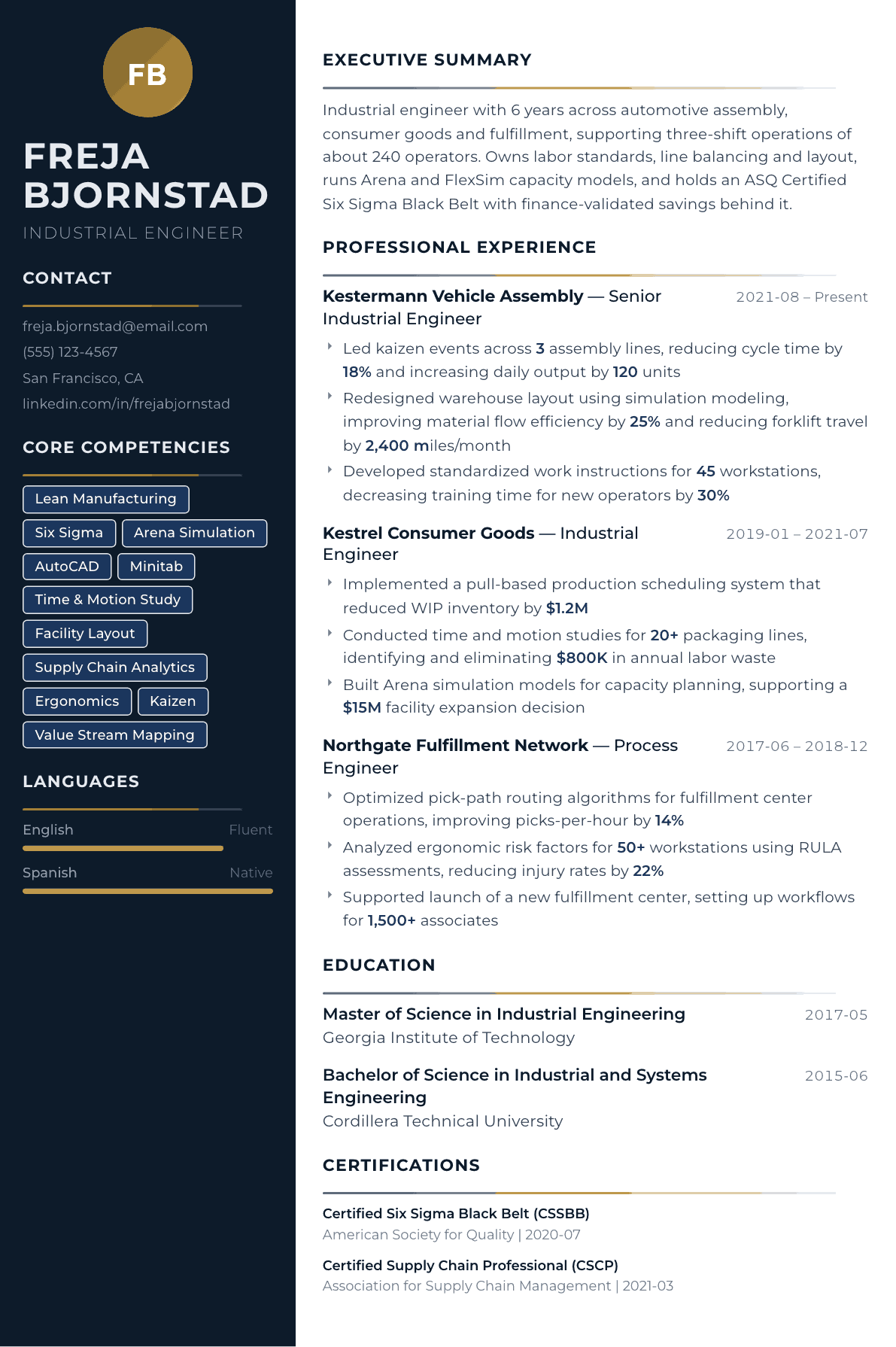
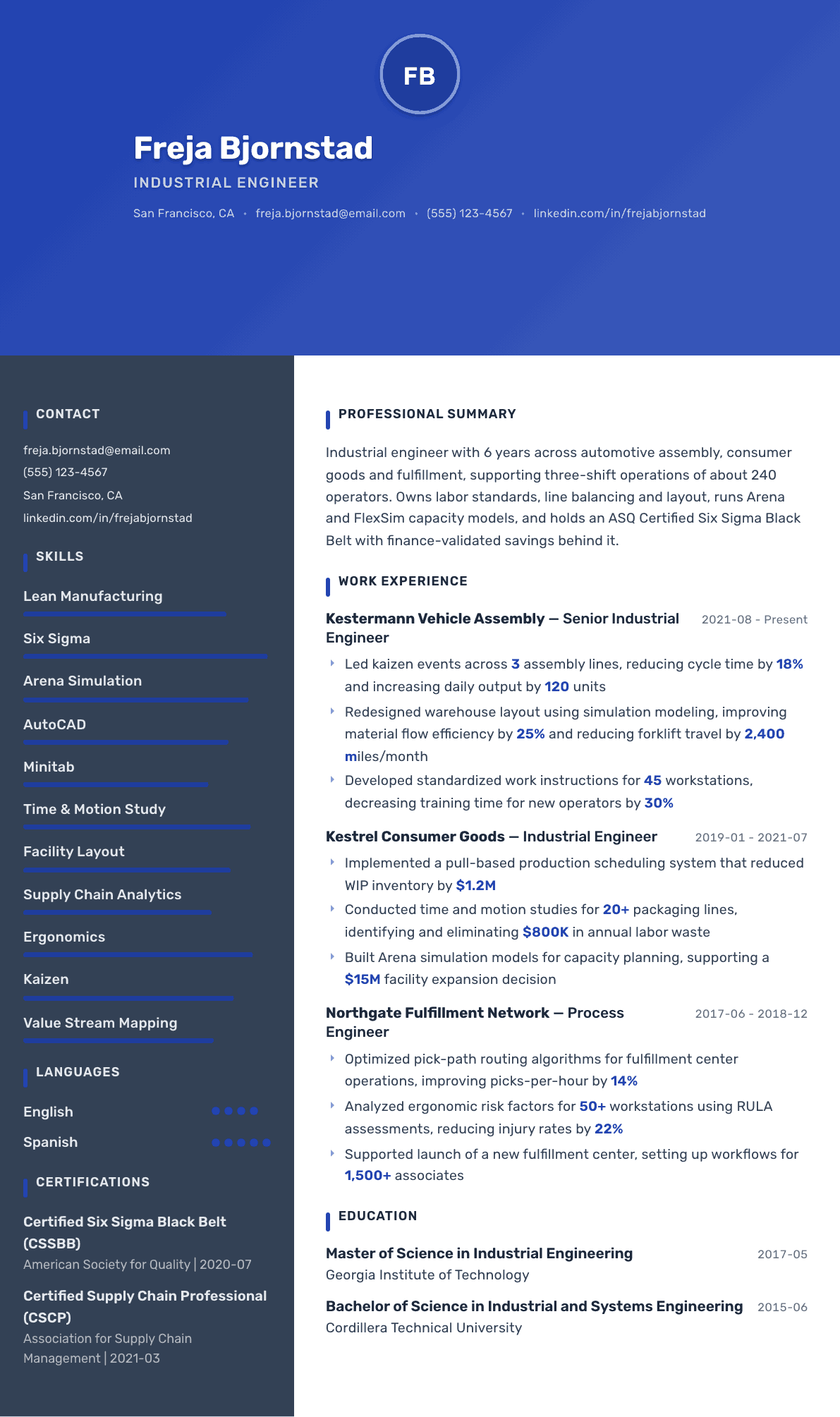
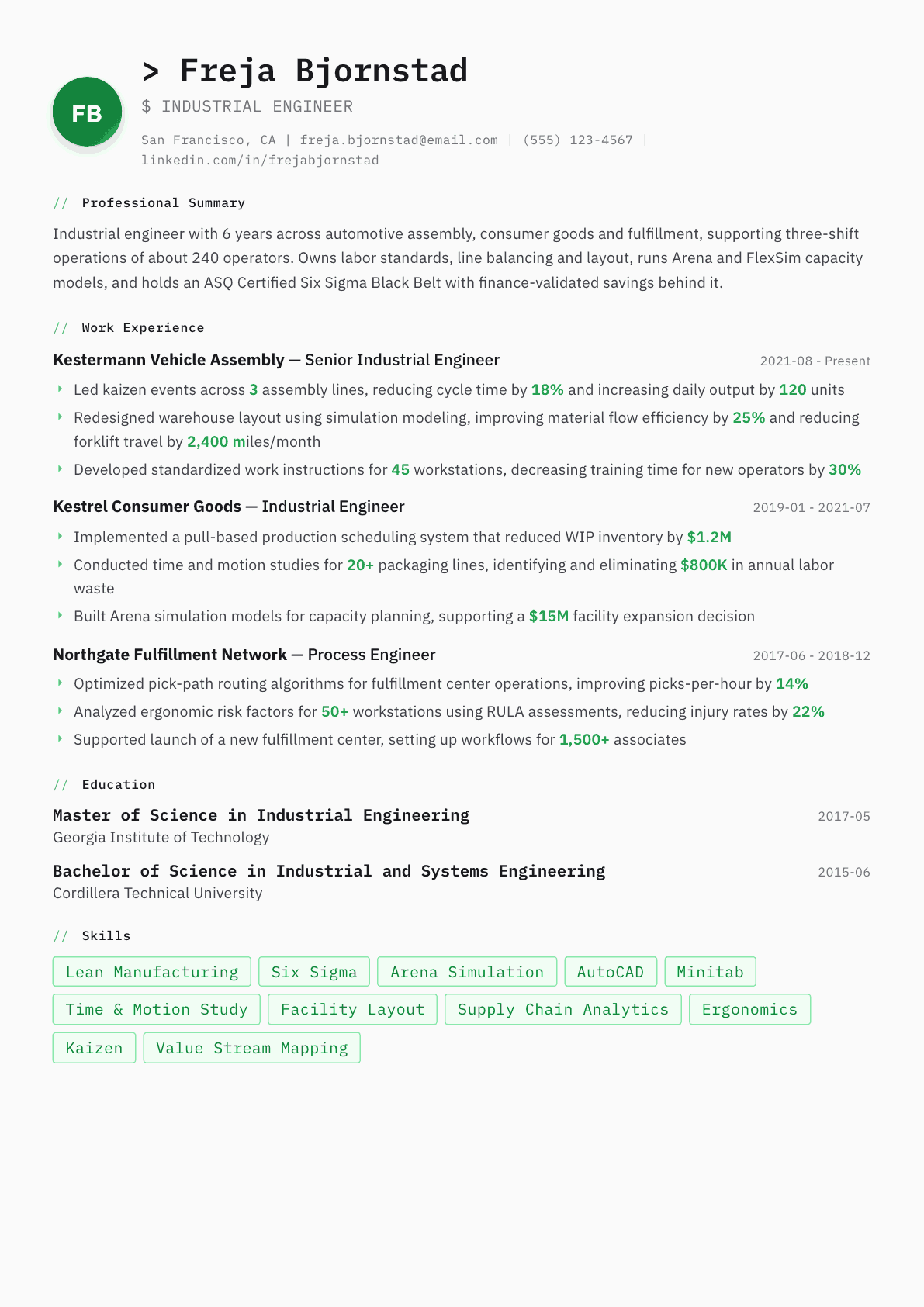
The same industrial engineer content laid out in three CVBooster templates, so you can see what the finished document looks like before you write a word.
Example Industrial Engineer summary
Industrial engineer and ASQ Certified Six Sigma Black Belt with 6 years across automotive assembly, consumer goods and fulfillment. Ran MOST work measurement across 45 workstations and rebuilt the labor standards in the enterprise system, cut cycle time 18% on three assembly lines through kaizen, and removed 2,400 forklift travel miles a month with a simulation-backed layout redesign.
Skills to list on a Industrial Engineer resume
- Lean Manufacturing
- Six Sigma
- Value Stream Mapping
- Kaizen
- 5S
- Arena Simulation
- FlexSim
- Minitab
- Time & Motion Study
- Facility Layout Design
- Ergonomics
- Supply Chain Optimization
- Capacity Planning
- AutoCAD
- Operations Research
What actually gets this resume read
- Write each bullet as constraint, method, result, and name the method: value stream map, MOST work measurement, line balance, SMED, discrete event simulation.
- Quantify in the units the plant reviews daily: seconds off a cycle, units per labor hour, changeover minutes, scrap rate, inventory turns, travel distance removed.
- Say who validated any saving you claim, because a figure signed off by finance carries weight that an engineer estimate does not.
- Name the issuing body for any belt, since an internal company belt and an accredited certification are not read the same way, and give the project behind it.
- Open each job with the operation: product, shifts, headcount supported, annual volume or daily order count, so scale is never left to the reader.
- List the systems of record you pull data from yourself, such as an enterprise resource planning package, a manufacturing execution system or a warehouse management system.
How to write a industrial engineer resume
Industrial engineering resumes are screened by an operations manager who is trying to answer one question: can this person walk onto my floor, measure what is actually happening, and make the line run better without stopping it. Everything else on the page is context for that question.
The trouble is that the vocabulary of the field has been worn smooth. Almost every applicant writes lean, continuous improvement, and process optimization. None of those words tell the reader what you touched. A plant leader wants the process, the volume, the constraint you attacked, and the number that moved: cycle time, takt attainment, changeover minutes, units per labor hour, scrap, throughput, inventory turns.
This guide covers the section order that operations recruiters expect, how to write summaries at three career stages, before and after bullets built on real industrial engineering work, and the questions that come up when you are moving between plants, distribution centers and service operations.
Format: single column, one page early, two pages once you have run projects
Reverse chronological, no graphics, no skill bars. Manufacturers and third party logistics companies run older applicant tracking systems, and a two column layout with icons is the fastest way to have your dates parsed out of order. Keep it a plain document that a plant manager can read on a phone in a break room.
Put a project or key achievements block on page one if your work is project shaped rather than steady state. Many industrial engineers do six month assignments across sites, and a reader needs to see the portfolio, not just the employer name.
- Header: name, city and state, phone, email, and a Six Sigma belt or professional registration if you hold one.
- Order: summary, technical skills, experience, projects if applicable, education, certifications.
- Name the industry in each job: automotive assembly, injection molding, food and beverage, fulfillment, hospital operations.
Summary: the setting, the volume, the improvement lever
Say what kind of operation you engineer for and at what scale. A reader treats a high mix low volume machine shop and a paced automotive assembly line as different professions, because the tools differ: one lives on setup reduction and scheduling, the other on line balancing and standard work.
Then name your strongest lever. Work measurement and labor standards, simulation and capacity modeling, layout and material flow, or quality systems and variation reduction. A summary that claims all four reads as a graduate who has done none of them deeply.
Experience: the constraint, the method, the number
Lead each job with a line describing the operation: product, shifts, headcount you supported, annual volume or daily order count. An industrial engineer supporting three shifts and two hundred operators is doing a different job from one supporting a prototype cell, and the resume should say which.
Each bullet should follow the same logic a kaizen report follows. What was the constraint, what method did you apply, what changed. Write the method by name: value stream map, time and motion study, MOST or MTM work measurement, line balance, spaghetti diagram, SMED changeover analysis, discrete event simulation, design of experiments. Naming the method is what separates an engineer from a coordinator who attended the event.
Quantify with the units the plant uses, not with generic improvement language. Seconds off a cycle, units per hour, pieces per labor hour, changeover minutes, on time shipment rate, inventory turns, square feet freed, travel distance removed, ergonomic risk score reduced. If a saving was calculated, say who validated it, because finance validated savings carry weight that engineer estimated savings do not.
Skills: methods, software, and the systems of record
Split the list so a screener can scan it. Methods on one line: lean, Six Sigma, value stream mapping, line balancing, SMED, TPM, kanban design, statistical process control, root cause analysis, failure mode and effects analysis. Software on another: simulation packages such as Arena, FlexSim or Simio, statistics in Minitab, layout in AutoCAD or Factory Design, plus the query and reporting tools you use, typically Excel at an advanced level, SQL, Power BI or Tableau.
Include the systems of record you have actually pulled data from. Naming an enterprise resource planning system such as SAP or Oracle, a manufacturing execution system, or a warehouse management system tells a hiring manager that you can get to the transaction data yourself rather than waiting on an analyst.
Ergonomics belongs here if you do it: RULA, REBA, the NIOSH lifting equation, and workstation redesign. Many postings in warehousing and assembly quietly weight this heavily because of injury cost.
Education, certifications and the belt question
A degree in industrial engineering, industrial and systems engineering, manufacturing engineering or operations research goes near the bottom once you have three years of work, with graduation date and any relevant coursework in operations research, simulation or supply chain removed after that point.
Belts are common enough that the belt alone is not a differentiator. What differentiates is the project behind it. If you completed a Green Belt or Black Belt project, give it a line: the process, the tools, and the verified result. State the issuing body, since an internal company belt and an accredited certification are not read the same way.
Industrial Engineer resume summary examples
New graduate
Industrial and systems engineering graduate with two co-op rotations in automotive assembly and a distribution center. Ran time studies on 14 workstations, built an Arena model of a packaging line, and completed a Green Belt project that cut manual sortation touches by 20%. Strong in Minitab, Excel and AutoCAD layout.
Four years on the floor
Industrial engineer supporting a three-shift injection molding and assembly plant of about 240 operators. Owns labor standards, line balancing and layout for 9 value streams. Led SMED work that cut average changeover from 46 to 18 minutes and freed capacity worth two additional production days per month.
Continuous improvement lead
Continuous improvement manager and Lean Six Sigma Black Belt with 11 years across food manufacturing and fulfillment. Runs the improvement portfolio for 4 sites, trains and coaches Green Belts, and builds the capacity models behind expansion decisions. Raised network units per labor hour by 17% over three years.
Work experience bullets: before and after
Before: Worked on continuous improvement projects to increase efficiency.
After: Ran a value stream map of the sub-assembly cell, found queue time was 62% of lead time, and introduced a two-bin kanban that pulled lead time from 9 days to 4.
The method, the finding and the before and after replace a phrase that every applicant in the stack has already used.
Before: Performed time studies on the production floor.
After: Completed MOST-based work measurement for 38 assembly stations, rebuilt the labor standards in the enterprise system, and cut standard-versus-actual variance from 22% to under 6%.
Naming the work measurement technique and where the standards landed shows the study was used, not filed.
Before: Redesigned the warehouse layout.
After: Slotted 4,000 SKUs by velocity and redesigned pick paths from the resulting spaghetti diagram, removing about 1,900 travel miles per month and lifting picks per hour by 14%.
The reader learns the analysis behind the layout and the two numbers a distribution manager tracks.
Before: Used simulation software to support capacity planning.
After: Built a discrete event model of the bottling line in FlexSim, tested 6 staffing and buffer scenarios, and showed a second labeler would add 11% throughput for a third of the cost of a new line.
A simulation bullet only lands when it names the scenarios tested and the decision the model settled.
Before: Improved workplace safety and ergonomics.
After: Scored 22 packing stations with RULA, redesigned reach heights and added lift assists at the 7 worst, and reduced recordable strain injuries on the shift by half over the following year.
The assessment tool and the count of stations turn a general claim into verifiable ergonomic work.
Hard skills
- Lean manufacturing
- Value stream mapping
- Time and motion study
- Work measurement (MOST, MTM)
- Line balancing and takt analysis
- SMED and changeover reduction
- Discrete event simulation
- Statistical process control
- Design of experiments
- Facility layout and material flow
- Capacity and labor modeling
- Minitab
- SAP and MES data extraction
- Ergonomic assessment (RULA, REBA)
Soft skills
- Floor presence with operators
- Facilitating kaizen events
- Persuading with data
- Cross-shift coordination
- Coaching belt candidates
- Written standard work
Certifications worth listing
- Certified Six Sigma Black Belt (CSSBB) (American Society for Quality)
- Certified Six Sigma Green Belt (CSSGB) (American Society for Quality)
- Certified Quality Engineer (CQE) (American Society for Quality)
- Certified in Planning and Inventory Management (CPIM) (Association for Supply Chain Management)
- Certified Supply Chain Professional (CSCP) (Association for Supply Chain Management)
- Professional Engineer, Industrial and Systems Engineering (State licensing board, NCEES examination)
- Certified Professional Ergonomist (CPE) (Board of Certification in Professional Ergonomics)
Mistakes that cost industrial engineer candidates the interview
- Writing the buzzwords without the method: lean and continuous improvement mean nothing until the reader sees which tool you used and on what process.
- Claiming savings with no basis. Say how the number was calculated and whether finance signed it, or a skeptical plant controller will discount the whole resume.
- Leaving out the scale of the operation, so a reader cannot tell whether you supported a prototype cell or three shifts of high volume assembly.
- Listing every improvement acronym you have heard of. Depth in two tools beats a shallow list of ten.
- Describing a kaizen event you attended as though you led it. Say facilitated, supported or participated, because interviewers ask who owned the follow-up actions.
- Hiding the analytics. If you pull your own data with SQL or build the dashboards, say so, because that is increasingly the part of the job that is scarce.
Industrial Engineer resume questions
How do I write an industrial engineer resume with no manufacturing experience?
Lead with the analytical work rather than the setting. Co-ops, capstone projects, simulation coursework and any process study in retail, healthcare or campus operations all count if you describe the measurement, the change and the result. Industrial engineering methods transfer across settings more easily than most people assume.
Should I put my Six Sigma belt in the header next to my name?
Only if the posting asks for a belt, which many operations roles do. Otherwise keep it in a certifications section with the issuing body named. What earns the interview is the project behind the belt, so give that project a bullet in your experience section.
Do industrial engineers need a PE license?
Most do not, since manufacturing work falls under the industrial exemption in many states. It matters if you work in consulting, facility design or anything that gets stamped for a building permit. Passing the Fundamentals of Engineering exam is still worth listing early in your career.
How do I show project work when I move between sites every few months?
Group the assignments under one employer heading and give each project a short block: site type, the problem, the method, the outcome. That structure reads far better than a long undifferentiated bullet list and makes the breadth of your portfolio obvious to a reader.
What metrics should an industrial engineer resume use?
Use the ones the operation reviews daily rather than generic efficiency claims. Cycle time, takt attainment, units per labor hour, overall equipment effectiveness, changeover minutes, scrap and rework rate, inventory turns, on time shipment, and travel distance or square footage recovered by a layout change.
Related resume examples
- Manufacturing Engineer Resume example
- Quality Engineer Resume example
- Process Engineer Resume example
- Mechanical Engineer Resume example
- Chemical Engineer Resume example
- Plant Engineer Resume example