Supply Chain Manager Resume Examples: what gets the call
A Supply Chain Management Resume That Shows the Network
By Mustafa Tarabya, founder of CVBooster · Published · Updated
Supply chain management resume examples and format: a full manager sample, a graduate example, planning and logistics bullets, S&OP and systems keywords.
Sample resumes for a supply chain manager
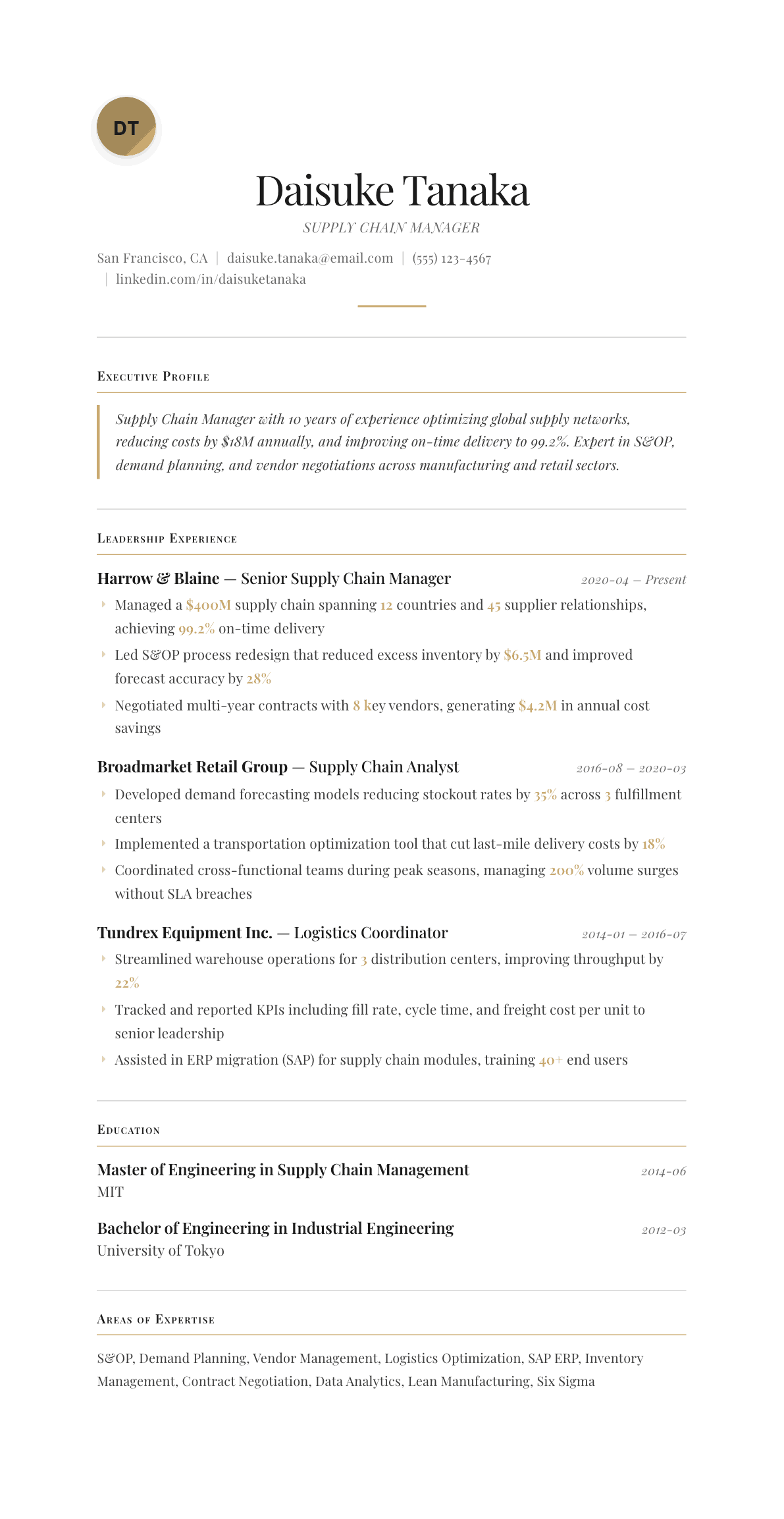
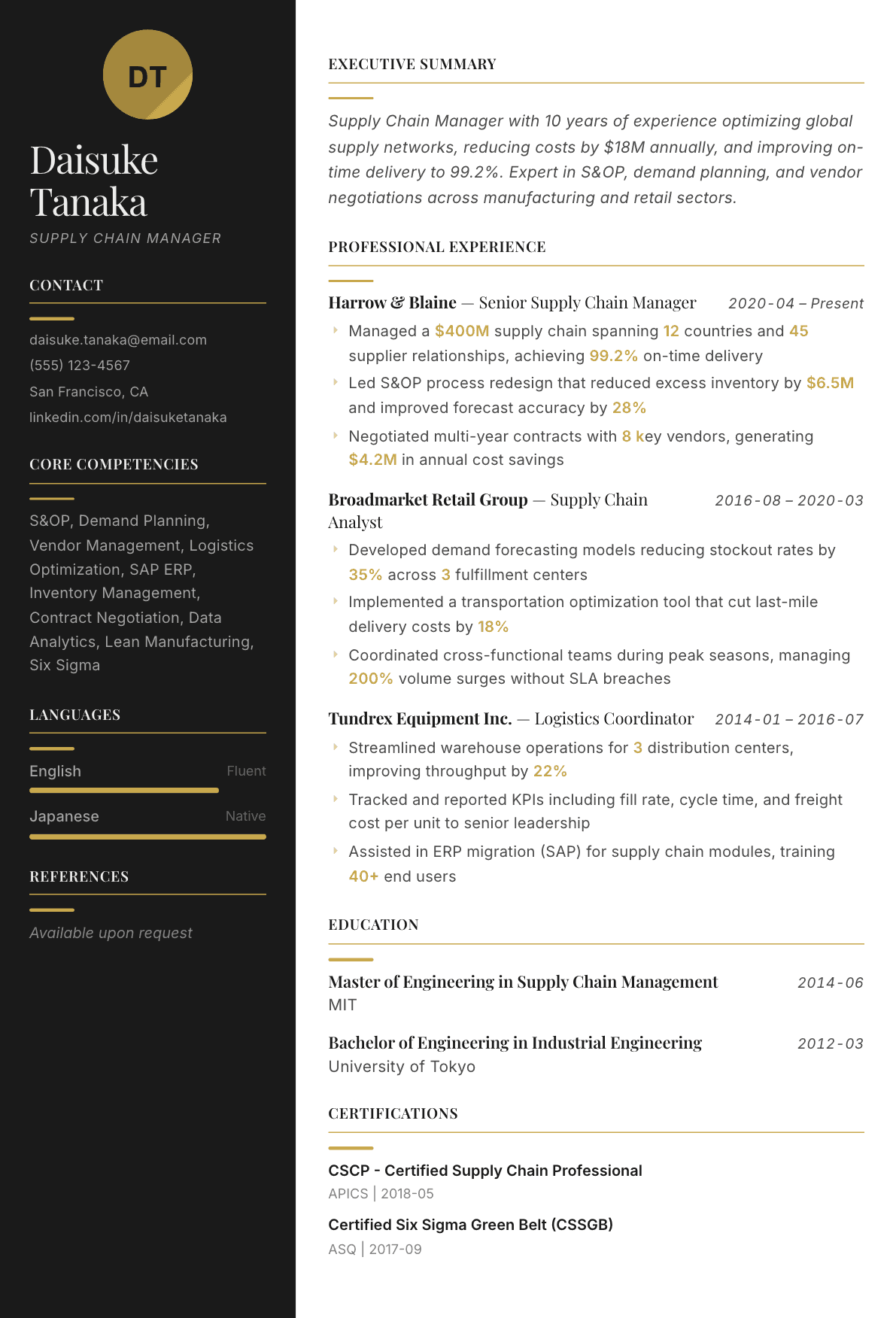
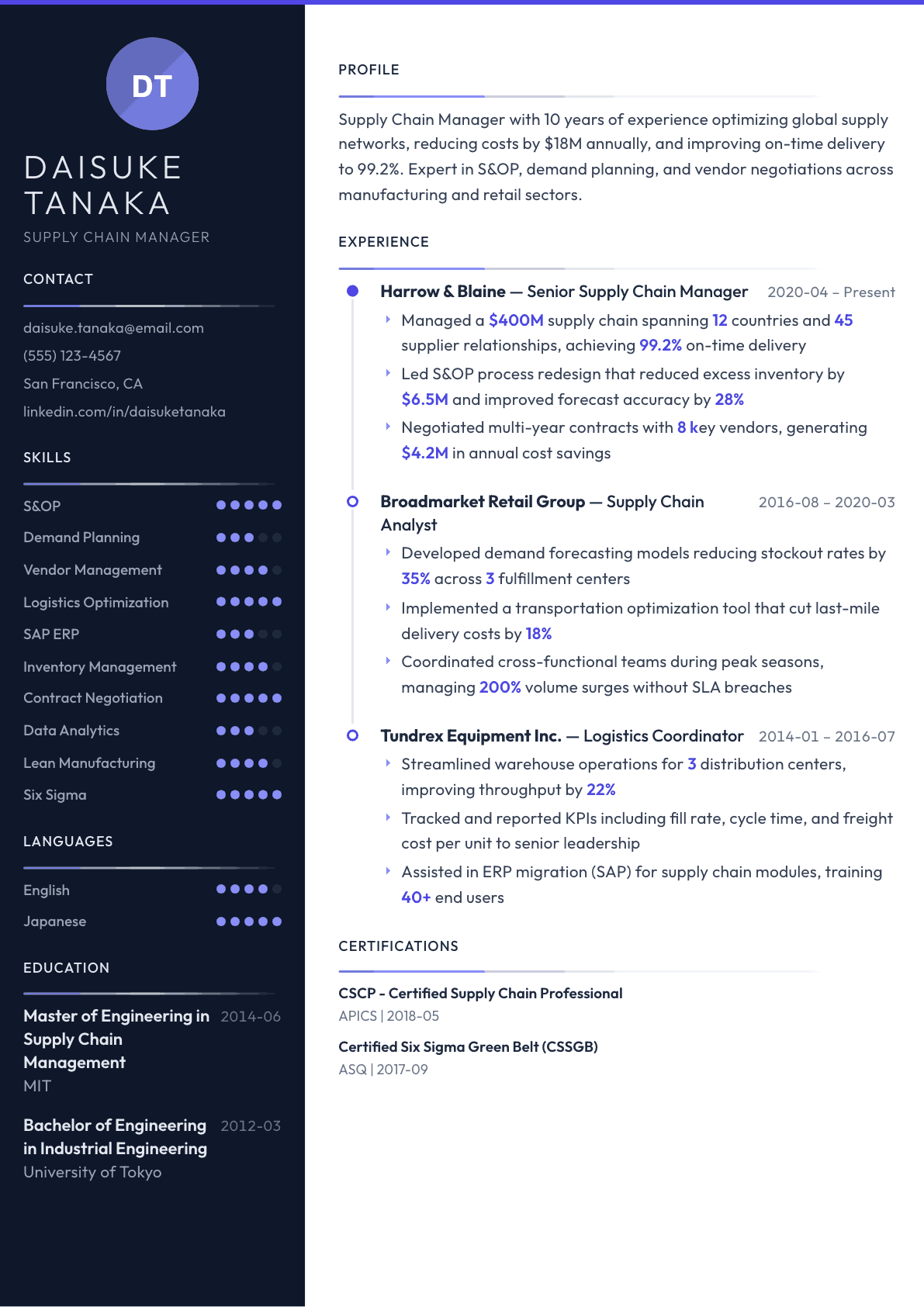
The same supply chain manager content laid out in three CVBooster templates, so you can see what the finished document looks like before you write a word.
Example Supply Chain Manager summary
Supply Chain Manager with 10 years of experience leading global supply operations across manufacturing and retail. Delivered $18M in annual cost savings through strategic sourcing, S&OP optimization, and vendor consolidation. CSCP-certified with deep expertise in SAP and demand forecasting. Seeking a Director-level role to drive end-to-end supply chain transformation.
Skills to list on a Supply Chain Manager resume
- Supply Chain Strategy
- S&OP
- Demand Planning
- Inventory Optimization
- Vendor Management
- Logistics
- Procurement
- SAP
- Oracle SCM
- Lean Manufacturing
- Six Sigma
- Contract Negotiation
- Data Analytics
- Warehouse Management
What actually gets this resume read
- Quantify cost savings, delivery improvements, and inventory reductions in every role.
- Highlight specific ERP systems (SAP, Oracle) and planning tools you have used.
- Show geographic scope and complexity of the supply chains you have managed.
- Include certifications like CSCP, CPIM, or Six Sigma prominently.
- Demonstrate cross-functional leadership with procurement, manufacturing, and logistics teams.
- Use industry-standard terminology that ATS systems recognize: S&OP, demand planning, fill rate.
How to write a supply chain manager resume
A supply chain manager resume gets read by an operations leader who is short of something right now: service level, inventory turns, capacity, or a plan she can trust. She is scanning to see whether you have run the specific link she is missing, in a network shaped like hers.
That makes the network description the most important thing on the page, and it is the thing most candidates leave out. Direct or distribution, domestic or import, make to stock or make to order, the number of nodes, the supplier count, the annual volume, the systems of record. Without it, an impressive cost reduction is unreadable, because nobody can tell what it was a reduction on.
This guide sets out the supply chain management resume format hiring managers expect, how to write planning, sourcing and logistics experience so it survives both the parser and the interview, two supply chain management resume examples written out, three summaries, before and after bullets, and the questions that come up most.
Supply chain management resume format: network first
Reverse chronological, one column, two pages once you have run more than one node. Under each employer, give a one-line network description before the bullets: the scope you owned, the number of sites, the supplier count, the annual volume or spend, and the systems. That line does work no summary can do.
Keep the functional vocabulary consistent with the posting. Planning, sourcing, logistics and fulfillment are separate disciplines with separate managers, and a resume that blurs them reads as though you did a little of everything without owning any of it.
- Network line under each role: scope, sites, suppliers, volume or spend, ERP and planning systems.
- Order: summary, experience, education, certifications, systems and skills.
- Name the industry. Cold chain grocery, aerospace aftermarket and fast fashion are three different jobs under one title.
- Give the incoterms and regions if you handle imports, because that is a distinct skill set a screener filters for.
Summary: the link you own and the numbers you moved
Three or four lines. Name the part of the chain you own, the network size, the industries, and two operating numbers you have moved: on-time in full, forecast accuracy, inventory turns, days of supply, fill rate, freight cost per unit, or supplier on-time delivery. Those are the numbers a director checks first.
If you are targeting a role wider than your last one, say what you have touched next to what you have owned. A planning manager applying for an end-to-end seat should name the sourcing and logistics work he partnered on rather than implying he ran it.
Experience: planning, sourcing, logistics and the S&OP table
Split your bullets across the four things a supply chain manager is judged on: service to the customer, working capital tied up in inventory, landed cost, and risk. One or two bullets each beats five bullets on cost reduction, because an all-cost resume reads as someone who will trade away service.
Sales and operations planning deserves its own bullet if you have run it. Say who sat at the table, the cadence, the horizon, and what changed when you took it over: a consensus forecast instead of three competing ones, a demand review that finance attends, a capacity view that reaches the plant floor.
For logistics work, give the mode mix, the carrier count, the lanes and the network moves. For sourcing, give the category, the spend band, the contract length and what you negotiated beyond price: payment terms, lead time commitments, capacity reservations, quality clauses.
Systems: name the platform and what you actually did in it
Every posting filters on the planning stack. Name the ERP and the module, the advanced planning tool, the warehouse and transportation systems, and the reporting layer. Then say what you did in them, because implementing a module, running a cutover and using a screen are three very different claims.
- ERP: SAP with the modules you used, Oracle, Microsoft Dynamics, NetSuite, Infor.
- Planning: SAP IBP, Kinaxis, o9, Blue Yonder, Anaplan, or a spreadsheet model you built and should describe honestly.
- Execution: warehouse management, transportation management, EDI transaction sets.
- Analysis: Excel at a serious level, SQL, Power BI or Tableau.
Certifications, education and the keywords postings repeat
Certification matters more here than in most operations roles because the vocabulary is standardized and hiring managers trust it. CPIM and CSCP are the two most recognized, and quality belts are common on the manufacturing side. Put them after your name if you hold them, then again in their own section with the issuing body.
A degree in supply chain, industrial engineering or operations research is common but not required. If your degree is unrelated, put it at the end and let the certifications and the network scope carry the credibility.
These postings recycle a narrow vocabulary: demand planning, S&OP, inventory optimization, supplier management, procurement, landed cost, on-time in full, lead time reduction, network design and continuous improvement. Use the posting words rather than your company synonyms, because internal terms like the weekly hookup mean nothing to a parser or a stranger.
Supply chain management resume examples, written out
People searching for a resume in supply chain management usually want to see finished pages, whatever their exact title. Here is a supply chain manager sample for a planner who moved up through purchasing and now runs planning and logistics for a consumer goods plant. The person and companies are invented. The network sits above the achievements, as the format section recommends.
The same shape works across supply chain titles: a planner or analyst keeps the systems line and the forecast and inventory bullets, a buyer leads with suppliers and spend categories, and a logistics lead leads with carriers, lanes and service levels. Keep every number one you could explain in an interview.
The manager sample is in the list below. First, a shorter example for a graduate with a supply chain management degree and one internship. Header: Marcus Bell, Supply Chain Analyst, city, phone, email. Summary: Supply chain management graduate with a summer internship in inbound planning at a food distributor; built the weekly purchase order suggestion file in Excel and cleaned item master data in the ERP. Experience: the internship with three bullets on replenishment, supplier follow up and a slow mover report. Education: BS in Supply Chain Management, with the capstone on warehouse slotting. Skills: Excel lookups and pivot tables, SAP basics, SQL coursework. One page is enough at this stage.
- Header: Andrea Collins, Supply Chain Manager. City, phone, email, LinkedIn. CSCP.
- Summary: Supply chain manager with eleven years in consumer goods manufacturing. Runs demand and supply planning, purchasing and outbound logistics for one plant and two distribution centers, and leads the monthly S&OP meeting with sales, finance and operations.
- Network: one plant, two distribution centers, about 120 suppliers, four carriers, a few hundred active items.
- Supply Chain Manager, a household products company, four years: leads a team of six planners and buyers; improved forecast accuracy and cut excess inventory by reviewing slow movers every month with sales; renegotiated carrier contracts after a lane study; set up a supplier scorecard for on time delivery.
- Earlier: Senior Buyer and Materials Planner, the same company and a food manufacturer, seven years.
- Systems and education: SAP S/4HANA, an advanced planning tool, Excel and Power BI. BS in Supply Chain Management; APICS CSCP.
Supply Chain Manager resume summary examples
First planning role
Supply chain analyst with 3 years in demand planning for a regional grocery distributor, covering 1,200 items across 2 distribution centers. Improved item-level forecast accuracy, ran the weekly replenishment cycle in SAP, and holds CPIM certification. Targeting a planning manager seat.
Seven years in
Supply chain manager with 7 years across planning and logistics for a consumer electronics importer: 5 overseas suppliers, 3 domestic distribution centers, and an ocean and air mode mix. Runs monthly S&OP, cut days of supply while holding fill rate, and led the move to a transportation management system.
End-to-end owner
End-to-end supply chain manager with 12 years in industrial manufacturing, owning planning, procurement and distribution across 4 plants and 45 suppliers in 12 countries. Rebuilt S&OP into a consensus process the CFO attends, redesigned the distribution network, and leads a team of 9.
Work experience bullets: before and after
Before: Managed supply chain operations for the company.
After: Owned planning, inbound freight and distribution for a 12-country network with 45 suppliers and 3 regional distribution centers, reporting to the VP of operations.
Scope, geography and reporting line let a reader picture the job, where managed operations could describe a stockroom.
Before: Reduced inventory levels.
After: Cut days of supply on the A and B items by resegmenting safety stock around demand variability, holding fill rate above 98% throughout the change.
Naming the method and the service level you protected turns a cut into a controlled improvement rather than a gamble.
Before: Ran the S&OP process.
After: Rebuilt monthly S&OP with a demand review, a supply review and an executive session, moving the business from 3 competing forecasts to one consensus number finance plans against.
The meeting structure plus the before and after state show what you changed, not just that a process existed.
Before: Negotiated with suppliers to reduce costs.
After: Renegotiated 8 contracts in a resin category, trading volume commitment for a shorter lead time and a capacity reservation clause that covered peak season.
Category, contract count and non-price terms show a manager who understands that unit cost is not the only lever.
Before: Improved on-time delivery.
After: Raised on-time in full from the low 80s to 96% across 2 distribution centers by fixing carrier appointment scheduling and a slotting problem in the pick module.
A named metric with a starting point and two root causes reads as work you did rather than a trend you sat beside.
Hard skills
- Demand planning and forecasting
- Sales and operations planning
- Inventory optimization and safety stock policy
- Strategic sourcing and supplier negotiation
- Transportation and carrier management
- Warehouse operations
- Distribution network design
- Import documentation and customs compliance
- SAP ERP
- Advanced planning tools such as Kinaxis and Blue Yonder
- Power BI and SQL reporting
- Lean and continuous improvement
- Supplier scorecards and risk assessment
Soft skills
- Cross-functional negotiation
- Escalation during disruption
- Clear briefing to executives
- Vendor relationship management
- Prioritization when capacity is short
- Team development
Certifications worth listing
- Certified in Planning and Inventory Management (CPIM) (Association for Supply Chain Management)
- Certified Supply Chain Professional (CSCP) (Association for Supply Chain Management)
- Certified in Logistics, Transportation and Distribution (CLTD) (Association for Supply Chain Management)
- SCPro Certification (Council of Supply Chain Management Professionals)
- Certified Six Sigma Green Belt (CSSGB) (American Society for Quality)
- Project Management Professional (PMP) (Project Management Institute)
Mistakes that cost supply chain manager candidates the interview
- Leaving the network out, so a cost result floats free of the volume, the node count and the industry that made it possible.
- Writing only cost bullets, which tells an operations director you will trade service and inventory health for a number she can already get.
- Listing planning systems without saying whether you used, configured or implemented them, which the interview establishes in about two questions.
- Using internal company jargon for standard processes, so neither the parser nor the reader recognizes the work as S&OP or replenishment.
- Claiming end-to-end ownership when you ran one link. Partnered on is a respectable verb and it survives a reference call.
- Omitting CPIM or CSCP from the top of the page when the posting names one of them as preferred.
Supply Chain Manager resume questions
What is the best format for a supply chain management resume?
Reverse chronological, one column, with a one-line network description under each employer before the bullets. Order it summary, experience, education, certifications, then systems and skills. Use one page as a graduate or analyst and two once you have run more than one site. A planner leads with forecasting, a buyer with suppliers and spend, a manager with the team and S&OP.
What metrics should a supply chain manager put on a resume?
Service, inventory and cost, in that order: on-time in full or fill rate, forecast accuracy, days of supply or turns, and landed or freight cost per unit. Give the starting point as well as the result, because an improvement without a baseline cannot be judged.
Do I need CPIM or CSCP to get a supply chain manager job?
Neither is legally required, but postings list them as preferred often enough that they act as a filter in large companies. CPIM suits planning and manufacturing roles, CSCP suits broader end-to-end roles. If you hold one, put it beside your name.
How do I show S&OP experience if my company called it something else?
Use the standard term and describe the mechanics: the demand review, the supply review, the reconciliation step, the executive meeting, the horizon and who owns the consensus number. Add your internal name for it only if the industry would recognize it.
How do I move from logistics into an end-to-end supply chain role?
Lead with the planning and sourcing work you have partnered on, add any S&OP attendance, and show one project that crossed functions such as a network redesign or an ERP cutover. Then name the gap honestly in the summary rather than hoping nobody checks.
Related resume examples
- Logistics Manager Resume example
- Procurement Manager Resume example
- Operations Manager Resume example
- Supply Chain Analyst Resume example
- Supply Chain Director Resume example
- Delivery Operations Manager Resume example