Outside Sales Representative Resume Examples: free score
Outside Sales Representative Resume for Territory Field Selling
By Mustafa Tarabya, founder of CVBooster · Published · Updated
Outside sales resume examples covering territory growth, route planning and field call volume, with ATS keywords and a writing guide.
Sample resumes for a outside sales representative
The same outside sales representative content laid out in three CVBooster templates, so you can see what the finished document looks like before you write a word.
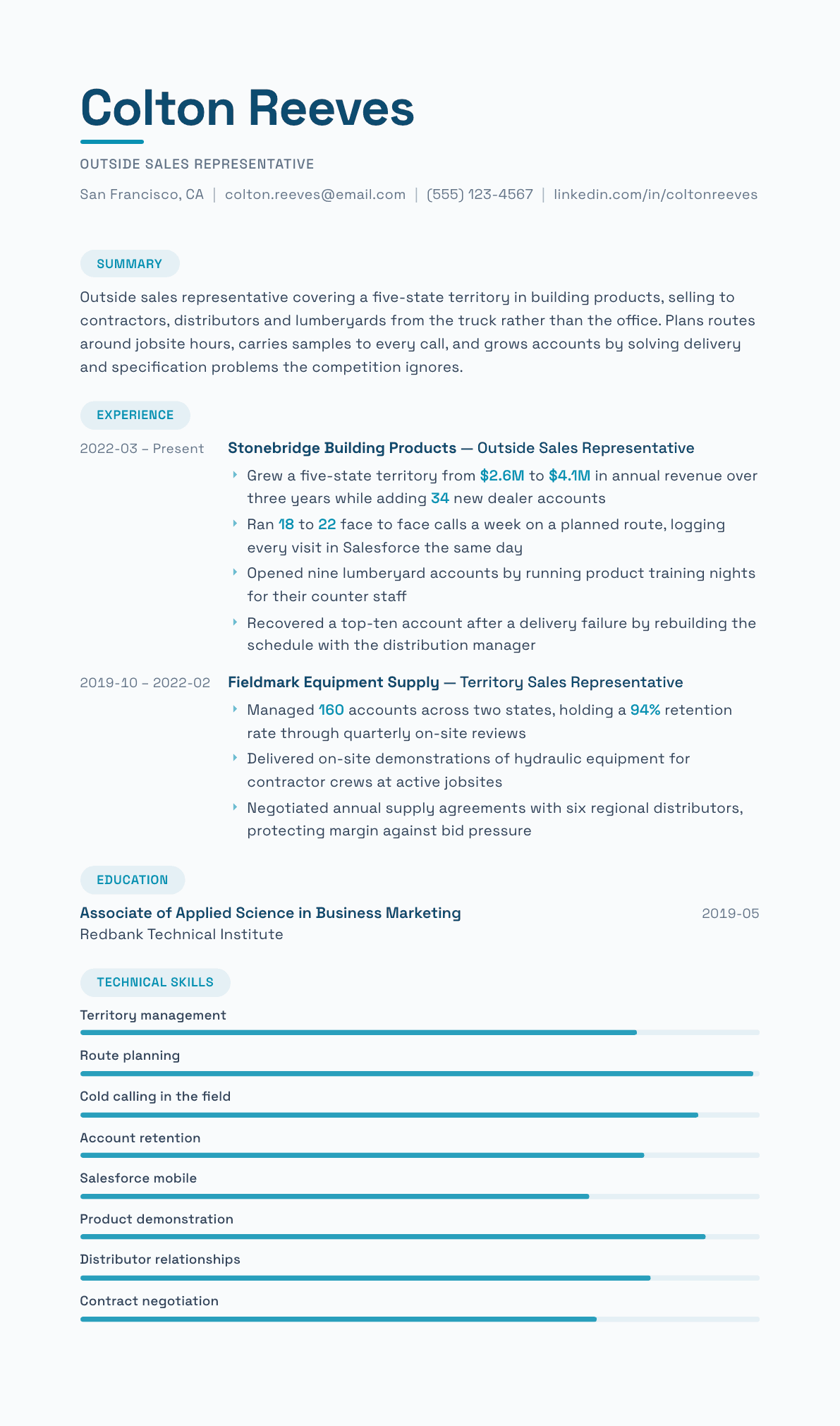
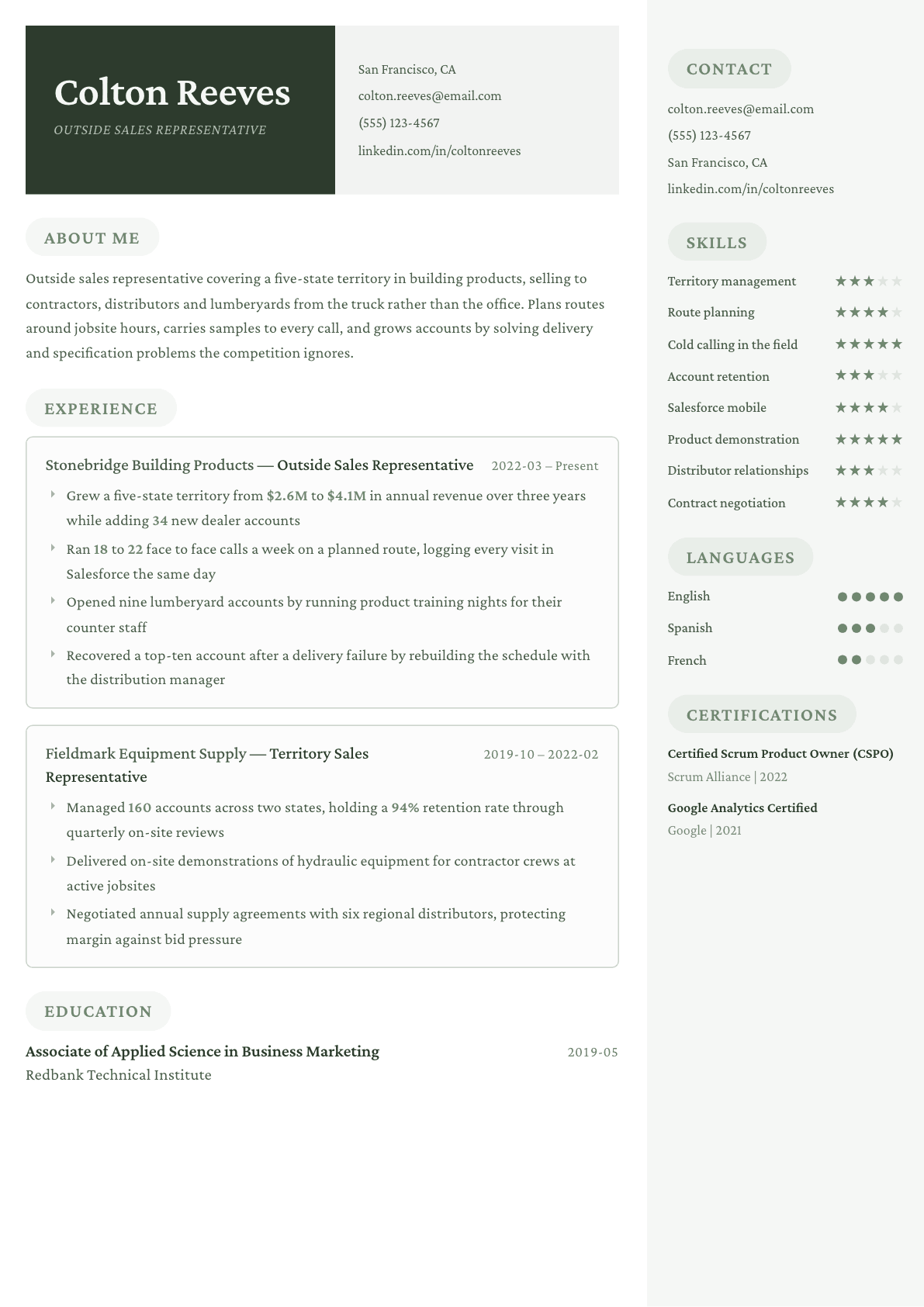
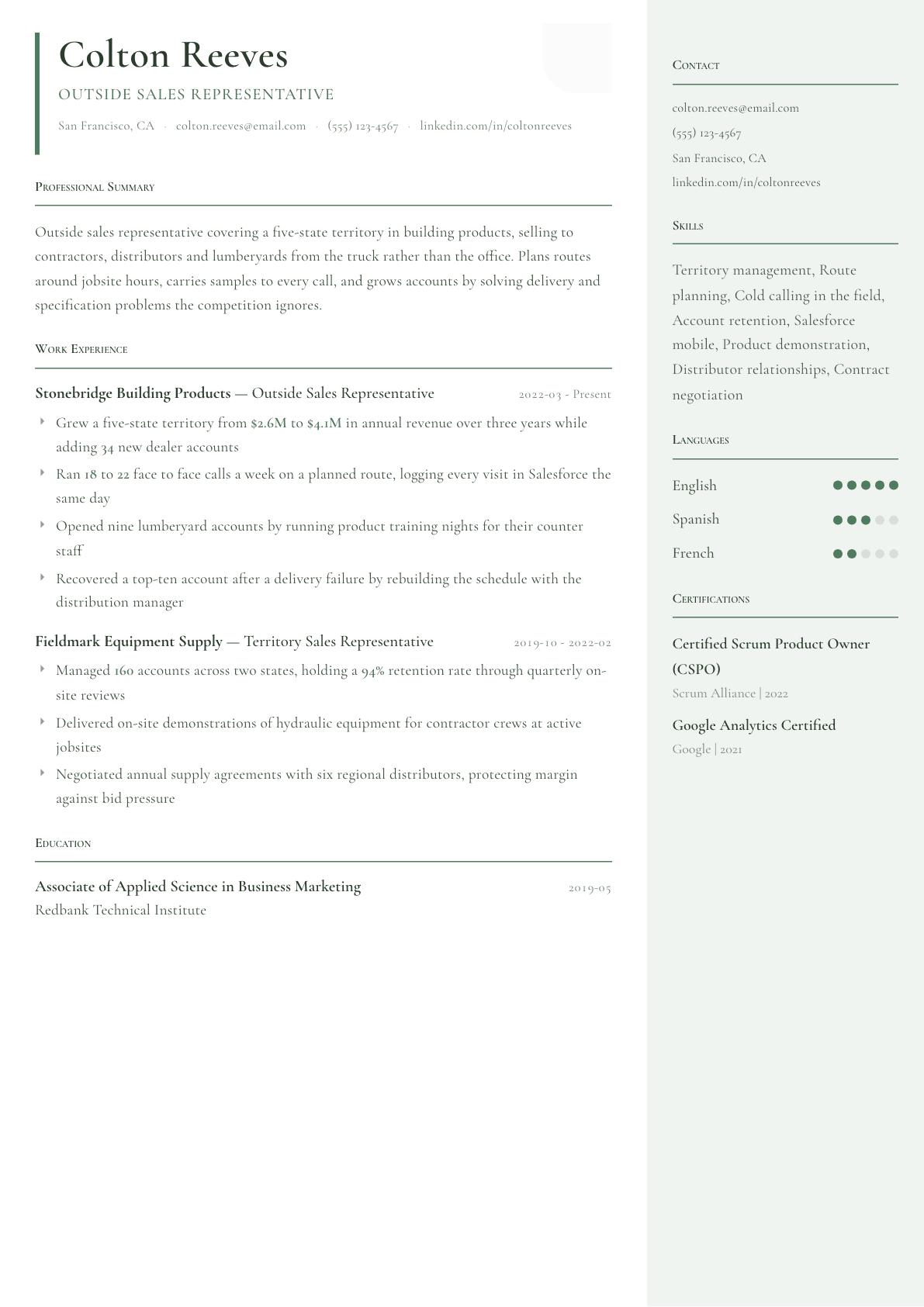
Example Outside Sales Representative summary
Outside sales representative with six years in building products and industrial equipment, growing a five-state territory from $2.6M to $4.1M while adding 34 dealer accounts. Runs 18 to 22 planned field calls a week, delivers on-site product training for counter and contractor crews, and holds account retention above ninety percent through quarterly on-site reviews. Comfortable with heavy overnight travel.
Skills to list on a Outside Sales Representative resume
- Territory management
- Route and call planning
- Field prospecting
- Account growth and retention
- Distributor and dealer management
- Product demonstration
- Contract and pricing negotiation
- Salesforce
- Trade show representation
- Technical product knowledge
- Customer training delivery
- Quota attainment
- Cold calling
- Expense and travel planning
What actually gets this resume read
- Define the territory by geography, account count and revenue, because that is how a regional manager sizes your last job.
- Show call volume per week and the split between existing accounts and new prospecting, since field managers track both.
- Give the territory revenue when you took it and when you left it, so the growth is attributable rather than claimed.
- Name the channel you sold through, whether direct, distributor, dealer or contractor, because the motions do not transfer cleanly.
- Mention a valid driver record, overnight travel percentage and the CRM you log calls in from the road.
- Include product training or demonstrations you delivered on site, which is the work that separates field sellers from phone sellers.
How to write a outside sales representative resume
Outside sales is a job done from a vehicle. The seller lives in a territory, plans a route, walks into jobsites, counters, back offices and loading docks, and builds revenue through face to face relationships that a phone call cannot replace. A regional manager reading your resume is trying to picture you in her territory on a Tuesday morning, and she wants proof you know how that day actually works.
The resumes that fail read like inside sales resumes with the word field added. They talk about pipeline and sequences and leave out the parts that define the job: the geography, the account count, the call plan, the samples in the truck, the overnight travel, the distributor who decides whether your product gets stocked at all.
This guide covers how to define a territory on paper, which numbers a field manager checks, how to write about route discipline and call volume, and how to present channel work, because in most outside sales roles the customer you visit and the customer who pays are not the same organization.
Define the territory in the first three lines
A territory is defined by four things: geography, account count, revenue and channel. Give all four. A five-state territory of 240 dealer accounts producing several million a year through distribution is a picture. A territory in the southeast selling building products is not.
State the travel pattern honestly: nights away per month, whether you have a home base or a company vehicle, how far the furthest account sits from you. Field managers screen for candidates who understand the travel before they arrive, because travel is the most common reason a new field seller quits in the first year.
- Geography stated concretely: states, counties, metro areas or drive radius.
- Account count and how many were active against dormant.
- Territory revenue when you inherited it and when you left it.
- Channel: direct end user, distributor, dealer, contractor, or a mix.
Territory growth is the headline number
The single most persuasive line on an outside sales resume is what the territory was worth when you took it and what it was worth when you left, with the timeframe. That framing makes growth attributable to you rather than to the market, especially when you add whether the territory was new, neglected or already performing.
Support it with account movement: new accounts opened, dormant accounts reactivated, accounts lost and why, and retention across the book. A field manager reading nine reactivated accounts knows exactly how much windshield time that took.
Where a territory shrank or held flat, give the cause in a clause. A plant closure, a distributor consolidation, a competitor buying the shelf space. Field territories move for reasons everyone in the industry recognizes.
Route discipline and call volume
Give calls per week and the split between existing accounts and prospecting stops. Eighteen to twenty-two planned face to face calls a week with a fixed cold call quota tells a manager you run a route rather than visiting whoever answers the phone.
Say how the plan is made and logged: routing by day of week, a rolling call cycle by account tier, same-day logging in the customer system from the vehicle. Field managers have all inherited a rep whose notes lived in a notebook that left with him, so the logging habit is worth a line of its own.
Include the unglamorous field work: counter days, morning jobsite visits before crews start, trade shows, association meetings, and product training nights for a distributor branch. That work is invisible in an inside sales resume and it is the core of this one.
Channel work: who you visit is not always who pays
If you sell through distribution, explain the two-sided motion. You create demand with the end user, contractor or specifier, and you protect availability with the distributor or dealer who stocks it. Show both sides: the specification you influenced and the branch you got the product listed in.
Name the levers you pulled at the channel: joint sales calls with a branch manager, counter staff training, promotion sell-in, planogram or shelf space, stocking agreements, price protection on a bid. Those are the concrete tools of the job and few candidates list any of them.
Say how you handled channel conflict, because it happens in every distributed business and a manager will ask.
Practical requirements that belong on the page
A clean driving record, a valid license, comfort with overnight travel and any equipment or safety credential the industry requires should appear in a short line near the skills block. In field roles these are screening criteria, not footnotes.
Add the technical depth the products demand: reading a specification, sizing equipment, understanding an installation constraint. In building products, industrial supply and equipment sales, technical credibility with a crew is what earns the second visit.
Outside Sales Representative resume summary examples
Moving from inside to field sales
Inside sales representative with two years supporting a field team, now moving to a territory role. Handled 160 accounts by phone, ran product demonstrations on customer visits alongside the regional seller, and holds a clean driving record with full availability for overnight travel.
Four years in a territory
Outside sales representative covering a five-state building products territory through dealers and lumberyards. Added 34 dealer accounts while growing territory revenue by roughly half, runs 18 to 22 planned field calls a week, and logs every visit the same day in Salesforce.
Senior territory representative
Senior field representative on the largest territory in the region, managing distributor relationships, annual supply agreements and contractor specification work. Holds retention above 90% through quarterly on-site reviews and trains newer representatives on route planning and counter days.
Work experience bullets: before and after
Before: Grew sales in my assigned territory.
After: Grew a five-state territory from a stagnant book to roughly half again its revenue over three years while adding 34 new dealer accounts, none inherited from another representative.
The starting condition, the timeframe and the account count make the growth attributable rather than ambient.
Before: Visited customers regularly across the region.
After: Ran 18 to 22 face to face calls a week on a planned route with a fixed prospecting quota each day, logging every visit in Salesforce from the vehicle before the next stop.
Call volume, route planning and same-day logging show field discipline rather than unstructured travel.
Before: Built relationships with distributors and dealers.
After: Opened nine lumberyard accounts by running evening product training for their counter staff, so the people recommending materials at the counter knew the range before a customer asked.
The specific channel tactic explains how the accounts were won and why they stayed.
Before: Kept my customers happy and retained their business.
After: Held a 94% retention rate across 160 accounts through quarterly on-site reviews that put stock levels, open claims and upcoming projects on one agenda.
The retention figure plus the review mechanism shows a repeatable account management routine.
Before: Recovered an important account that we almost lost.
After: Recovered a top-ten account after a delivery failure by rebuilding the schedule with their distribution manager on site and committing to a weekly stock check for the following quarter.
Naming the failure, the person and the commitment shows how the relationship was actually repaired.
Hard skills
- Territory management and planning
- Route and call cycle planning
- Field prospecting and cold calls
- Distributor and dealer management
- On-site product demonstration
- Specification and technical selling
- Stocking and supply agreements
- Contract and pricing negotiation
- Trade show and association work
- Salesforce logging from the field
- Account retention reviews
- Counter staff training delivery
Soft skills
- Self-direction without supervision
- Stamina for windshield time
- Rapport with crews and counter staff
- Planning a week alone
- Composure after a service failure
- Local network building
Certifications worth listing
- Certified Professional Manufacturers Representative (CPMR) (Manufacturers Representatives Educational Research Foundation)
- OSHA 10-Hour Construction Safety (OSHA Training Institute)
- Certified Professional Sales Person (CPSP) (National Association of Sales Professionals)
Mistakes that cost outside sales representative candidates the interview
- Describing a territory without geography, account count or the revenue it carried.
- Writing an inside sales resume with the word field inserted, so none of the travel or channel work appears.
- Giving current revenue without the starting point, which hides whether you grew anything.
- Omitting call volume, so a field manager cannot tell whether you ran a route or reacted to inbound calls.
- Leaving out the driving record, travel availability and any safety credential the industry screens on.
- Skipping the channel entirely when the distributor decides whether the product is on the shelf at all.
- Claiming strong relationships without one example of an account recovered or a specification won.
Outside Sales Representative resume questions
What is the difference between outside sales and inside sales?
Outside sales is territory based and face to face, built on route planning, site visits and channel relationships. Inside sales runs from an office by phone and email against a call or meeting quota. The skills overlap, but the daily rhythm and the travel expectation are entirely different.
How do I describe a sales territory on a resume?
Give geography, account count, revenue at the start and end of your tenure, and the channel you sold through. Add the travel pattern and how far the furthest account sits from your base, because a regional manager screens on whether the travel matches her patch.
Should I list my driving record on an outside sales resume?
Yes, a single line stating a valid license and clean record near the skills block. Many field roles include a company vehicle and an insurance check, so confirming it early removes a screening question and signals you understand the practical side of the job.
How do I move into outside sales from an inside role?
Lead with any customer visits, trade shows or ride-alongs you have already done, plus product knowledge deep enough to hold a technical conversation. State your travel availability explicitly and target industries where your product knowledge transfers rather than starting from scratch.
What numbers matter most for a field sales resume?
Territory revenue growth with the starting point, new accounts opened, retention across the book, calls per week and quota attainment. Those five give a regional manager a picture of how you work a patch, not just what it produced last year.