Regional Sales Manager Resume Examples: read this first
Build a Regional Sales Manager Resume That Covers All Territories
By Mustafa Tarabya, founder of CVBooster · Published · Updated
Create a territory-driven regional sales manager resume with multi-location team leadership, quota management, and market expansion skills that hiring managers look for.
Sample resumes for a regional sales manager
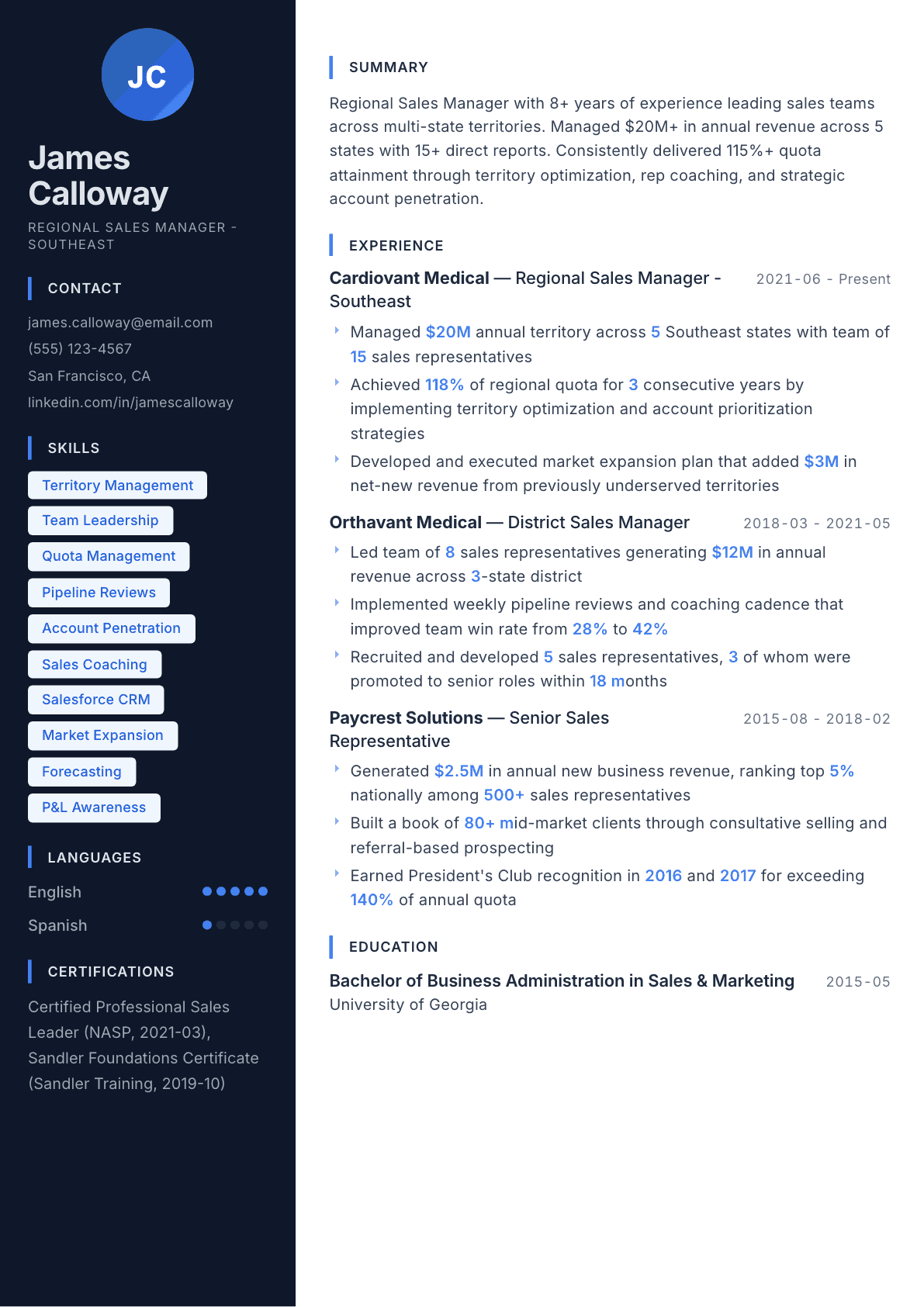
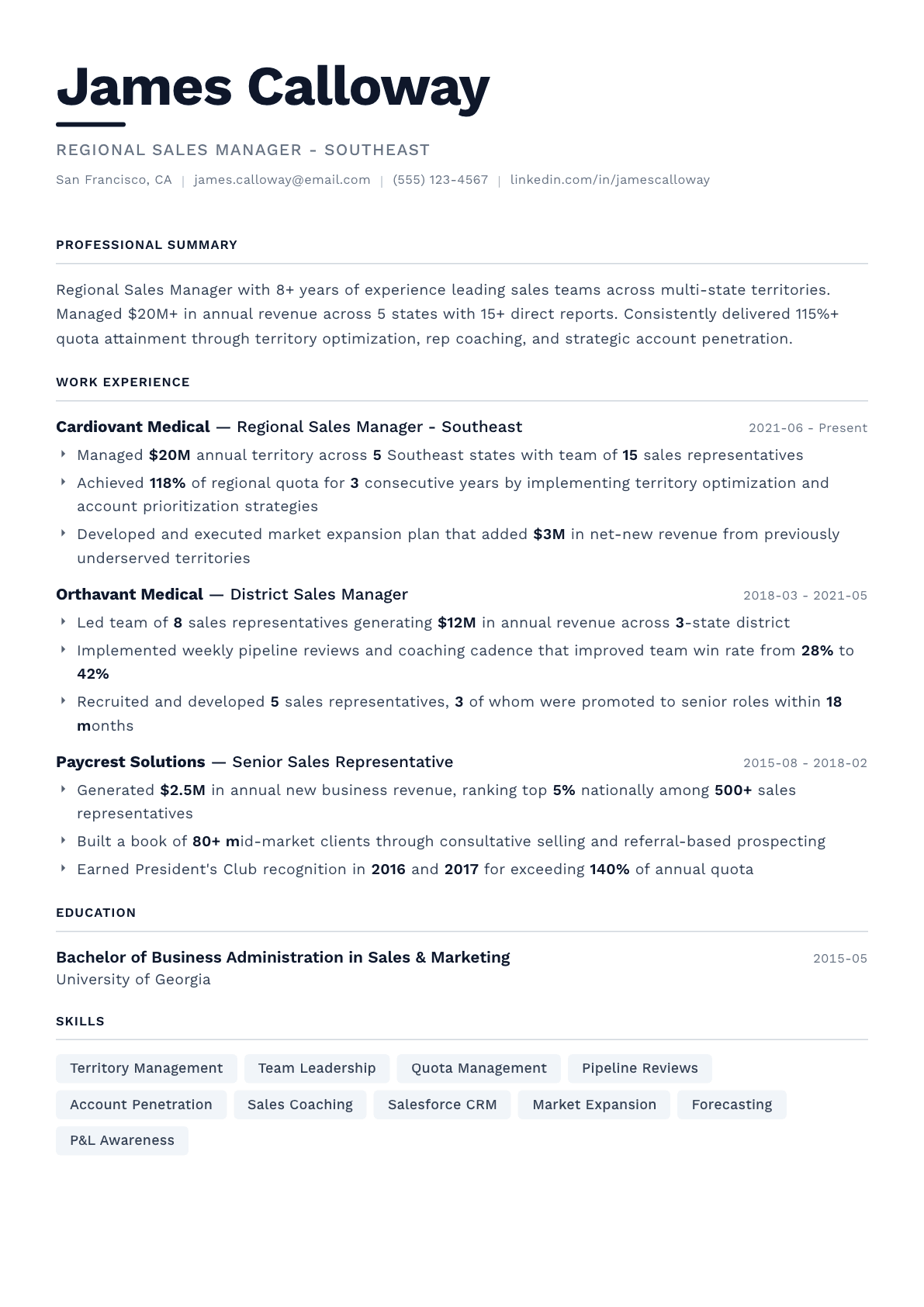
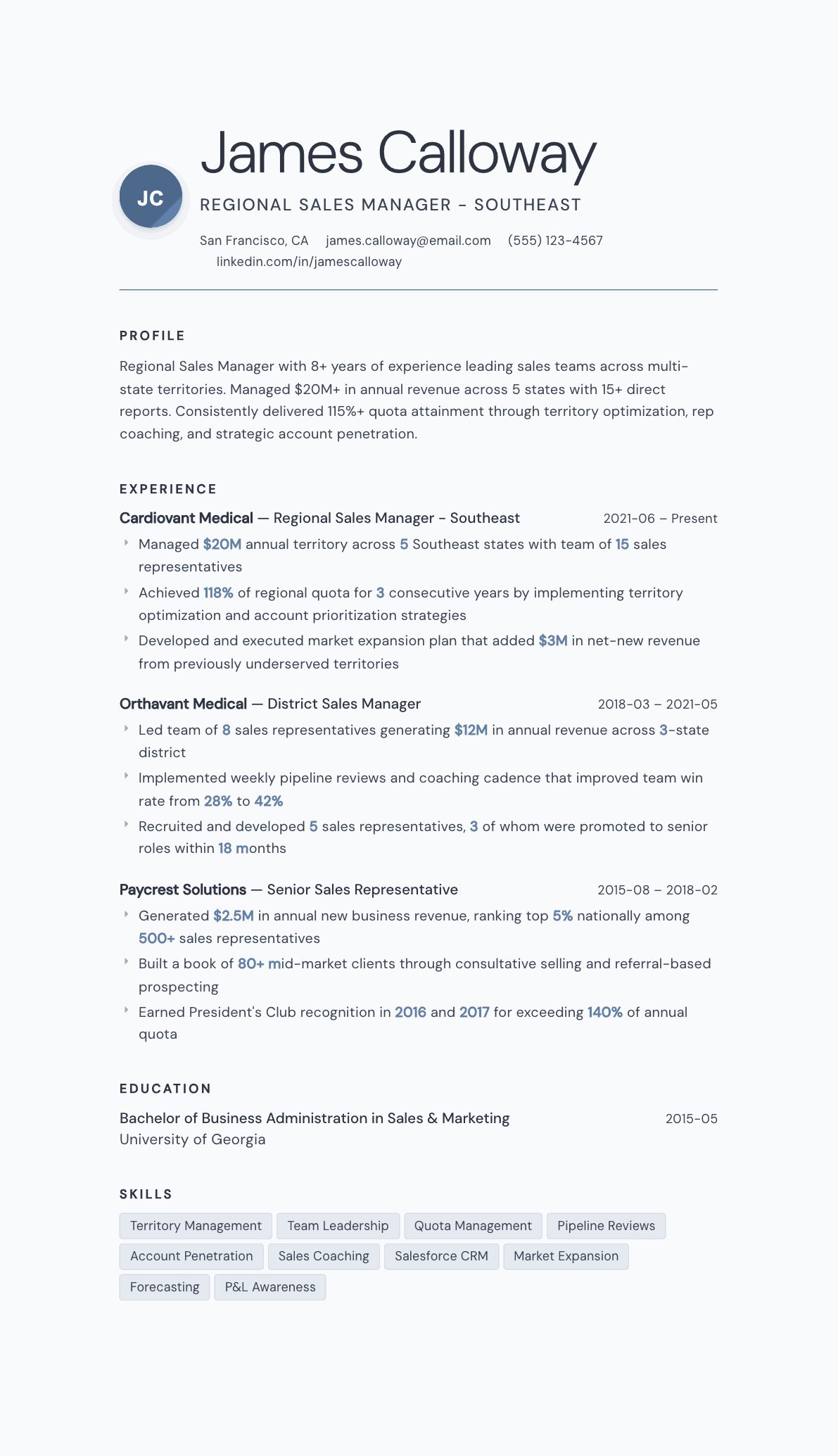
The same regional sales manager content laid out in three CVBooster templates, so you can see what the finished document looks like before you write a word.
Example Regional Sales Manager summary
Regional Sales Manager with 8 years of experience leading 15-person teams across five-state territories. Delivered 118% quota attainment on a $20M territory at Cardiovant Medical for three straight years. Strong in territory optimization, weekly pipeline coaching, and opening underserved markets in medical device and technology sales.
Skills to list on a Regional Sales Manager resume
- Regional Sales Management
- Territory Management
- Team Leadership
- Quota Management
- Pipeline Management
- Sales Coaching
- Market Expansion
- Account Penetration
- Forecasting
- Salesforce CRM
- Hiring & Development
- Consultative Selling
- P&L Management
- Strategic Planning
What actually gets this resume read
- Specify your territory: region, number of states/countries, and team size to give context to your impact.
- Quantify quota attainment: percentage achieved, consecutive quarters/years, and ranking vs. peers.
- Highlight territory optimization: how you allocated resources, prioritized accounts, and expanded into new markets.
- Showcase rep development: hiring, coaching, promotion rates, and attrition reduction.
- Include sales methodology and coaching frameworks used to develop your team.
- Mention cross-functional coordination with marketing, product, and customer success teams.
How to write a regional sales manager resume
A regional sales manager resume is read as a management record, not a selling record. The vice president reviewing it wants to know how many representatives reported to you, what the region was worth, whether the team hit its number, and what you did to the team to make that happen. A page full of personal selling achievements signals a candidate who has not made the transition from individual contributor to leader.
The details that matter are structural: how many states or districts, how many accounts or distributors, whether the region was growing, flat or being rebuilt, and how the team was composed. Taking over an established region at a large employer and building a new one from two representatives are both credible achievements, but they are different jobs and the resume has to say which.
This guide covers the format sales leaders expect, how to write a summary that puts the region and the team first, how to write bullets about coaching and territory design rather than deals, which reporting and planning skills to name, and the questions managers ask when they step up from a senior selling seat or move between industries.
Format: two pages, region scope before results
Two pages is standard. Open every management role with a scope line: the geography, the number of direct reports, the annual revenue the region carried, the customer or distributor base, and the products sold. Without that line, an attainment figure underneath is unreadable, because a region with five representatives and one with twenty are different management problems.
Keep any individual contributor roles below the management ones and compress them. They establish credibility and should not consume the page. If your most recent selling seat is more impressive than your management record, the resume still has to lead with the management record, because that is the job being filled.
- Header: name, city and state, phone, email, professional profile link, willingness to travel.
- Order: summary, region results, management experience with scope lines, selling experience, education.
- Scope line: states or districts, direct reports, region revenue, account or distributor count.
- Say whether you inherited, rebuilt or built the region, since each demands different evidence.
Summary: geography, team size, revenue, attainment
Four facts in the first two lines: the geography, the team size, the region revenue band, and attainment against plan. A regional sales manager running a multi state region with a mid sized team in medical devices has described a role a hiring leader can match against their own opening. Statements about driving growth through strategic leadership are true of every candidate for this title.
Add the industry and the channel, because they change the job entirely. Selling through hospital systems, through independent distributors, through retail buyers, or direct to enterprise accounts all require different management, and leaders filter hard on channel experience.
Experience: what you did to the team and the territory
The strongest regional manager bullets describe a change you made and the result it produced across the team. Territory realignment, a new coverage model, a cadence of pipeline reviews, a ride along and coaching schedule, a stack ranking that surfaced underperformance early, or a change in how forecasts were called. These are the levers a manager actually pulls, and naming them proves you know where the job sits.
Hiring and development belongs on the page in numbers. How many representatives you hired, how many you turned around, how many you promoted, and what your voluntary turnover looked like against the wider organization. A manager who develops people is worth more over three years than one who only hits a number, and hiring leaders know it.
Show forecasting and reporting discipline. Regional managers are the level at which the company number becomes real, so accuracy of your regional call, how you ran the pipeline review, and what you did with underperforming districts are all fair evidence. Include one example of an underperformer you fixed and one you exited, since both are part of the job.
- Region revenue at handover versus at your exit, with the attainment for each year.
- Team size, structure, and the number of representatives you hired and promoted.
- Territory design changes and what they did to coverage or win rate.
- Coaching cadence: field rides, one to one reviews, pipeline reviews, call coaching.
- Forecast accuracy and how you ran the monthly or quarterly business review.
Planning, analytics and the systems behind the region
Name the tools you managed the region in: the customer relationship system, the forecasting and analytics layer, the territory and quota planning tool, and the reporting you built for your own leadership. Regional managers who can read their own data rather than waiting on operations get to decisions faster, so say what reports you built and what decisions came out of them.
Also name the planning artifacts: annual territory plans, quota allocation across representatives, account segmentation, and the compensation or incentive mechanics you worked within. A candidate who has allocated quota across a team understands a part of the job that individual contributors never see.
Keywords a sales vice president scans for
Regional sales management, territory management, quota allocation, team leadership, pipeline review, forecast accuracy, sales coaching, field rides, hiring and onboarding, distributor management, key account penetration, market expansion, performance management, and business review cadence. Place each next to a result rather than in a list, because the reader is a sales leader who will judge whether the word is backed by a mechanism.
Regional Sales Manager resume summary examples
First management seat
Senior sales representative moving into regional management after two years as a player coach for four newer representatives, running their pipeline reviews and field rides while carrying a reduced territory. Consistent quota attainment, and looking to own a district team and its number outright.
Regional manager
Regional Sales Manager covering five states in medical devices with a team of twelve representatives and a region carrying an eight figure annual number. Delivered plan in each of the last three years, realigned territories to close coverage gaps, and promoted three representatives into senior roles.
Multi-district leader
Regional sales leader with eleven years managing multi-state teams in industrial equipment, most recently three districts, four district managers and 28 representatives. Rebuilt a region that had missed plan for two years, restructured territories and quota, and returned it to growth within four quarters.
Work experience bullets: before and after
Before: Managed a sales team and grew regional revenue.
After: Led twelve representatives across five states in a region carrying an eight figure annual number, delivering 112% and 118% of plan in consecutive years.
Team size, geography, region scale and attainment by year give the reader the management picture a growth claim leaves out.
Before: Coached the team to improve performance.
After: Introduced a weekly one to one on pipeline plus two field rides per representative each quarter, lifting the number of representatives at or above plan from five of twelve to nine of twelve.
A named coaching cadence and a change in the count of reps at plan proves the coaching produced something measurable.
Before: Recruited and hired new sales representatives.
After: Hired nine representatives over three years using a structured interview and a ride along assessment, with seven still in the seat after two years and two promoted to senior territory roles.
A hiring method, a retention figure and promotions show the quality of the hires rather than only the count.
Before: Reorganized territories to improve coverage.
After: Rebalanced territories using account potential rather than existing revenue, moving 60 accounts between representatives and reducing the gap between the largest and smallest territory workload.
The criterion used and the movement of accounts show a deliberate design decision instead of an administrative shuffle.
Before: Provided accurate forecasts to leadership.
After: Ran a monthly regional pipeline review with a documented stage definition, holding the regional forecast within a narrow band of actual bookings across eight quarters.
Forecast accuracy is only believable when the resume names the review process and the run of quarters behind it.
Hard skills
- Regional sales management
- Quota allocation and territory design
- Pipeline and forecast management
- Sales coaching and field rides
- Hiring and onboarding
- Performance management
- Distributor and channel management
- Key account penetration
- Business review facilitation
- Salesforce reporting and dashboards
- Market and competitive analysis
- Incentive plan administration
Soft skills
- Direct feedback
- Decision making under pressure
- Motivating a dispersed team
- Conflict resolution
- Prioritization across districts
- Executive communication
Certifications worth listing
- Certified Sales Leadership Professional (CSLP) (Sales Management Association)
- Salesforce Certified Administrator (Salesforce)
- Project Management Professional (PMP) (Project Management Institute)
Mistakes that cost regional sales manager candidates the interview
- Leading with personal selling achievements, which tells a vice president you have not made the move to leadership.
- Giving attainment with no region revenue or team size, so there is no way to weigh the result.
- Omitting whether the region was inherited, rebuilt or newly built, when those are three different management jobs.
- Writing about coaching without naming a cadence, an assessment or a change in how many reps made plan.
- Leaving out hiring and turnover, which is half the job at this level and the half most candidates forget.
- Ignoring the channel, so the reader cannot tell distributor management from direct enterprise selling.
- Avoiding any mention of underperformance, when handling it is a core expectation of the seat.
Regional Sales Manager resume questions
How do I move from a senior sales seat into regional management?
Surface every piece of leadership you have already done: mentoring newer reps, running a pipeline review, covering for a manager, onboarding a hire, or leading a territory project. Then rewrite those as management outcomes rather than favors, since hiring leaders want evidence you can produce results through other people.
Should a regional sales manager resume include personal quota results?
Include them only in earlier individual contributor roles and keep them compressed. In management roles the number that counts is the team number, and personal selling results at the top of a management resume suggest you are still carrying deals your representatives should be closing.
What if my region missed plan one year?
Show the year with the cause attached: a product recall, a distributor change, two open territories, or a market that contracted across the industry. A leader who reads a missed year with a clear diagnosis and the corrective action you took will trust the rest of the resume more, not less.
How do I show coaching if my company had no formal program?
Describe the routine you built yourself: how often you rode along, what you reviewed in one to ones, what you listened for on calls, and how you documented development plans. An informal cadence you designed and stuck to is often more convincing than a corporate program you merely participated in.
Does industry experience matter when changing sectors as a regional manager?
It matters most where the channel is unusual, such as regulated medical selling or distributor heavy industrial markets. Bridge it by leading with management mechanics that transfer, then naming what you already understand about the new channel, including its buying cycle and who holds the purchasing authority.