Patient Advocate Resume Examples: the lines they read
Build a Patient Advocate Resume Around Grievances and Resolved Barriers
By Mustafa Tarabya, founder of CVBooster · Published · Updated
Patient advocate resume examples with grievance handling, financial assistance, care navigation and the keywords hospital advocacy teams search.
Sample resumes for a patient advocate
The same patient advocate content laid out in three CVBooster templates, so you can see what the finished document looks like before you write a word.
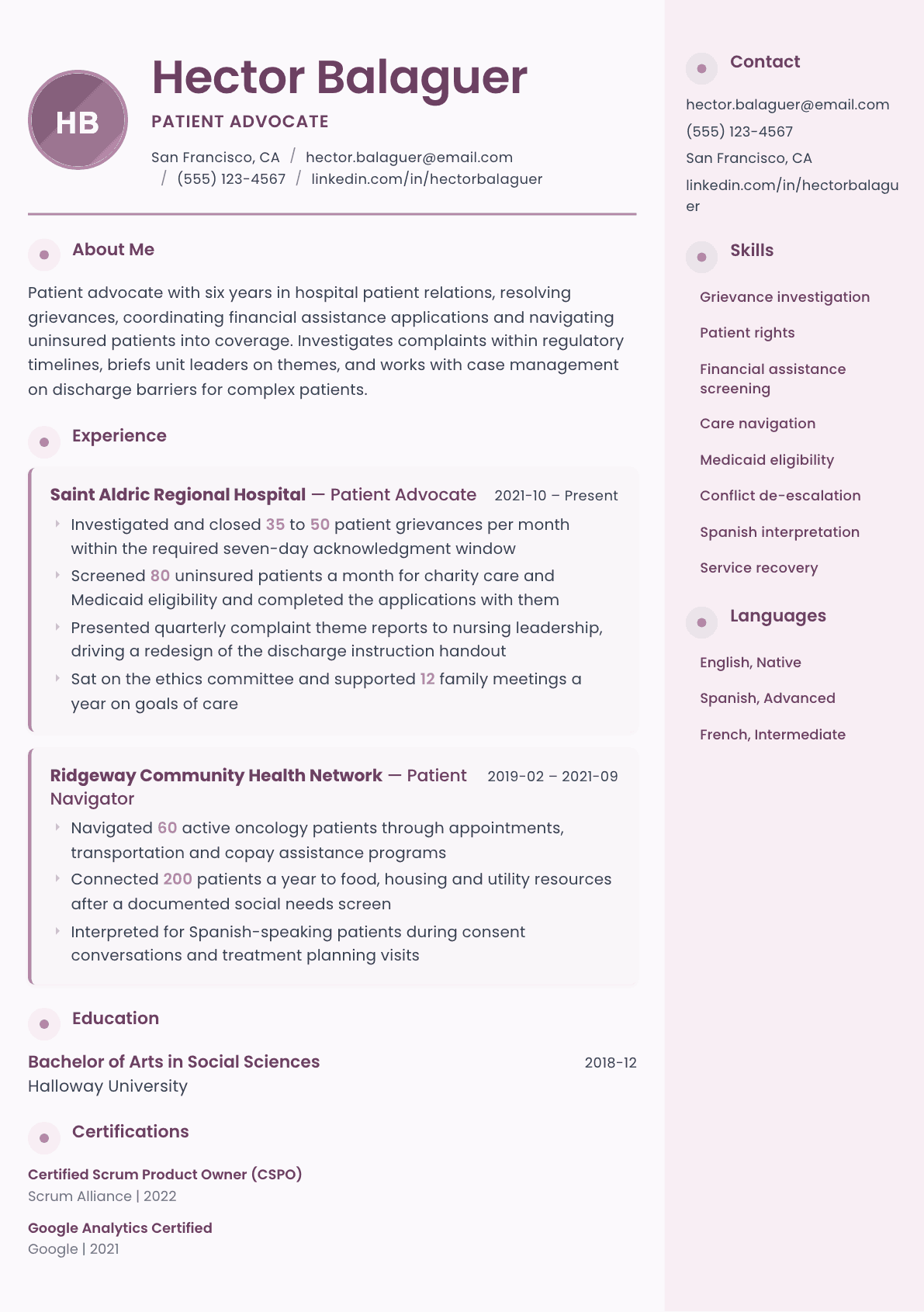
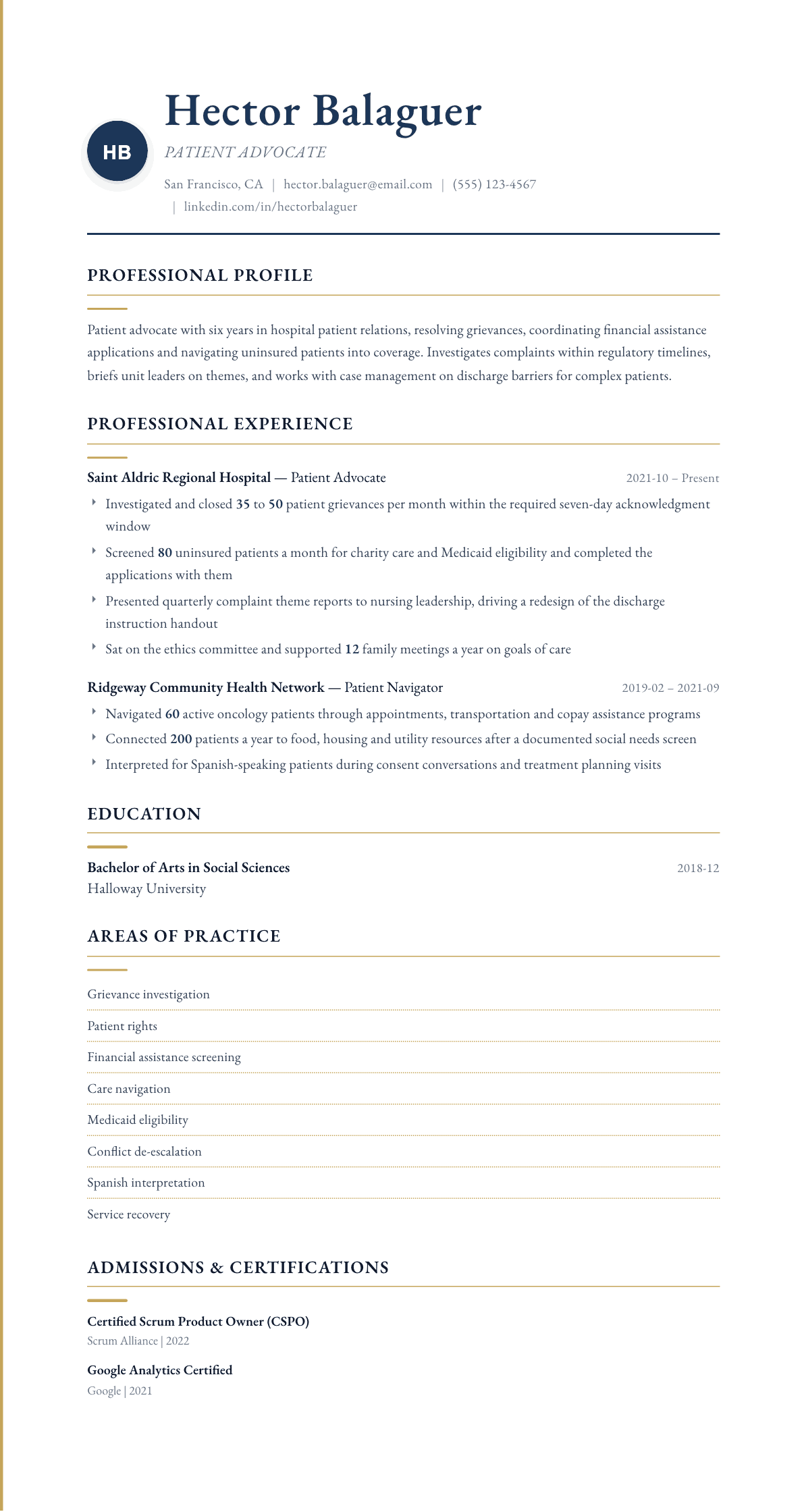
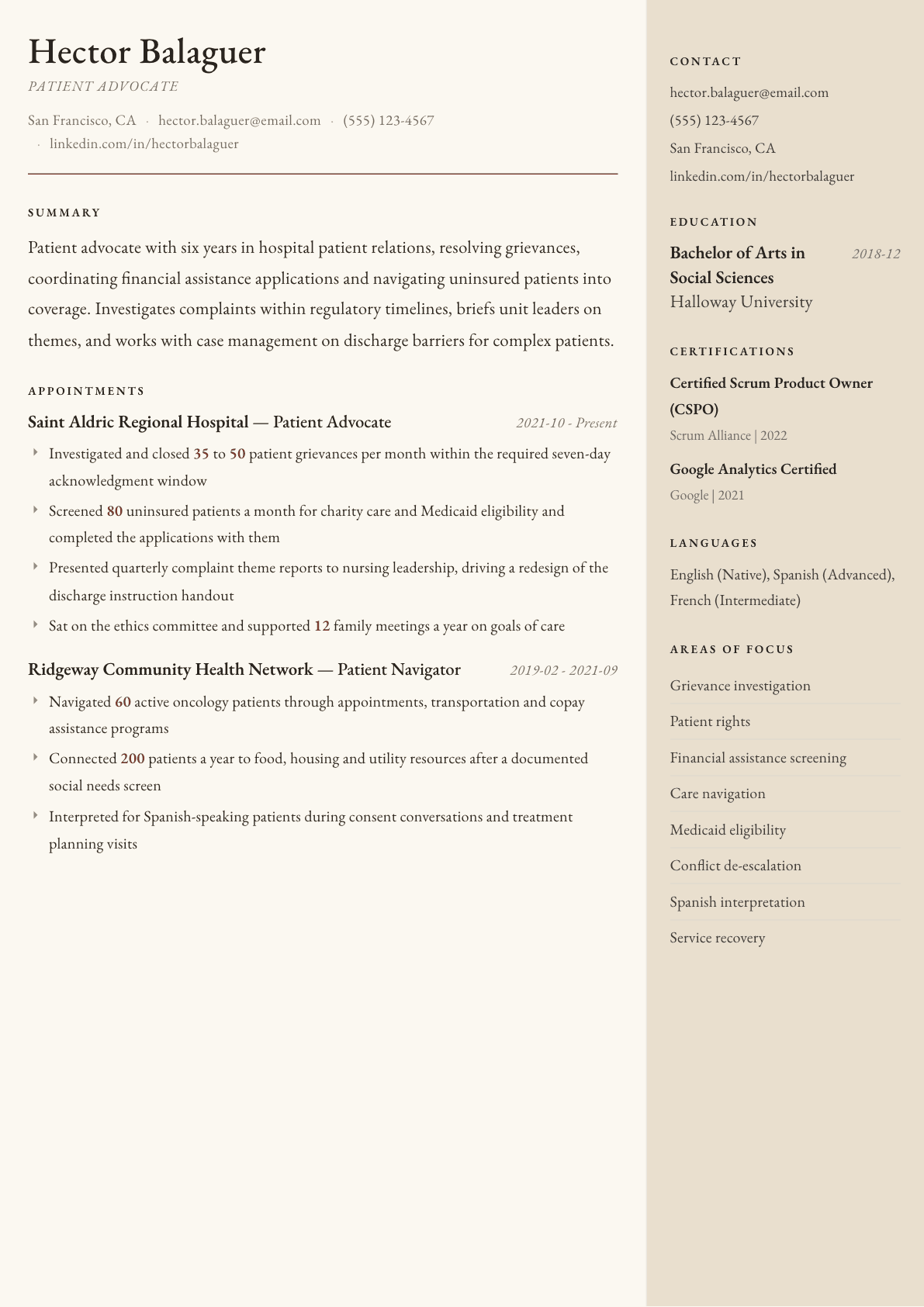
Example Patient Advocate summary
Patient advocate with six years in hospital patient relations, closing up to fifty grievances a month inside regulatory timelines and screening eighty uninsured patients monthly for charity care and Medicaid. Reports complaint themes to nursing leadership, sits on the ethics committee, supports goals of care meetings, and interprets for Spanish-speaking families during consent and treatment planning conversations.
Skills to list on a Patient Advocate resume
- Grievance investigation and resolution
- Patient rights and informed consent
- Service recovery
- Financial assistance screening
- Medicaid and marketplace eligibility
- Care navigation
- Social needs screening
- Discharge barrier resolution
- Conflict de-escalation
- Ethics committee participation
- Complaint trend reporting
- Interdisciplinary collaboration
- Medical interpretation
- HIPAA compliance
What actually gets this resume read
- Lead with complaint and grievance volume plus the turnaround you held, because those are regulated timelines.
- Distinguish complaints resolved at the bedside from formal grievances, since the two have different requirements.
- Show financial navigation work such as charity care screening or Medicaid applications with real monthly counts.
- Name the committees you sat on, because advocacy roles are judged partly by how far up your voice carried.
- Include language skills and interpreter work, as advocacy teams recruit specifically for community languages.
- Give one example of a system change that came from complaint data, not just the number of cases you closed.
How to write a patient advocate resume
A patient advocate is hired to absorb the hardest conversations in a hospital and turn them into something the organization can act on. Grievances arrive with regulatory clocks attached. Financial barriers arrive with a patient who has already skipped a medication. Discharge barriers arrive with a bed that cannot be released. The director reading your resume wants to see that you can carry all three without losing the timeline.
The title is used loosely across the industry, which is why the resume has to be specific. Some advocates run a formal grievance process inside patient relations. Some are financial navigators screening for charity care and coverage. Some are disease-specific navigators walking oncology patients through treatment. Say which one you have been, then show the range beyond it.
This guide covers how to write grievance work with the timelines intact, how to quantify navigation and financial screening, how to show that complaint data changed something, and the questions advocates ask when they are moving between community, hospital and payer settings.
Format: one page, with the advocacy model named up front
Reverse-chronological, one page unless you have more than a decade in patient relations. Open with a summary that names the setting, the caseload and the model you worked in, whether that is formal grievance handling, financial navigation, care navigation or a hybrid. Ambiguity here costs you the read.
Under each employer, give the facility size and the population served before the bullets. An advocate at a safety net hospital and one at a specialty cancer center face different barrier patterns, and naming yours lets a director judge the fit honestly.
- Header: name, city and state, phone, email, and languages spoken at a professional level.
- Section order: summary, experience, education, certifications, languages and community training.
- Context line per employer: facility type, population served, monthly caseload.
Grievances: volume, timelines and the difference from complaints
A complaint resolved at the bedside and a formal grievance are different objects with different obligations, and a director will notice immediately if the resume treats them as one. Give monthly volume for each, the acknowledgment and resolution timelines you worked to, and the share you closed inside them.
Describe the investigation itself. Interviewing staff, reviewing the record, coordinating with risk management and nursing leadership, then writing the response letter is skilled work with a defensible sequence. A bullet that walks through that sequence is far stronger than one that says resolved patient concerns.
Financial and coverage navigation: screening with real counts
Financial navigation is measurable. Give the number of uninsured or underinsured patients screened per month, the programs you screened against such as charity care, Medicaid or a marketplace plan, and how many applications you completed with the patient rather than handed over.
Copay assistance, drug manufacturer programs and transportation or meal support all belong here as well. Avoid quoting the amounts recovered unless you owned the figure. The count of patients moved into coverage is the number that reads as your work and the one you can defend in an interview.
- Patients screened per month and the programs screened against.
- Applications completed with the patient, and the approval follow-through you tracked.
- Assistance programs you enrolled patients into by name of program type.
Navigation and discharge barriers: show the resolution
Care navigation is judged by removed obstacles. Transportation, housing instability, food insecurity, interpreter needs, health literacy and appointment adherence are the recurring barriers, and each one has a different fix. Say which you resolved most often and how, since that reveals your actual community knowledge.
Discharge barrier work should be written alongside case management rather than in place of it. Describe your part: the family meeting you prepared, the placement objection you unpicked, the coverage question you answered so a discharge could proceed.
System change, committees and credibility
The senior version of this role does not only close cases, it changes the thing that caused them. Give one clear example: a complaint theme report that led to a rewritten discharge instruction, a consent process clarified after repeated confusion, a signage or interpreter fix that reduced a recurring grievance category.
Committee work builds that credibility, so name the committees plainly: ethics, patient and family advisory council, quality, patient experience. Add interpreter qualification and any community health worker or advocacy training, because those are exactly what advocacy teams recruit for.
Patient Advocate resume summary examples
Moving in from community work
Social sciences graduate with two years of community outreach connecting families to food, housing and insurance enrollment support. Trained in trauma-informed communication and fluent in Spanish. Seeking a hospital patient advocate role, bringing eligibility screening experience and a working knowledge of local assistance programs.
Navigator, three years
Patient navigator supporting 60 active oncology patients through appointments, transportation and copay assistance enrollment. Connects about 200 patients a year to food, housing and utility resources after a documented social needs screen, and interprets for Spanish-speaking families during consent and treatment planning conversations.
Hospital patient relations
Patient advocate closing 35 to 50 grievances a month within the required acknowledgment window at a regional hospital. Screens 80 uninsured patients monthly for charity care and Medicaid, presents quarterly complaint theme reports to nursing leadership, and serves on the ethics committee supporting goals of care meetings.
Work experience bullets: before and after
Before: Resolved patient complaints and concerns.
After: Investigated and closed 35 to 50 formal grievances a month within the required seven-day acknowledgment window, interviewing staff, reviewing the record and drafting the written response for leadership signature.
Volume, the regulatory clock and the investigation sequence show a managed process rather than general helpfulness.
Before: Helped uninsured patients find financial assistance.
After: Screened 80 uninsured patients a month for charity care and Medicaid eligibility, completed the applications alongside the patient and tracked each determination through to a coverage decision.
Monthly volume plus completion and follow-through prove navigation work rather than a referral handoff.
Before: Reported complaint trends to hospital leadership.
After: Presented quarterly complaint theme reports to nursing leadership, which drove a redesign of the discharge instruction handout after repeated confusion about medication timing.
A named change caused by the reporting shows influence, where a reporting duty alone shows only routine.
Before: Worked with the ethics committee on difficult cases.
After: Served on the hospital ethics committee and supported about twelve family meetings a year on goals of care, preparing families beforehand and documenting agreed decisions afterward.
Meeting count and the before and after roles turn membership into described participation.
Before: Assisted Spanish-speaking patients with communication.
After: Interpreted for Spanish-speaking patients during consent conversations and treatment planning visits, and flagged health literacy gaps to the care team before discharge teaching began.
Naming the encounter types and the escalation shows qualified interpretation rather than casual language help.
Hard skills
- Grievance investigation and written response
- Patient rights and informed consent processes
- Service recovery
- Financial assistance and charity care screening
- Medicaid and marketplace eligibility
- Care navigation and barrier resolution
- Social needs screening
- Complaint trend analysis and reporting
- Discharge barrier coordination
- Medical interpretation
- HIPAA compliance
- Committee documentation
Soft skills
- De-escalation with distressed families
- Neutrality between patients and staff
- Trauma-informed communication
- Boundary setting under emotional load
- Persuasion without authority
- Discretion with sensitive disclosures
Certifications worth listing
- Board Certified Patient Advocate (BCPA) (Patient Advocate Certification Board)
- Certified Healthcare Access Associate (CHAA) (National Association of Healthcare Access Management)
- Certified Healthcare Interpreter (CHI) (Certification Commission for Healthcare Interpreters)
- Certified Medical Interpreter (CMI) (National Board of Certification for Medical Interpreters)
Mistakes that cost patient advocate candidates the interview
- Leaving the advocacy model unnamed, so a director cannot tell grievance handling from financial navigation from disease-specific navigation.
- Writing about compassion instead of caseload, timelines and resolved barriers that a reader can weigh.
- Blurring bedside complaints and formal grievances, which signals unfamiliarity with the obligations attached to each.
- Claiming recovered amounts you never owned rather than the patient counts that clearly belong to your work.
- Omitting the one example where complaint data changed a process, which is the difference between senior and junior advocacy.
- Listing language ability without the setting, when consent and treatment conversations are exactly where it counts.
- Filing committee memberships as titles with no description of what you contributed inside them.
Patient Advocate resume questions
What is the difference between a patient advocate and a case manager?
Case management owns the clinical plan, utilization review and discharge disposition. Advocacy owns the patient perspective: rights, grievances, financial barriers and access. The two overlap at discharge, so describe your part of that overlap rather than claiming the whole of it.
Do I need a certification to work as a patient advocate?
It is not usually required in hospital patient relations, though a board credential helps in independent and private advocacy where there is no employer to vouch for you. Interpreter certification is separately valuable and often screened for directly.
How do I quantify advocacy work that feels unmeasurable?
Count what passes through your desk: cases opened and closed, share closed inside the required window, patients screened, applications completed, barriers resolved by type, committees served. Those counts describe scope honestly without pretending to attribute clinical outcomes to your work.
How do I move from community outreach into a hospital advocacy role?
Lead with eligibility screening, enrollment support and the assistance programs you know by name, since those transfer directly. Then address the gap: hospital advocacy adds grievance process and regulatory timelines, so name any complaint handling you have already done.
Should I describe a difficult case on my resume?
Not as a story, which eats space and invites confidentiality problems. Describe the category and your method instead, such as coverage denials before a scheduled procedure, then keep the specific case ready as an interview answer where you can control the detail.