Practice Manager Resume Examples: the lines they read
Write a Practice Manager Resume That Shows Clinic Results
By Mustafa Tarabya, founder of CVBooster · Published · Updated
Practice manager resume example with provider support, revenue cycle detail, staffing keywords and a section by section guide for clinic hiring.
Sample resumes for a practice manager
The same practice manager content laid out in three CVBooster templates, so you can see what the finished document looks like before you write a word.
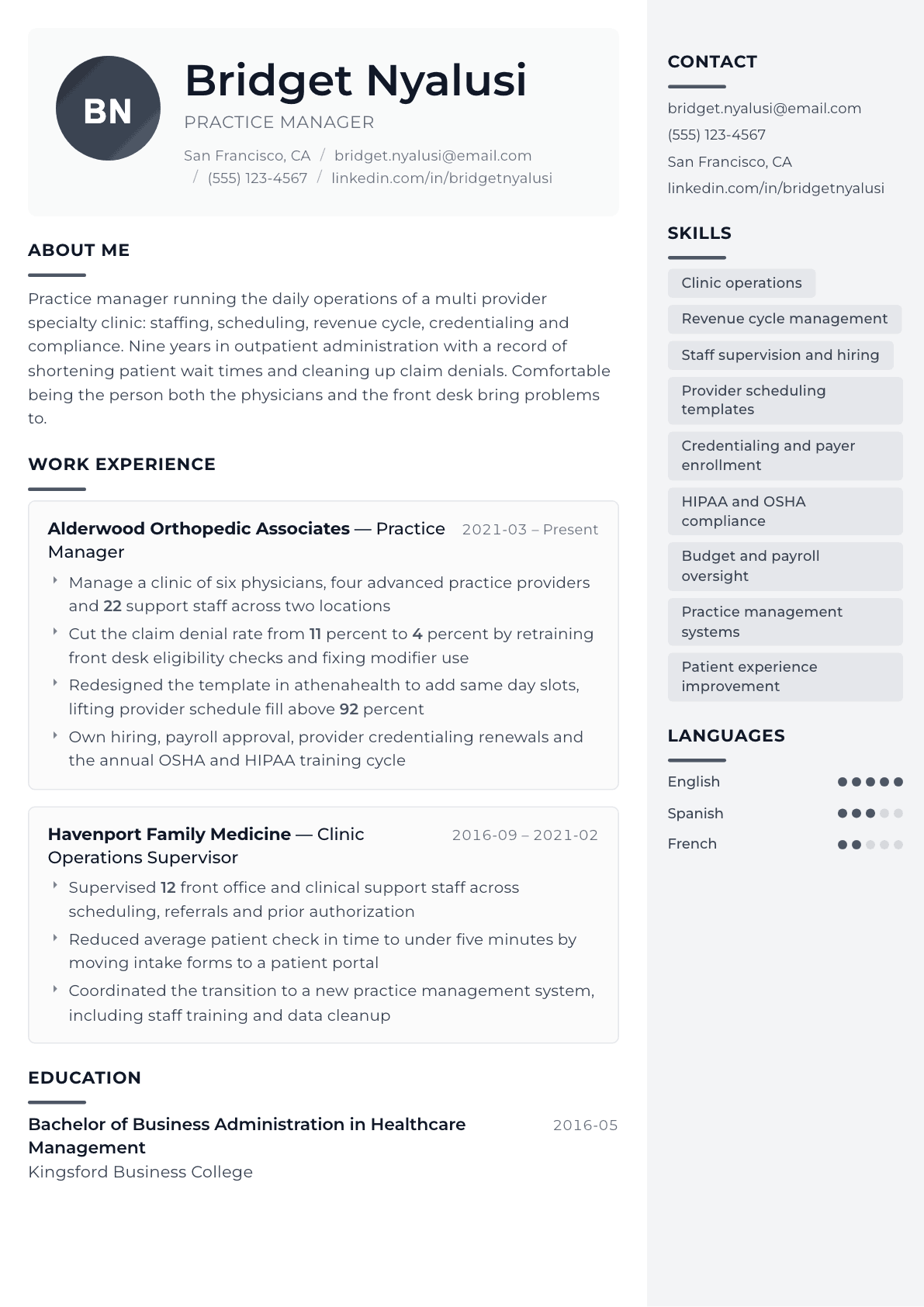
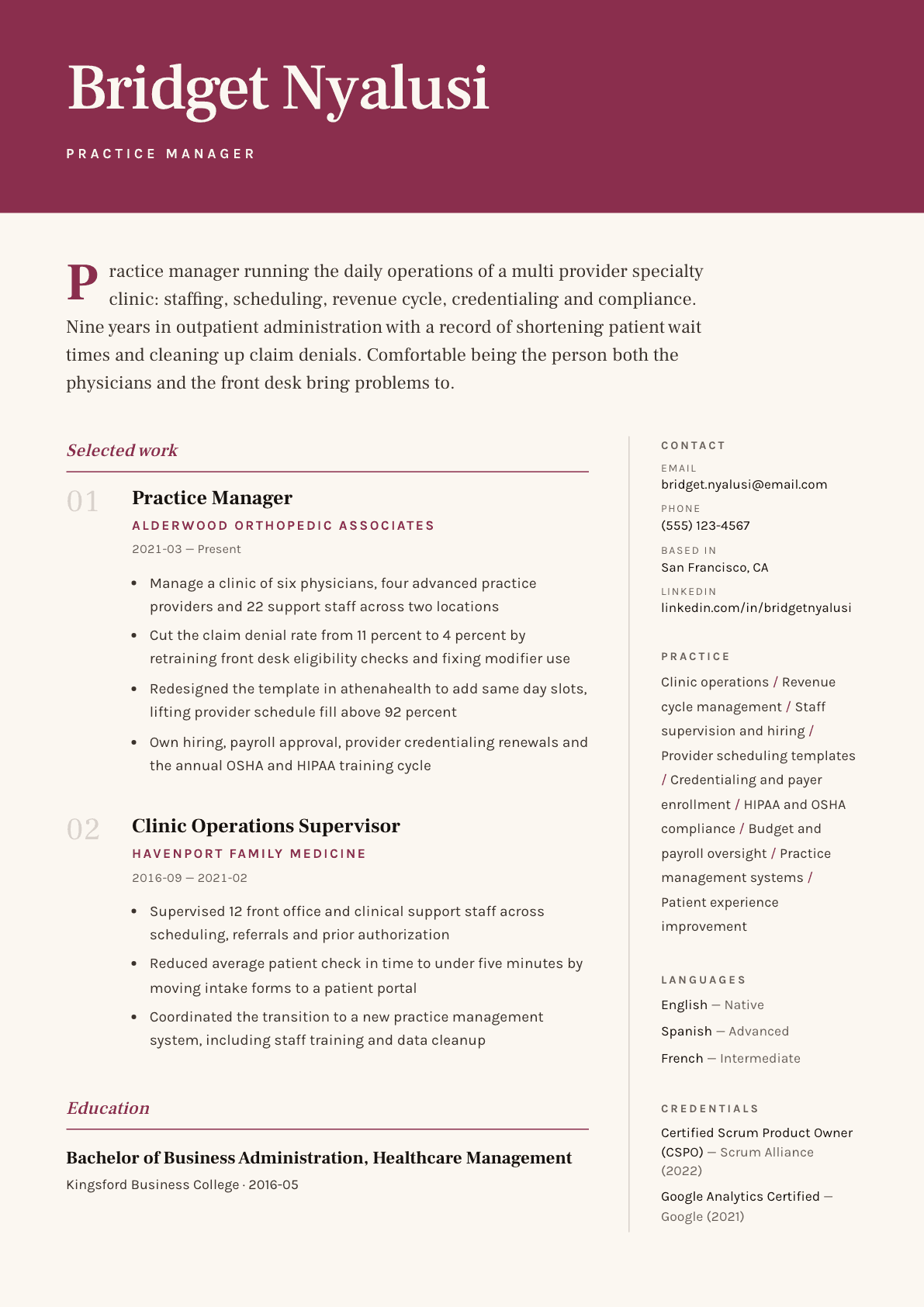
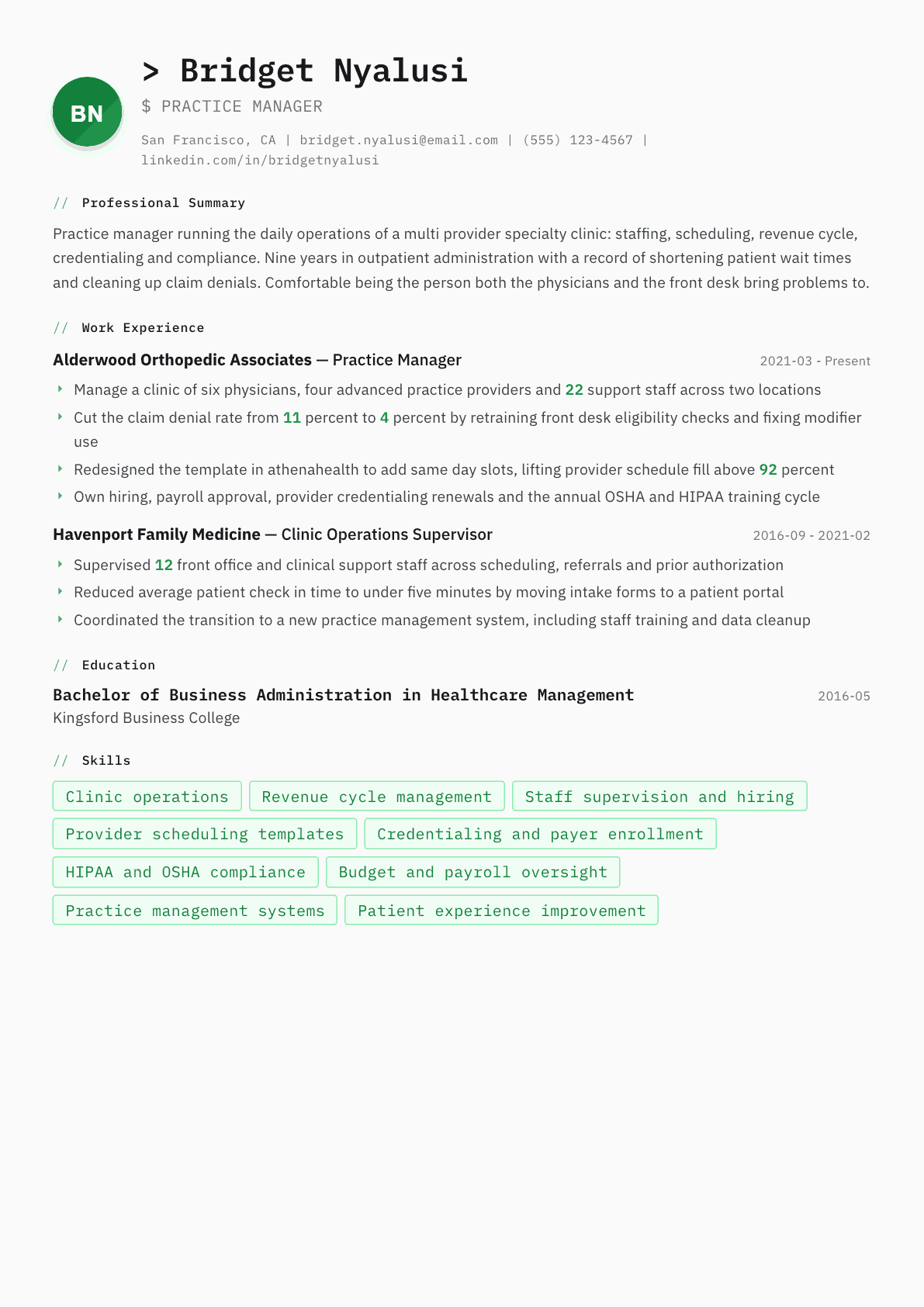
Example Practice Manager summary
Practice manager with nine years running outpatient specialty and primary care clinics, covering staffing, scheduling, revenue cycle, credentialing and compliance. Cut denial rates by more than half at a six physician orthopedic group and rebuilt scheduling templates to raise provider fill. Known for steady handling of payroll, payer enrollment and the training calendar so clinicians can stay focused on patients.
Skills to list on a Practice Manager resume
- Medical practice operations
- Revenue cycle management
- Claim denial reduction
- Provider scheduling and template design
- Staff hiring and supervision
- Payroll and budget oversight
- Provider credentialing and payer enrollment
- HIPAA and OSHA compliance
- Patient flow improvement
- Practice management systems
- Vendor and supply contract management
- Prior authorization workflow
- Financial and productivity reporting
- Patient experience and complaint resolution
What actually gets this resume read
- Give the size of the practice: provider count, staff headcount, locations, specialty and daily patient volume.
- Show revenue cycle results such as denial rate, days in accounts receivable, collections at time of service and coding accuracy.
- Name the practice management and electronic record systems you have run, since clinic owners hire for that exact experience.
- Include credentialing and payer enrollment work, because a lapsed provider enrollment stops a clinic from being paid.
- Demonstrate people management with hiring numbers, turnover, training cycles and how you handled a difficult staffing period.
- Add compliance ownership covering HIPAA, OSHA and any state clinic requirements, as this often sits with the practice manager.
How to write a practice manager resume
The person hiring a practice manager is usually a physician owner or an administrator who has just watched a clinic run badly. Claims are unpaid, the schedule has holes at eleven in the morning and none at four, the front desk has turned over twice this year, and a provider enrollment lapsed without anyone noticing. Your resume has to read like the answer to that specific mess.
That means the file must be operational rather than administrative in tone. Clinic size, provider count, daily patient volume, denial rate, days in accounts receivable, schedule fill, staff headcount and turnover are the vocabulary. A resume that lists supervising staff and managing operations gives an owner no way to judge whether you can fix anything.
This guide covers how to write it, with example summaries at three career stages, before and after bullets from primary care and specialty settings, and the questions practice managers ask when moving between specialties or from a hospital owned group into private practice.
Format: one to two pages with the practice profile up front
One page under six years, two after. Reverse chronological, plain headings, no columns. Under your summary add a practice profile line for your current role: specialty, number of physicians and advanced practice providers, number of support staff, number of locations and average daily patient volume. An owner reading it can immediately tell whether you have run something the size of their clinic.
Specialty matters more than candidates expect. Orthopedics with surgical scheduling and durable medical equipment, dermatology with high volume and pathology, behavioral health with prior authorization burdens and primary care with panel management are genuinely different operations. Name yours in every entry.
- Header: name, city and state, phone, email, and any management credential.
- Sections: summary, practice profile, operations experience, revenue cycle results, systems, credentials, education.
- List every practice management and electronic record system by name; owners search on them directly.
Summary: size, scope, and the two results you are proudest of
Four lines. Years in outpatient management, the specialties you have run, the size of the largest practice you managed, and the scope you owned. Scope usually spans staffing, scheduling, revenue cycle, credentialing, compliance, vendors and facilities. Say which of those you actually held, because in some groups a billing company holds the revenue cycle and in others it sits entirely with you.
Close with two concrete results. A denial rate you brought down and a schedule fill you raised will do more work than any description of your management style.
Experience: the four systems that make a clinic work
Organize the bullets under each role around the four systems an owner worries about, whether or not you use those words as headings.
Revenue cycle: eligibility verification at check in, coding accuracy and modifier use, charge capture, claim scrubbing, denial rate, days in accounts receivable, collections at time of service, and patient balance follow up. Scheduling and access: template design, same day capacity, no show rate and what you did about it, provider productivity, and wait times from request to appointment. People: headcount, hiring, cross training, turnover, performance management and the training calendar. Compliance and credentialing: privacy and safety training cycles, incident handling, chart audits, provider enrollment with each payer, license and certification tracking, and any state clinic requirements.
Wherever a number exists, use it. Practice management is one of the few healthcare roles where almost everything is measured, so a resume with no measures suggests you never looked at the reports.
Systems, vendors and the operational plumbing
Name the practice management system, the electronic record, the clearinghouse, the patient engagement or reminder platform, the payroll system and the reporting tools you have used. Owners hire for the exact system in place because a manager who already knows it can be useful in a week rather than a quarter.
Add vendor and contract work if you owned it: medical supply agreements, laboratory and imaging arrangements, equipment leases, waste and linen services, cleaning, and the building lease itself. This is unglamorous and it is a real part of the job, and mentioning it signals that you have run a whole practice rather than one department of it.
Credentials, keywords and the patient experience side
List any management credential you hold with its issuing body, along with coding or compliance certifications. These are not required everywhere, and they read as evidence of formal knowledge in a field many people enter sideways from the front desk.
Finish with patient experience work, since it is increasingly measured and often lands on the manager. Complaint resolution, survey administration and follow up, check in flow redesign, portal adoption and communication with patients about billing all belong here. Mirror the phrases postings use, including revenue cycle, prior authorization, credentialing, patient flow, staff supervision and compliance.
Practice Manager resume summary examples
Stepping up from supervisor
Clinic operations supervisor with four years overseeing twelve front office and clinical support staff across scheduling, referrals and prior authorization. Cut average check in time to under five minutes by moving intake to the patient portal, and coordinated a practice management system conversion. Ready for full practice manager responsibility in a primary care setting.
Running a specialty clinic
Practice manager for a two site orthopedic group with six physicians, four advanced practice providers and 22 support staff. Owns staffing, scheduling templates, revenue cycle, credentialing and compliance. Reduced the claim denial rate from 11% to 4% and raised provider schedule fill above 92% through template redesign and same day capacity.
Multi site or group administrator
Practice administrator with twelve years across primary care and multi specialty groups, currently overseeing four locations, eighteen providers and a staff of sixty. Accountable for the operating budget, payer contracting support, provider enrollment, facilities and the annual compliance cycle, with a record of stable staffing through two system conversions.
Work experience bullets: before and after
Before: Managed the billing process.
After: Cut the claim denial rate from 11% to 4% in a year by retraining front desk eligibility verification, correcting modifier use with the coders and adding a weekly denial review with the billing team.
A measured change with the three mechanisms behind it proves revenue cycle competence rather than oversight.
Before: Handled provider schedules.
After: Redesigned provider templates to add same day and post operative slots, lifting schedule fill above 92% while cutting the average wait for a new patient appointment from five weeks to twelve days.
Template work tied to fill and access shows you can operate the clinic calendar, which is the manager core skill.
Before: Supervised the front office team.
After: Managed 22 support staff across two sites, cross trained the front desk on referrals and prior authorization, and cut annual turnover by moving to published schedules four weeks ahead.
Headcount, cross training and a retention mechanism turn supervision into a staffing strategy an owner can copy.
Before: Took care of credentialing.
After: Owned provider credentialing and payer enrollment for ten clinicians, tracking every revalidation date on a shared calendar so no enrollment lapsed across four years.
A lapsed enrollment stops payment, so the tracking method and the clean record are the point of the bullet.
Before: Kept the clinic compliant.
After: Ran the annual privacy and workplace safety training cycle for all staff, completed quarterly chart and controlled substance log audits, and prepared documentation for a state clinic inspection with no citations.
Naming the audits and the inspection outcome shows compliance as a managed process rather than a claim.
Hard skills
- Medical practice operations
- Revenue cycle and denial management
- Accounts receivable and collections
- Provider schedule template design
- Staff hiring, training and supervision
- Payroll and operating budget management
- Provider credentialing and payer enrollment
- Privacy and workplace safety compliance
- Prior authorization and referral workflow
- Practice management and record systems
- Vendor and lease contract management
- Productivity and financial reporting
Soft skills
- Absorbing pressure from providers and staff
- Clear communication about money
- Fair and consistent performance management
- Composure with upset patients
- Negotiation with vendors and payers
- Discretion with confidential staffing matters
Certifications worth listing
- Certified Medical Practice Executive (CMPE) (American College of Medical Practice Executives)
- Certified Medical Manager (CMM) (Professional Association of Health Care Office Management)
- Certified Professional Coder (CPC) (AAPC)
- Certified Professional Biller (CPB) (AAPC)
- Certified in Healthcare Compliance (CHC) (Health Care Compliance Association)
Mistakes that cost practice manager candidates the interview
- Describing the job in duty language without a single operational number attached to any of it.
- Leaving out the practice profile, so an owner cannot tell whether you have run a clinic of their size.
- Ignoring the revenue cycle when the practice you are applying to has a billing problem it needs solved.
- Failing to name the practice management and record systems, which owners search for directly.
- Omitting credentialing and enrollment work, one of the quietest ways a clinic loses money.
- Presenting yourself as an office administrator when the posting is for someone accountable for financial performance.
Practice Manager resume questions
What is the difference between a practice manager and a medical office manager?
Titles overlap, but a practice manager usually carries financial accountability including revenue cycle, budget and provider productivity, while an office manager often focuses on daily front office operations and staffing. Read the posting for budget and revenue language.
Do I need a coding certification to be a practice manager?
It is not required, and it helps considerably in specialties where coding drives revenue. Even without certification, showing that you understand modifier use, charge capture and denial patterns will separate you from candidates who leave billing entirely to a vendor.
How do I switch specialties as a practice manager?
Lead with the systems that transfer, meaning revenue cycle, staffing, credentialing and compliance, and then show that you know what is different about the target specialty, such as surgical scheduling, authorization burden or high volume visit flow.
Should I include the size of the budget I managed?
Include the scope rather than a precise figure if you prefer, such as owning the operating budget for a four location group with eighteen providers. Owners want to know the level of financial responsibility you have carried before, not your former practice finances.
How do I show results if my clinic was already well run?
Show maintenance and risk avoided. Holding turnover flat through a system conversion, keeping enrollments current across four years, or passing an inspection without citations are genuine results, and an experienced owner recognizes how hard they are.