Registered Nurse Resume Examples: the lines they read
Write a Registered Nurse Resume That Reaches the Unit Manager
By Mustafa Tarabya, founder of CVBooster · Published · Updated
Registered Nurse resume example and guide: license placement, unit and ratio detail, certifications, charting systems, ATS keywords and a ready summary.
Sample resumes for a registered nurse
The same registered nurse content laid out in three CVBooster templates, so you can see what the finished document looks like before you write a word.
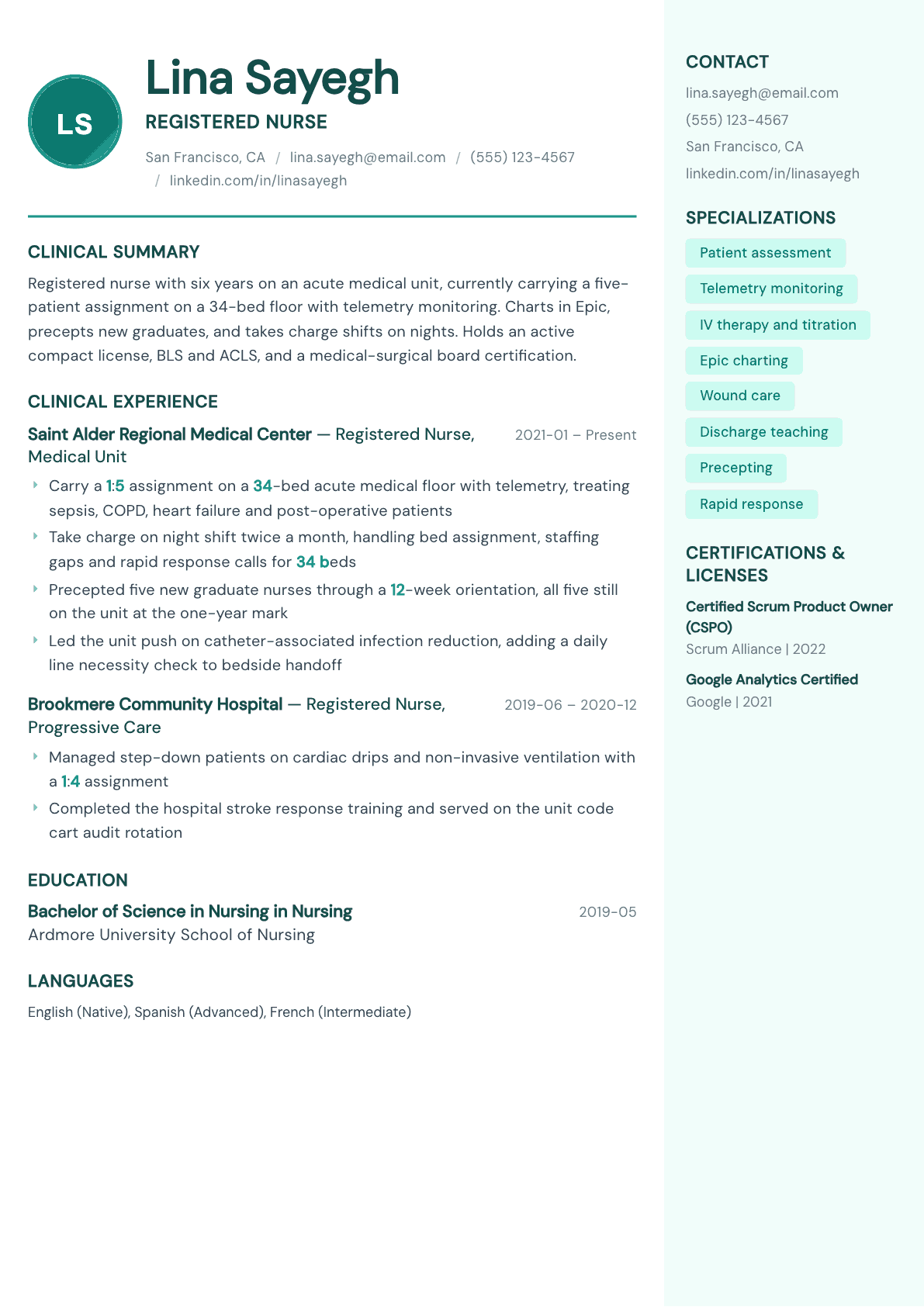
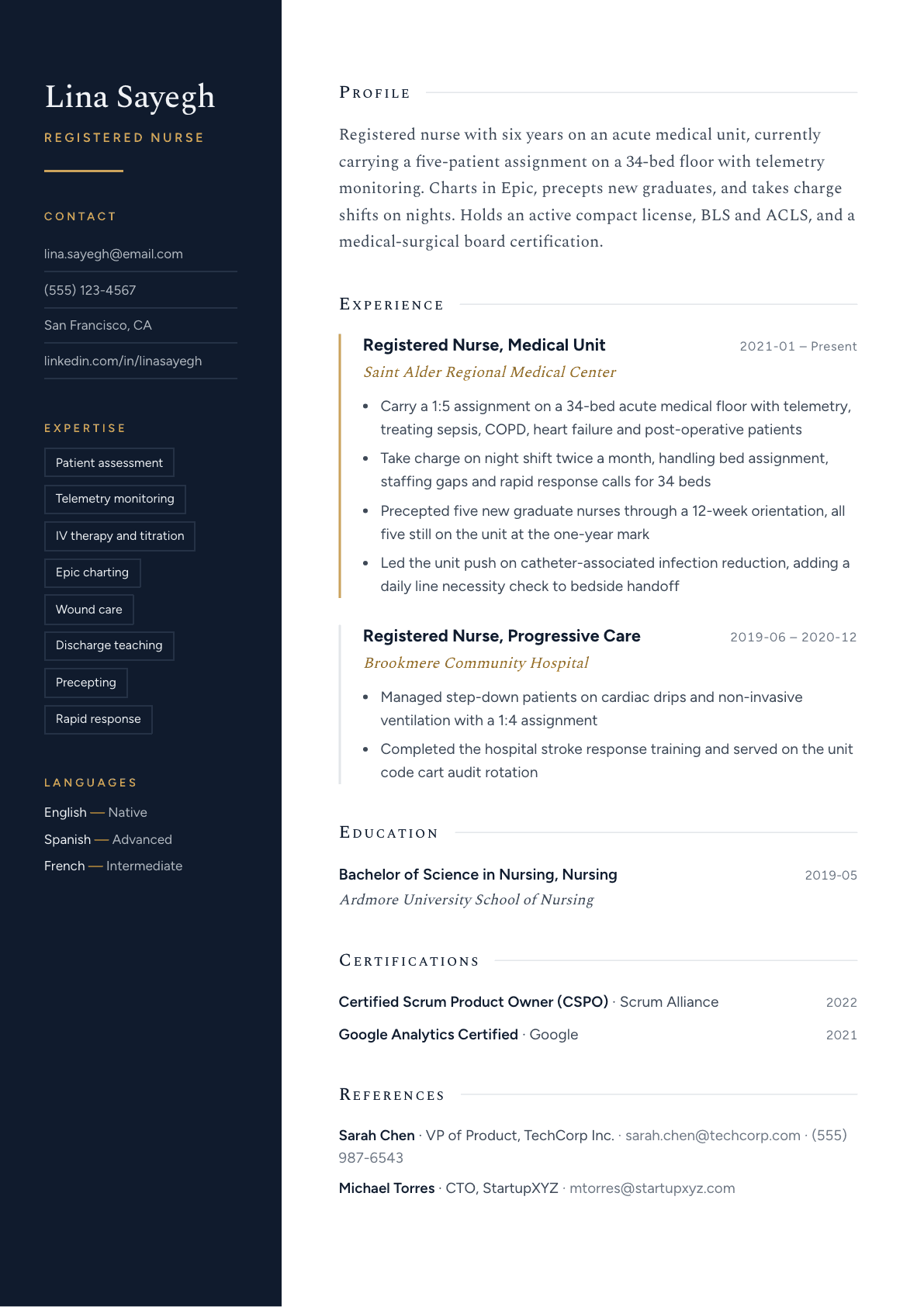
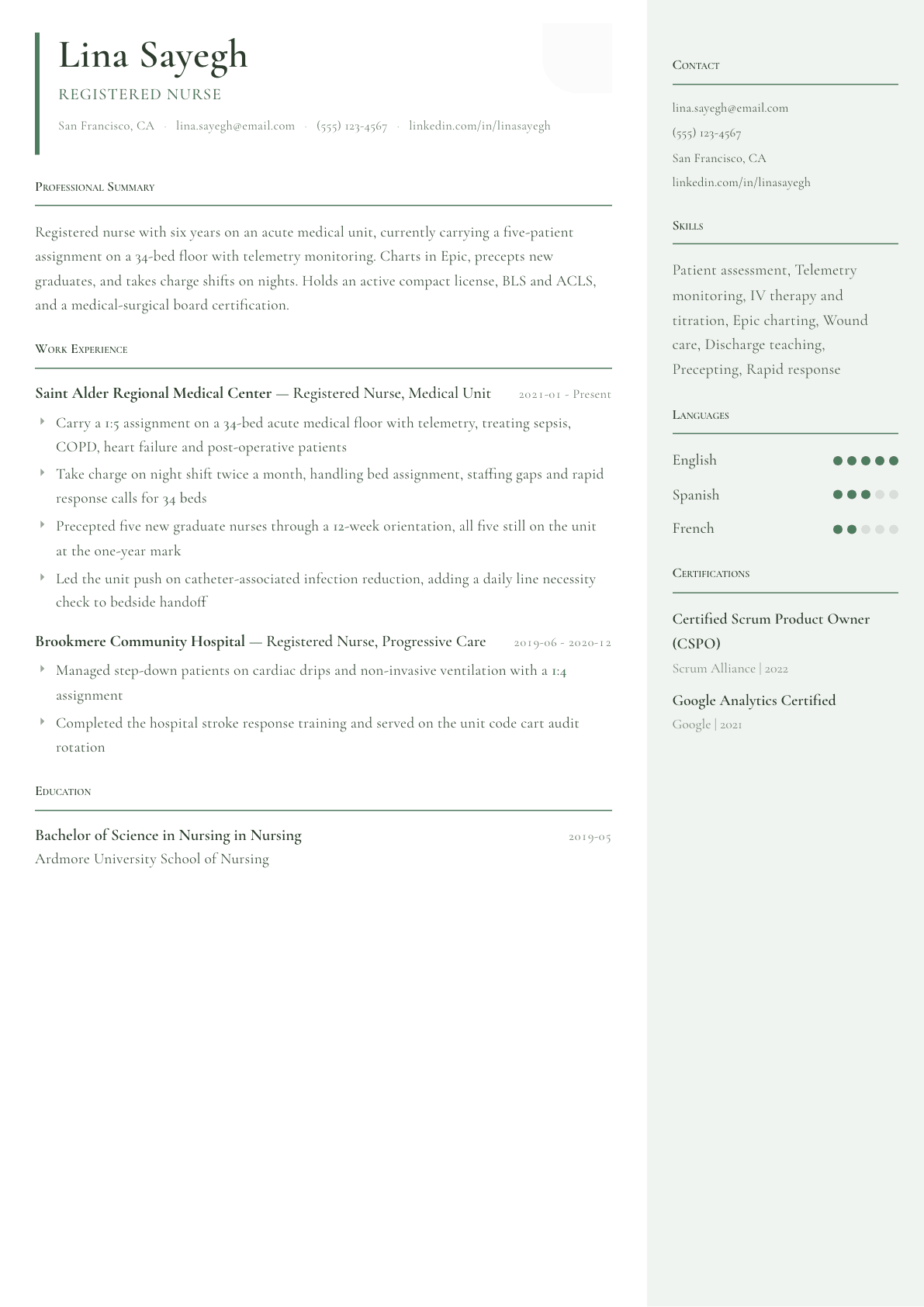
Example Registered Nurse summary
Registered nurse with six years in acute medical and progressive care, currently carrying a five-patient telemetry assignment on a 34-bed floor and taking charge shifts twice a month. Holds a compact license, BLS, ACLS and medical-surgical board certification, charts in Epic, and has precepted five new graduates through orientation. Seeking a progressive care or intermediate care position in a teaching hospital.
Skills to list on a Registered Nurse resume
- Patient assessment
- Medication administration
- IV insertion and titration
- Telemetry interpretation
- Wound care
- Care planning
- Epic
- Cerner
- Discharge education
- Infection prevention
- Rapid response and code participation
- Charge nurse duties
- Precepting new graduates
- Interdisciplinary rounding
What actually gets this resume read
- Put your credentials after your name in the header and repeat the license state and expiry in its own section.
- Name the unit, the bed count and the patient ratio in every job, because that is how a manager reads acuity.
- List specialty certifications above BLS, since the specialty credential is what moves you up the pile.
- Say which charting system you use, as hospitals filter on Epic, Cerner and Meditech experience directly.
- Show clinical judgment in bullets: escalations, deteriorating patients, drips titrated, procedures assisted.
- Include precepting, charge shifts and committee work, which separate you from every other applicant with six years.
How to write a registered nurse resume
Two screens stand between a registered nurse and an interview. The first is automated and looks for the license, the certifications, the specialty words from the posting and clean dates. The second is a unit manager with vacancies who wants to know whether you can take a full assignment on her floor with a short orientation. A resume that clears one and not the other goes nowhere.
The information that satisfies both is mostly factual and mostly missing from the average nursing resume: license type and state, certification issuers, the unit and its bed count, the patient ratio you carried, the acuity, the charting system, and the equipment you are checked off on. None of it requires embellishment, and all of it is what a nurse manager is trying to reconstruct while reading.
This guide covers the layout hospital systems parse cleanly, how to describe a unit so acuity is unmistakable, where credentials belong, three summaries covering a nursing career from residency to charge, before-and-after bullets and the questions registered nurses ask when they apply to a new facility.
Format: reverse chronological, plain columns, credentials in the header
Reverse chronological is the only safe choice. Hospital applicant tracking systems are conservative, and a design-led layout with sidebars, icons or text boxes frequently loses the employment dates, which is the field a nurse recruiter checks first.
Put your credentials after your name in the header in the conventional order, then repeat them in full further down with issuing bodies and expiry dates. One page is right for a new graduate. Two pages is normal once you have several units, certifications and charge or preceptor experience behind you.
- Header: name followed by your credentials (BSN, RN), city and state, phone, email, and every state where your RN license is active.
- Section order: summary, licensure and certifications, clinical experience, education, skills and equipment.
- New graduates put education above experience and add a clinical rotations block with hours.
Licensure: the section recruiters read before anything else
Give the license type, the issuing state board, the status and the expiry. If you hold a multistate privilege under the Nurse Licensure Compact, name it and state your primary state of residence, because facilities in compact states screen for it directly and travel assignments depend on it.
List certifications with the exact issuing organization, not just the acronym. A recruiter verifying credentials wants to see the body that granted them, and a nurse who writes them correctly signals familiarity with how verification works.
If a license or certification is pending, say so with the expected date rather than leaving a gap. An honest pending line is routine; a discovered omission is not.
Clinical experience: unit, beds, ratio, population, acuity
Open every job with a facility and unit line before the bullets. Trauma level, teaching status, bed count of the unit, the assignment ratio you carried and the patient population together tell a manager your acuity in one glance. Without them, a busy intermediate care floor and a low-acuity clinic look the same on paper.
Then three to five bullets that show judgment rather than routine. The drips you titrate, the devices you manage, the deteriorating patients you escalated, the procedures you assist with, the protocols you initiate. Anything that is true of every registered nurse in the country is taking up space that a differentiating detail should occupy.
Add one bullet per job on work beyond the bedside if you have it: charge shifts, precepting, a shared governance council, a unit-based quality project, super-user status on a charting upgrade, or code cart and equipment audits. Managers hire for the floor but promote from this list.
- Facility line: hospital type, trauma or teaching status, unit name, bed count.
- Assignment line: nurse to patient ratio, shift length and pattern, population and typical diagnoses.
- Judgment bullets: escalations, titrations, devices, protocols initiated.
- Beyond bedside: charge, precepting, committees, audits, super-user roles.
Skills and equipment: keywords the software matches on
Keep this section factual and clinical. Name the charting system by product, since hospitals filter on Epic, Cerner and Meditech experience to shorten orientation. Name the equipment you are competent with: infusion and patient-controlled analgesia pumps, telemetry, ventilators, chest tubes, continuous renal replacement, wound vacuum systems.
Include procedures and access: peripheral IV starts, blood draws, central line dressing changes, nasogastric tube placement, urinary catheter insertion, wound care and specimen collection. Leave personality traits out of this list, because they belong in bullets where they can be evidenced.
Tailoring to the posting without rewriting the resume
Hospital postings are built from templates, so the same phrases recur: patient assessment, plan of care, medication administration, patient and family education, interdisciplinary rounding, infection prevention, evidence-based practice, and the unit name. Mirror the exact wording once in your summary and once inside a bullet where you actually did it.
Then change two things per application: the summary line and the first bullet of your most recent job. A nurse applying to an intermediate care posting leads with drips, telemetry and rapid response, while the same nurse applying to a clinic leads with chronic disease teaching and care coordination. The rest of the document can stay as it is.
Registered Nurse resume summary examples
New graduate seeking residency
Newly licensed registered nurse with 720 clinical hours across medical-surgical, obstetrics and a 160-hour capstone on a telemetry unit. Trained in Epic during rotations, certified in BLS and ACLS, and applying to a nurse residency program in adult acute care.
Six years on an acute floor
Registered nurse with six years on a 34-bed acute medical unit, carrying a five-patient telemetry assignment and taking night charge twice a month. Board certified in medical-surgical nursing, precepts new graduates, and led the unit line necessity check that reduced catheter-associated infections.
Charge nurse and preceptor
Charge nurse with fourteen years across progressive care and critical care, running a 28-bed unit on nights: assignments, admissions flow, rapid response and staffing escalation. Preceptor for the residency cohort and chair of the unit practice council for the past three years.
Work experience bullets: before and after
Before: Provided nursing care to patients on a medical unit.
After: Carry a 1:5 assignment on a 34-bed acute medical floor with continuous telemetry, treating sepsis, heart failure, COPD exacerbation and post-operative patients across 12-hour nights.
Ratio, bed count, monitoring and the diagnosis mix let a manager judge acuity instead of guessing at it.
Before: Monitored patients and reported changes to the physician.
After: Initiate the sepsis protocol on early recognition, draw lactate and cultures before antibiotics, and escalate deteriorating patients to rapid response, averaging two activations a month.
Naming the protocol, the sequence and the escalation frequency demonstrates clinical judgment rather than observation.
Before: Trained new nurses on the unit.
After: Precepted five new graduate nurses through a 12-week residency orientation using weekly competency checklists, with all five still practicing on the unit at the one-year mark.
The structure of the orientation and the retention outcome turn training into measurable development work.
Before: Took part in quality improvement on the unit.
After: Led the unit effort on catheter-associated urinary tract infections by adding a daily line necessity check to bedside handoff and auditing compliance weekly for two quarters.
A named target, a specific intervention and an audit period show ownership of an improvement rather than attendance.
Before: Charted patient care in the electronic record.
After: Document assessments, medication administration and care plan progress in Epic, and served as unit super-user during the flowsheet upgrade, coaching sixteen colleagues through the change.
Super-user status and the number coached turn routine charting into evidence of system competence and leadership.
Before: Educated patients before they went home.
After: Deliver heart failure discharge teaching on daily weights, fluid limits and symptom thresholds using teach-back, and confirm caregiver understanding before the discharge order is released.
A named condition, the content taught and the verification method make patient education specific and checkable.
Hard skills
- Head-to-toe patient assessment
- Medication administration and titration
- Peripheral IV insertion and blood draws
- Telemetry rhythm interpretation
- Ventilator and oxygen therapy support
- Wound care and drain management
- Central line dressing and care
- Care plan development
- Epic and Cerner documentation
- Infection prevention practice
- Rapid response and code participation
- Discharge planning and patient education
Soft skills
- Prioritizing a full assignment
- Handoff and bedside report clarity
- Escalating to a reluctant provider
- Family communication in bad news
- Precepting patience
- Steadiness during a code
Certifications worth listing
- Basic Life Support (BLS) (American Heart Association)
- Advanced Cardiovascular Life Support (ACLS) (American Heart Association)
- Pediatric Advanced Life Support (PALS) (American Heart Association)
- Medical-Surgical Nursing Certification (MEDSURG-BC) (American Nurses Credentialing Center)
- Certified Medical-Surgical Registered Nurse (CMSRN) (Medical-Surgical Nursing Certification Board)
- PCCN (Progressive Care Nursing) (American Association of Critical-Care Nurses)
- Trauma Nursing Core Course (TNCC) (Emergency Nurses Association)
Mistakes that cost registered nurse candidates the interview
- Leaving the license state, status and expiry off the page, which stalls the file at the credentialing step.
- Writing generic duty bullets that describe the profession rather than the nurse who performed them.
- Omitting bed count and assignment ratio, so acuity is invisible and every unit reads the same.
- Using acronyms alone for certifications without the issuing body a recruiter needs for verification.
- Choosing a two-column template with graphics that hospital parsers read out of order and truncate.
- Sending an identical resume to a critical care posting and an outpatient posting instead of swapping the summary and first bullet.
- Listing personality traits in the skills section where the software is matching clinical keywords.
Registered Nurse resume questions
How should a registered nurse list a compact license?
Write the license type, your primary state of residence, the multistate privilege under the Nurse Licensure Compact, and the expiry date. Facilities in compact states and every travel agency screen for this, so it belongs in the credentials section rather than buried in a summary line.
What should a new graduate nurse put instead of experience?
Lead with education, then a clinical rotations block giving each placement the facility, unit, hours and one line on what you did. Add your capstone separately with its hours and preceptor setting. Externships, patient care technician work and nursing assistant roles all count and should be listed as employment.
Do I need a specialty certification to change units?
Not usually, but it makes the case for you. A nurse moving from medical-surgical to progressive care with a relevant board certification is competing on evidence rather than intent. If you are studying for one, list it as in progress with the expected examination date.
How do I explain travel assignments on a nursing resume?
Group them under the agency as one employer, then list each assignment as a sub-entry with the facility type, unit, ratio and dates. That keeps the dates continuous, avoids the appearance of job hopping, and still shows a manager the range of units you have worked.
Should I include continuing education on a nursing resume?
Include courses that match the posting, such as chemotherapy administration, dysrhythmia interpretation, wound care or trauma nursing, with the provider and year. Skip routine annual competencies every nurse completes, since they add length without telling a manager anything new.