Patient Coordinator Resume Examples: what gets the call
Write a Patient Coordinator Resume That Shows Scheduling and Access Results
By Mustafa Tarabya, founder of CVBooster · Published · Updated
Patient coordinator resume examples covering scheduling volume, referrals, prior authorization and the access keywords clinics screen for.
Sample resumes for a patient coordinator
The same patient coordinator content laid out in three CVBooster templates, so you can see what the finished document looks like before you write a word.
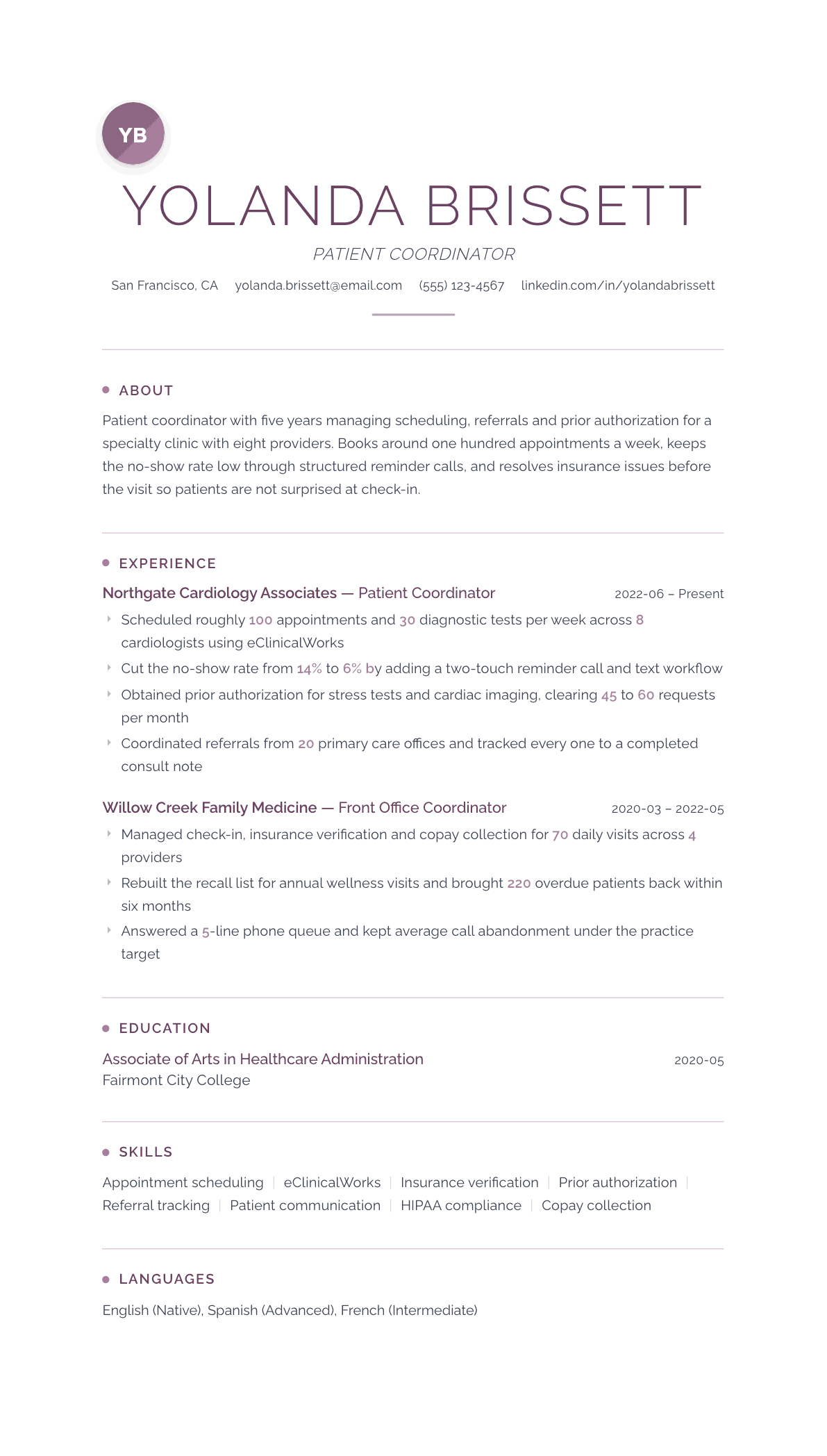
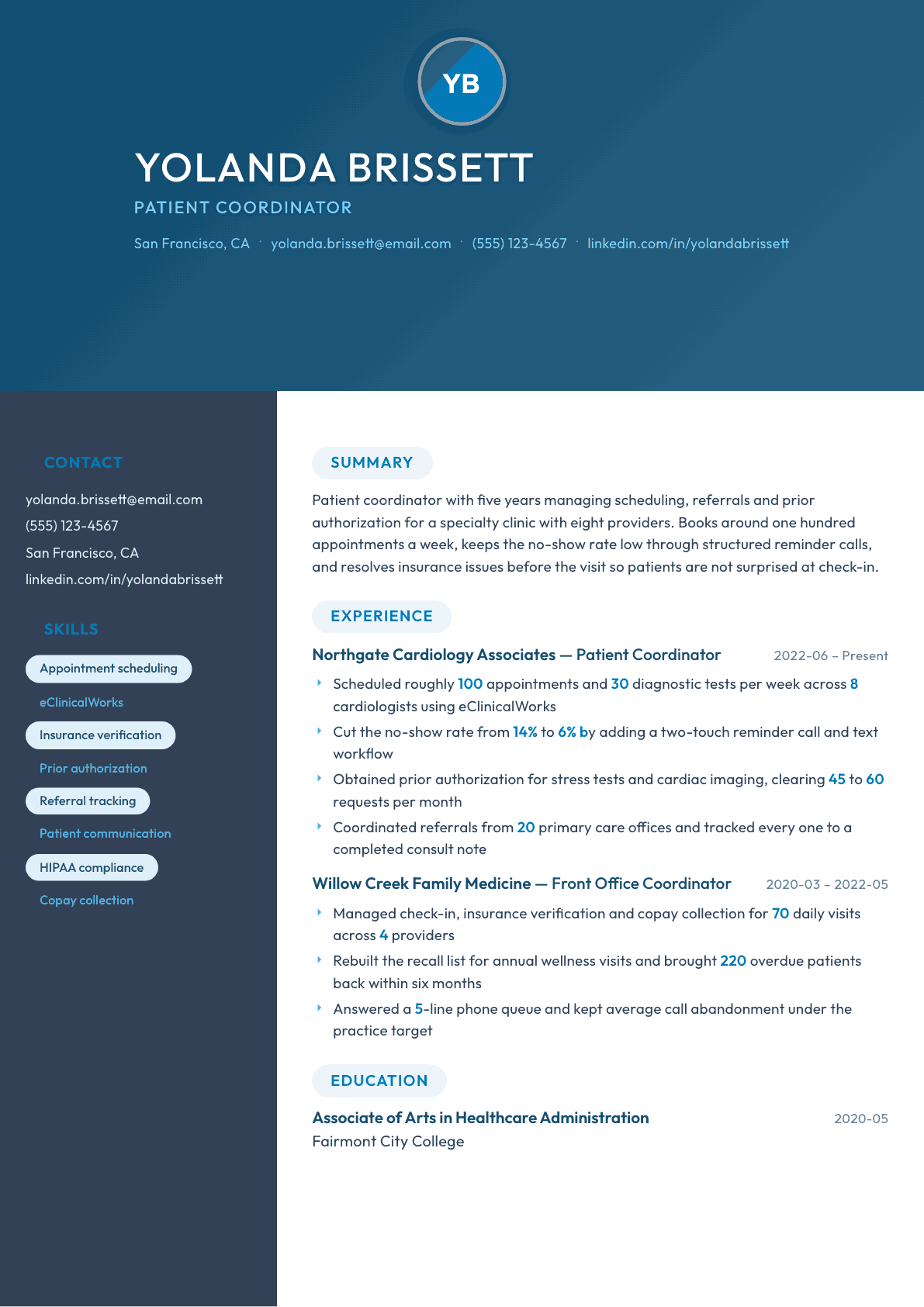
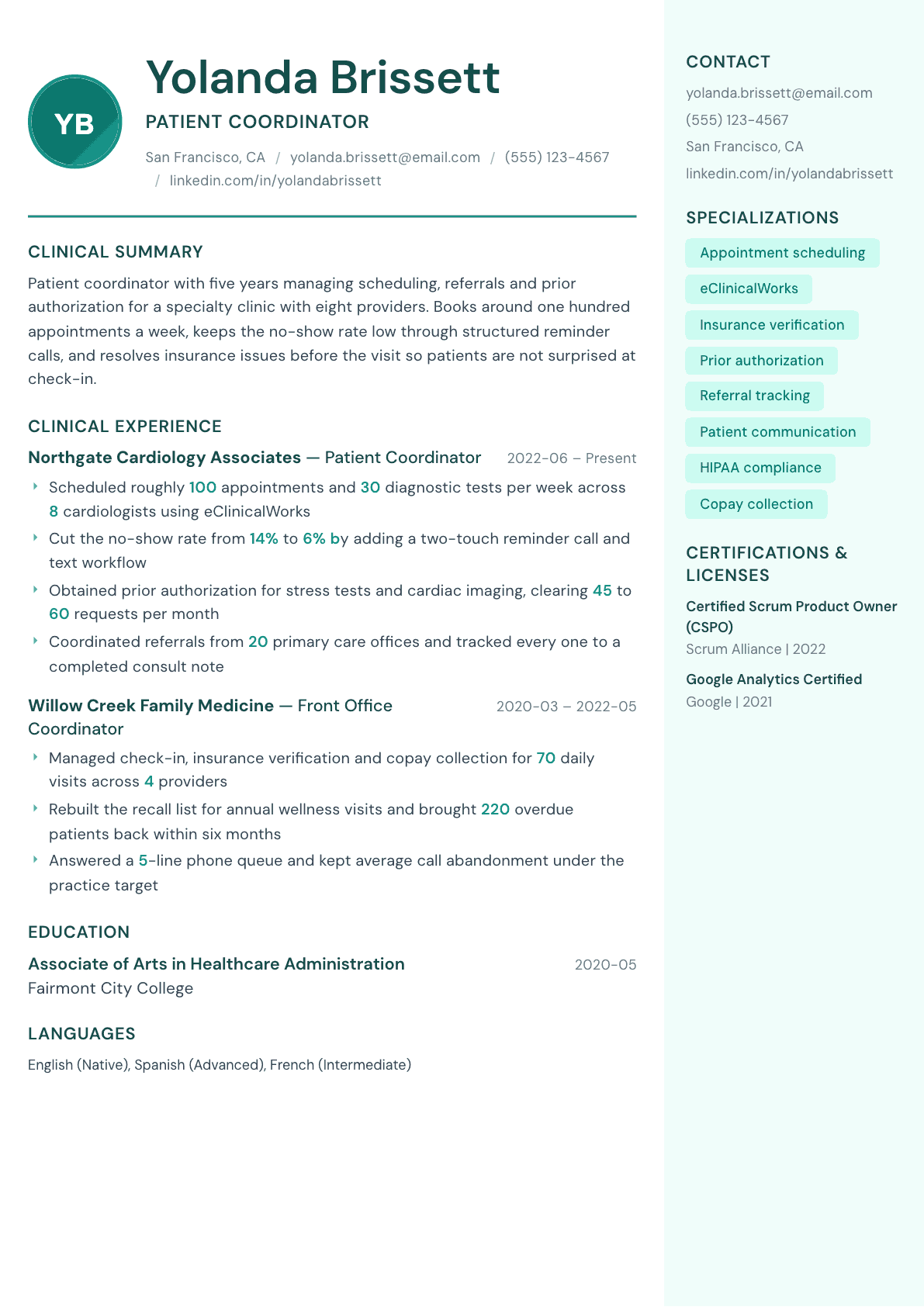
Example Patient Coordinator summary
Patient coordinator with five years supporting an eight-physician cardiology practice, booking about one hundred appointments and thirty diagnostic tests each week. Rebuilt the reminder workflow and cut no-shows by more than half, clears fifty prior authorizations a month, and tracks every incoming referral through to a completed consult note. Experienced in eClinicalWorks, eligibility checks and patient portal support.
Skills to list on a Patient Coordinator resume
- Appointment scheduling
- Referral coordination
- Prior authorization
- Insurance eligibility verification
- Patient registration
- Copay and balance collection
- Recall and reminder workflows
- Phone queue management
- eClinicalWorks
- Epic Cadence
- Patient portal support
- HIPAA compliance
- Medical terminology
- Conflict de-escalation
What actually gets this resume read
- Give the number of providers you support and the weekly appointment volume, because that is the scale question.
- Report no-show rate, wait time or third next available appointment if you improved any of them.
- Name the practice management system by its exact vendor name so the applicant tracking system matches it.
- Separate referral coordination from scheduling, since specialty clinics treat those as different competencies.
- Show insurance work such as eligibility checks and prior authorization, because access roles carry that duty.
- Mention bilingual ability and phone queue volume if you have them, as both are screened for in patient access.
How to write a patient coordinator resume
A patient coordinator controls the front half of a clinic's revenue and most of its reputation. Every appointment that goes unfilled, every referral that stalls, every authorization that arrives after the procedure was scheduled shows up on a report someone reviews. Practice managers hire against those failures, so the resume that stands out is the one written in the same terms.
That means numbers most coordinators never think to include: providers supported, appointments booked per week, no-show rate, authorizations cleared per month, referrals tracked to a completed note. None of these require access to a dashboard. They come from describing your own desk accurately.
This guide covers how to size your role in a way a manager recognizes, how to separate scheduling from referral and authorization work, which practice management systems to name, and the questions coordinators ask when they want to move into a supervisor or patient access lead position.
Format: one page with the practice profile up front
One page, reverse-chronological. Under each employer, write a context line naming the specialty, the number of providers, the daily or weekly visit volume and the systems in use. Specialty matters because a cardiology desk full of stress test authorizations is a different job from a primary care desk full of annual wellness recalls.
Keep a systems block near the top. Practice management software is a hard filter in this field, and a manager who sees a familiar name assumes you will be productive in the first week rather than the fourth.
- Header: name, city and state, phone, email, and languages you speak with patients.
- Section order: summary, systems, experience, education, certifications.
- Context line per employer: specialty, provider count, visit volume, scheduling system.
Scheduling: volume, templates and the no-show problem
Give appointments booked per week and the number of providers whose templates you managed. Add the appointment types if they varied meaningfully, since booking a new consult, a follow-up and a diagnostic test are three different template rules and a manager knows which ones cause trouble.
No-shows are the metric practices watch, so if you improved the rate, say what you changed: a second reminder touch, a text confirmation, a waitlist you called from when a slot opened, a policy conversation at booking. Where you never saw the number, describe the workflow you ran and the backfill you achieved instead of inventing a figure.
Referrals and authorizations: track them to closure
Referral coordination is judged on closure, not on receipt. A coordinator who logs incoming referrals is doing half the job. One who tracks each referral through scheduling, the visit and the consult note back to the referring office is doing the whole thing, and that is what specialty practices are short of.
Prior authorization deserves its own bullets with monthly volume and the service types involved. Imaging, procedures, infusions and specialty drugs all have different payer requirements, and naming them proves you have handled the hard ones rather than the routine office visit.
- Incoming referral volume and how many you tracked to a completed consult note.
- Authorizations obtained per month by service type.
- Peer to peer review coordination or appeal support if you handled it.
Registration, eligibility and the money conversation
Registration accuracy is where denials are born. Describe the eligibility and benefit checks you run before the visit, the demographic and insurance verification at check-in, and the patient responsibility estimates you give. A coordinator who prevents a denial is worth more than one who is merely pleasant at the desk, and both are worth naming.
Collection at the time of service belongs here too. Copay collection rate, outstanding balance conversations and payment plan setup are uncomfortable tasks that practices struggle to staff, so evidence that you handle them calmly is a genuine differentiator.
Systems, service recovery and the keywords
Name the exact systems: Epic Cadence, eClinicalWorks, athenahealth, NextGen, Kareo, along with the patient portal and any reminder or texting platform. Add the phone system if you worked a queue, with the line count and the call volume you handled.
Patient access postings recycle predictable wording: patient registration, insurance verification, prior authorization, referral coordination, scheduling templates, patient portal, HIPAA, medical terminology, service recovery. Use the true ones once in the summary and once inside a bullet where the work is shown.
Patient Coordinator resume summary examples
First clinic role
Healthcare administration graduate with retail customer service experience and a clinic externship covering check-in, insurance verification and copay collection. Trained in medical terminology and privacy rules, comfortable on a multi-line phone queue, and seeking a first patient coordinator position in an outpatient practice.
Two years in primary care
Front office coordinator managing check-in, insurance verification and copay collection for about 70 daily visits across four primary care providers. Rebuilt the annual wellness recall list and returned 220 overdue patients within six months, while holding call abandonment under the practice target on a five-line queue.
Specialty practice coordinator
Patient coordinator for an eight-physician cardiology practice, booking roughly 100 appointments and 30 diagnostic tests weekly in eClinicalWorks. Cut no-shows from 14% to 6% with a two-touch reminder workflow, clears 45 to 60 imaging authorizations monthly, and tracks referrals from 20 primary care offices to a completed consult note.
Work experience bullets: before and after
Before: Scheduled appointments for physicians in the clinic.
After: Scheduled roughly 100 appointments and 30 diagnostic tests per week across eight cardiologists in eClinicalWorks, managing separate templates for new consults, follow-ups and test slots.
Weekly volume, provider count, system and template complexity size the desk in a way a generic sentence cannot.
Before: Reduced the number of patients who missed appointments.
After: Cut the no-show rate from 14% to 6% by adding a two-touch reminder call and text workflow and calling a standing waitlist to backfill cancellations the same day.
A before and after rate with the two mechanisms behind it converts an outcome claim into a repeatable process.
Before: Obtained insurance authorizations for procedures.
After: Obtained prior authorization for stress tests and cardiac imaging, clearing 45 to 60 requests a month through payer portals and coordinating peer to peer reviews when an initial request was denied.
Service types, monthly volume and the escalation path show experience with authorizations that actually get denied.
Before: Handled referrals from other offices.
After: Coordinated referrals from 20 primary care offices and tracked each one from receipt through scheduling to a completed consult note returned to the referring provider.
Naming the closure loop distinguishes referral management from simply logging what arrives.
Before: Answered phones and helped patients at the front desk.
After: Managed a five-line phone queue alongside check-in for 70 daily visits, verifying insurance, collecting copays and holding call abandonment under the practice target.
Line count, visit volume and a named service measure show the interruption load you sustained.
Hard skills
- Appointment scheduling and template management
- Referral coordination and closure tracking
- Prior authorization
- Insurance eligibility and benefit verification
- Patient registration and demographic accuracy
- Copay and balance collection
- Recall and reminder workflows
- Multi-line phone queue management
- eClinicalWorks
- Epic Cadence
- Patient portal support
- Medical terminology
Soft skills
- Calm handling of upset patients
- Clear explanation of coverage and cost
- Prioritizing walk-ins against a full schedule
- Discretion at a public front desk
- Coordination with clinical staff
- Reliability under interruption
Certifications worth listing
- Certified Medical Administrative Assistant (CMAA) (National Healthcareer Association)
- Certified Healthcare Access Associate (CHAA) (National Association of Healthcare Access Management)
- Certified Revenue Cycle Representative (CRCR) (Healthcare Financial Management Association)
Mistakes that cost patient coordinator candidates the interview
- Describing the role as answering phones and booking appointments, which erases the authorization and referral work that carries the value.
- Giving no provider count or visit volume, so a manager cannot judge whether you have run a desk their size.
- Naming the scheduling system generically instead of writing the vendor name a filter searches for.
- Treating referrals as received rather than tracked to closure, which is the failure specialty practices complain about.
- Leaving out collection work because it feels uncomfortable, when practices actively screen for people who handle it well.
- Listing bilingual ability as an afterthought at the bottom, when many clinics recruit specifically for a community language.
Patient Coordinator resume questions
What numbers belong on a patient coordinator resume?
Providers supported, appointments booked per week, no-show rate if you influenced it, authorizations cleared per month, and referrals tracked to closure. Every one of these comes from describing your own desk rather than needing a management report.
How is a patient coordinator different from a medical receptionist?
The receptionist role centers on the front desk: check-in, phones and registration. A coordinator owns the workflow behind the visit as well, meaning referral closure, authorization, test scheduling and recall. Write bullets that show that ownership rather than desk coverage.
Do I need a certification for a patient access job?
Rarely required, and useful when you have one. A healthcare access or medical administrative credential helps an entry application clear the first screen, while experience with the specific practice management system usually carries more weight for anyone with a track record.
How do I show I can handle difficult patients?
Show it through situations rather than adjectives: a walk-in worked into a full schedule, a coverage denial explained before a procedure, a balance conversation that ended in a payment plan. Concrete situations survive an interview question that adjectives do not.
What gets me promoted to patient access lead?
Evidence that you improved a process rather than only running one. Reminder workflows you designed, staff you trained, templates you rebuilt, recall lists you created and reports you produced for the practice manager all read as supervisory readiness.