Veterinary Receptionist Resume Examples: free ATS score
Build a Veterinary Receptionist Resume Clinics Notice
By Mustafa Tarabya, founder of CVBooster · Published · Updated
Veterinary receptionist resume examples with scheduling, triage phone and client service keywords, plus a full guide to the front desk of a clinic.
Sample resumes for a veterinary receptionist
The same veterinary receptionist content laid out in three CVBooster templates, so you can see what the finished document looks like before you write a word.
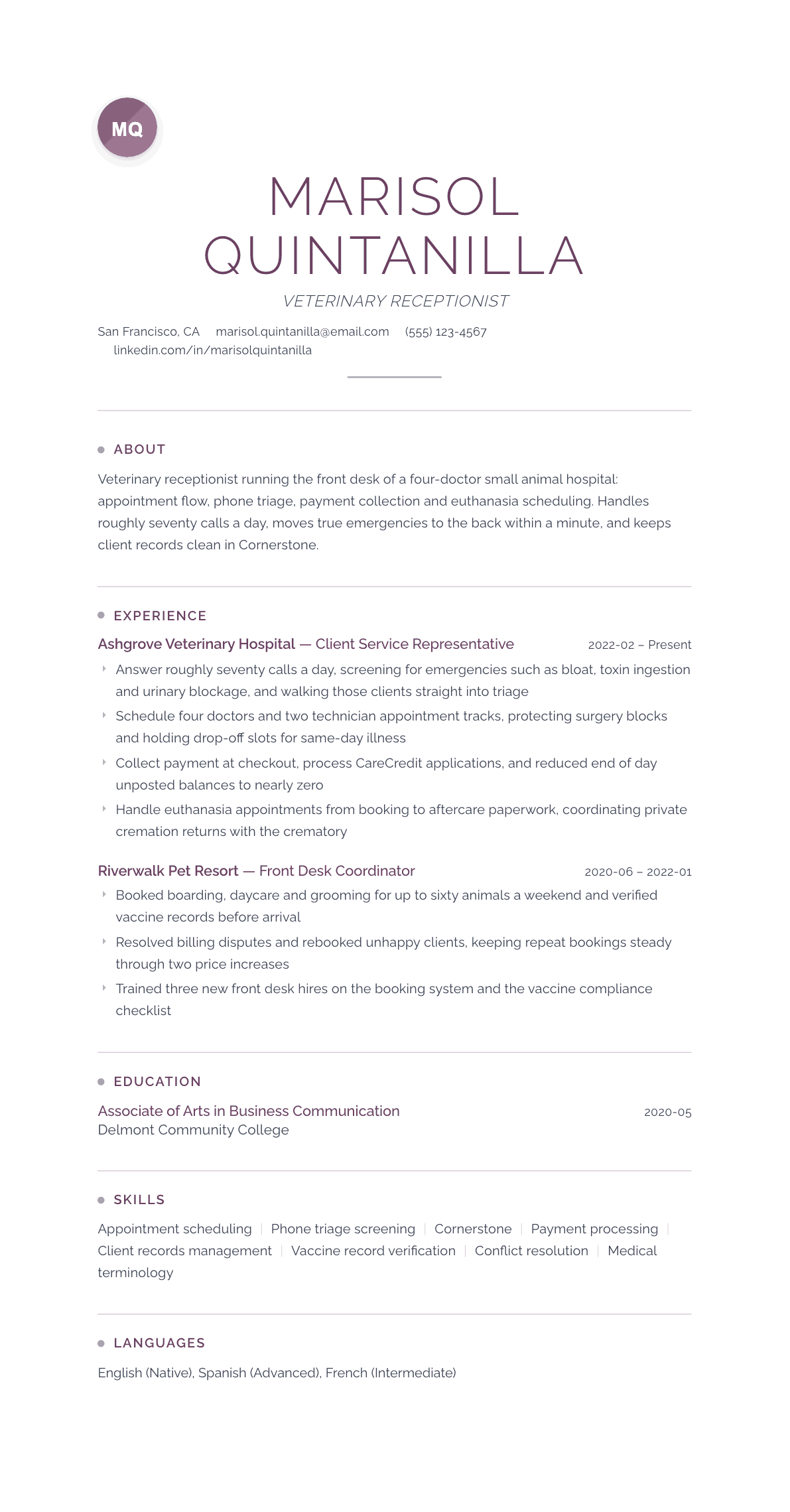
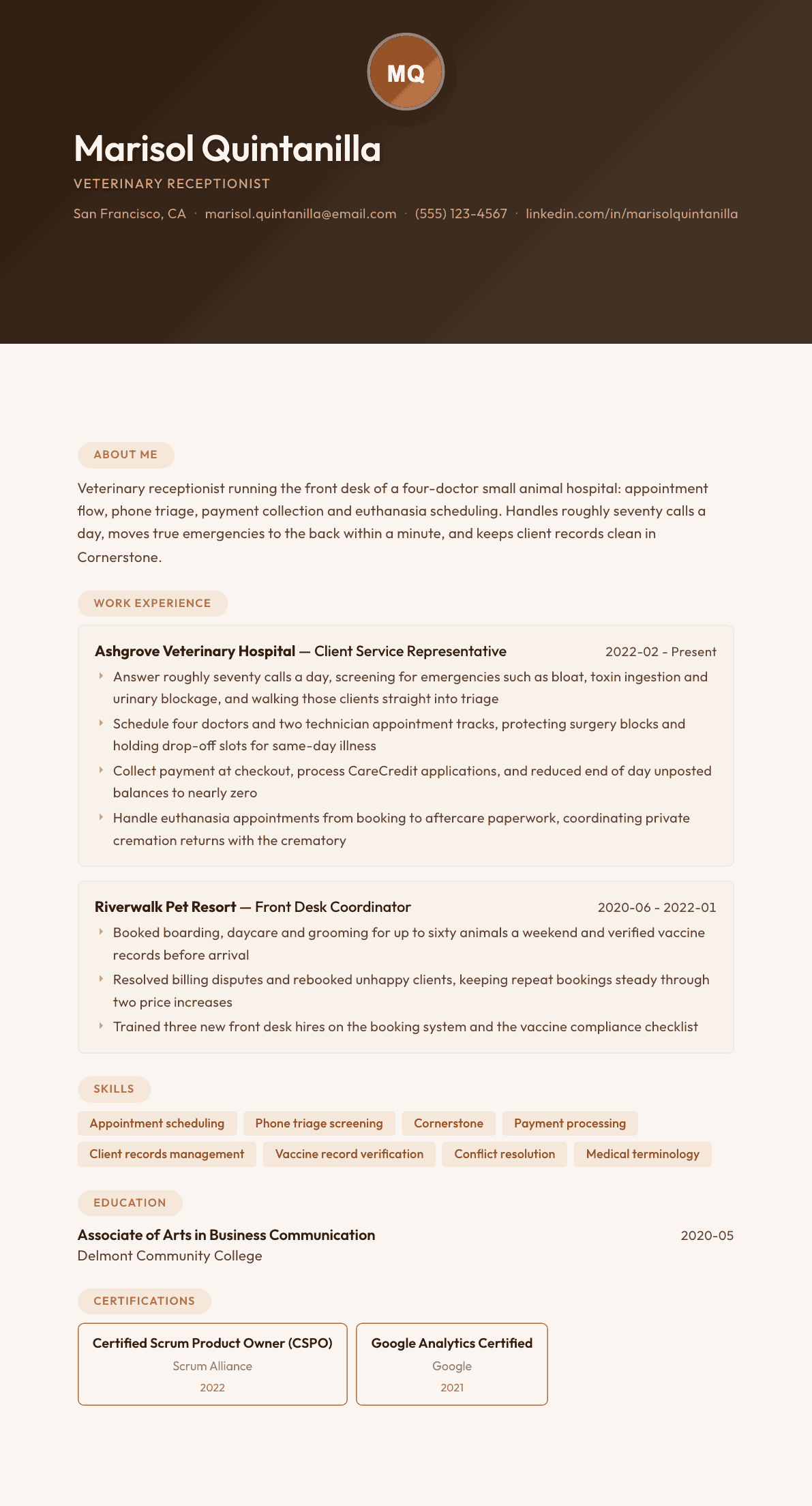
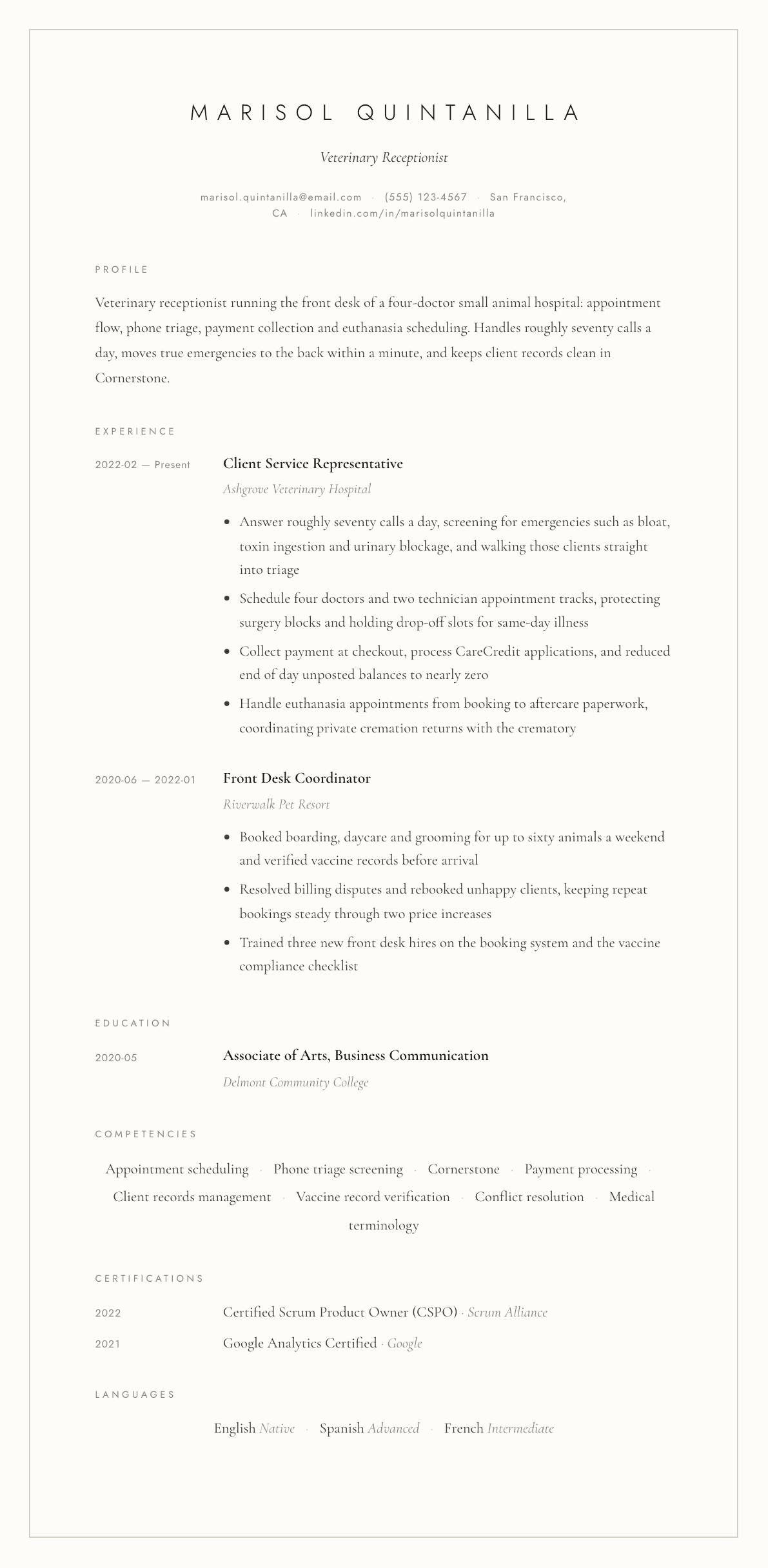
Example Veterinary Receptionist summary
Veterinary receptionist with four years at the front desk of a small animal hospital, managing the schedule for four doctors, screening calls for true emergencies, and collecting payment at checkout. Calm with grieving clients and with the ones who arrive angry. Fluent in Cornerstone and ezyVet, and trusted to train new client service hires.
Skills to list on a Veterinary Receptionist resume
- Appointment scheduling
- Phone triage screening
- Client service and de-escalation
- Payment collection and deposits
- CareCredit and payment plans
- Vaccine and record verification
- Medical records management
- Cornerstone
- Avimark
- ezyVet
- Prescription refill coordination
- Euthanasia and aftercare coordination
- Referral coordination
- Inventory and retail sales
- Veterinary terminology
What actually gets this resume read
- Show that you can screen a call for emergencies, because phone triage is the skill that separates veterinary reception from retail.
- Give the size of the practice, the number of doctors you scheduled, and the daily call or client volume.
- Name the practice software, since Cornerstone, Avimark, ezyVet and ImproMed appear directly in job postings.
- Include the money side: payment collection, deposits, payment plans and how you handled unpaid balances.
- Mention how you handle euthanasia appointments and grieving clients, which every hospital worries about and few resumes address.
- Use real veterinary vocabulary such as vaccine titers, heartworm testing and spay recovery to prove you know the field.
How to write a veterinary receptionist resume
The veterinary receptionist is the only person in the hospital who talks to every client, handles every payment and decides, on the phone, whether an animal needs to be seen in twenty minutes or on Thursday. Practice managers know that a weak front desk costs the hospital more than a weak kennel assistant ever could, so this resume is read closely.
Retail and general reception experience is not enough on its own. What sets a veterinary front desk apart is phone triage, medical vocabulary, payment conversations that happen while an owner is frightened, and the ability to book a euthanasia appointment with the right room, the right time and the right aftercare paperwork. Show those and the retail background becomes an asset.
Below is the format hospitals expect, how to write phone triage and money handling so a manager believes them, three summaries from a career changer to a client service lead, five rewritten bullets, and the questions receptionists ask when they move between clinics.
Format: one page, clean, no clip art
One page, reverse-chronological, single column. Resist the temptation to decorate a veterinary resume with paw prints; the practice manager wants to read the schedule volume and the software, and anything competing for attention costs you.
Use the job title the hospital uses. Many practices call this role client service representative or client care coordinator, so mirror the posting language in your headline while keeping receptionist in the skills or summary for keyword matching.
- Header: name, city and state, phone, email.
- Order: summary, front desk experience, systems and skills, education, certifications.
- Career changers add a short line connecting retail or call center volume to clinic pace.
Summary: hospital size, call volume, and the hard part
Give the number of doctors you schedule for, the daily call or client volume, the practice software, and one hard thing you handle well. Phone triage, collections at checkout or euthanasia coordination are all good candidates, because they are the tasks that make front desk roles hard to fill.
A career changer should use the summary to translate. High-volume call handling, cash reconciliation and de-escalation in retail all map directly onto this job, and naming that mapping saves the reader from doing it.
Experience: the phone, the schedule, and the money
Start each entry with the hospital profile: doctors, appointment tracks, whether the practice offers surgery, boarding or urgent care, and the software. Then write to three themes.
The phone comes first. Describe screening, not answering. Say which presentations you route straight to triage, such as urinary blockage, bloat, toxin ingestion, dystocia, seizures and heat stroke, and note that anything uncertain goes to a technician rather than to a guess. That is the sentence that proves you are safe on the phone.
The schedule is second. Show that you manage provider capacity: separate appointment tracks for doctors and technicians, protected surgery blocks, drop-off slots for same-day illness, and a short-call list for cancellations. Give the daily appointment volume.
The money is third, and most receptionist resumes skip it. Payment collected at checkout, deposits for surgery, financing applications, estimates reviewed with owners before treatment begins, and end of day reconciliation. A hospital that has been chasing unpaid balances will read that block first.
Medical vocabulary and records: prove the fluency
Use real clinical terms where they belong: vaccine series and titers, heartworm and tick-borne testing, spay and neuter recovery, dental prophylaxis, prescription refills that require an examination within the year, and controlled medication rules. A receptionist who uses these words correctly needs far less training.
Cover records work as well: uploading referral and shelter histories, requesting records from other hospitals, verifying rabies certificates, filing health certificates, and keeping owner contact details current so reminders actually arrive.
The emotional part of the job, written plainly
Euthanasia scheduling, grieving clients and owners who cannot afford the estimate are the parts of the role that cause turnover. Write one calm bullet about how you handle them: a quiet room booked at the end of the day, aftercare choices explained before the appointment, cremation returns tracked, and a sympathy card sent. No adjectives are needed; the process speaks for itself.
Veterinary Receptionist resume summary examples
Career changer from retail
Customer service professional with three years in high-volume retail, handling roughly ninety transactions a shift, daily cash reconciliation and complaint resolution. Long-time volunteer at a rescue with vaccine clinic experience. Seeking a veterinary front desk role, with medical terminology coursework completed.
Three years at the front desk
Veterinary receptionist supporting a four-doctor small animal hospital, managing about seventy calls a day, two appointment tracks and checkout for every visit. Screens calls for emergencies such as blocked cats and toxin ingestion, and keeps end of day balances reconciled to zero in Cornerstone.
Client service lead
Client service lead for a seven-doctor hospital with urgent care hours, supervising five front desk staff. Builds the reception schedule, writes the phone triage script, owns the accounts receivable follow-up, and coordinates euthanasia appointments and aftercare returns with the crematory.
Work experience bullets: before and after
Before: Answered phones and booked appointments.
After: Handled roughly seventy calls a day, screening for urinary blockage, bloat and toxin ingestion, and walking those clients directly into triage rather than into the next open slot.
Call volume plus named emergency presentations proves triage judgment instead of order taking.
Before: Scheduled patients for the doctors.
After: Scheduled four doctors and two technician appointment tracks, protecting surgery blocks and holding daily drop-off slots for same-day illness.
It shows capacity planning across providers, which is the difference between managing a schedule and filling it.
Before: Took payments from clients.
After: Collected payment at checkout on every visit, processed financing applications for large estimates, and reconciled the drawer to zero at close of day.
Naming the collection point, the financing path and the reconciliation shows the money side is controlled.
Before: Handled difficult clients.
After: De-escalated wait time and estimate complaints at the counter, offered a technician callback with a written estimate breakdown, and kept the exam room flow moving.
A specific method and a resolution turn a vague claim into something a manager can trust.
Before: Helped with euthanasia appointments.
After: Coordinated euthanasia visits end to end: a quiet room at the end of the schedule, aftercare options explained in advance, and private cremation returns tracked to the family.
The process detail shows the hardest appointment in the building is handled with a system, not improvisation.
Hard skills
- Phone triage screening
- Multi-provider appointment scheduling
- Payment collection and drawer reconciliation
- Financing and payment plan applications
- Estimate review with owners
- Medical records requests and uploads
- Vaccine and rabies certificate verification
- Prescription refill coordination
- Cornerstone, Avimark and ezyVet navigation
- Referral and specialty coordination
- Retail and pharmacy inventory at the counter
Soft skills
- Calm under a full lobby
- De-escalation at the counter
- Compassion during end of life visits
- Clear handoff to the treatment area
- Discretion with client finances
Certifications worth listing
- Certified Veterinary Practice Manager (CVPM) (Veterinary Hospital Managers Association)
- Fear Free Certified Professional (Fear Free)
- Approved Veterinary Assistant (AVA) (National Association of Veterinary Technicians in America)
Mistakes that cost veterinary receptionist candidates the interview
- Writing the resume as generic reception work, with no phone triage, no clinical vocabulary and no clue that it is a veterinary hospital.
- Leaving out the practice software, which several hospitals search for before they read anything else.
- Omitting payment collection and reconciliation, which is a large part of why the role exists.
- Using vague words like "busy" instead of the call volume, the doctor count and the daily appointment load.
- Skipping euthanasia and grief handling, the exact part of the job managers worry a new hire cannot do.
- Listing a love of animals as a qualification on a role that is mostly people, phones and money.
Veterinary Receptionist resume questions
Do I need veterinary experience to be a veterinary receptionist?
Not always. Hospitals hire from retail, call centers and medical reception when the applicant shows volume handling, cash accuracy and de-escalation. Add animal exposure from volunteering or fostering, and study basic medical terminology before the interview.
How do I show phone triage skill on a resume?
Name the presentations you route immediately to a technician, such as urinary blockage, bloat, seizures, dystocia and toxin ingestion, and state that anything uncertain gets passed to clinical staff rather than judged at the desk. That single sentence carries the point.
Which veterinary software should I list?
List every practice management system you have actually used, including Cornerstone, Avimark, ezyVet, ImproMed or Vetter, plus the client communication tool. Hospitals weigh software fluency heavily because it removes weeks of onboarding.
How do I describe handling euthanasia appointments?
Describe it as a process: the room and time you book, the aftercare options discussed before the visit, the paperwork completed in advance, and how cremation returns are tracked. Managers read this as evidence you will not need rescuing during a hard day.
Should I put my own pets on a veterinary resume?
No. Personal pet ownership is not a qualification and takes space from call volume, scheduling and payment handling. If you have fostered for a rescue or worked vaccine clinics, list that instead, because it is structured animal work.