PhD Student Resume Examples: free ATS score and gap list
Build a PhD Student Resume for Internships, Fellowships and First Jobs
By Mustafa Tarabya, founder of CVBooster · Published · Updated
PhD student resume example with dissertation framing, teaching and research bullets, transferable skill keywords and a full writing guide.
Sample resumes for a phd student
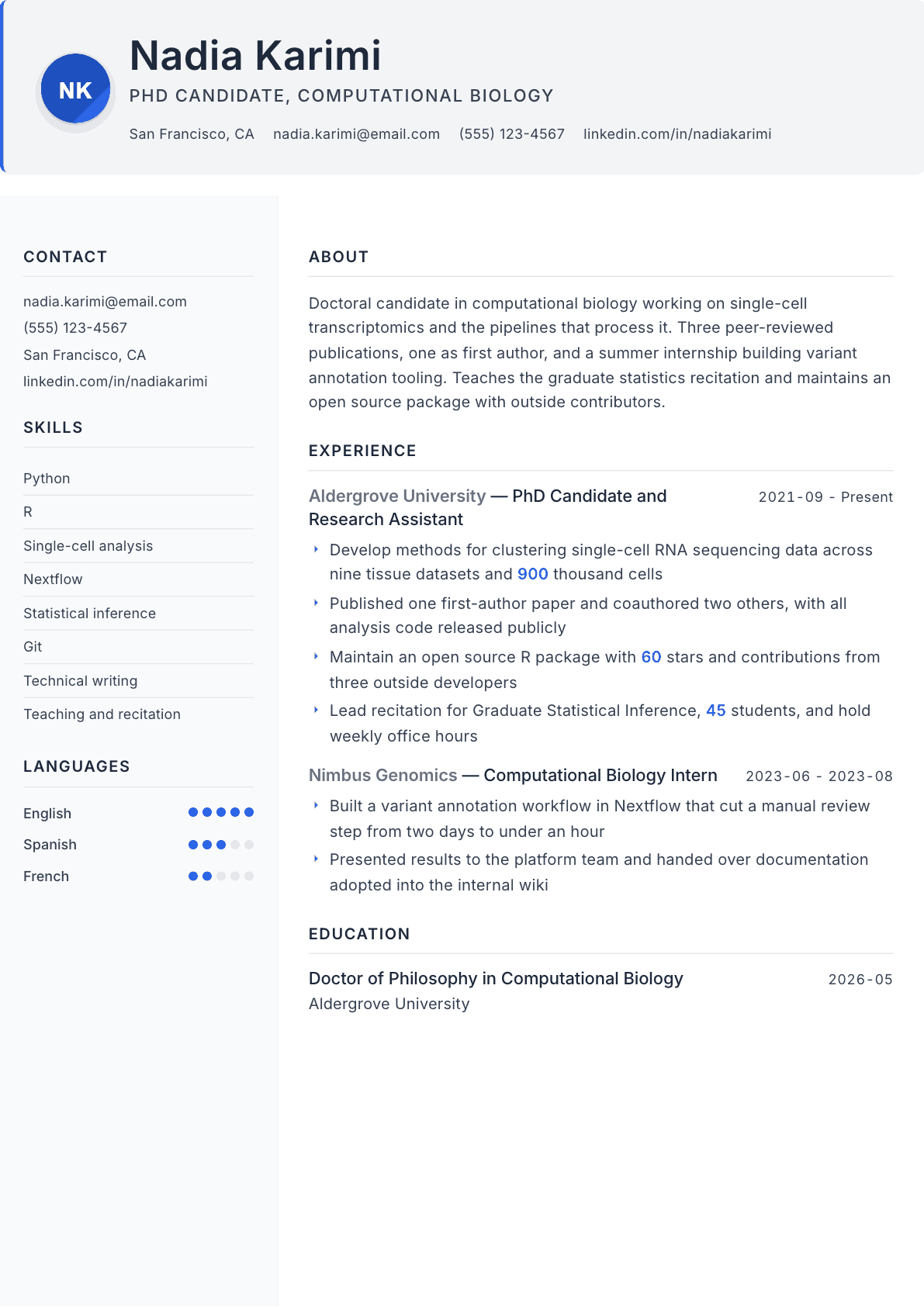
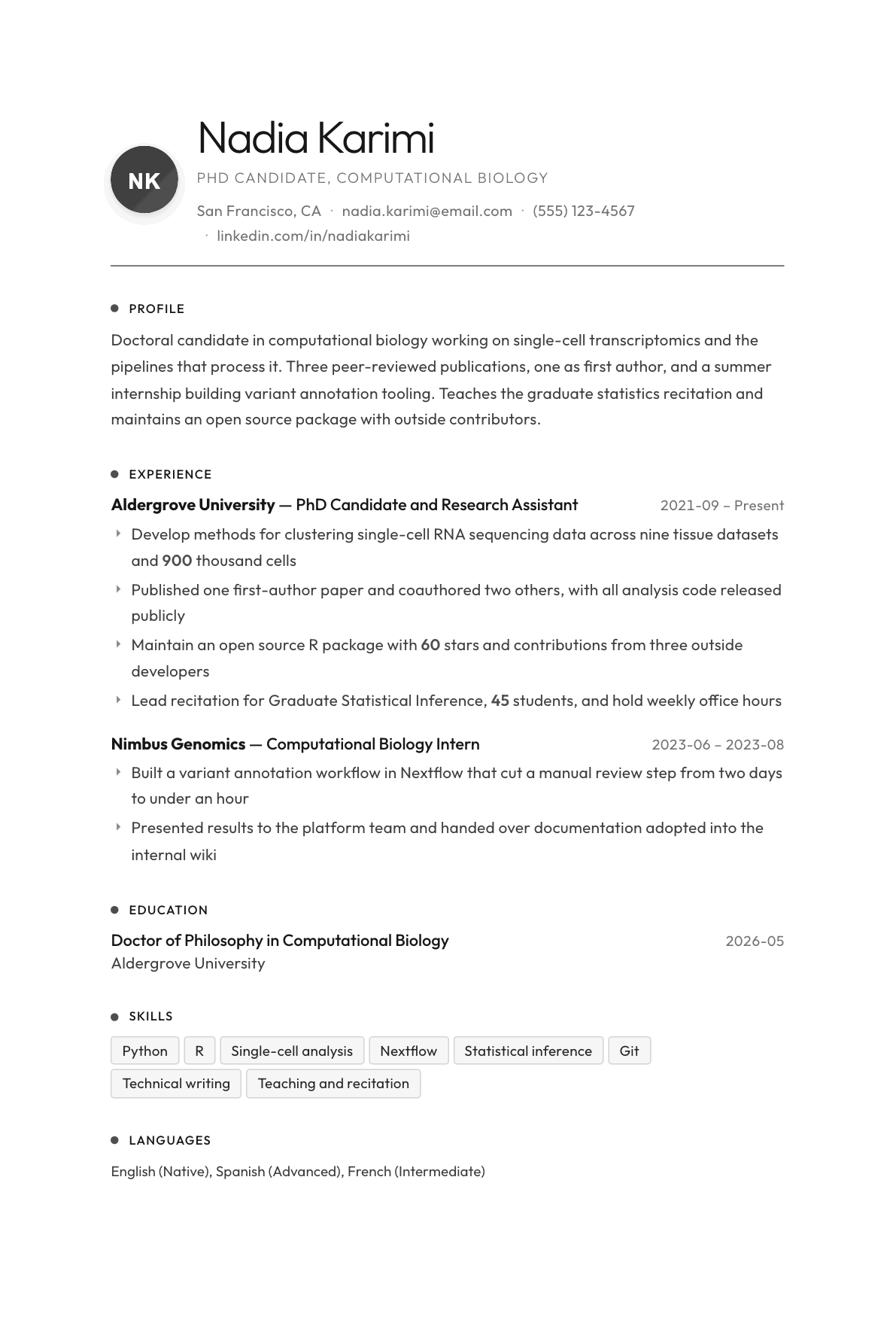
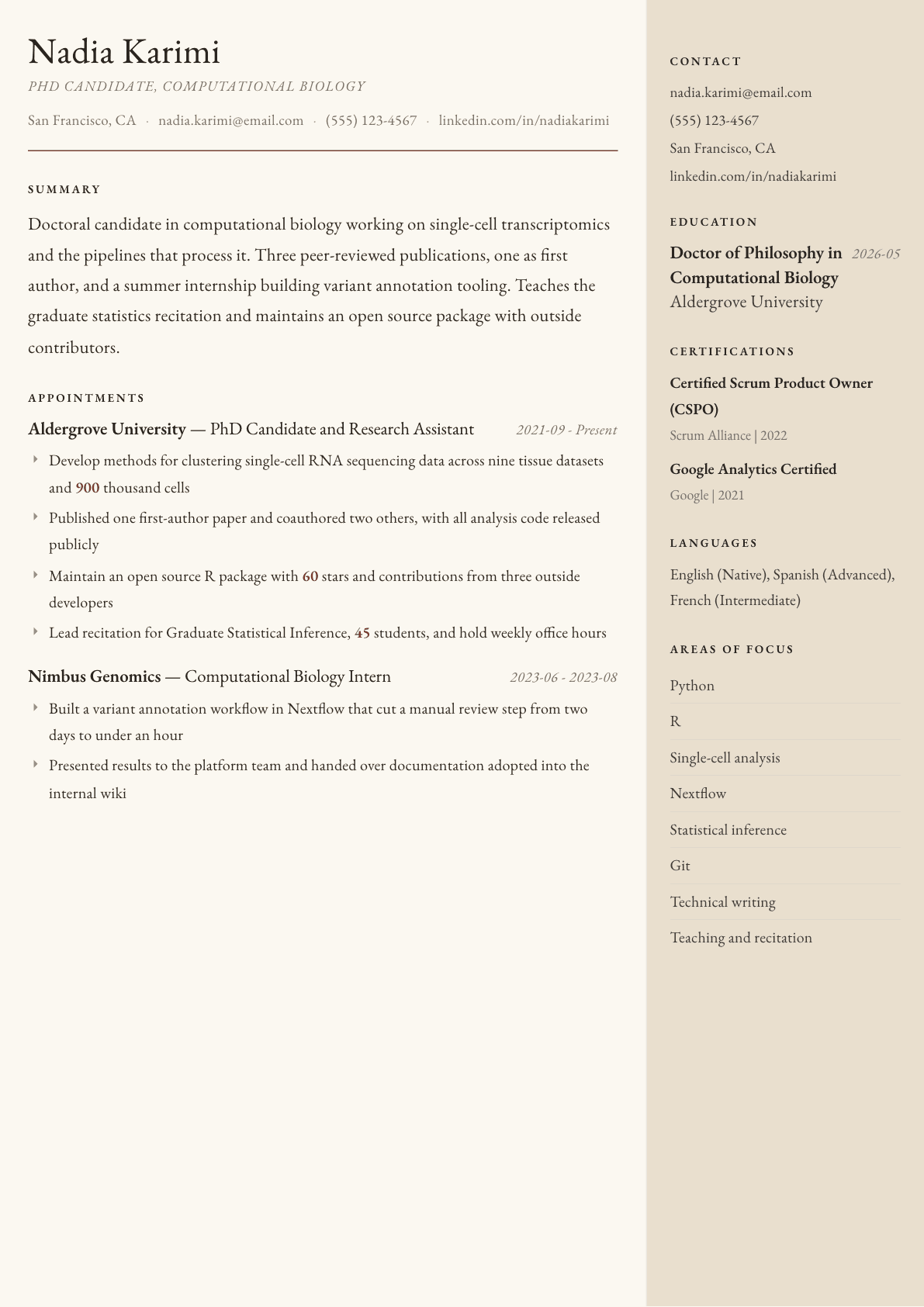
The same phd student content laid out in three CVBooster templates, so you can see what the finished document looks like before you write a word.
Example PhD Student summary
Doctoral candidate in computational biology developing clustering methods for single-cell transcriptomic data across nine tissue datasets. Three peer-reviewed publications, one as first author, and an industry internship that automated a variant annotation workflow. Maintains an open source R package with outside contributors and leads the graduate statistics recitation. Seeking a computational scientist role after the defense next spring.
Skills to list on a PhD Student resume
- Research design
- Data analysis
- Python
- R
- Statistical inference
- Machine learning
- Version control with Git
- Workflow automation
- Scientific writing
- Literature review
- Conference presentation
- Teaching assistance
- Open source contribution
- Technical documentation
- Project planning
What actually gets this resume read
- Decide who is reading before you write, because a fellowship panel wants the dissertation and an industry recruiter wants the tooling.
- Give your expected completion date and your candidacy status, since employers and funders both need to know when you are available.
- Describe the dissertation in one plain sentence a non-specialist can follow, then let the bullets carry the technical detail.
- Translate research work into deliverables for industry applications: datasets built, pipelines automated, models validated, code released.
- List teaching separately from research so the reader can see instructional experience without hunting for it in project bullets.
- Include internships, consulting and collaborations outside the laboratory, because they answer the question about working beyond academia.
How to write a phd student resume
A PhD student writes a resume for at least three different readers over the course of the degree: a fellowship panel, a summer internship recruiter, and eventually an employer who may know nothing about the field. The mistake almost everyone makes is writing one document and sending it to all three.
A fellowship panel wants the dissertation, the methods and the scholarly trajectory. An internship recruiter wants the tooling, the deliverables and whether you can finish something in twelve weeks. Neither is a lesser audience, and neither is served by a file that hedges between them.
This guide covers how to structure a doctoral student resume for each purpose, how to describe a dissertation in one legible sentence, three summaries from a first-year student to a candidate about to defend, before-and-after bullets, and the questions graduate students ask when they start applying outside the department.
Format: one page for jobs, longer for academic applications
Keep the internship or industry version to one page until you have publications and an internship of your own, then two. For fellowships, departmental awards and academic applications, use the curriculum vitae format your field expects, which will run longer and include every presentation and award.
State your status plainly near the top: enrolled year, whether you have advanced to candidacy, and your expected completion date. Employers and funders both plan around availability, and leaving them to guess costs you interviews.
- Header: name, city and state, phone, email, and a code repository or scholarly profile link if you maintain one.
- For industry: summary, technical skills, research experience, internships, education, selected publications.
- For academic: education, research experience, publications, presentations, teaching, awards, service.
The dissertation: one plain sentence, then the detail
Write a single sentence a smart reader outside your field can follow, then let the bullets carry the technical content. If the sentence needs three subfield terms to make sense, it is not the sentence, it is a title. Titles belong in the education section, not in the summary.
Underneath, give the method, the data and the scale: the number of interviews, the size of the dataset, the number of samples, the model class, the instrument. Scale is what converts a research description into evidence that you can execute a long project.
Research experience written as deliverables
Doctoral work produces artifacts, and artifacts are what a resume can show. A dataset you assembled and documented. A pipeline you automated. A package you released. A method you validated against a benchmark. An experiment you ran end to end. Write each bullet around the artifact rather than around the activity.
Do not hide collaboration. Naming your role on a group project, and the part you owned, reads far better than an ambiguous bullet that a recruiter will probe in the first interview. Precision here is a strength, not a confession.
For every result, say where it landed. Published, presented, released publicly, adopted by the laboratory, handed to a collaborator. Work that went nowhere is still worth listing, but work with a destination is what a reader remembers.
Teaching, internships and everything outside the laboratory
Give teaching its own section rather than burying it inside a research entry. Recitations led, students taught, office hours held and any course you were instructor of record for all matter, both for academic applications and as evidence of communication ability for industry ones.
Internships, consulting projects, industry collaborations and open source contributions answer the question a recruiter is quietly asking about whether you can work outside a department. If you have any, give them their own section with the same detail you would give a research entry.
- List fellowships and competitive awards with the issuing body.
- Include conference presentations, marking talks separately from posters.
- Note leadership in a graduate association, seminar series or outreach program.
Translation and keywords
For industry applications, translate the vocabulary once and keep it consistent. A dissertation becomes a multi-year research project. Fieldwork becomes primary data collection. A literature review becomes evidence synthesis. Advising undergraduates becomes mentoring. Coordinating a seminar becomes program coordination.
Then name the technical stack in its own block, because that is what a screening filter reads: the programming languages, the statistical frameworks, the workflow managers, the version control, and any domain platform your field runs on. That block is often what decides whether a doctoral student clears the first screen at all.
PhD Student resume summary examples
First-year student
First-year doctoral student in computational biology with a masters in statistics and two years of analysis work on sequencing data. Rotating through two laboratories, comfortable in Python and R, and seeking a summer internship applying statistical methods to genomic datasets.
Advanced to candidacy
Doctoral candidate developing clustering methods for single-cell transcriptomic data across nine tissue datasets. One first-author paper and two coauthored, with all analysis code released publicly. Maintains an open source R package with outside contributors and leads the graduate statistics recitation.
Defending this year
Doctoral candidate defending in the spring, with three peer-reviewed publications and an industry internship that automated a variant annotation workflow. Built reproducible pipelines used by the laboratory and mentored two junior students. Seeking a computational scientist role in genomics or therapeutics.
Work experience bullets: before and after
Before: Working on my dissertation in computational biology.
After: Develop clustering methods for single-cell RNA sequencing data across nine tissue datasets, benchmarking against three published approaches.
The method, the data scale and the benchmark make the project legible to someone outside the subfield.
Before: Wrote code for my research.
After: Maintain an open source R package for single-cell clustering with contributions from three outside developers and documented tutorials.
A public package with external contributors proves engineering practice that private analysis scripts cannot.
Before: Did a summer internship at a genomics company.
After: Built a variant annotation workflow in Nextflow during a summer internship, cutting a manual review step from two days to under an hour.
The tool and the time saved turn an internship line into a measurable delivery a recruiter can evaluate.
Before: Was a teaching assistant for a statistics course.
After: Led recitation for Graduate Statistical Inference with 45 students, holding weekly office hours and writing supplementary problem sets.
Student count and the materials you produced show instructional ownership rather than attendance.
Before: Published some papers with my advisor.
After: Published one first-author paper and coauthored two others, releasing the analysis code and processed data for each alongside publication.
Authorship position and open release show both credit and reproducibility practice in a single line.
Hard skills
- Research design
- Statistical inference
- Data analysis
- Python
- R
- Machine learning
- Workflow automation
- Version control with Git
- Scientific writing
- Literature synthesis
- Conference presentation
- Technical documentation
- Open source development
- Experimental and survey methods
Soft skills
- Self-directed project management
- Persistence through long timelines
- Explaining technical work simply
- Collaboration across advisors
- Peer mentoring
- Prioritizing under an open-ended workload
Mistakes that cost phd student candidates the interview
- Sending the same document to a fellowship panel and an industry recruiter when the two want different evidence.
- Describing the dissertation in a sentence only three people in the world can parse.
- Omitting the expected completion date, which employers and funders both need in order to plan.
- Leaving the technical stack scattered inside prose instead of putting it in one block a screen can read.
- Listing coursework at length while giving research deliverables two vague lines.
- Hiding internships or consulting work out of a belief that they look like divided attention.
PhD Student resume questions
Should a PhD student use a resume or a curriculum vitae?
Both, kept in sync. Use the curriculum vitae for fellowships, academic applications and departmental awards. Use a one or two-page resume for internships and industry roles, where a full scholarly record buries the practical evidence a recruiter needs.
How do I list a degree I have not finished?
Give the institution, the program and the expected completion date, and note candidacy status if you have advanced. Listing an in-progress doctorate is standard practice and is only a problem if the completion date is missing or implied to be past.
Do I include coursework on a doctoral resume?
Rarely, and only when the courses map directly to a requirement in the posting. Graduate coursework is assumed at this level, and the space is better spent on research deliverables, tooling and anything you produced that someone else uses.
How do I apply for industry jobs without any industry experience?
Reframe research as delivery and give evidence of finishing. Datasets documented, code released, pipelines automated, results presented to a non-specialist audience. Then add any collaboration, consulting or open source work that took place outside your own department.
Will employers think I am overqualified?
Some will, so remove the ambiguity. State the role you want, connect your methods to the work in the posting, and let the summary make clear that you are applying deliberately rather than retreating from an academic path.