Pipefitter Resume Examples: free ATS score and gap list
Write a Pipefitter Resume That Reads Like a Spool Drawing
By Mustafa Tarabya, founder of CVBooster · Published · Updated
Pipefitter resume examples covering process piping, weld prep, rigging, hydrostatic testing and the industrial keywords contractors screen for.
Sample resumes for a pipefitter
The same pipefitter content laid out in three CVBooster templates, so you can see what the finished document looks like before you write a word.
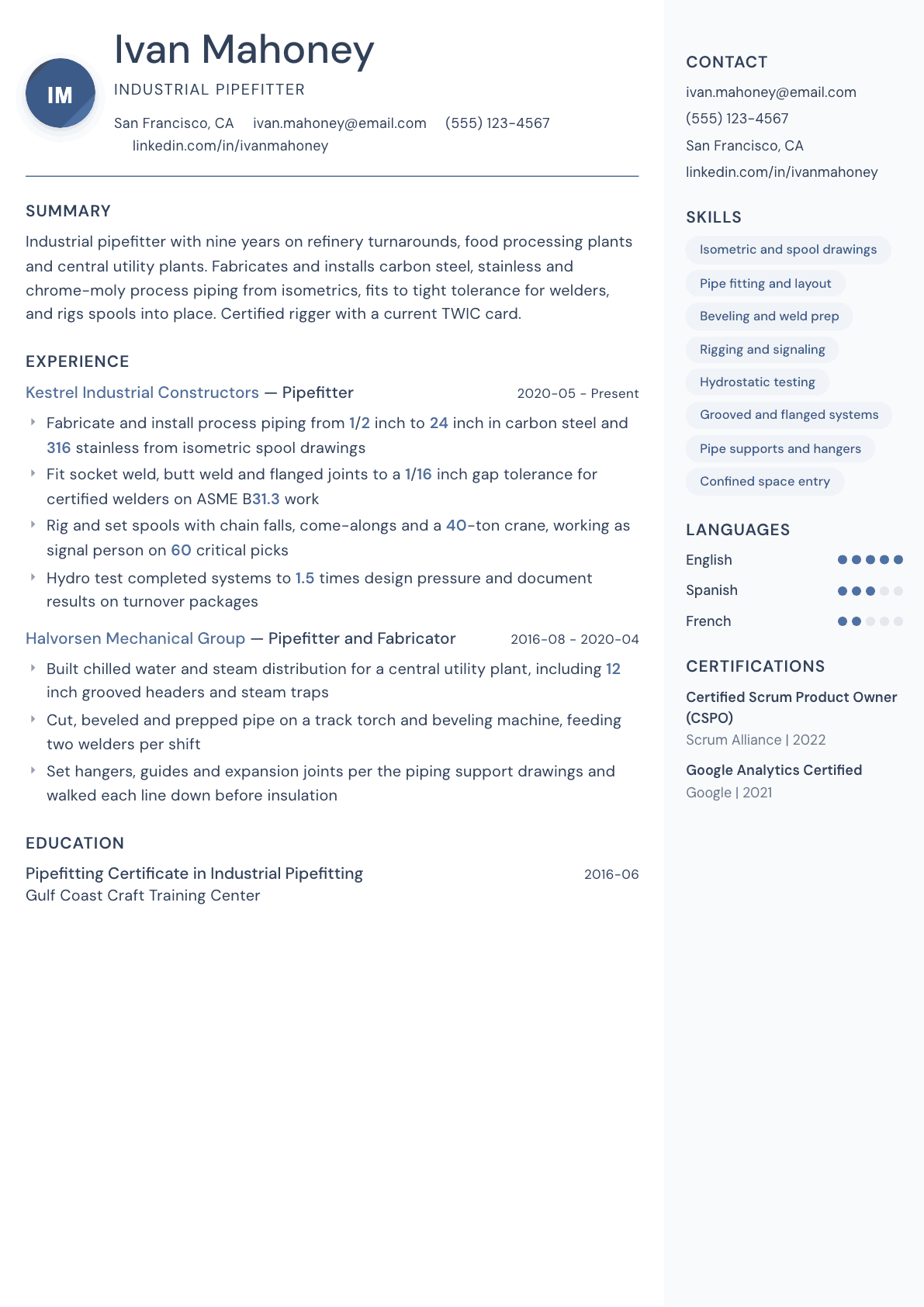
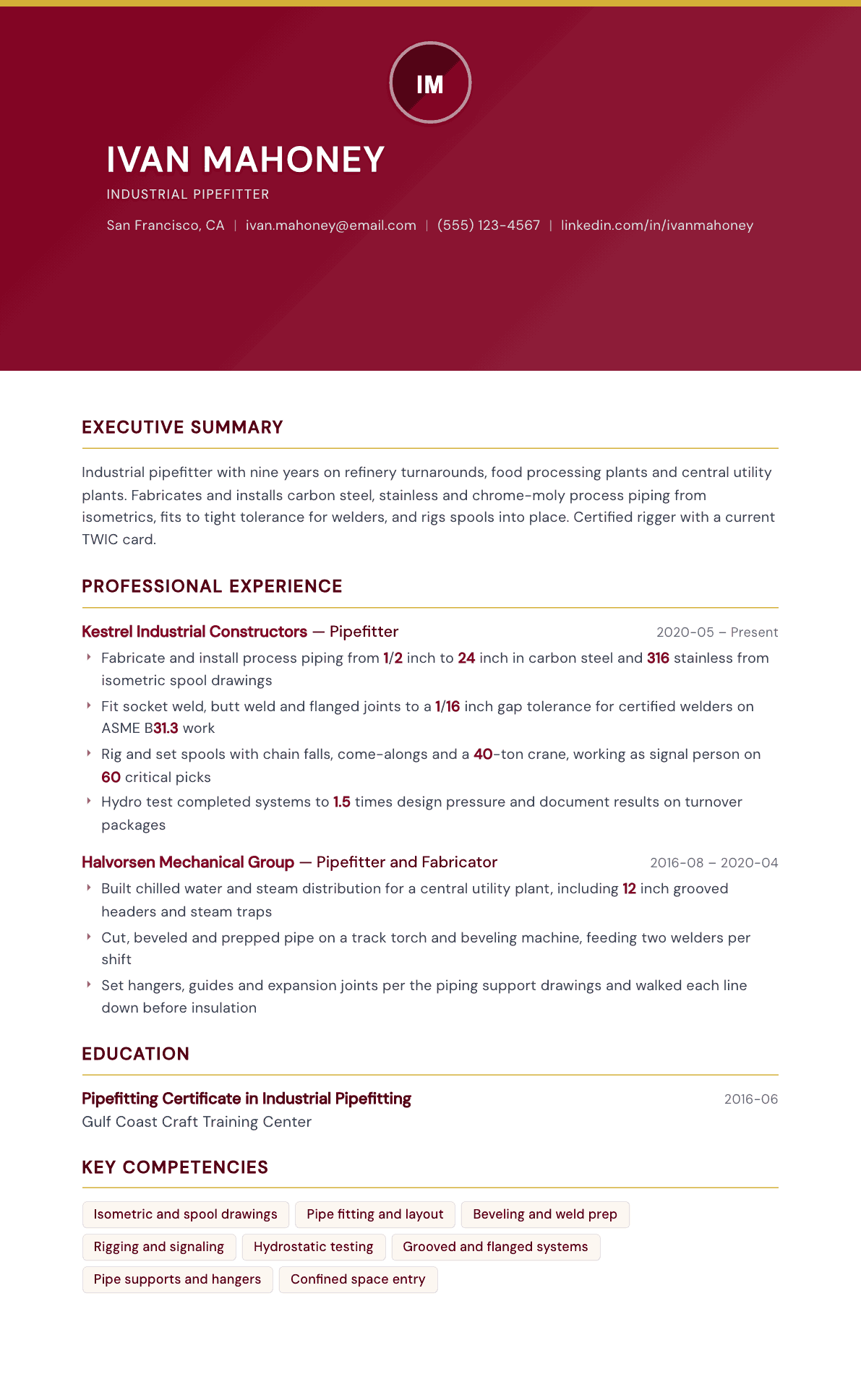
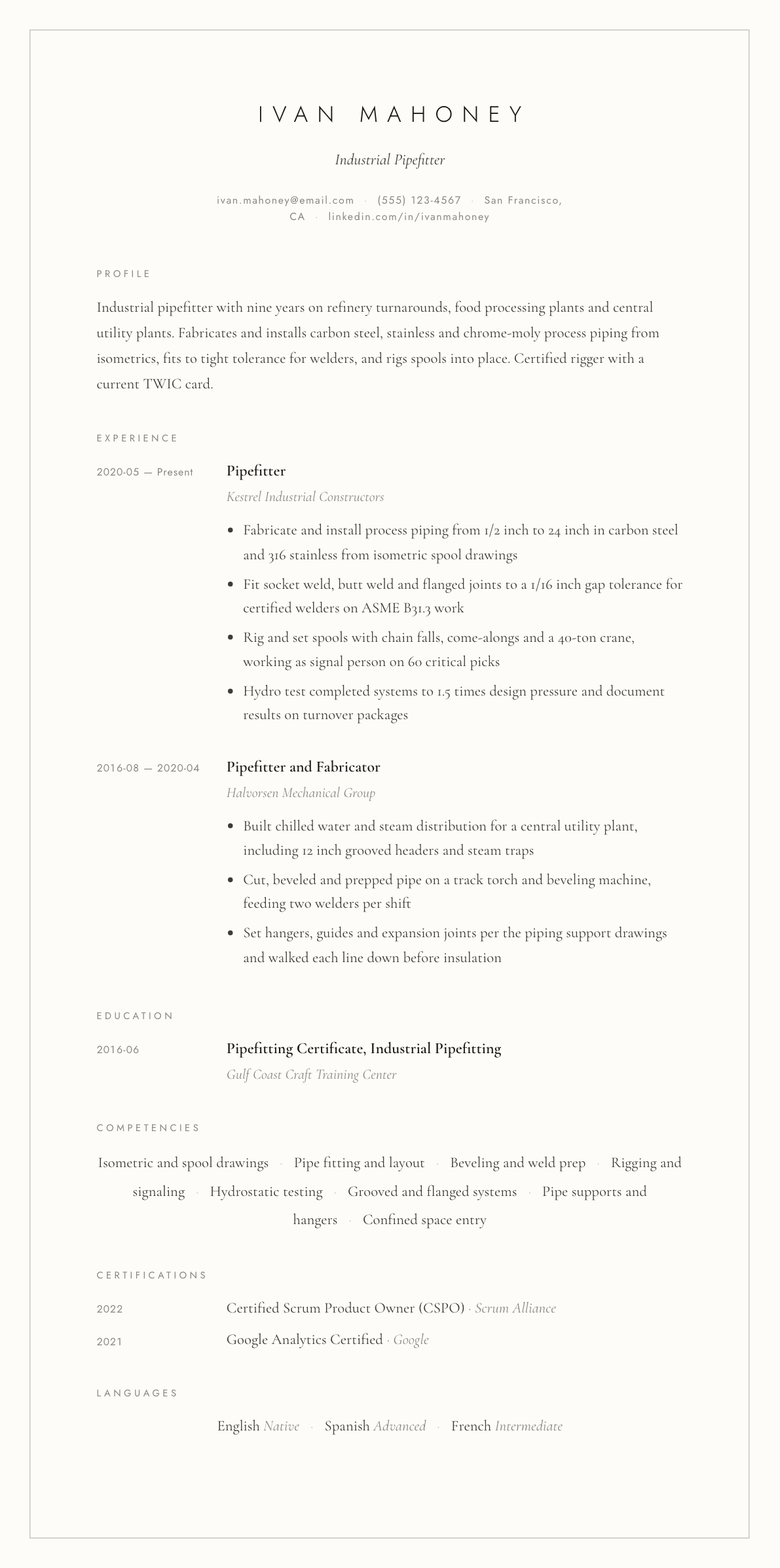
Example Pipefitter summary
Industrial pipefitter with nine years on refinery turnarounds, process plants and central utility plants. Fabricates and installs carbon steel and stainless process piping from 1/2 inch to 24 inch, fits to tolerance for certified welders on ASME B31.3 systems, and rigs spools into place as a certified signal person. Handles hydro testing and turnover documentation. Current TWIC card and available for travel and shutdown schedules.
Skills to list on a Pipefitter resume
- Process piping fabrication
- Isometric and spool drawing reading
- Carbon steel and stainless piping
- Socket weld and butt weld fitting
- Flange alignment and bolt torquing
- Beveling and weld prep
- Grooved piping systems
- Pipe supports and hangers
- Rigging and signaling
- Hydrostatic and pneumatic testing
- ASME B31.3
- Turnaround and shutdown work
- Confined space entry
- Threading and cutting equipment
- Line walkdowns and turnover packages
What actually gets this resume read
- State the piping codes you have worked to, such as ASME B31.1 or B31.3, and the materials you have fit.
- Give pipe sizes and schedules by range, because a fitter who runs 24 inch is screened differently from one who runs 2 inch.
- List every certification card up front: rigger, signal person, TWIC, confined space, respirator fit test.
- Describe turnaround and shutdown work with the plant type and the duration, since owners hire on that history.
- Show the fabrication side separately from the field install side, including layout methods and takeoffs.
- Include testing and turnover experience: hydro, pneumatic, line walkdowns and package documentation.
How to write a pipefitter resume
A pipefitter resume is screened by a craft superintendent or an industrial staffing coordinator who has a job starting on a fixed date and a headcount to fill. The first three things they look for are the codes you have fit to, the pipe sizes and materials you have handled, and which safety and access cards you hold today. A resume that answers those in the top third gets a call the same afternoon.
The second thing they weigh is whether you fit or you weld or you do both. Fitters are hired to lay out, cut, bevel and fit joints to tolerance so a certified welder can burn them in. If you also hold weld tests, that belongs on the page as a separate credential rather than blended into the fitting work, because the two are staffed from different lists.
This guide walks through the structure that gets a fitter placed, how to write spool and system work so it reads like a scope, three summaries from helper to foreman, before and after bullets, and the questions fitters ask when a turnaround call comes and the resume is three years stale.
Format: one page for the field, cards near the top
Keep it to one page unless you have a long list of plants and turnarounds worth naming, in which case a second page of project history is fine. Use a plain reverse-chronological layout. Industrial staffing offices scan quickly and often print, so avoid anything that depends on color to be readable.
Directly under your contact details, put a credentials block: safety and access cards, rigging and signal certification, respirator fit test status, and any port or plant access credential. On industrial work these gate whether you can be badged at all, so they belong above the job history.
- Header: name, city and state, phone, email, travel availability.
- Credentials block: access card, safety training, rigger and signal certification, fit test.
- Then project history by plant type, weld tests if held, education, skills.
Experience: plant type, system, size and material
Organize experience by employer, then by project inside it. For each project give the plant or facility type, the systems you worked on, and the pipe range. Refinery process piping, food plant sanitary lines, chilled water and steam in a central utility plant, and compressed air headers are all different worlds, and a superintendent staffs them differently.
Materials and sizes carry more weight than almost anything else on the page. Carbon steel, stainless grades, chrome-moly alloy, copper nickel, high density polyethylene and grooved carbon steel each imply different fitting habits. State the size range you routinely handle and the schedules, because a fitter who has run large bore is not interchangeable with one who has run small bore.
Then say what you do inside a joint. Layout from isometrics, takeoffs, cutting and beveling, fit tolerance, tacking if you are qualified, flange alignment and bolt torquing, and setting supports, guides and expansion joints. That is the work, and it is what separates a fitter from a helper.
Codes, testing and turnover documentation
Say which piping codes you have worked to and the inspection regime that came with them. Work under a process piping code involves weld maps, joint numbering, inspector holds and documentation, and a fitter who has lived inside that system is easier to put on a job than one who has not.
Add the testing and closeout side. Hydrostatic and pneumatic testing, blinds and isolation, line walkdowns against the isometric, punch list correction and turnover package documentation. Owners judge a contractor on turnover, so a fitter who understands it is valuable beyond the wrench.
Rigging, access and the safety picture
Pipefitting is a rigging trade as much as a fitting trade. Say what you have rigged, with what, and in what role: chain falls, come-alongs, spreader bars, and whether you have acted as the signal person on crane picks. Give a critical pick count if you have one, since that is a trained responsibility rather than a task.
Access and atmosphere matter too. Confined space entry, elevated work with fall protection, hot work permits, and energized system isolation are all conditions a superintendent has to plan around. Listing them shows you understand the permit system rather than merely holding a card.
Turnarounds, travel and availability
Turnaround history is a hiring credential of its own. Name the plant type, the season and the duration in weeks, and the craft headcount you worked within. Then state your travel radius, your per diem expectations in general terms, and whether you can start on short notice. Staffing coordinators are filling a date, and the fitter who answers the availability question on paper is the one who gets scheduled.
Pipefitter resume summary examples
Fitter helper moving up
Pipefitter helper with two years on commercial mechanical and central plant work, cutting and prepping carbon steel to 8 inch, setting hangers and guides, and staging spools for the fitters. Holds a current safety card, fall protection and confined space training, and is available for travel and shutdown schedules.
Nine years industrial
Industrial pipefitter with nine years on refinery turnarounds, food processing plants and central utility plants. Fabricates and installs carbon steel and stainless process piping from 1/2 inch to 24 inch, fits socket and butt weld joints to tolerance for certified welders, and rigs spools as a certified signal person.
Fitter foreman
Pipefitter foreman with eighteen years across refinery, chemical and power plant work, running crews of ten to fourteen on shutdowns. Plans daily work from isometrics and weld maps, sequences rigging and critical picks, manages hydro testing, and assembles turnover packages for owner acceptance.
Work experience bullets: before and after
Before: Installed pipe at industrial plants.
After: Fabricated and installed process piping from 1/2 inch to 24 inch in carbon steel and 316 stainless, working directly from isometric spool drawings on process piping code systems.
Size range, materials and the code family together define the fitter a superintendent is trying to hire.
Before: Fit pipe for the welders.
After: Fit socket weld, butt weld and flanged joints to a consistent root gap and alignment tolerance, keeping two certified welders in continuous work across each shift.
Joint types, tolerance and welder throughput show the fitting standard rather than the general activity.
Before: Used a crane to move pipe spools.
After: Rigged and set spools with chain falls, come-alongs and a 40-ton crane, acting as signal person on 60 critical picks inside congested pipe rack areas.
The rigging gear, the crane class and the signal role turn a movement task into a certified responsibility.
Before: Tested the piping when it was done.
After: Hydro tested completed systems to the design test pressure, installed and logged blinds for isolation, and documented results on the turnover package for owner acceptance.
Isolation, documentation and turnover show you understand the close of a job, not just the install.
Before: Prepped pipe before welding.
After: Cut and beveled pipe on a track torch and a portable beveling machine, dressing the land and checking angle so the welder never had to rework a prep.
The equipment and the quality check describe a prep standard that a welder and an inspector both notice.
Hard skills
- Isometric and spool drawing reading
- Pipe layout and takeoffs
- Carbon steel and stainless fabrication
- Socket weld and butt weld fitting
- Beveling and weld preparation
- Flange alignment and bolt torquing
- Grooved and threaded piping systems
- Pipe supports, guides and expansion joints
- Rigging and crane signaling
- Hydrostatic and pneumatic testing
- Line walkdowns and turnover packages
- Confined space and hot work permits
Soft skills
- Working to tolerance without supervision
- Crew coordination on a shutdown clock
- Clear signal communication
- Planning the next joint ahead
- Safety discipline under time pressure
Certifications worth listing
- Rigger Level I (National Commission for the Certification of Crane Operators)
- Signalperson (National Commission for the Certification of Crane Operators)
- Pipefitting Level Three (NCCER)
- OSHA 30-Hour Construction (OSHA Outreach Training Program)
- Transportation Worker Identification Credential (Transportation Security Administration)
Mistakes that cost pipefitter candidates the interview
- Writing pipe work with no size range or material, which leaves a superintendent unable to place you on a system.
- Burying the access and safety cards at the bottom when they decide whether you can be badged onto the site at all.
- Blending fitting and welding into one description, so neither the fitter list nor the welder list claims you.
- Omitting turnaround history, which is the single strongest signal for industrial and shutdown staffing.
- Leaving out travel radius and start availability when the job being filled has a fixed mobilization date.
- Describing rigging as helping to move pipe instead of naming the gear, the pick count and the signal role.
Pipefitter resume questions
Should a pipefitter resume list weld tests?
Yes, in a separate credentials line with the process, position and material, and the date the test was last renewed. Keep it apart from the fitting bullets so a coordinator staffing welders can find it instantly.
How do I write turnaround experience?
Give the plant type, the duration in weeks, the craft headcount you worked within and the systems you touched. Repeat turnarounds at the same facility are worth naming, because owners favor contractors bringing back known hands.
Does commercial mechanical experience count for an industrial job?
It counts when you translate it. Chilled water headers, steam distribution, grooved systems and hanger work all transfer. Name the pipe sizes and the drawings you worked from so the reader can map it onto process work.
How important is rigging on a pipefitter resume?
It is close to essential above small bore work. State your rigger and signal certifications, the crane classes you have worked around, and whether you have handled critical picks, because that responsibility is trained and verifiable.
What if I have gaps between projects?
Gaps are normal in shutdown work and readers expect them. Label the periods as between projects or seasonal layoff, keep the dates accurate, and let the project list carry the story instead of stretching the employment dates.
Related resume examples
- Welder Resume example
- Plumber Resume example
- Pipe Welder Resume example
- Journeyman Plumber Resume example
- Millwright Resume example
- Glazier Resume example